
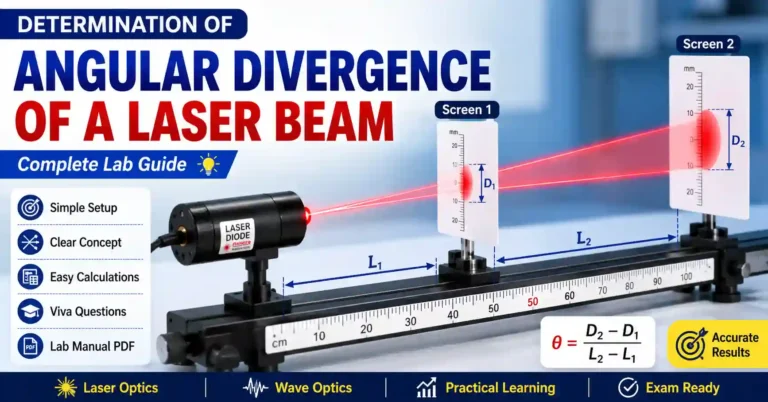
In this comprehensive lab guide, we will break down the determination of angular divergence of laser beam. Whether you are setting up your apparatus in the lab or preparing to ace your upcoming physics viva, this guide will provide the exact concepts, formulas, and insights you need to succeed.
Contents
Toggle🌟 Introduction:
If you’ve ever shone a torch and noticed how the beam spreads wider as you move it farther from the wall—lasers do the same thing, just much, much less. That spreading is what we call “angular divergence of laser beam,” and measuring it turns out to be one of the most elegant experiments in your engineering physics lab.
Aim of the Experiment:
To determine the angular divergence of a given laser source by measuring the beam spot diameter at different distances from the laser source.
Importance in Engineering Physics:
The determination of angular divergence of laser beam experiment is one of the fundamental experiments in engineering physics because it helps students understand how a laser beam behaves as it propagates through space.
Although lasers are highly directional, every practical laser beam spreads slightly due to diffraction and optical limitations. Measuring this divergence provides valuable insight into the quality, focusing capability, and performance of laser systems.
This experiment also strengthens students’ understanding of important optical concepts such as laser beam propagation, diffraction, beam collimation, Gaussian beam characteristics, and precision measurement techniques.
Ultimately, this experiment bridges theoretical optics with real-world engineering applications.
🌍 Applications of Angular Divergence Measurement:
From an engineering perspective, angular divergence is a critical parameter:
- In designing and optimizing:
- Fiber-optic communication systems,
- Laser machining,
- Medical laser instruments,
- LiDAR technology,
- Optical sensing, and
- Precision alignment systems.
- Engineers use divergence measurements to ensure that laser beams maintain sufficient intensity and accuracy over long distances.
- In designing and optimizing:
💡 Important Points Every Student Should Know:
Understanding a few key concepts before entering the laboratory will make this experiment much easier and help you answer viva questions confidently.
✅ What is Angular Divergence?
Angular divergence is the gradual spreading of a laser beam as it travels away from its source.
It represents the angle between the outer edges of the expanding laser beam and is usually expressed in the following:
- radians (rad)
- milliradians (mrad)
The smaller the divergence angle, the better the laser beam quality.
✅ Why Does a Laser Beam Diverge?
Although laser light is highly directional, no laser beam can remain perfectly parallel.
The main reasons are the following:
- Diffraction
- Finite aperture size
- Beam imperfections
- Optical misalignment
- Characteristics of the laser cavity
This is why even a high-quality laser pointer forms a larger spot after traveling several meters.
✅ Why is Measuring Angular Divergence Important?
Angular divergence determines how well a laser beam maintains its focus over long distances.
It directly affects the performance of systems such as the following:
- Fiber-optic communication
- Laser cutting and welding
- Medical laser surgery
- Laser printers
- Barcode scanners
- LiDAR systems
- Alignment instruments
- Distance measurement devices
A low-divergence laser can travel farther while maintaining higher intensity.
✅ Typical Angular Divergence Values
Different lasers exhibit different divergence angles depending on their design and application.
| Laser Type | Typical divergence |
|---|---|
He-Ne Laser |
0.5–1.5 mrad |
Semiconductor Laser |
2–10 mrad |
High-Power Industrial Laser |
<1 mrad |
Laser Pointer |
1–2 mrad |
These values may vary depending on the laser source and optical setup used in the laboratory.
✅ Factors Affecting Angular Divergence
Several practical factors influence the measured divergence angle:
- Beam quality
- Laser wavelength
- Aperture diameter
- Alignment of optical components
- Measurement accuracy
- Ambient vibrations
- Temperature variations
- Diffraction effects
Understanding these factors helps minimize experimental errors and improve measurement accuracy.
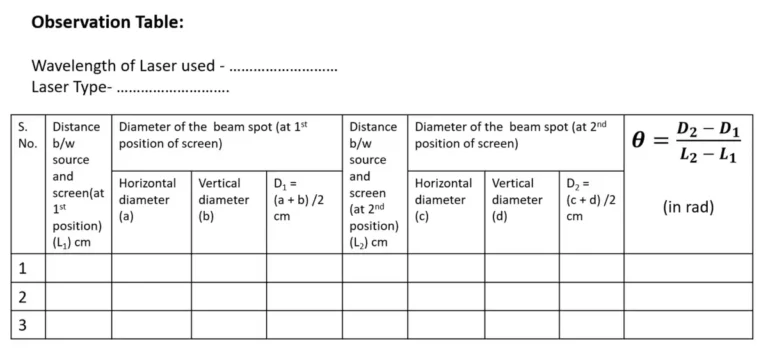
📊 Observation Table:
📌 3. Experiment Summary:
The Determination of Angular Divergence of a Laser Beam experiment measures how a laser beam spreads as it travels through space. It helps students evaluate laser beam quality and understand its significance in modern optical and engineering applications.
| Particular | Description |
|---|---|
Objective |
To determine the angular divergence of a laser beam by measuring its diameter at different distances. |
Principle |
A laser beam expands gradually due to diffraction. The divergence angle is calculated from the change in beam diameter over a known propagation distance. |
Apparatus Required |
Semiconductor laser, screen, measuring scale, optical bench, meter scale, graph sheet (if required). |
Formula Used |
θ = (D₂ − D₁)/(L₂ − L₁) (for small angles, in radians) |
Measured Quantity |
Beam diameter at different distances |
Result Obtained |
Angular divergence of the laser beam in radians or milliradians (mrad). |
Common Viva Topic |
Laser properties, divergence, diffraction, beam quality, Gaussian beam |
📥 Download the Complete Lab Manual PDF:
You can read the complete laboratory manual directly below or download it for offline study.
📥Modified Lab Manual PDF:
Video Tutorials:
🎯 Exam-Oriented Questions and Answers:
1. What is the angular divergence of a laser beam?
Answer: Angular divergence is the small angle through which a laser beam spreads as it travels away from its source. It is usually measured in radians or milliradians (mrad). A smaller divergence angle indicates a more collimated and higher-quality laser beam.
2. Why does a laser beam diverge?
Answer: A laser beam diverges because no optical system can produce a perfectly parallel beam. Diffraction, finite aperture size, imperfections in the laser cavity, and optical alignment all contribute to the gradual spreading of the beam during propagation.
3. What is the aim of the angular divergence experiment?
Answer: The aim of the experiment is to determine the angular divergence of a laser beam by measuring its diameter at different distances from the laser source and calculating the divergence angle using the appropriate mathematical relationship.
4. What is meant by a collimated laser beam?
Answer: A collimated laser beam consists of light rays that travel nearly parallel to each other, resulting in very little beam spreading over long distances. Although highly collimated, all practical laser beams exhibit a small amount of divergence.
5. What is the SI unit of angular divergence?
Answer: The SI unit of angular divergence is the radian (rad). In laser engineering, it is commonly expressed in milliradians (mrad) because laser divergence angles are typically very small.
6. Why is beam diameter measured at different distances?
Answer: Measuring the beam diameter at different distances allows us to determine how rapidly the laser beam spreads. The rate of increase in beam diameter is used to calculate the angular divergence of the laser beam.
7. Which instrument is used to measure beam diameter?
Answer: In undergraduate laboratories, the beam diameter is generally measured using a screen and a millimeter scale. In advanced laboratories, beam profilers, CCD cameras, or laser beam analyzers provide more accurate measurements.
8. Which type of laser is commonly used in this experiment?
Answer: A low-power semiconductor diode laser or a Helium-Neon (He-Ne) laser is commonly used because it produces a stable, monochromatic, coherent, and highly directional beam suitable for laboratory measurements.
9. What factors affect angular divergence?
Answer: Angular divergence depends on several factors, including laser wavelength, aperture size, beam quality, optical alignment, diffraction effects, and imperfections in the laser cavity.
10. Why is angular divergence important?
Answer: Angular divergence determines how well a laser beam maintains its intensity and focus over long distances. It is crucial in optical communication, laser machining, medical lasers, LiDAR, and precision measurement systems.
11. Why is a laser preferred over ordinary light in this experiment?
Answer: Laser light is monochromatic, coherent, highly directional, and nearly collimated. These properties make it ideal for accurately measuring beam divergence and studying optical phenomena.
12. What is meant by beam quality?
Answer: Beam quality describes how closely a real laser beam resembles an ideal Gaussian beam. Better beam quality results in lower divergence, improved focusing, and higher performance in practical applications.
13. How is angular divergence reduced?
Answer: Angular divergence can be reduced by improving beam collimation, increasing the beam diameter using beam expanders, using high-quality optical components, and minimizing diffraction effects.
14. What is diffraction?
Answer: Diffraction is the bending and spreading of light waves when they encounter an obstacle or aperture. It is one of the primary reasons why even highly collimated laser beams gradually diverge.
15. Give two applications of low-divergence laser beams.
Answer: Low-divergence laser beams are widely used in long-distance optical communication, laser alignment systems, industrial cutting, laser surgery, LiDAR, surveying, and precision scientific measurements.
16. What are the main characteristics of a laser beam?
Answer: The four characteristics of a laser beam are high monochromaticity, high coherence, high intensity, and remarkable directionality.
17. What happens to the spot size if you place a convex lens in front of the laser?
Answer: The convex lens will initially converge the beam to a focal point (minimum spot size or beam waist), after which the beam will diverge much faster than it originally did.
18. How does the wavelength of a laser affect its angular divergence?
Answer: Angular divergence is directly proportional to the wavelength of the laser light. According to diffraction principles, longer wavelengths (such as infrared lasers) experience greater angular spreading than shorter wavelengths (such as blue or UV lasers) when passing through identical aperture sizes.
🎓 Viva Questions and Answers
Q1. What is a laser?
Answer:
A laser is a device that produces highly coherent, monochromatic, directional, and intense light through the process of stimulated emission.
Q2. What is angular divergence?
Answer:
It is the angle through which a laser beam spreads as it propagates.
Q3. Why does the laser spot become larger with distance?
Answer:
Because the laser beam diverges due to diffraction and the finite size of the laser aperture.
Q4. What is meant by beam diameter?
Answer:
Beam diameter is the width of the laser beam measured perpendicular to its direction of propagation.
Q5. Which property of the laser is verified in this experiment?
Answer:
High directionality (low divergence) of the laser beam.
Q6. Which type of light is emitted by a laser?
Answer:
Monochromatic, coherent, highly directional, and polarized light.
Q7. What is coherence?
Answer:
Coherence is the property in which light waves maintain a constant phase relationship.
Q8. What is monochromatic light?
Answer:
Light having a single wavelength or a very narrow range of wavelengths.
Q9. What is stimulated emission?
Answer:
It is the process in which an excited atom emits a photon identical to an incoming photon.
Q10. Why are small-angle approximations used?
Answer:
Because laser divergence angles are extremely small, allowing us to use θ ≈ tanθ.
Q11. What is the unit of beam diameter?
Answer:
Millimeter (mm) or meter (m).
Q12. What is the unit of angular divergence?
Answer:
Radian (rad) or milliradian (mrad).
Q13. What is an optical bench?
Answer:
An optical bench is a rigid platform used for accurate alignment of optical components.
Q14. Why is the room kept dim during the experiment?
Answer:
To clearly observe the laser spot and improve measurement accuracy.
Q15. Why should the screen be perpendicular to the beam?
Answer:
To obtain the true beam diameter without geometric distortion.
Q16. Why is proper alignment necessary?
Answer:
Misalignment causes incorrect beam diameter measurements and inaccurate divergence values.
Q17. What is beam collimation?
Answer:
Beam collimation is the process of making light rays nearly parallel.
Q18. Which laser generally has lower divergence?
Answer:
Helium-neon lasers generally have lower divergence than semiconductor diode lasers.
Q19. Why should direct viewing of the laser beam be avoided?
Answer:
Laser light can damage the retina and cause permanent eye injury.
Q20. Mention two applications of laser divergence measurement.
Answer:
Laser communication and industrial laser alignment.
Q21. Why are multiple readings taken?
Answer:
To reduce random errors and improve experimental accuracy.
Q22. What is Gaussian beam propagation?
Answer:
It is the ideal mathematical model describing how a laser beam expands as it travels.
Q23. What is the relationship between beam quality and divergence?
Answer:
Better beam quality results in lower angular divergence.
Q24. Can a laser beam have zero divergence?
Answer:
No. Due to diffraction, every practical laser beam exhibits some divergence.
Q25. State one limitation of this experiment.
Answer:
Measurement accuracy is limited by the precision of beam diameter measurements and alignment errors.
❓Frequently Asked Questions (FAQs)
1. Why is the angular divergence of a laser beam measured?
Measuring angular divergence helps evaluate the directional quality and performance of a laser beam. It is essential for applications requiring high precision, such as optical communication, laser machining, medical lasers, LiDAR, surveying, and scientific instrumentation.
2. What is the formula for calculating angular divergence?
For small angles, the angular divergence is calculated using:
θ = (D2 - D1)/(L2 - L1)
where:
- θ = Angular divergence
- D₁, D₂ = Beam diameters
- L₁, L₂ = Corresponding distances from the laser source
3. What are the common sources of error in this experiment?
Common sources of error include improper alignment of the laser and screen, inaccurate beam diameter measurement, parallax error, ambient light interference, optical bench vibrations, and incorrect distance measurements.
4. What are the applications of angular divergence measurement?
Angular divergence measurement is widely used in fiber-optic communication, laser cutting, laser welding, medical surgery, barcode scanners, LiDAR, satellite communication, optical metrology, industrial alignment, and scientific research.
5. Why can't a laser beam remain perfectly parallel?
A perfectly parallel laser beam is impossible because of diffraction, finite beam aperture, and optical imperfections. As a result, every practical laser beam experiences a small but measurable angular divergence.
6. What is a good angular divergence value for a laser?
A good angular divergence for a laser is less than 1 milliradian (mrad). Lower divergence means the laser beam remains narrow and focused over longer distances, making it ideal for precision applications.
🔗 Related Concepts You Can Explore:
To strengthen your understanding of laser optics, you may also like to read these related experiments and theory articles available on Smart Study Zone.
🌟 Laser and Fiber Optics:
🌟 Wave Optics Experiments:
- 📘 Determination of Grating Element using Laser Beam
- 📘 Newton’s Rings Experiment
- 📘 Fresnel’s Biprism Experiment
- 📘 Wavelength of Sodium Light using Plane Diffraction Grating
🌟 Semiconductor Experiments:
- 📘 Determination of Energy Band Gap of a Semiconductor
- 📘 V-I Characteristics of PN Junction Diode