
Visit:  https://smartstudyzone.in
For High-Quality, More Free Study Notes
Contents
Toggle📘 Introduction
Think about the last time you played a music CD, scanned a product barcode at a grocery store, or enjoyed a crisp Blu-ray movie. Behind every one of those experiences sits a tiny chip smaller than a grain of salt — the semiconductor laser.
The world today runs on light more than most people realize. From ultra-fast internet connections and facial recognition in smartphones to laser surgeries and autonomous vehicles, semiconductor lasers are quietly powering modern technology.
In simple terms, a semiconductor laser is a specially designed P-N junction diode that emits coherent light when forward-biased. It is also called a diode laser or laser diode.
By the time you reach the conclusion, you will understand:
- What a semiconductor laser is
- Its principle and construction
- Energy band diagram and working mechanism
- Step-by-step mathematical explanation
- Advantages, limitations, and applications
- Solved numerical problems
- Important exam questions and SEO-focused FAQs
📜 Historical Background
The story of semiconductor lasers began in the early 1960s, shortly after the invention of the first ruby laser. Scientists realized that semiconductors could also produce laser light when electrons and holes recombine if electrical energy is supplied correctly.
In 1962, the first practical semiconductor laser was demonstrated independently by:
- Robert N. Hall
- Marshall Nathan
These early lasers operated only at very low temperatures. Later developments introduced heterojunction structures that allowed efficient room-temperature operation, revolutionizing fiber-optic communication and compact electronics.
Today, semiconductor lasers are among the most widely manufactured lasers in the world.
⚙️ Basic Theory of Semiconductor Laser
A semiconductor laser is a special type of laser device that produces coherent light using semiconductor materials. It is commonly known as a laser diode because it works similarly to a p-n junction diode. When an electric current passes through the junction, electrons and holes recombine, releasing energy as photons.
Under suitable conditions, these photons stimulate the emission of more photons, producing a highly concentrated beam of monochromatic light. It operates on the same four pillars as every other laser: an active medium, an energy source (pump), population inversion, and an optical resonator.
Construction of a Semiconductor Laser
A semiconductor laser is built around a p-n junction, which is formed by joining p-type and n-type semiconductor materials. The most commonly used materials include gallium arsenide (GaAs), indium phosphide (InP), and gallium nitride (GaN).
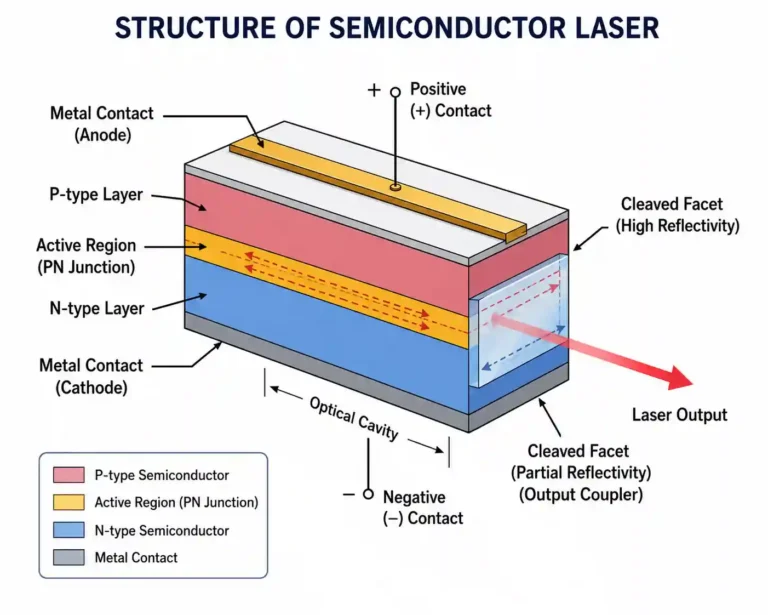
The semiconductor laser consists of three essential components, each playing a distinct role as shown in the following structural diagram. Let us examine them one by one.
1. Active Medium (Gain Medium):
The active medium is the heart of the semiconductor laser. It is a thin layer—often just a few nanometers to a few micrometres thick — of a direct-bandgap semiconductor. The most common choice for near-infrared emission is gallium arsenide (GaAs). For visible red light (780–850 nm range), AlGaAs/GaAs structures are used. For telecommunications at 1310 nm and 1550 nm, InGaAsP on an indium phosphide (InP) substrate is the standard.
The central part of the device is known as the active region. This is where electrons and holes combine to produce photons.
2. Energy Source (Pump) — Forward Bias Current:
Unlike most other lasers, the semiconductor laser does not need an optical pump or a discharge lamp. The pump is simply a DC electric current injected through the p-n junction by a forward-bias voltage. When forward-biased above the threshold voltage, electrons flood into the active region from the n-side, and holes pour in from the p-side.
This carrier injection creates the population inversion necessary for lasing. The pump energy is, at its core, electrical energy from a battery or power supply—which is why diode lasers are so efficient and easy to drive.
3. Optical Resonator:
At the ends of the semiconductor crystal, reflective surfaces form an optical resonant cavity. The front and back faces are polished to act as partially reflecting and fully reflecting mirrors.
These mirrors cause photons to bounce back and forth repeatedly through the active region. Each pass stimulates additional photon emission, amplifying the light intensity until a strong laser beam emerges from one end.
Energy Level Diagram:
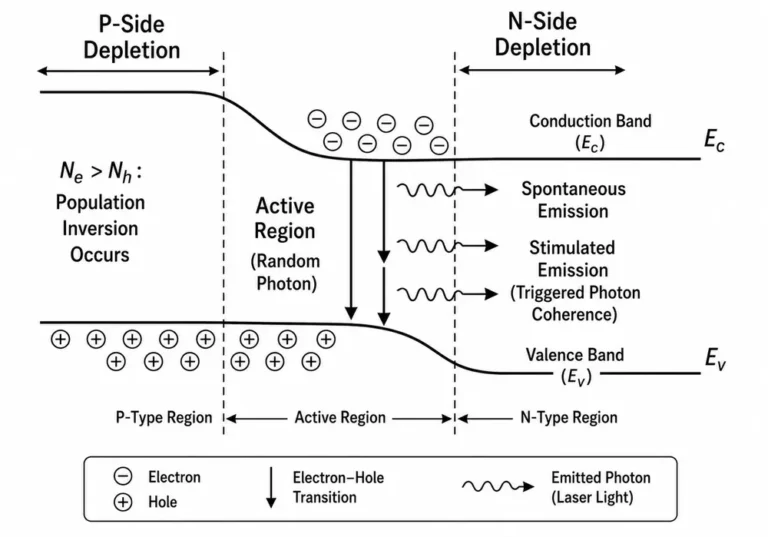
The energy band diagram of a semiconductor laser is fundamentally different from the discrete-level diagrams of He-Ne or Nd:YAG lasers. In semiconductors, we don’t deal with isolated atoms but with energy bands, as shown below.
Conduction Band (EC): Where electrons move freely.
Valence Band (EV): Where holes exist.
Band Gap (Eg): The “forbidden zone” that photons must overcome.
When the junction is heavily doped, the Fermi level moves into the conduction band on the N-side and into the valence band on the P-side. Under forward bias, these bands overlap in the “Active Region,” creating a state of Population Inversion where the conduction band is packed with electrons and the valence band is packed with holes.
Working Principle of Semiconductor Laser
The working of a semiconductor laser can be understood in the following stages.
1. Carrier Injection:
When forward bias is applied:
- Electrons from the N-region enter the junction
- Holes from the P-region enter the junction
This increases carrier concentration in the active region.
2. Population Inversion:
At sufficiently high current:
- Electron concentration in the conduction band becomes very large
- Hole concentration in the valence band also increases
Thus, more electrons occupy higher energy states than lower states. This condition is called population inversion.
3. Spontaneous Emission:
Even below threshold, some electron–hole recombination occurs spontaneously, producing photons travelling in random directions. A small fraction of these photons happen to travel along the length of the cavity (parallel to the facets). These become the seed photons that will ultimately trigger stimulated emission.
4. Stimulated Emission:
A seed photon with energy hν ≈ Eg travels through the active region and encounters an electron in the conduction band sitting just above the bandgap energy.
This photon stimulates the electron to recombine with a valence band hole, emitting a second photon identical in frequency, phase, direction, and polarization to the incident one.
5. Optical Amplification and Laser Action:
The photons repeatedly reflect between the two mirror surfaces. Each reflection stimulates more emissions, amplifying light intensity. Finally, coherent laser output emerges through the partially reflecting surface.
🧮 Mathematical Analysis of Semiconductor Laser:
To understand the operational limits of a semiconductor laser, we must mathematically analyze the relationship between the material’s energy gap and the current required to trigger lasing.
I. Wavelength Determination:
The fundamental characteristic of the emitted laser light is its wavelength, which depends directly on the bandgap energy (Eg) of the semiconductor active medium. When an electron from the conduction band recombines with a hole in the valence band, a photon is released.
The energy of this emitted photon (E) is given by:
Since frequency (ν) is related to the speed of light (c) and wavelength (λ) by ν = c/λ, we can express the energy as:
To find the wavelength in a practical unit like Angstroms (Å), we rearrange the equation:
By substituting the standard value and converting Joules to electron-volts, we get:
This equation tells us that by engineering the material to have a specific bandgap, we can precisely tune the color of the laser light.
II. The Condition for Optical Gain:
For a laser to work, the “optical gain” (g) must be sufficient to amplify the light as it travels through the crystal. According to the Bernard-Duraffourg condition, lasing can only occur if the difference in the quasi-Fermi levels (ΔF) exceeds the photon energy:
Physically, this means we must inject enough current to push the Fermi levels into the bands, ensuring that stimulated emission outweighs absorption.
III. Threshold Current Density (Jth):
Lasing begins only when the gain in the medium exactly balances the losses. The total loss in the system includes internal absorption (α) and the light escaping through the partially reflective faces (R1 and R2).
The threshold condition for a cavity of length L is expressed as:
Because the gain (g) is proportional to the current density (J) applied to the diode, we can relate this to the Threshold Current Density:
Where η represents the internal quantum efficiency. This derivation shows that to reduce the power required to start the laser (lower Jth), we must either increase the length of the laser chip or improve the reflectivity of its ends.
⚖️ Comparison with Other Lasers:
| S. No. | Feature | Semiconductor (Diode) Laser | He-Ne Gas Laser | Nd:YAG Solid-State Laser |
|---|---|---|---|---|
1. |
Active Medium |
GaAs, InGaAsP, etc. |
He-Ne gas mixture |
Nd³⁺ ions in YAG crystal |
2. |
Pump Source |
Electric current (direct) |
Electrical discharge |
Flashlamp / diode laser |
3. |
Size |
Millimetre-scale chip |
10–100 cm tube |
Compact to large |
4. |
Efficiency |
30–70% (wall-plug) |
~0.1% |
1–5% |
5. |
Output Power |
mW to kW (arrays) |
1–50 mW |
mW to MW (pulsed) |
6. |
Wavelength Range |
375 nm – 3 µm |
632.8 nm (fixed) |
1064 nm (primary) |
7. |
Cost |
Very low (mass produced) |
Moderate |
High |
✅ Advantages of Semiconductor Laser:
- Very compact size
- High efficiency
- Low power consumption
- Direct electrical operation
- Fast modulation capability
- Low manufacturing cost
- Long operational life
❌ Limitations of Semiconductor Laser:
- Output power is comparatively low
- Beam divergence is high
- Temperature sensitivity
- Requires precise fabrication
- Junction heating may reduce performance
🚀 Applications of Semiconductor Laser:
Fiber Optic Communication: These lasers carry trillions of bits of data across oceans through glass fibers.
Optical Storage: Your CD, DVD, and Blu-ray players use semiconductor lasers to read microscopic pits on discs.
Barcode Scanners: The red line you see at the supermarket checkout is often a laser diode.
Laser Printing: High-speed printers use these lasers to “write” images onto a drum.
Medical Diagnostics: Used in non-invasive blood analysis and skin treatments.
🚀 Quick Answer Section:
What is semiconductor laser?
A semiconductor laser is a laser device that uses a semiconductor PN junction as the active medium. It converts electrical energy directly into coherent light through stimulated emission.
What is population inversion in semiconductor lasers?
In a semiconductor laser, population inversion means that the conduction band near the active junction has more electrons than the valence band has holes at the same energy range, creating a condition where stimulated emission dominates over absorption.
What is threshold current in a semiconductor laser?
The threshold current is the minimum injection current at which the optical gain in the active region exactly equals the total cavity loss (internal absorption plus mirror transmission losses). Below this current, only spontaneous emission occurs. At and above it, stimulated emission dominates, and coherent laser output begins.
What is the Bernard–Duraffourg condition?
The Bernard–Duraffourg condition states that for optical gain (lasing) to occur in a semiconductor, the separation between the quasi-Fermi levels of the conduction and valence bands must be greater than or equal to the bandgap energy: EFc − EFv ≥ Eg. This is the semiconductor equivalent of population inversion in conventional lasers.
What is the lasing wavelength of a GaAs semiconductor laser?
GaAs has a bandgap of approximately 1.42 eV at room temperature, corresponding to a lasing wavelength of about 870 nm — in the near-infrared region, just beyond the visible red. The exact wavelength can shift slightly with temperature and carrier density. AlGaAs alloys can extend this to shorter wavelengths in the 750–870 nm range.
What are the main applications of semiconductor lasers?
Semiconductor lasers are used in optical fibre communications (1310 nm and 1550 nm), optical storage (CD/DVD/Blu-ray), laser printing, barcode scanning, medical treatments, pumping of fibre and solid-state lasers, atomic physics and quantum computing, and LiDAR systems in autonomous vehicles. They are the most widely manufactured laser type in the world.
What are the main applications of semiconductor lasers?
Semiconductor lasers are used in optical fibre communications (1310 nm and 1550 nm), optical storage (CD/DVD/Blu-ray), laser printing, barcode scanning, medical treatments, pumping of fibre and solid-state lasers, atomic physics and quantum computing, and LiDAR systems in autonomous vehicles. They are the most widely manufactured laser type in the world.
🧠 Conclusion
The Semiconductor Laser is one of the most important inventions in modern optoelectronics. Its compact size, high efficiency, direct electrical operation, and rapid modulation capability have transformed communication, medicine, data storage, and industrial technologies.
From the physics of stimulated emission to the engineering of PN junctions, semiconductor lasers beautifully combine quantum mechanics and electronics into a practical device that powers much of today’s digital world.
Understanding its construction, working mechanism, mathematical relations, and applications not only helps students score well in exams but also builds a strong foundation for advanced studies in photonics and optical engineering.
📝 PYQs / Most Expected Questions
- Explain the construction and working of a semiconductor laser.
- Draw and explain the energy band diagram of a semiconductor laser.
- Derive the wavelength relation for a semiconductor laser.
- Why are direct bandgap semiconductors preferred in laser diodes?
- Compare a semiconductor laser with Nd:YAG laser.
- Explain population inversion in semiconductor lasers.
- Discuss applications of semiconductor lasers.
- Write the advantages and limitations of a semiconductor laser.
- Explain stimulated emission in a PN junction laser.
- Describe the optical resonator in a semiconductor laser.
Solved Numerical Problems:
How to calculate the wavelength of emitted laser light?
Question: Calculate the wavelength of light emitted by a GaAs laser with a bandgap energy of 1.43 eV.
Solution:
Given: Eg = 1.43 eV, h = 6.626 × 10⁻³⁴ J·s, c = 3 × 10⁸ m/s
Find: Wavelength (λ)
Using the simplified formula:
$$\lambda = \frac{12400}{E_g}$$
$$\Rightarrow \lambda = \frac{12400}{1.43}$$
$$\Rightarrow \lambda \approx 8671 \text{ Å}$$
Result: The wavelength is approximately 867 nm (Infrared region).
How to calculate the bandgap energy of the material used in semiconductor laser?
Question: A semiconductor laser emits light of wavelength 632 nm. Find the bandgap energy of the material used.
Solution:
Given: λ = 632 nm = 6320 Å.
Find: Eg in eV.
$$E_g = \frac{12400}{\lambda}$$
$$\Rightarrow E_g = \frac{12400}{6320}$$
$$\Rightarrow E_g \approx 1.96 \text{ eV}$$
Result: The bandgap energy is 1.96 eV.
How to calculate the frequency of radiation emitted by a semiconductor laser?
Question: Find the frequency of radiation emitted by a semiconductor laser of wavelength 850 nm.
Solution:
Given: λ = 850 nm
Find: Frequency (ν)
Using,
$$ν = \frac{c}{\lambda}$$
$$\Rightarrow \nu=\frac{3\times10^8}{850\times 10^{-9}} $$
$$\Rightarrow \nu\approx 3.53\times10^{14}$$
Result: The frequency is 3.53 × 10¹⁴ Hz.
Exam Tips for Students to Score High:
- Always draw neat energy band diagrams.
- Write the laser action mechanism in sequence.
- Mention population inversion clearly.
- Highlight direct bandgap property.
- Memorize the wavelength formula.
- Use labeled diagrams for better presentation.
- Write applications with real-life examples.
❓ FAQs (People Also Ask)
Why is Gallium Arsenide used instead of Silicon?
GaAs is a Direct Bandgap semiconductor, meaning electrons can drop directly from the conduction band to the valence band to release a photon. Silicon is an Indirect Bandgap material, where energy is lost as heat (phonons) rather than light.
What is the active region in semiconductor laser?
The active region is the thin junction layer where electron-hole recombination and laser emission occur.
What is the wavelength formula of semiconductor laser?
The wavelength is given by λ = hc/Eg, where Eg is the bandgap energy.
Can semiconductor lasers be different colors?
Yes! By changing the material (like using Indium Gallium Nitride for blue lasers), we can change the bandgap and thus the color of the light.
Why are semiconductor lasers called laser diodes?
They are called laser diodes because they resemble semiconductor diodes in structure and operation while producing laser light.
What is the difference between an LED and a semiconductor laser?
An LED emits incoherent and scattered light, while a semiconductor laser emits coherent, monochromatic, and highly directional light.
What type of pumping is used in semiconductor lasers?
Electrical pumping is used in a semiconductor laser through forward biasing of the PN junction.
Where are semiconductor lasers used in daily life?
They are used in fiber optics, barcode readers, laser printers, medical devices, and optical storage systems.
Is a laser pointer a semiconductor laser?
Yes, most modern laser pointers use semiconductor laser diodes. Red laser pointers (635–670 nm) use AlGaInP/GaAs diodes, green laser pointers use a more complex system, and compact blue laser pointers use GaN diodes directly at 445–470 nm.