
The Fermi level is one of the most important concepts for understanding how semiconductors behave electrically. But why does it shift when a semiconductor is doped, and what does its position actually tell us about electrons and holes? Let’s explore the Fermi level in intrinsic and extrinsic semiconductors through simple explanations, energy-band diagrams, formulas, and practical examples.
Contents
Toggle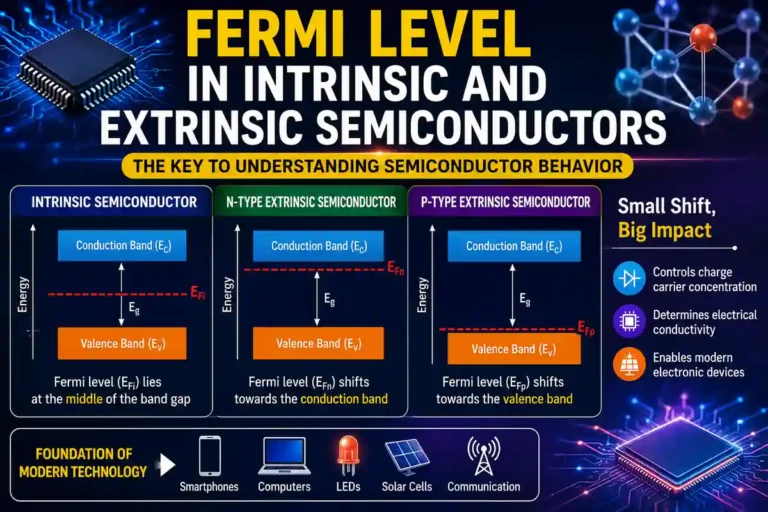
🔬 Introduction
In semiconductor physics, merely knowing the energy band structure is not sufficient to understand electrical behavior. We must also know how electrons are distributed among the available energy states. The concept that provides this information is the Fermi level.
The position of the Fermi level plays a decisive role in determining:
- Carrier concentration
- Type of semiconductor (intrinsic, n-type, or p-type)
- Electrical conductivity
In this guide, you’ll learn what the Fermi level physically means, why it sits at the mid-gap in a pure semiconductor, how doping pushes it toward the conduction or valence band, the significance of the Fermi level in intrinsic and extrinsic semiconductors, the complete mathematical derivation of its position, solved numericals, and the exact answers examiners are looking for in GATE, JEE, and university exams.
⚡ What Exactly Is the Fermi Level?
Formally, the Fermi level is the energy level at which the probability of finding an electron in an available energy state is exactly 50% at any temperature above absolute zero. However, it is important to understand that this energy level does not necessarily represent an actual energy state that an electron can occupy.
In a semiconductor, it may lie inside the forbidden energy gap, where no allowed electron states exist. Therefore, it is better to think of this level as a reference energy that helps us understand how electrons are distributed among the available states in the conduction and valence bands.
The occupation probability is given by the Fermi-Dirac distribution function:
$$f(E) = \frac{1}{1+e^\left( \frac{E-E_F}{k_BT} \right)} $$
Here, when E = EF, the exponential term becomes 1, and f(E) collapses to exactly 0.5 — confirming the definition. This single equation is the backbone of everything that follows.
🔬 Position of the Fermi Level in Semiconductors:
To determine the position of this reference level in a semiconductor, we need to understand how charge carriers are distributed within the material. In particular, we consider the electron concentration in the conduction band (n) and of holes in the valence band (p).
Once these carrier concentrations are known, we can derive the Fermi-level equation and determine its position for intrinsic as well as different types of extrinsic semiconductors.
🧪 Fermi Level in an Intrinsic Semiconductor:
Let’s derive the exact position of the Fermi level in an intrinsic semiconductor from first principles. The electron concentration in the conduction band and the hole concentration in the valence band are given by:
where Nc and Nv are the effective density of states in the conduction and valence bands, respectively. And EFi is the intrinsic Fermi energy.
For an intrinsic semiconductor, the crystal is electrically neutral, and carriers are generated only in pairs, so
$$n = p = n_i \qquad … (3)$$
Hence equating Eq. (1) and Eq. (2):
Rearranging the exponential terms to isolate EFi on the left-hand side:
Taking the natural logarithm of both sides:
Solving for EFi:
But, $$N_C=2\left(\frac{2\pi m_e^*kT}{h^2}\right)^{3/2} $$
and $$N_V=2\left( \frac{2\pi m_h^*kT}{h^2} \right)^{3/2}$$
Hence, $$E_F=\frac{E_C+E_V}{2}+\frac{3kT}{4}log_e\left(\frac{m_h^*}{m_e^*} \right)\qquad … (8)$$
Physical Meaning:
At absolute zero (T = 0 K), or under the assumption that the effective masses of electrons and holes are identical (mₑ* = mₕ*), the logarithmic term evaluates to zero:
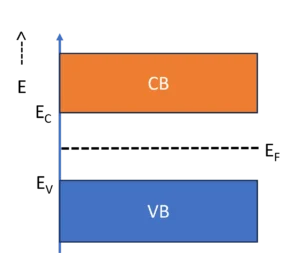
$$E_{Fi} = \frac{E_c + E_v}{2}$$The intrinsic Fermi level lies exactly at the center of the forbidden energy bandgap, as shown in Figure 1.
Because mₕ* is typically slightly larger than mₑ* in real semiconductors such as silicon, EFi shifts upward slightly with increasing temperature.
🟦 Fermi Level in an N-Type Extrinsic Semiconductor
When a pure semiconductor is doped with pentavalent donor atoms (e.g., phosphorus or arsenic in silicon) at a concentration of ND cm-3, the donors ionize completely at room temperature, releasing electrons into the conduction band.
Assuming the donor concentration is much larger than the intrinsic carrier concentration (ND >>ni ), and all donors are ionized:
Equating this to the conduction band electron density formula from Eq. (1):
Isolating the exponential term:
Taking the natural logarithm:
Rearranging to solve for EFn:
We can also express EFn relative to the intrinsic Fermi level EFi using the relation
$$n = n_i \exp\left(\frac{E_{Fn} – E_{Fi}}{k_B T}\right) $$
Physical Meaning:
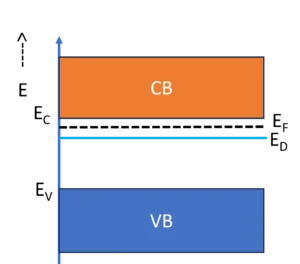
- Because ND > ni, the term ln(ND/ni) is positive, which shifts the Fermi level EFn upward toward the bottom of the conduction band EC.
- High electron concentration increases the probability of occupancy near the conduction band.
- Hence, the Fermi level shifts upward as shown in Figure 2.
- This shift explains the high conductivity of n-type semiconductors.
🟥 Fermi Level in p-Type Semiconductor:
When a semiconductor is doped with trivalent acceptor impurities (e.g., boron in silicon) at a concentration of NA cm-3, the acceptor atoms ionize by accepting electrons from the valence band, generating free holes.
Assuming complete ionization at room temperature and NA >> ni:
Using Eq. (2):
Taking the natural logarithm:
Solving for EFp:
Expressed relative to EFi:
Physical Meaning:
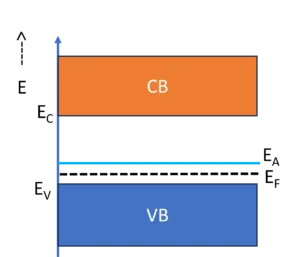
Because NA > ni, the term k T \ln(NA/ni) is subtracted from EFi, shifting EFp downward toward the top of the valence band EV, as shown in Figure 3.
💻 Interactive Energy Band & Fermi Shift Simulator:
To visualize how donor doping (ND), acceptor doping (NA), and temperature (T) move the Fermi level in real time, explore the interactive model below:
🧪 Interactive: Watch the Fermi Level Move
Physical Significance of Fermi Level in Semiconductors:
- Probability of Occupation: The Fermi level is defined using the Fermi-Dirac distribution function, representing the energy state where the probability of occupation is 50% (f(E) = 1/2).
- Indicator of Carrier Type (Doping):
- Intrinsic: lies near the middle of the bandgap, which indicates equal concentration of electrons and holes.
- N-type: shifts upward, closer to the conduction band, which indicates higher electron density.
- P-type: shifts downward, closer to the valence band, which indicates higher hole density.
- Temperature Dependence: The Fermi energy level represents the maximum energy that an electron can possess (the “sea of electrons” level). As the temperature increases, its position shifts, which reflects changes in the electron population.
- Charge Transport (Equilibrium): In a semiconductor device, the Fermi energy level must be constant throughout the material at thermodynamic equilibrium. If there is any difference in Fermi levels between materials, it indicates a potential difference or nonequilibrium state between the materials.
⚖️ Comparison: Intrinsic vs n-type vs p-type Fermi Level
| Property | Intrinsic | n - type | p - type |
|---|---|---|---|
Majority carrier |
Electrons = Holes |
Electrons |
Holes |
Fermi level position |
Mid-gap (slightly above center) |
Close to Ec |
Close to Ev |
Doping |
None (pure crystal) |
Pentavalent donors |
Trivalent acceptors |
Effect of ↑ temperature |
Stays near mid-gap |
Moves toward mid-gap |
Moves toward mid-gap |
Conductivity source |
Thermal generation only |
Donor ionization + thermal |
Acceptor ionization + thermal |
📌 Quick Answer Section:
## What is the Fermi level in a semiconductor?
It is the energy level at which the probability of finding an electron in an available state is 50% at thermal equilibrium. In a semiconductor, it lies within or near the forbidden energy gap. Its position indicates the relative tendency for electrons and holes to occupy conduction- and valence-band states.
## Why does the Fermi level move in an n-type semiconductor?
The Fermi level moves upward in an n-type semiconductor because donor impurities provide additional electrons. The increased electron concentration makes conduction-band states more likely to be occupied. Consequently, the Fermi energy level shifts closer to the conduction-band edge.
## Why does the Fermi level move downward in a p-type semiconductor?
In a p-type semiconductor, acceptor impurities increase the hole concentration. Since holes are associated with missing electrons in the valence band, the Fermi energy level shifts downward toward the valence-band edge. Greater acceptor concentration generally produces a larger downward shift.
## What is the formula for Fermi level in an n-type semiconductor?
For a non-degenerate n-type semiconductor under equilibrium conditions, the Fermi energy level is approximately $$E_F=E_i+kT\ln(N_D/n_i)$$
Assuming the donors are fully ionized and the electron concentration is approximately equal to the donor concentration.
## What is the formula for Fermi level in a p-type semiconductor?
For a non-degenerate p-type semiconductor with fully ionized acceptors, the Fermi energy level is approximately $$E_F=E_i-kT\ln(N_A/n_i)$$
Thus, increasing acceptor concentration lowers the Fermi level relative to the intrinsic Fermi energy level.
🧮 Solved Numerical Problems
Problem 1: Calculate Intrinsic Fermi Energy Level Shift
Question: Calculate the shift in the intrinsic Fermi energy level relative to the center of the bandgap in Silicon at T = 300 K, given that mₕ* = 0.81 m0 and mₑ* = 0.28 m0, where m0 is the free electron mass. Take kBT = 0.0259 eV at 300 K.
Given: T = 300 K, kBT = 0.0259 eV, mₕ* / mₑ*= 0.81 / 0.28 = 2.893
Find:
$$ΔE = E_{Fi} – \frac{E_c + E_v}{2}$$
Calculation: Using Eq. (8):
Answer: The intrinsic Fermi energy level lies 0.0206 eV above the mid-gap energy.
Problem 2: Fermi Level Position in N-Type Silicon
Question: A silicon sample is doped with 1016 cm-3 Phosphorus atoms. If the effective density of states in the conduction band is Nc = 2.8 × 1019 cm⁻³ at T = 300 K, find the position of the Fermi energy level relative to the conduction band edge Ec.
Given: Donor concentration ND = 1016 cm-3 ,Nc = 2.8 × 1019 cm-3 , Thermal voltage kT = 0.0259 eV
Find:
$$E_c – E_{Fn}$$
Calculation:
Using Eq. (12):
Answer: The Fermi level EFn lies 0.206 eV below the conduction band edge Ec.
Problem 3: Fermi Level Position in P-Type Silicon Relative to $$E_{Fi}$$
Question: Silicon at T = 300 K is doped with 2 × 1017 cm-3 Boron atoms. Given the intrinsic carrier concentration ni = 1.5 × 1010 cm-3, determine how far the Fermi level lies below the intrinsic Fermi level EFi.
Given: Acceptor concentration NA = 2 × 1017 cm⁻³, ni = 1.5 × 1010 cm-3, kT = 0.0259 eV
Find: $$E_{Fi} – E_{Fp}$$
Calculation: Using Eq. (18):
Answer: The Fermi energy level lies 0.425 eV below the intrinsic Fermi level EFi.
📝 PYQs / Most Expected Questions
Conceptual Questions
- What is meant by the Fermi level?
- Explain the physical significance of the Fermi energy level.
- Define the intrinsic Fermi energy level.
- Why does the Fermi level lie near the middle of the forbidden gap in an intrinsic semiconductor?
- Explain the effect of donor impurities on the Fermi level.
- Explain the effect of acceptor impurities on the Fermi level.
- Distinguish between Fermi level positions in intrinsic, n-type, and p-type semiconductors.
- Explain the relationship between Fermi level and carrier concentration.
Derivation Questions
- Derive the expression for the intrinsic Fermi level.
- Derive the expression
$$
E_F=E_i+kT\ln\left(\frac{N_D}{n_i}\right)
$$
for an n-type semiconductor.
- Derive the expression
$$
E_F=E_i-kT\ln\left(\frac{N_A}{n_i}\right)
$$
for a p-type semiconductor.
- Derive the relationship between Fermi level and electron concentration.
- Derive the relationship between Fermi level and hole concentration.
- Explain the temperature dependence of the Fermi level in an extrinsic semiconductor.
❓ FAQs
## Is the Fermi level the same as the conduction band?
No. The Fermi energy level and conduction-band edge are different concepts. The conduction band represents a range of allowed electron energies, while the Fermi level is a statistical reference energy associated with electron occupation. In an n-type semiconductor, the Fermi level moves closer to the conduction-band edge but normally remains below it in a non-degenerate semiconductor.
## What happens to the Fermi level when temperature increases?
It changes with temperature because carrier concentrations, dopant ionization, and intrinsic carrier generation change. At sufficiently high temperatures, intrinsic carriers become increasingly important, and an extrinsic semiconductor tends to behave more like an intrinsic semiconductor.
## Why is the Fermi level important in semiconductor devices?
The Fermi level helps determine electron and hole concentrations and therefore the electrical behavior of semiconductor materials. Since electronic devices depend on controlled carrier concentrations, understanding this reference level is essential for analyzing diodes, transistors, LEDs, photodiodes, solar cells, and integrated circuits.
## What is the intrinsic Fermi level represented by?
The intrinsic Fermi level is generally represented by (Ei). It is the Fermi level of an intrinsic semiconductor at thermal equilibrium. For an idealized semiconductor with equal effective densities of states in the conduction and valence bands, it lies at the middle of the forbidden energy gap.
## Can the Fermi level lie inside the conduction band?
Yes. In a heavily doped or degenerate n-type semiconductor, the Fermi level can move into the conduction band. Similarly, in a heavily doped p-type semiconductor, it can move into the valence band. The simple Maxwell–Boltzmann formulas used for ordinary non-degenerate semiconductors then need modification.
## What is the relationship between Fermi level and conductivity?
The Fermi level influences the concentration of mobile electrons and holes. Since semiconductor conductivity depends on these carrier concentrations and their mobilities, changing the Fermi level through doping can strongly change conductivity. This is one reason controlled doping is fundamental to semiconductor technology.
## Why does doping change the Fermi level?
Doping changes the number of available charge carriers and introduces donor or acceptor energy levels. To maintain the correct statistical distribution of electrons at thermal equilibrium, the chemical potential—and hence the Fermi level—shifts. Donor doping shifts it upward, while acceptor doping shifts it downward.
For a premium experience, sagamingvertical is where it’s at. Feels top-notch and the interface is great. Peep it: sagamingvertical