
Every smartphone call, every LED that glows, every computer processor, and every solar panel depends on the movement of billions of tiny electrons. But have you ever wondered what determines where these electrons stay and when they start moving? The answer lies in a remarkable concept called the Fermi Level.
Once you understand the concept of fermi level, many topics in semiconductor physics—from diodes and transistors to integrated circuits—become surprisingly simple.
“Dive into this comprehensive guide and read till the end to understand the concept of the Fermi level, solve complex numericals effortlessly, and ace your engineering physics exams today!”

Contents
Toggle🚀 Introduction:
Imagine entering a 20-floor hotel where each room represents an energy state available for electrons. Naturally, guests occupy the lower floors first because they require less effort to reach. As more guests arrive, the lower floors become full, and the remaining guests move to higher floors.
Now think for a moment:
- How do electrons decide which energy levels to occupy inside a solid?
- Why does copper conduct electricity so easily, while glass does not?
- What determines whether a material behaves as a conductor, semiconductor, or insulator?
The answers to all these questions lie in one of the most important concepts of solid-state physics—the Concept of Fermi level.
At absolute zero (0 K), electrons occupy the lowest available energy states first but cannot crowd into the same state because of the Pauli’s exclusion principle. This creates a special reference energy called the Fermi Level, which separates the occupied and unoccupied energy states. Its position helps us understand how electrons are distributed inside a material and how they contribute to electrical conduction.
The concept of Fermi level forms the foundation of semiconductor physics and explains the working of modern electronic devices such as diodes, transistors, LEDs, solar cells, integrated circuits, and computer chips. Once you understand this concept, many advanced semiconductor topics become much easier to learn.
In this article, you will learn the concept of Fermi Level, its physical significance, the Fermi–Dirac distribution function, its position in conductors, semiconductors, and insulators, the effect of temperature and doping, practical applications, and exam-oriented numerical problems—all explained in simple language with clear diagrams and real-world examples for your exams.
Before exploring the detailed theory, let us first understand how this remarkable concept originated.
📜 Historical Background:
The idea traces back to the 1920s, when physicist Enrico Fermi and mathematician Paul Dirac independently worked out how particles like electrons — which obey the Pauli exclusion principle—must statistically distribute themselves among available energy states.
This gave birth to what we now call Fermi-Dirac statistics. Unlike classical particles that can pile into the same energy state without restriction, electrons are fermions: no two electrons in a system can occupy the exact same quantum state. This single rule is what forces electrons to stack up in energy, floor by floor
Today, the concept of the Fermi level forms the foundation of
- Semiconductor Physics
- Solid State Physics
- Nanoelectronics
- Microelectronics
- Optoelectronics
- Quantum Devices
- Integrated Circuit Design
Without this concept, modern electronic engineering would not have advanced to its current level.
The Basic Concept of Fermi Level:
The concept of Fermi level refers to a special reference energy level in a solid that indicates the likelihood of electron occupancy under thermal equilibrium.
In simple terms, this energy level acts as a dividing line between energy states that are more likely to be occupied by electrons and those that are less likely to be occupied.
# What is the Fermi Level?
The Fermi Level (denoted as EF) is the energy level at which the probability of finding an electron is exactly 50% at any temperature above absolute zero.
At absolute zero temperature (0 K), it becomes the highest energy state occupied by electrons, with
- All energy states below the Fermi level are completely filled with electrons.
- All energy states above the Fermi level remain completely empty.
This makes the Fermi level an essential reference for understanding the distribution of electrons in solids.
As temperature increases, some electrons acquire sufficient thermal energy to move into higher energy states. This means that the electron distribution changes continuously with temperature. To predict this distribution accurately, scientists developed a statistical law known as the Fermi–Dirac Distribution Function.
This function is one of the most important equations in semiconductor physics because it tells us the probability that an electron occupies an available energy state.
The Fermi-Dirac Distribution Function:
The distribution of electrons across available energy states E at a thermodynamic temperature T is governed by the Fermi-Dirac distribution function, expressed as:
Where:
f(E) = Probability of occupation of energy state E
E = Energy state under consideration
EF = Fermi level energy
kB = Boltzmann constant (1.38 × 10⁻²³ J/K or 8.617 × 10⁻⁵ eV/K
T = Absolute temperature in Kelvin (K)
Let’s examine how this function behaves under two critical temperature conditions:
Case I: At Absolute Zero Temperature (T = 0 K)
For energy levels below the Fermi level (E < EF):
E – EF < 0 (a negative quantity).
$$\lim_{T \to 0} \frac{E – E_F}{k_B T} = -\infty$$$$f(E) = \frac{1}{1 + e^{-\infty}} = \frac{1}{1 + 0} = 1$$Physical Meaning: Every quantum energy level below EF is 100% completely filled with electrons.
For energy levels above the Fermi level (E > EF):
E – EF > 0 (a positive quantity).
$$\lim_{T \to 0} \frac{E – E_F}{k_B T} = +\infty$$$$f(E) = \frac{1}{1 + e^{+\infty}} = \frac{1}{1 + \infty} = 0$$Physical Meaning: Every quantum energy level above EF is completely empty.
This step-function behavior at T = 0 K reflects a sharp cutoff at EF.
Case II: At Finite Temperature (T > 0 K)
When temperature increases above 0 K, thermal agitation kicks electrons from states just below EF to states just above EF.
If we set E = EF:
This leads directly to our modern definition: At any temperature T > 0 K, the Fermi level is the energy level at which the probability of electron occupation is exactly 0.5 (50%).
⚡ Fermi-Dirac Distribution Simulator
🧠 Physical Meaning of the Fermi Level
Many students mistakenly believe that the Fermi level is an energy level occupied by an electron.
This is not entirely correct.
The Fermi level is not a physical electron orbit or a separate energy band. Instead, it is a reference energy level that helps us predict how electrons are distributed among the available energy states.
A simple way to understand this is through a mountain analogy. Imagine a mountain with people standing at different heights. Instead of counting each person individually, suppose a horizontal line is drawn across the mountain.
People below this line are densely populated, while very few people stand above it. This horizontal line acts like the reference energy level. It does not represent a person.
It simply acts as a reference line for describing the distribution. Likewise, the Fermi level divides the energy states into:
- States having a high probability of containing electrons.
- States having a low probability of containing electrons.
This simple interpretation becomes extremely useful when studying semiconductors.
Position of Fermi Level in Different Solids:
The position of this reference energy level in the energy band structure decides the electrical nature of a material.
Fermi Level in Conductors:
In conductors, the valence band and conduction band overlap, so a large number of free electrons are available. The Fermi level lies within the conduction band or in the overlapping region of the two bands. Because of this, electrons can move easily when an electric field is applied, resulting in high electrical conductivity.
Fermi Level in Semiconductors:
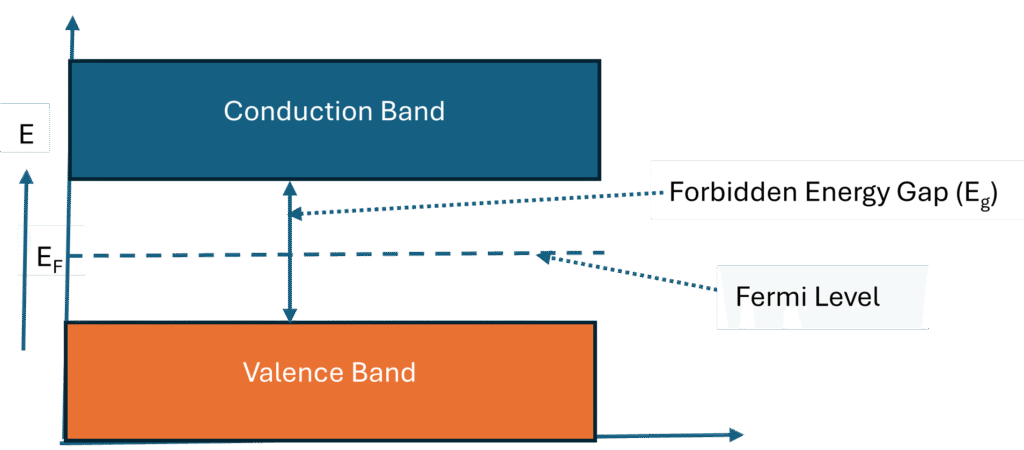
In an intrinsic semiconductor, the valence band is completely filled, and the conduction band is empty at absolute zero. There is a small energy gap between the two bands. The reference level lies nearly at the center of this gap. Because of this, very few electrons are available for conduction at low temperatures. As the temperature increases, electrons gain energy and move to the conduction band, so the conductivity increases.
Fermi Level in Insulators:
In insulators, the forbidden energy gap is very large. The valence band is completely filled, and the conduction band is empty.
The Fermi energy level lies
- Well inside the forbidden energy gap, closer to the middle
Because the energy gap is large, electrons cannot move to the conduction band under normal conditions, so insulators have negligible electrical conductivity.
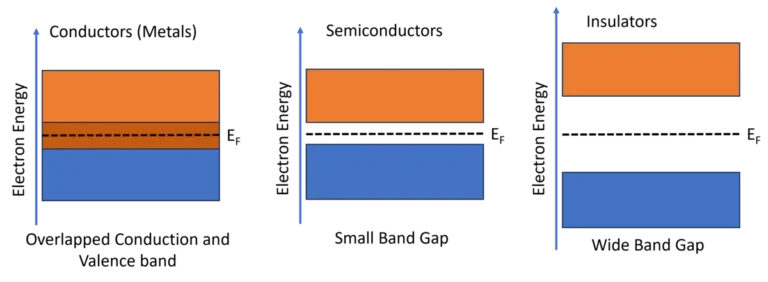
📊 Comparison of Fermi Level in Different Materials:
| Material Type | Position of Fermi Level | Physical Meaning |
|---|---|---|
Conductor (Metal) |
Inside conduction band or overlapping band |
Plenty of empty states just above $E_F$, so electrons move freely with the tiniest push of energy or voltage. |
Intrinsic Semiconductor |
Exactly at the middle of the forbidden energy gap |
Equal probability of electrons in valence and conduction bands; conduction only happens once thermal energy or light excites electrons across the gap. |
N-type Semiconductor |
Shifts closer to the conduction band |
Donor impurities add extra electrons, raising the Fermi Level toward the conduction band edge. |
P-type Semiconductor |
Shifts closer to the valence band |
Acceptor impurities create extra holes, pulling the Fermi level toward the valence band edge. |
Insulator |
Lies deep inside a very wide forbidden gap |
Gap is so large (typically > 5 eV) that virtually no electron gets enough thermal energy to cross it at room temperature. |
📐 Derivation of the Fermi Energy at Absolute Zero:
To find an actual formula for the Fermi energy, physicists use the free electron gas model, in which the conduction electrons of a metal are treated as a gas of free particles confined inside a box of volume V. Because electrons are fermions, they must fill available quantum states according to the Pauli exclusion principle, starting from the lowest energy upward.
Step 1 — Counting available states (density of states):
For a free electron gas in three dimensions, the number of quantum states with energy between E and E + dE is given by the density of states function:
This expression physically tells us how many “seats” exist in a thin energy slice near E—it grows as E1/2, meaning higher energies offer more available states, much like a stadium having more seats the further you climb from the ground.
Step 2 — Filling states at absolute zero:
At T = 0 K, every available state is either completely filled or completely empty, so electrons occupy all states from E = 0 up to some maximum energy—the Fermi energy EF. Since each state can hold 2 electrons (spin up and spin down), the total number of electrons N is obtained by integrating the density of states up to EF and multiplying by 2:
This step simply says: the total number of electrons in the metal equals the sum of all filled seats, counted from the ground floor to the Fermi floor.
Step 3 — Carrying out the integration:
Using $$\int_0^{E_F} E^{1/2}dE = \frac{2}{3}E_F^{3/2}$$
Equation (2) becomes:
This equation now directly relates the electron density inside the metal to the Fermi energy—the more electrons packed into a given volume, the higher the Fermi energy must climb to accommodate them all, just as a packed auditorium forces latecomers into higher balcony seats.
Step 4 — Solving for the Fermi energy:
Rearranging equation (3) to isolate EF:
This final result is often rewritten in the more familiar engineering-physics textbook form using Planck’s constant h = 2πℏ:
Physically, equation (5) tells us that the Fermi energy depends only on two things: the mass of the electron and the number of free electrons packed per unit volume, N/V. Double the electron density, and the Fermi energy rises—but not proportionally; it grows only as the two-thirds power because higher-energy states hold more room for electrons than lower ones do exponentially.
Importance of the Fermi Energy Level:
The concept of Fermi level is important because it:
- Explains electrical conductivity of materials
- Helps compare conductors, semiconductors, and insulators
- Determines carrier concentration in semiconductors
- Plays a key role in semiconductor devices and junctions
✅ Advantages of the Concept of Fermi Level:
The Fermi energy level is much more than a theoretical concept. It provides a powerful framework for understanding and designing electronic materials.
1. Explains Electrical Conductivity:
The position of the Fermi level helps explain why some materials conduct electricity easily while others do not. It serves as a direct indicator of the availability of mobile charge carriers.
2. Foundation of Semiconductor Physics:
The concepts of intrinsic semiconductors, extrinsic semiconductors, and doping are all based on the position of the Fermi energy level. Without it, modern semiconductor theory would be incomplete.
3. Essential for Electronic Device Design:
Engineers use the Fermi state to design and optimize semiconductor devices such as diodes, transistors, LEDs, solar cells, and integrated circuits.
4. Predicts Electron Distribution:
The Fermi–Dirac distribution function uses the Fermi level to predict the probability of electron occupancy at different temperatures.
5. Supports Modern Nanoelectronics:
Advanced technologies such as nanotechnology, quantum computing, and microelectronics rely heavily on the concept of the Fermi energy level to understand electron behavior at the nanoscale.
⚠️ Limitations of the Concept of Fermi Level:
Although this reference energy level is extremely useful, it also has certain limitations.
1. Thermal Equilibrium Assumption:
The conventional concept of the Fermi energy level is strictly applicable to materials in thermal equilibrium. Under strong external excitation, separate quasi-Fermi levels may be required.
2. Does Not Show Electron Motion:
This reference energy level indicates the probability of electron occupancy but does not directly describe how electrons move under an applied electric field.
3. Requires Quantum Mechanical Understanding:
A complete understanding of the Fermi energy level depends on quantum mechanics and statistical physics, making it challenging for beginners.
4. Not a Physical Energy Band:
The Fermi level is a reference energy level rather than a physical band. Students often misunderstand it as an actual electron orbit or energy band.
5. Complex in Advanced Materials:
In materials with strong electron interactions or complex band structures, a simple Fermi level description may not capture all physical phenomena.
🌍 Applications of the Concept of Fermi Level:
The Fermi energy level plays a central role in numerous fields of science and engineering.
1. Semiconductor Device Design 📱
The operation of p–n junction diodes, transistors, and integrated circuits depends on the position of this reference energy level before and after junction formation.
2. Solar Cells ☀️
The separation of electrons and holes in solar cells is strongly influenced by the alignment of the Fermi level. Proper Fermi energy level engineering improves the efficiency of photovoltaic devices.
3. Light Emitting Diodes (LEDs) 💡
LED performance depends on electron-hole recombination, which is controlled by carrier concentrations associated with this reference energy level.
4. Laser Diodes 🔴
Semiconductor laser diodes require precise control of carrier injection and population inversion, both of which are related to changes in the Fermi level under bias.
5. Microprocessors and Computer Chips 💻
Every integrated circuit inside a computer or smartphone contains billions of semiconductor devices whose electrical behavior is determined by this reference energy level.
6. Nanoelectronics 🔬
As electronic devices become smaller, the accurate determination of the Fermi energy level becomes increasingly important for predicting quantum effects.
7. Material Characterization 🧪
Scientists use techniques such as photoelectron spectroscopy to estimate the Fermi level and study the electronic properties of new materials.
8. Sensors and Biosensors 🌡️
Modern gas sensors and biosensors detect changes in surface charge by monitoring shifts in the Fermi energy level, enabling highly sensitive measurements.
🚀 Quick Answer Section:
### What is Fermi Level?
The Fermi Level is the reference energy level in a solid that indicates the probability of electron occupancy. At 0 K, it is the highest occupied energy level. At temperatures above 0 K, it is the energy level where the probability of finding an electron is exactly 50%.
### What is the difference between Fermi Level and Fermi Energy?
The Fermi Energy is the numerical value of the highest occupied energy level at 0 K, whereas the Fermi Level is the reference energy used to describe electron occupancy at any temperature. In undergraduate Engineering Physics, both terms are often used interchangeably for simplicity.
### Where is the Fermi level located in an intrinsic semiconductor?
In an intrinsic semiconductor, the Fermi level lies approximately at the center of the forbidden energy gap. This central position reflects the equal concentration of electrons and holes under thermal equilibrium, resulting in balanced electrical properties.
### Why does the Fermi level move in an n-type semiconductor?
When pentavalent impurity atoms are added to a semiconductor, extra electrons become available. As a result, the Fermi level shifts upward toward the conduction band, indicating that electrons require less energy to become free and participate in electrical conduction.
### Why does the Fermi Level move downward in a p-type semiconductor?
Adding trivalent impurity atoms creates additional holes in the valence band. Consequently, the Fermi Level shifts downward toward the valence band, reflecting the increased hole concentration and the greater probability of hole conduction in the semiconductor.
### What is the probability of electron occupancy at the Fermi Level?
According to the Fermi–Dirac Distribution Function, the probability that an energy state exactly at the Fermi Level is occupied by an electron is 50% under thermal equilibrium. This important result is valid at any temperature and is widely used in semiconductor physics.
### How does temperature affect the Fermi level?
As temperature increases, electrons gain thermal energy and occupy higher energy states. Although the electron distribution changes significantly, the Fermi Level remains the reference energy where the probability of electron occupancy is 50%. In intrinsic semiconductors, its position changes only slightly with temperature.
### How does the Fermi level explain electrical conductivity?
The position of the Fermi Level determines how easily electrons can enter the conduction band. A Fermi level close to or inside the conduction band results in high electrical conductivity, whereas a Fermi level within a wide band gap corresponds to poor conductivity.
### What are the applications of the Fermi Level?
The Fermi Level is essential in designing semiconductor devices such as diodes, transistors, LEDs, laser diodes, solar cells, integrated circuits, sensors, and nanoelectronic devices. It helps engineers predict electron behavior and optimize the electrical performance of modern electronic components.
Practice Numerical Problems 🧮:
Problem 1: Occupation Probability Above Fermi Level
Question: Evaluate the probability that an energy state 0.2 eV above the Fermi level is occupied by an electron at T = 300 K. (Given kB = 8.617 × 10⁻⁵ eV/K).
Solution:
Given: E – EF = 0.2 eV, T = 300 K, kB = 8.617 × 10⁻⁵ eV/K
To Find: f(E)
Calculation: Let us first calculate the value of kBT:
Now compute the exponent term:
Substitute into the Fermi-Dirac formula:
Answer: The probability of finding an electron at 0.2 eV above EF is approximately 0.0436% (or 4.36 × 10⁻⁴).
Problem 2: Temperature Calculation for Given Probability
Question: At what temperature will an energy state 0.5 eV above the Fermi level have a 1% probability of occupation?
Solution:
Given: E – EF = 0.5 eV = 0.5 × 1.602 × 10-19 J = 8.01 × 10⁻²⁰ J, f(E) = 0.01 (1%), kB = 1.38 × 10⁻²³ J/K
To Find: Temperature T
Calculation:
Taking the natural logarithm on both sides:
Rearranging for T:
Answer: The required temperature is approximately 1263 K.
Problem 3: Shift of Fermi Level in n-type Silicon
Question: Calculate the shift in the Fermi level relative to the intrinsic Fermi level (Ei) for an n-type silicon crystal doped with donor concentration ND = 10-16 cm-3 at T = 300 K. Given ni = 1.5 × 1010 cm-3.
Solution:
Given: ND = 110-16 cm-3
ni = 11.5 × 1010 cm-3
kB T = 0.0259 eV at 300 K
To Find: EF – Ei
Calculation: For complete ionization in an n-type semiconductor, n ≈ ND.
The electron concentration equation relative to Ei is:
Rearranging for EF – Ei:
Substituting values:
Answer: The Fermi level shifts 0.347 eV above the intrinsic Fermi level.
Important Examination Questions:
Short Answer Questions:
- Define Fermi level.
- What is the significance of Fermi level at 0 K?
- Where does the Fermi level lie in an intrinsic semiconductor?
Long Answer Questions:
- Explain the concept of the Fermi level and its position in conductors, semiconductors, and insulators with neat diagrams.
- Describe the significance of the Fermi level in determining the electrical properties of solids.
 Very frequently asked question

Conceptual Questions:
- Why is the probability of electron occupancy 50% at the Fermi level?
- Why does the position of Fermi level differ in different materials?
❓ FAQs:
### Is the Fermi Level a real energy level?
Answer:
No. The Fermi Level is not a physical energy level occupied by electrons. It is a reference energy level used to predict the probability of electron occupancy in a solid. It plays a central role in understanding electron distribution and electrical conductivity.
### Why is the Fermi Level called the chemical potential of electrons?
The Fermi Level is often referred to as the chemical potential of electrons because it represents the energy required to add one more electron to a material under thermal equilibrium. In advanced solid-state physics, the chemical potential and Fermi level are equivalent at equilibrium.
### Can the Fermi Level change with temperature?
Yes. In semiconductors, the Fermi Level shifts slightly with temperature because the concentrations of electrons and holes change. However, in metals, the shift is extremely small and is generally neglected for most engineering applications.
### Why is the Fermi Level different for n-type and p-type semiconductors?
Doping changes the concentration of charge carriers. Donor impurities increase the electron concentration, shifting the Fermi Level toward the conduction band, while acceptor impurities increase the hole concentration, shifting it toward the valence band.
### What is the relationship between the Fermi Level and electrical conductivity?
The closer the Fermi Level is to the conduction band, the easier it is for electrons to become free and conduct electricity. Therefore, the position of the Fermi Level strongly influences the electrical conductivity of a material.
### Why is the Fermi Level important in semiconductor devices?
The Fermi Level determines the distribution of electrons and holes, making it essential for analyzing and designing semiconductor devices such as diodes, transistors, LEDs, laser diodes, solar cells, and integrated circuits.
### Is the Fermi Level the same in thermal equilibrium?
Yes. In a material at thermal equilibrium, the Fermi Level remains constant throughout the material. This constant Fermi Level is an important condition used to analyze semiconductor junctions and electronic devices.
📖 Conclusion:
The Concept of Fermi Level is one of the most fundamental ideas in solid-state and semiconductor physics. It provides a simple yet powerful way to understand how electrons are distributed within a material and why different materials exhibit different electrical properties.
We learned that the Fermi Level is the highest occupied energy level at absolute zero (0 K) and, under thermal equilibrium, serves as the reference energy at which the probability of electron occupancy is 50%. Its position relative to the valence band and conduction band determines whether a material behaves as a conductor, semiconductor, or insulator.
The movement of the Fermi Level due to doping explains the behavior of n-type and p-type semiconductors, making it indispensable for understanding the operation of modern electronic devices such as diodes, transistors, LEDs, laser diodes, solar cells, integrated circuits, and sensors.
Rather than treating the Fermi Level as just another theoretical concept, think of it as the energy reference that connects quantum mechanics with practical electronics. Once this idea is clear, many advanced semiconductor topics become much easier to understand.