
Visit:  https://smartstudyzone.in
For High-Quality, More Free Study Notes
Contents
Toggle1. 📘 Introduction to Nd:YAG Laser:
The Nd:YAG laser (Neodymium-doped Yttrium Aluminum Garnet laser) is one of the most widely used solid-state lasers. It plays a crucial role in modern technology. The Nd:YAG laser is so focused, so powerful, and so precise that it can cut metal, perform eye surgery, and transmit signals across space.
By the end of this article, you will thoroughly understand:
- How an Nd:YAG laser is constructed,
- How its four-level energy system enables efficient lasing action,
- How Nd:YAG laser works step-by-step
- How to mathematically derive the key parameters, and
- Why this laser appears in everything from ophthalmology clinics to missile rangefinders?
Let’s begin.
2. 📜 Historical Background of Nd:YAG Laser:
The Nd:YAG laser was developed in 1964 by J.E. Geusic and colleagues at Bell Labs, soon after the invention of the first laser. Scientists needed a more efficient and powerful laser than ruby lasers, and Nd: YAG became the perfect solution.
It revolutionized:
- Industrial machining
- Medical treatments
- Scientific research
3. 🏗️ Construction of Nd:YAG Laser:
The Nd:YAG laser is a solid-state laser, meaning its active medium is a crystalline solid rather than a gas or liquid. To understand its construction, let us know about its key components that work together to produce a laser beam.
1. Active Medium—The Nd:YAG Crystal Rod
The active medium of the Nd:YAG laser is a cylindrical rod of a synthetic YAG crystal doped with neodymium ions (Nd³⁺) at a concentration of typically 0.5% to 1.5% by weight.
The rod is usually 6–10 cm long and 6–9 mm in diameter, though dimensions may vary by application. Both flat ends of the rod are polished to optical quality and coated.
2. Pumping Source — Flashlamp or Laser Diode
Since the Nd:YAG laser is a solid-state laser, it uses optical pumping to excite neodymium ions from the ground state to higher energy levels. Traditionally, a Krypton or Xenon flash lamp is used. In modern high-efficiency versions, laser diodes are used.
3. Optical Resonator (Cavity)
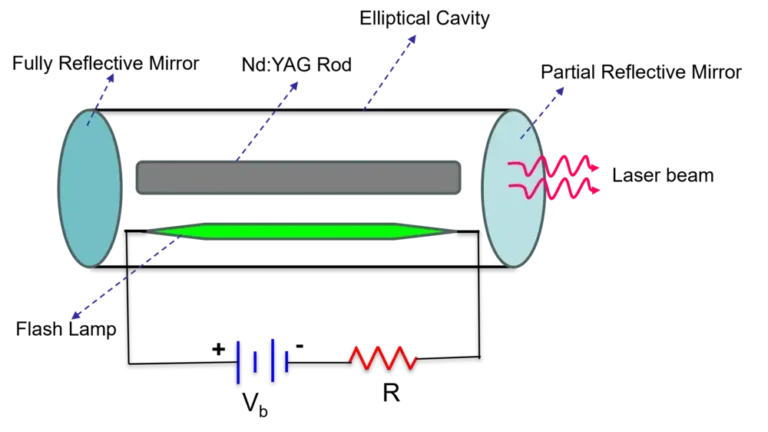
The optical resonator consists of two mirrors placed on either side of the active rod, along its optical axis. The back mirror has near-100% reflectivity, while the output coupler mirror transmits a fraction of the light as the usable laser beam.
For many applications, additional optical elements—like Q-switches, etalons, or frequency-doubling crystals—are placed inside this cavity.
4. Cooling System
Because optical pumping generates substantial heat (especially with flashlamps), the crystal rod is enclosed in a flow tube through which deionized water circulates.
Temperature stability is essential — even small thermal gradients inside the crystal cause thermal lensing, which degrades beam quality.
The rod and the flash lamp are often placed inside an elliptical cavity. Because of the geometric properties of an ellipse, any light starting at one focus (the lamp) is reflected directly onto the other focus (the rod), ensuring maximum energy absorption. The schematic diagram of the Nd:YAG laser is shown in the following figure:
4. ⚡ Energy Level Diagram of Nd:YAG Laser:
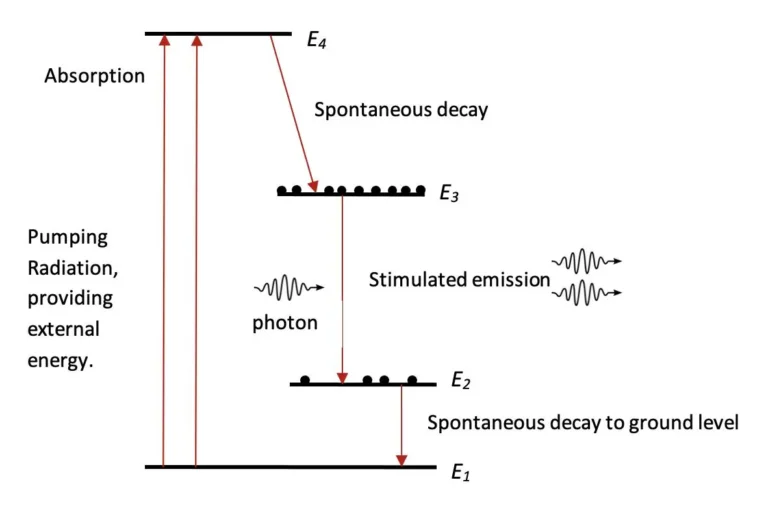
The Nd:YAG laser operates on a four-level energy system, which makes it highly efficient. Let us consider an Nd:YAG laser with four energy levels, E1, E2, E3, and E4, and N electrons as shown in the following energy level diagram. The number of electrons in the energy states E1, E2, E3, and E4 will be N1, N2, N3, and N4.
The energy level E1 is known as the ground state, E2 is the next higher energy state or excited state, E3 is the metastable state or excited state, and E4 is the pump state or excited state. Let us assume that initially, the population will be N1 > N2 > N3 > N4.
5.⚙️ Working Principle of Nd:YAG Laser:
The working involves three main processes:
- Optical Pumping (Absorption): When the pump source (flashlamp or laser diode) is enabled, its photons are absorbed by ground-state Nd³⁺ ions, exciting them into the pump state E4.
Non-Radiative Decay to Metastable Level: After a short period of time, the excited neodymium ions will fall into the next lower energy state or metastable state E3 by releasing non-radiative energy.
Population Inversion: The lifespan of the metastable state E3 is significantly longer than that of the pump state E4. Consequently, the electrons arrive at E3 significantly more rapidly than they depart from E3. As a result, population inversion is accomplished by increasing the amount of electrons in the metastable E3.
- Stimulated Emission and Laser Action: Once population inversion is established between Level 3 and Level 2, a spontaneously emitted photon of energy hν = E₃ − E₂ traveling along the cavity axis can trigger stimulated emission: it forces another excited ion to emit an identical photon (same wavelength, phase, and direction). This photon pair triggers two more emissions, which trigger four, and so on.
Resonator Feedback and Output: The two mirrors act like a feedback system. They make light bounce back and forth through the crystal many times, so it gets stronger on each pass. One mirror is slightly transparent, so a small part of the light comes out as the laser beam, while the rest keeps reflecting inside.
Lower-Level Depopulation: After stimulated emission, the ion drops to Level 2. From there, it quickly returns to the ground state (Level 1) without emitting light, and this happens in just nanoseconds. Because of this fast return, Level 2 stays almost empty all the time, which helps maintain population inversion. In simple terms, the system resets itself after each lasing cycle.
When the laser working is steady, the gain of the light becomes equal to the losses in the cavity—this is called the threshold condition.
6. 🧮 Key Parameters of Nd:YAG Lasers:
6.1. Photon Energy and Wavelength:
The energy of the photon emitted during the laser transition between the upper laser level (E₃) and the lower laser level (E₂) is given by the fundamental quantum relation: $$E = h\nu$$
Here, h is Planck’s constant (6.626 × 10⁻³⁴ J·s), and ν is the frequency of the emitted radiation. Since frequency and wavelength are related through the speed of light c by ν = c/λ, we can write: $$E = \frac {hc}{\lambda}$$
6.2. Population Inversion and Gain Coefficient:
The optical gain of the laser medium per unit length is given by: $$g(\nu)=\sigma(\nu)\cdot \Delta N$$
where σ(ν) is the stimulated emission cross-section (a measure of how likely a photon is to trigger stimulated emission from an excited ion), and ΔN is the population inversion density—the excess number of atoms per unit volume in the upper laser level over the lower laser level: $$\Delta N = N_3-N_2$$
For the four-level system, because Level 2 remains essentially empty (N₂ ≈ 0) at room temperature, we have: $$\Delta N = N_3$$
6.3. Threshold Pump Power:
At the laser threshold, the gain exactly compensates all losses in the cavity per round trip. Writing the round-trip condition: $$R_1\cdot R_2\cdot e^{(2g\cdot L)} =\frac{1}{\left( 1-\delta \right)^2}$$
where R₁ and R₂ are the mirror reflectivities, g is the gain coefficient, L is the crystal length, and δ represents fractional internal losses (scattering, absorption by impurities, etc.).
Taking the natural logarithm of both sides: $$2gL = ln\left(\frac{1}{R_1R_2}\right) + 2·ln\left(\frac{1}{1−δ}\right) $$
The left side is the round-trip gain, and the right side represents total cavity losses (mirror transmission loss plus internal losses).
The threshold inversion density Nth required for lasing is therefore: $$N_{th} = \frac{\left[ln\left(\frac{1}{R_1R_2}\right) + 2·ln\left(\frac{1}{1−δ}\right)\right]}{2\sigma L}$$
6.4. Output Power:
The useful output power extracted from the laser through the output coupler can be expressed as: $$P_{out} = η · (P_{pump} − P_{th}) $$
where η = slope efficiency of the laser (typically 10–25% for flashlamp-pumped and 30–60% for diode-pumped Nd:YAG),
Ppump = the incident pump power, and
Pth = the threshold pump power.
7. 🌟Characteristics of Nd:YAG Laser:
Wavelength: Its primary output is in the infrared region at 1064 nm. However, using “frequency doubling,” it can produce visible green light at 532 nm.
Efficiency: Being a 4-level laser, it is much more efficient than the Ruby laser. Its slope efficiency can reach 2% to 3% with lamp pumping and much higher with diode pumping.
Output Power: It can operate in Continuous Wave (CW) mode or pulsed mode (using Q-switching). In pulsed mode, it can generate kilowatts of peak power.
8. ⚖️ Comparison with Other Lasers:
| S. No. | Feature | Nd:YAG Laser | CO₂ Laser | He-Ne Laser |
|---|---|---|---|---|
1. |
Type |
Solid-state (4-level) |
Gas (4-level) |
Gas (4-level) |
2. |
Wavelength |
1064 nm (Near IR) |
10,600 nm (far IR) |
632.8 nm (red) |
3. |
Mode |
CW & pulsed |
CW & pulsed |
CW |
4. |
Efficiency |
High |
Moderate |
Low |
5. |
Key Application |
Surgery, cutting, ranging |
Cutting, engraving |
Alignment, barcode |
9. ✅ Advantages and Limitations:
Advantages:
High Thermal Conductivity: The YAG crystal dissipates heat well, allowing for high-power operation.
Low Threshold: Being a 4-level system, it requires less energy to start lasing.
Versatility: Can be frequency-doubled to produce green light.
Limitations:
Cost: Synthetic YAG crystals are expensive to grow.
Cooling Needs: At very high powers, it requires sophisticated water-cooling systems to prevent “thermal lensing” (where the rod acts like a lens due to heat).
10. 🔬 Applications of Nd:YAG Laser:
1. 🩺 Medical Field: Nd: YAG lasers are widely used in:
- Eye surgeries (like LASIK)
- Skin treatments
- Tumor removal
2. 🏭 Industrial Uses: Used for:
- Cutting metals
- Welding
- Drilling
3. 🛡️ Military and Defense: Applied in:
- Range finding
- Target designation
- Laser weapons
4. 🔬 Scientific Research: Used in spectroscopy
11. ⚠️ Safety Measures:
- Always wear protective goggles
- Avoid direct exposure
- Use proper shielding
- Follow operational guidelines
12. 🔮 Future Scope of Nd:YAG Laser:
The future looks bright for Nd:YAG laser technology. With advancements in:
- Fiber optics
- Medical tech
- Manufacturing automation
13.⚡ Quick Answer Section:
What is Nd:YAG laser?
An Nd:YAG laser is a solid-state laser using a Yttrium Aluminum Garnet crystal doped with Neodymium ions. It operates as a four-level system, typically emitting light in the infrared spectrum at 1064 nm. It is widely used in medicine, manufacturing, and military applications due to its high efficiency and power.
What does Nd:YAG stand for?
Nd:YAG stands for Neodymium-doped Yttrium Aluminium Garnet. Neodymium (Nd³⁺) is the active lasing ion, while Yttrium Aluminium Garnet (Y₃Al₅O₁₂) is the transparent crystalline host material. Together, they form a solid-state laser active medium operating primarily at 1064 nm.
What is the wavelength of Nd:YAG laser?
The primary emission wavelength of an Nd:YAG laser is 1064 nm, in the near-infrared. Via frequency doubling (second harmonic generation), it produces 532 nm (green). Third and fourth harmonics yield 355 nm and 266 nm, giving the same laser system access to green, UV, and deep-UV radiation.
Is Nd:YAG a three-level or four-level laser?
Nd:YAG is a four-level laser system. The lower laser level sits well above the ground state, ensuring its thermal population is negligible at room temperature. This makes population inversion achievable with relatively low pump power, enabling efficient continuous-wave operation at room temperature — a key advantage over three-level lasers like ruby.
What pumping method does an Nd:YAG laser use?
Nd:YAG lasers use optical pumping — either with xenon or krypton flashlamps (for high-energy pulsed systems) or, more efficiently, with semiconductor diode lasers emitting near 808 nm. Diode pumping greatly improves electrical-to-optical efficiency, extending lamp life and reducing thermal problems in the crystal.
What is Q-switching in an Nd:YAG laser?
Q-switching is a technique that intentionally introduces high losses into the laser cavity (low Q-factor) during pumping, preventing lasing. This allows population inversion to build to a very large value. When the Q-switch is rapidly opened, the stored energy releases as a single, intense nanosecond pulse with peak powers reaching megawatts.
Why is the Nd:YAG laser used in tattoo removal?
Q-switched Nd:YAG pulses (nanoseconds to picoseconds) deliver intense, rapid bursts of energy at both 1064 nm and frequency-doubled 532 nm. These selectively shatter tattoo ink particles into microfragments small enough for the body’s immune system to clear without thermally damaging surrounding skin tissue—a process called “selective photothermolysis.”
14. 🧠 Conclusion:
The Nd:YAG laser stands as a pillar of modern photonics. By leveraging the unique properties of Neodymium ions in a rugged YAG host, this system provides a stable, powerful, and efficient light source. Whether it’s cutting through steel or healing a patient’s vision, the Nd:YAG remains an indispensable tool in the scientist’s and engineer’s toolkit.
15. 📝 PYQs / Most Expected Exam Questions:
Conceptual Questions:
- Explain why the Nd:YAG laser is classified as a four-level laser system. What advantage does this offer over a three-level system?
- What is optical pumping? Describe with reference to the Nd:YAG laser the two types of pumping sources used and compare their efficiencies.
- With the help of a neat diagram, describe the construction and working of an Nd:YAG laser.
- Define population inversion and stimulated emission. Explain how these two phenomena combine to produce laser action in Nd:YAG.
- Compare Nd:YAG laser with CO₂ laser on the basis of: type of system, pumping mechanism, wavelength, efficiency, and operating mode.
- State and explain the threshold condition for laser oscillation in Nd:YAG. What parameters can a laser designer control to lower the threshold?
Derivation Questions:
- Derive an expression for the energy of a photon emitted during the laser transition in Nd:YAG. Calculate the energy in eV for λ = 1064 nm.
- Starting from the round-trip gain-equals-loss condition, derive the expression for threshold population inversion density in an Nd:YAG laser.
- Show that the output power of a laser above threshold is linearly proportional to pump power. Define slope efficiency and explain its significance.
16. 🔢 Solved Numerical Problems:
Q1. How to calculate the gain coefficient?
Question:
In an Nd:YAG laser, the population of atoms in the upper energy level is N2 = 6 × 10¹⁸ m⁻³, and in the lower energy level is N1 = 2 × 10¹⁸ m-3. If the stimulated emission cross-section is σ = 3 × 10-20 m2, calculate the gain coefficient.
Solution:
Given: N1 = 2 × 10¹⁸ m-3
N2 = 6 × 10¹⁸ m-3
σ = 3 × 10-20 m2
Find:
Gain coefficient (g)
Formula Used: g = σ(N2 – N1)
Substituting the values
⇒ g = 3 × 10-20(6 × 10¹⁸ – 2 × 10¹⁸)
⇒ g = 12 × 10-2
⇒ g = 0.12 m-1
Result: g = 0.12 m-1
Q2. How to calculate the energy of a photon emitted?
Question:
An Nd:YAG laser emits light of wavelength 1064 nm. Calculate the energy of a single photon.
Given:
λ = 1064 nm = 1064 × 10-9 m
h = 6.626 × 10⁻³⁴ J.s
c = 3 × 10 m/s
Find: Energy (E)
Formula Used: $$E = \frac{hc}{\lambda}$$
Substituting the values
$$E = \frac{6.626 × 10^{-34} \times 3 × 10^8}{1064 × 10^{-9}}$$
$$\Rightarrow E = 1.87 \times 10^{-19} J$$
or
$$E = \frac{1.87 \times 10^{-19}}{1.6 \times 10^{-19}} eV$$
$$⇒E = 1.167 eV$$
Result: The energy of a single photon is E = 1.167 eV.
Q3. How to calculate the frequency of Laser Light?
Question:
Calculate the frequency of radiation emitted by an Nd:YAG laser of wavelength 1062 nm.
Solution:
Given:
λ = 1064 nm = 1064 × 10-9 m
c = 3 × 10⁸ m/s
Find: Frequency (f)
Formula Used:
$$f =\frac{c}{\lambda}$$
Substituting the values
$$f =\frac{3 × 10^8}{1064 × 10^{-9}} $$
$$f = 2.82 \times 10^{14} Hz$$
Result: The frequency of radiation emitted by an Nd:YAG laser is 2.82 × 10¹⁴ Hz
17. ❓ FAQs (People Also Ask)
1. Is Nd:YAG laser beam visible?
No, it emits infrared radiation, which is invisible to the human eye.
2. Is it safe for the eyes?
Absolutely not without protection. Because the 1064 nm beam is invisible, your blink reflex won't save you. Always wear laser safety goggles rated for that wavelength.
3. What is the difference between CW and pulsed Nd:YAG operation?
In continuous-wave (CW) mode, the laser emits a steady beam — ideal for welding, cutting with controlled heat input, or pumping other lasers. In pulsed mode, energy is stored and released as intense nanosecond bursts with megawatt peak powers — ideal for ablation, rangefinding, and medical applications.
4. Why is neodymium preferred over other rare-earth dopants in YAG?
Nd³⁺ has exceptionally favourable spectroscopic properties in YAG: broad absorption bands well-matched to flashlamps and 808 nm diodes. Other rare earths like Erbium or Holmium are used in specialised YAG lasers for mid-IR emission, but for the 1064 nm band, Nd³⁺ remains unmatched.
5. Can it be used in surgery?
Yes, widely used in eye and dental surgeries.