



📘 Introduction
Contents
ToggleA simple tilt of a CD under light reveals a vivid spread of rainbow colors shimmering across its surface. This striking display isn’t due to any coating or paint—it arises from the wave nature of light through a phenomenon known as diffraction of light. The very same principle allows scientists to analyze light from distant stars and determine their composition.
A diffraction grating is one of the most accurate tools used to separate light into its component wavelengths. This controlled interference makes diffraction gratings far more powerful than prisms for studying light. It plays a central role in physics labs, astronomy, and even modern optical devices.
By the end of this article, you will know about:
- The basic principle and construction of a diffraction grating,
- The full mathematical derivation of the grating equation,
- Conditions for principal maxima, minima, and secondary maxima,
- The concept of missing orders,
- Maximum number of observable orders,
- What happens under oblique incidence,
- The dispersive power and how all of this connects to real instruments and applications.
Let’s begin.
📜 Historical Background of Diffraction Grating
The journey of the grating began in the late 18th century with David Rittenhouse, an American astronomer who created the first primitive version using hairs spaced closely together.
However, it was Joseph von Fraunhofer in 1821 who truly revolutionized the field. By winding fine wire around a frame, he created the first “wire grating” and used it to measure the wavelengths of the dark lines in the solar spectrum—now famously known as Fraunhofer lines.
Later, in the late 1800s, Henry Rowland developed engines capable of ruling thousands of lines per inch on glass and metal surfaces. This leap in manufacturing shifted spectroscopy from a niche curiosity into the backbone of modern astrophysics and analytical chemistry.
Modern diffraction gratings are often produced using holographic techniques, where two coherent laser beams interfere on a photosensitive surface to form extremely precise groove patterns. With this method, it is possible to create gratings containing more than 6,000 fine lines within just a single centimeter.
📖 Diffraction Grating and Its Types
A diffraction grating is an optical device consisting of a large number of narrow, parallel, equally spaced slits (or rulings) engraved on a transparent or reflective surface.
When a light wavefront strikes this surface, each slit acts as a source of secondary wavelets. These wavelets then interfere with each other and create a pattern of bright and dark fringes.
There are two main types:
- Transmission grating: It is made by drawing a large number of fine, equidistant, and parallel lines on an optically plane glass plate with a diamond point. Light passes through the transparent slits. Such grating is called a plane transmission grating and is used in most laboratory spectrometers.
- Reflection grating: It is made by drawing lines on a plane or a concave silvered surface. Light then gets reflected from a point situated between two lines. Such grating is called a plane or concave reflective grating. Used in many astronomical spectrographs and CD/DVDs.
The ruled portions are opaque, and the unruled portions are transparent.
The key parameter of any grating is its grating element (also called the grating constant or grating period), denoted by d or e.
The distance between the centers of two consecutive slits of a diffraction grating is called the grating element. If the grating has N slits per unit length, then: $$d=\frac{1}{N}$$
If the width of each transparent slit is a and the width of each opaque space between them is b, then
$$d = a + b$$
What is Diffraction Grating?
A diffraction grating is an optical device with many equally spaced slits that diffract light and produce interference patterns. It is used to separate light into its component wavelengths with high precision.
📊 Derivation: Intensity Distribution & Grating Equation
The derivation of the grating equation brings together two ideas:
- Single-slit diffraction (which determines how light spreads from each slit) and
- Multi-slit interference (which determines in which directions the contributions from all the slits add up constructively).
Let us delve into this carefully.
Let us consider a diffraction grating with N slits, each of width 𝑎 separated by opaque rulings of width b, so the grating element is d = 𝑎 + b.
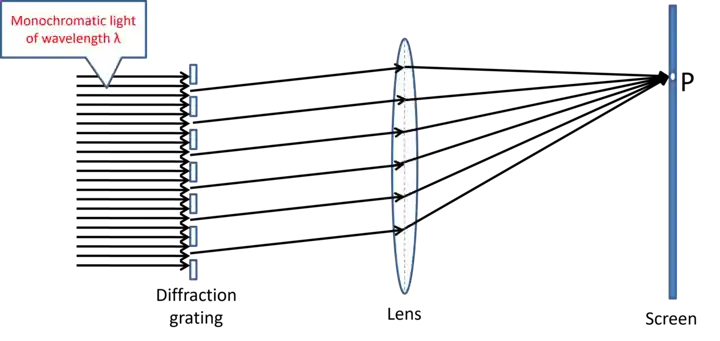
The Single Slit Diffraction:
Consider a parallel beam of monochromatic light of wavelength λ incident normally on a diffraction grating. We want to determine the intensity of the light diffracted at an angle θ.
When light passes through the grating, each of the N slits acts as a coherent source of secondary wavelets. These waves spread out and interfere with one another at different angles. In this way, we get N diffracted waves at an angle θ, each of amplitude-
$$R_\theta=R_0\frac{sin\,p}{p} \qquad …(1)$$
$$Where, \, p = \frac{\pi a sin\ \theta}{\lambda}$$
The Multi-Slit Interference:
These waves interfere at a point P on a distant screen (under Fraunhofer diffraction conditions), and the resultant intensity depends on the path difference between waves emerging from adjacent slits. The path difference between the successive waves is-
$$\Delta = (a + b) \sin\ \theta = d \sin\ \theta$$
Therefore, the corresponding phase difference is-
$$\phi = \frac{2\pi}{\lambda} d\sin\ \theta \qquad …(2)$$
Therefore, the resultant waves due to the superposition of N such diffracted waves can be expressed as-
$$Y=R_\theta\left[\cos\ \omega t+\cos(\omega t+\phi)+\cos(\omega t+2\phi)+ …. N\ terms\right]$$
$$=R_\theta\left[ \frac{e^{i\omega t}+e^{-i\omega t}} {2}+ \frac{e^{i(\omega t+\phi)} +e^{-i(\omega t+\phi)}} {2}+\frac{e^{i(\omega t+2\phi)}+e^{-i(\omega t+2\phi)}} {2}+ … N\ terms\right]$$
$$\left [Since,\, cosθ = \frac{e^{iθ}+e^{-iθ}}{2}\right]$$
For simplicity, let us express the amplitude as the real parts of complex numbers; we have
$$Y =R_\theta\, e^{i\omega t}\left[ 1+e^{i\phi}+e^{2i\phi}+ ….N\, terms \right]$$
$$Y=R_\theta\, e^{i\omega t}\left[ \frac{1-e^{iN\phi}} {1-e^{i\phi}} \right]$$
This is the resultant wave equation at point P after the interference of N diffracted waves at an angle θ.
Here, $$R_\theta\left[ \frac{1-e^{iN\phi}}{1-e^{i\phi}} \right]$$ represents the amplitude of the resultant wave.
Since intensity is proportional to the square of amplitude, the intensity produced at point P is obtained by multiplying the amplitude by its complex conjugate.
$$I_\theta=kR_\theta^2\left(\frac{1-e^{iN\phi}} {1-e^{i\phi}} \right)\left( \frac{1-e^{-iN\phi}} {1-e^{-i\phi}} \right) $$
$$\Rightarrow I_\theta=kR_\theta^2\left(\frac{1-cos\,N\phi} {1-cos\,\phi} \right) $$
$$=kR_\theta^2\left[\frac{sin^2\left(\frac{N\phi}{2}\right)}{sin^2\left(\frac{\phi}{2}\right)}\right]$$
$$\left[Since, \, cos2A = 1 – 2sin^2 A\right]$$
$$I_\theta=kR_0^2\left(\frac{sin\,p}{p}\right)^2\left[\frac{sin^2\left(\frac{N\phi}{2}\right)}{sin^2\left(\frac{\phi}{2}\right)}\right]$$
$$=kN^2R_0^2\left(\frac{sin\,p}{p}\right)^2\left[\frac{sin^2\left(\frac{N\phi}{2}\right)}{Nsin^2\left(\frac{\phi}{2}\right)}\right]$$
If θ = 0, then by simplifying for θ = 0, $$I_0 = kN^2R_0^2$$ Therefore, the resultant intensity is given by
$$ \color{Red}{I_\theta=I_0\left(\frac{\sin\,p}{p}\right)^2\left[\frac{\sin^2\left(\frac{N\phi}{2}\right)}{N\sin^2\left(\frac{\phi}{2}\right)}\right] \qquad … (3)}$$
This is the complete intensity distribution equation for a diffraction grating. It consists of two parts:
The Diffraction Term: $$\left( \frac{sin\,p}{p} \right)^2$$ – This describes the intensity distribution due to a single slit.
The Interference Term: $$\left[\frac{\sin^2\left(\frac{N\phi}{2}\right)}{N\sin^2\left(\frac{\phi}{2}\right)}\right] $$ – This describes the intensity due to the interference of waves obtained from N slits.
Therefore, the resultant intensity at a point on the screen is determined by the interference of N diffracted waves.
Conditions for Maxima and Minima:
Condition for Principal Maxima
From equation (3), it is clear that the intensity would be maximum when $$sin\left(\frac{\phi}{2}\right)=0$$ This occurs when $$\frac{\phi}{2} = \pm n\pi$$ where n = 0, 1, 2, 3, ….
Substituting the value of 𝜙
$$\frac{\pi d sin\,\theta}{\lambda}=n\pi$$
$$\color{Red}{\Large d sin\ \theta= n\lambda \qquad … (4)}$$
This is the famous grating equation. and it is the condition for principal maxima.
Here, n=0, ±1, ±2,… is the order of diffraction. When n = 0, we get the central principal maximum. When n = 1, we get the first-order principal maxima, and so on.
At central principal maxima, intensity is $$I_0 = kN^2R_0^2$$
Hence, increasing the number of slits on the grating, the intensity of the central maxima increases, and it is N2 times the intensity due to a single slit.
Condition for Minima
The intensity becomes zero when $$ sin \frac{N𝜙}{2} = 0 $$ but $$ sin\frac{𝜙}{2} ≠ 0 $$ This happens when
$$\frac{N\phi}{2}=\pm m\pi \qquad … (5)$$
where m can be any integer except multiples of N. If m is a multiple of N, we return to the principal maxima condition.
Substituting the value of 𝜙 in eq. (5)
$$\frac{N}{2}\times \frac{2\pi }{\lambda}d sin\,\theta=\pm m\pi$$
$$\Rightarrow \color{Red}{\Large d sin\,\theta=\pm \frac{m}{N}\lambda}\qquad … (6)$$
This is the condition for minima.
Here, m = 0 gives a principal maxima, and m = 1, 2, 3, …… (N-1) gives minima, and m = N gives a principal maxima again. Thus, there are (N-1) minima between two consecutive principal maxima.
Secondary maxima:
As there are (N-1) minima b/w two adjacent principal maxima, there must be (N-2) other maxima b/w two principal maxima. These are known as Secondary Maxima.
The intensity of secondary maxima is given by $$\color{Red}{I_s=I_0\left(\frac{\sin\,p}{p}\right)^2\left[\frac{1}{1+(N^2-1)\sin^2\left(\frac{\phi}{2}\right)}\right] \qquad … (7)} $$
It is clear that as N increases, the intensity of secondary maxima decreases and becomes negligible when N becomes very large.
What is Grating Element?
Grating element is the distance between two adjacent slits and is equal to:
𝑎 = slit width, b = opaque spacing)
What is the Grating Equation?
The grating equation is: d sin θ = nλ
It gives the condition for bright fringes in a diffraction grating.
📐Angular Half-Width of Principal Maxima
The angular half-width dθ is the angular distance from the peak to the first adjacent minimum. We can find that the width is inversely proportional to the number of slits N.
The angular half-width of the nth-order Principal maxima is
$$d\theta_n=\frac{\lambda}{N d\,cos\,\theta_n}$$
where L = Nd is the total width of the grating.
🌈 Diffraction Pattern
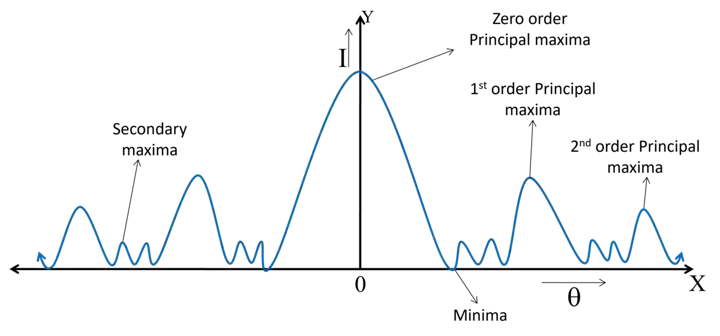
❌ Missing Orders in Diffraction Grating
In the diffraction pattern of N parallel slits, not all orders of the principal maxima are present. Some of them may be absent. This happens if the condition for a maximum for the grating coincides with the condition for a minimum for a single slit.
If $$(a+b) \sin \theta = n\lambda$$ and $$a \sin \theta = m\lambda$$ then:
If 𝑎 = b, then n = 2m, and m = 1, 2, 3, ………. Thus, the 2nd, 4th, and 6th orders maximum will be missing.
🔢 Maximum number of orders available with Grating
Since the maximum value of sin θ is 1, the maximum order n is limited by:
🔄 Diffraction Grating Under Oblique Incidence
So far, we assumed the light falls normally (perpendicularly) on the grating. In many practical situations — especially with reflection gratings in spectrographs — light strikes the grating at an angle i to the normal. This is called oblique incidence.
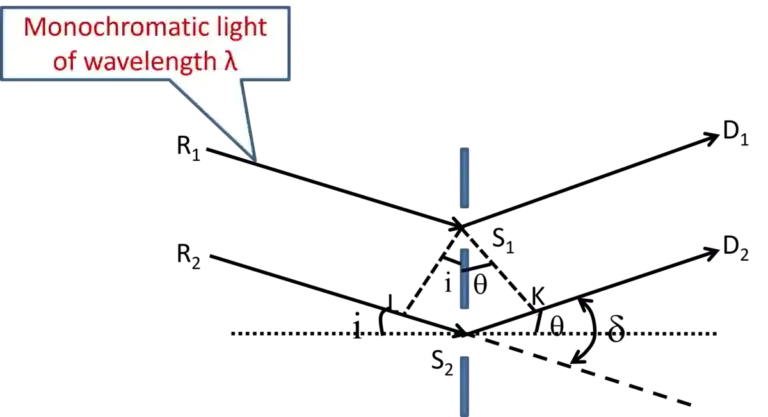
When light falls on a diffraction grating at an angle (called oblique incidence), the path difference between rays from adjacent slits comes from two parts:
Due to the incident wave
Because light is coming at an angle i, one slit receives the wave slightly earlier than the next. This introduces a path difference of:Due to the diffracted wave
After passing through the slits, the light spreads out at an angle θ, adding another path difference:
Combined Condition:
- If the incident and diffracted rays are on opposite sides of the normal, the two path differences add: $$d(\sin\, i + \sin\,θ) = n\lambda$$
- If both rays are on the same side of the normal, the path differences subtract: $$d(sin\,θ-sin\, i)=n\lambda$$
💡 Special Case (Normal Incidence)
When light falls straight on the grating:
The equation becomes:
Oblique incidence simply modifies the path difference by including the angle of incoming light. The basic principle of interference remains the same.
What is Dispersive Power of Grating?
Dispersive power is the ability of a grating to separate different wavelengths and is given by:
🔷Dispersive Power of the Diffraction Grating
The dispersive power of a grating quantifies how well the grating separates different colors. The dispersive power of a diffraction grating is defined as the rate of change of the angle of diffraction with wavelength (dθ/dλ).
To derive an expression for this, we differentiate the grating equation,
λ (treating n and d as constants):
$$d\,cos\,\theta\,.\frac{d\theta}{d\lambda}=n$$
$$\Rightarrow \frac{d\theta}{d\lambda}=\frac{n}{d\,cos\,\theta}$$
This represents the dispersive power of a diffraction grating.
⚖️ Comparison: Single Slit vs N-Slit Diffraction
| S. No. | Feature | Single Slit Diffraction | Diffraction Grating (N-slits) |
|---|---|---|---|
1. |
Primary Cause |
Interference of wavelets from a single wavefront. |
Combined effect of diffraction (at each slit) and interference (between slits). |
2. |
Fringe Sharpness |
Fringes are broad and blurred. |
Fringes are very sharp, narrow lines. |
3. |
Intensity |
Intensity fades very quickly. |
Intensity is highly concentrated in specific orders. |
4. |
Number of Maxima |
Few secondary maxima are visible. |
Multiple “orders” (n=1, 2, 3…) are clearly visible |
5. |
Application |
Basic study of wave nature. |
Spectroscopy, measuring wavelengths, fiber optics. |
Why is Diffraction Grating More Accurate than Prism?
Diffraction grating produces sharper and more distinct spectral lines due to multiple slit interference, making it more accurate than a prism for wavelength measurement.
✅ Advantages and Limitations
✅ Advantages
❌ Limitations
- Extremely high resolving power achievable with many rulings
- Nearly uniform (linear) dispersion simplifies wavelength measurement
- Works across UV, visible, and infrared with appropriate grating materials
- Holographic gratings have very low scattered light (stray light)
- Can be blazed to concentrate intensity into a desired order
- Precise absolute wavelength calibration possible
- Light is spread across many orders, reducing intensity in any one order
- Order overlap can cause confusion (2nd order of 400 nm falls at same angle as 1st order of 800 nm)
- Transmission gratings absorb some light; reflection gratings need precise alignment
- Manufacture of fine, high-quality gratings is expensive
- Missing orders reduce the available spectrum
🚀 Applications of Diffraction Grating
Astronomy: Analyzing the light from stars to determine their temperature and chemical makeup.
Optical Communications: Using “Arrayed Waveguide Gratings” to split different data channels in fiber optic cables.
Laser Tuning: Selecting specific wavelengths in a tunable laser cavity.
Medical Diagnostics: In spectrometers that analyze blood samples or tissue using light absorption.
🧠 Conclusion
The diffraction grating is a powerful tool that transforms light into measurable data. Its ability to produce sharp and precise spectra makes it essential in science and engineering.
Understanding this concept not only strengthens your wave optics foundation but also prepares you for advanced applications in modern technology.
📝 PYQs (Most expected question)
Conceptual Questions:
- What is a diffraction grating? Distinguish between a transmission grating and a reflection grating.
- What is the grating element? How is it related to the number of lines per centimeter?
- Explain why the principal maxima in a grating pattern are much sharper than those in a double-slit pattern.
- What is meant by a “missing order” in a grating spectrum? Under what conditions does a missing order occur?
- How does the dispersive power of a grating depend on the order of diffraction and the grating constant?
- Why does the resolving power of a grating increase with the number of rulings, even if the grating constant remains the same?
- State the condition for the maximum number of orders observable with a diffraction grating.
- What modification is made to the grating equation when light falls obliquely on the grating?
Derivation Questions:
- Derive the expression for the intensity distribution due to N slits and identify the conditions for principal maxima and minima.
- Derive the expression for the angular half-width of a principal maximum and discuss its significance.
- Derive the expression for the dispersive power of a diffraction grating and explain each factor.
- Starting from the grating equation, derive the condition for missing orders.
- Obtain the modified grating equation for oblique incidence using a geometrical path-difference argument.
🔢 Solved Numerical Problems
How to calculate the angle of diffraction using a diffraction grating?
Question: A grating has 6000 lines per centimeter. Calculate the angle of diffraction for the first-order spectral line of wavelength 589 nm.
Solution:
Given: N = 6000 lines/cm, n = 1, λ = 589 × 10-7 cm.
Find: θ
$$d = 1/N = 1/6000\,cm$$
Using grating equation $$d \sin \theta = n\lambda$$
$$\sin \theta = \frac{n\lambda}{d} = 1 \times (589 \times 10^{-7}) \times 6000$$
$$\sin \theta = 0.3534$$
$$\theta = \arcsin(0.3534) \approx 20.7^\circ$$
Result: The first-order angle is approximately 20.7°.
How to calculate the maximum order?
Question: Find the maximum number of orders possible for a light of 500 nm falling on a grating with a grating element of 2 μm.
Given: λ = 500 × 10-9 m, d = 2 × 10⁻⁶ m.
Find: nmax
Solution:
$$n = \frac{d \sin \theta}{\lambda}$$ For nmax, $$\sin \theta = 1$$
$$n = \frac{2 \times 10^{-6}}{500 \times 10^{-9}} = \frac{2000}{500} = 4$$
Result: The maximum number of orders is 4.
❓ FAQs (People Also Ask)
What is diffraction grating?
An optical device with many equally spaced parallel slits is used to split light.
What is grating element?
It is the distance between the centers of two consecutive slits.
What are missing orders?
Orders of maxima that disappear due to overlapping.
How do I calculate the number of lines per mm?
Simply by calculating the reciprocal of the grating element d.
What is the difference between a transmission and a reflection grating?
A transmission grating has transparent slits (like glass), while a reflection grating uses tiny grooves on a reflective surface (like a mirror or a CD).
Why are gratings preferred over prisms in spectroscopy?
Gratings provide much higher resolving power and a linear spread of colors, allowing for more precise measurements.