
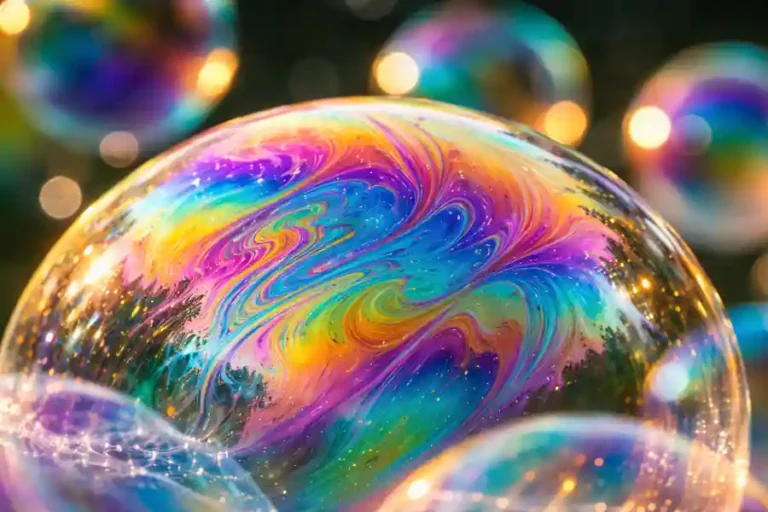
Have you ever observed a soap bubble or a thin layer of oil and noticed swirling, rainbow-like patterns? (As shown in the following figure). These are not tricks of imagination. This simple observation beautifully explains the interference of light waves.
Interference occurs when two or more light waves superimpose on each other and redistribute energy to produce a resultant wave of greater, lesser, or equal amplitude. This phenomenon is not limited to light—it is also seen in sound waves and water waves.
Interference isn’t just a theory—it powers real technologies like anti-reflective lenses, noise-cancelling headphones, interferometers, and even gravitational wave detectors. Understanding it helps you grasp the true nature of light and its practical impact.
By the end of this article, you will understand:
- What causes interference?
- What interference really means
- How fringe patterns are formed
- The mathematics behind it (every step, clearly explained),
- The two types of interference,
- Real-world engineering applications, and
- Common misconceptions that even advanced students fall into.
Contents
Toggle1. 🕰️ Historical Background: Wave optics
The concept of interference was strongly established by Thomas Young through his famous double-slit experiment (1801). At that time, scientists debated whether light was a particle or a wave.
Young’s experiment clearly showed that light behaves like a wave, because it produces interference patterns—something particles alone cannot explain.
This discovery became a cornerstone of wave optics.
2. 📖 Interference of Light Waves:
When two or more light waves meet in space, they do not pass through each other unchanged. Instead, their electric field amplitudes add up at every point where they overlap. Because of these interactions, the brightness of the light changes instead of staying the same. This phenomenon, in which light intensity changes due to the superposition of waves, is called interference.
In simple words:
Interference describes the phenomenon of energy redistribution that occurs when two or more light waves from coherent sources superimpose.
Now, the magic of interference depends critically on one thing: the phase relationship between the waves.
If two waves arrive at a point with their crests aligned (in phase), they reinforce each other—this is constructive interference. If a crest arrives with a trough (out of phase by half a wavelength), they cancel each other out—this is destructive interference.
3.  Types of Interference:
 Types of Interference:
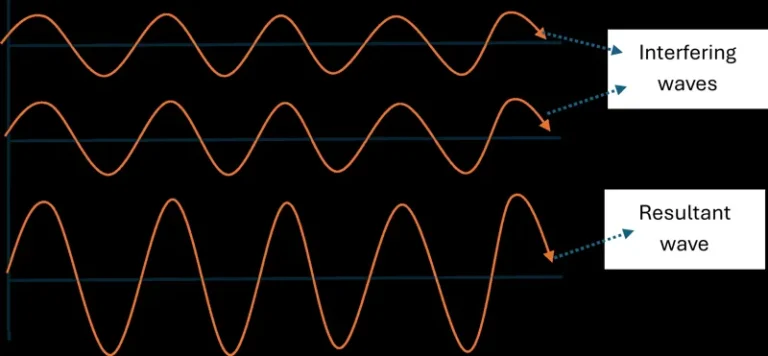
1. Constructive Interference
Constructive interference occurs when two waves meet in such a way that their crests (and troughs) coincide perfectly. The resulting amplitude is the sum of the individual amplitudes, producing a bright fringe (in the context of light).
In constructive interference, the resultant intensity is greater than the sum of the intensities of individual waves. ie
$$ I\gt I_1+I_2$$
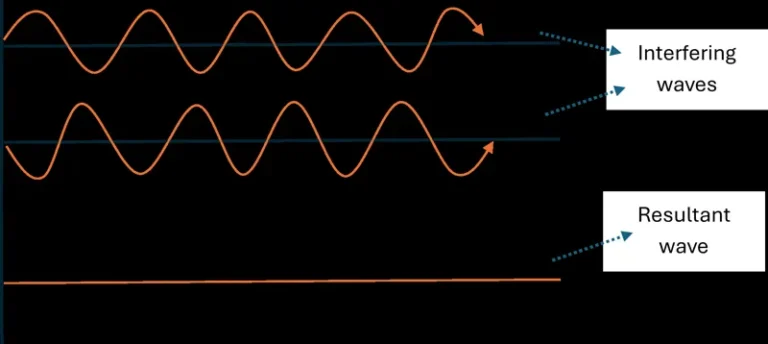
2. Destructive Interference
Destructive interference occurs when the crest of one wave coincides with the trough of another. The waves cancel each other out (partially or completely), producing a dark fringe.
In destructive interference, the resultant intensity is less than the sum of the individual wave intensities. ie
$$ I\lt I_1+I_2$$
4. 📐 Mathematical Treatment of Interference:
4.1. 🌟 Resultant Intensity due to superposition of two interfering waves:
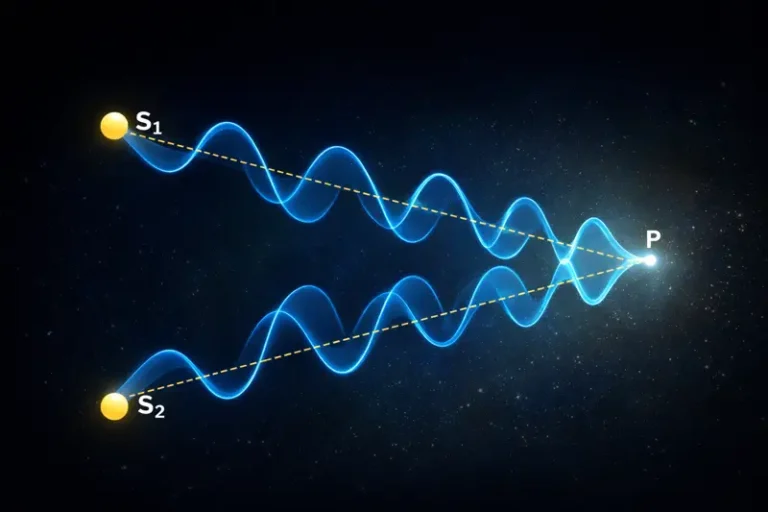
Let us consider two monochromatic light waves originating from two coherent sources, S1 and S2. Suppose these waves have the same frequency and travel in the same direction, meeting at a point P as shown in the following figure.
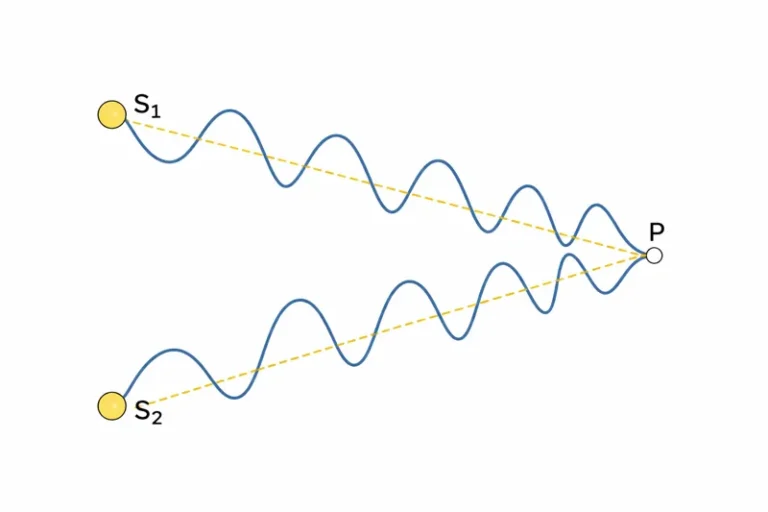
The displacement of the first wave can be represented as:
Where α1 is the amplitude, ω is the angular frequency, and t is time.
The second wave, having a phase difference of φ relative to the first, is expressed as:
According to the principle of superposition, the resultant displacement Y at point P is the sum of these two displacements:
Using the trigonometric identity sin(A + B) = sin A cos B + cos A sin B, we expand the second term:
To simplify the expression into a single wave equation, we make the following substitutions. Let:
Substituting these back into our expression for Y:
This equation shows that the resultant wave is also a simple harmonic wave with a resultant amplitude A.
To find the value of A, we square and add Eq. (1) and Eq. (2):
Since the intensity of light (I) is directly proportional to the square of its amplitude (A2), we can write the intensity at point P as:
This equation represents the intensity of the resultant wave. It tells us that the intensity is not just the sum of the two lights; there is an “interference term” (2√I₁I₂cosφ) that dictates whether the point is bright or dark based on the phase difference.
4. 2. Condition for Bright Fringes:
From equation (3), it is clear that for a bright fringe
$$cos\phi=1\qquad i.e.\qquad phase\; difference(\phi)=2n\pi$$
And hence, the resultant intensity becomes
$$I = I_1 + I_2 + 2I_1I_2 = \left(I_1+I_2\right)^2$$
$$\Rightarrow I\gt I_1+I_2$$
Since,
$$path\; difference(\Delta)=\frac{\lambda}{2\pi}\times phase\; difference$$
$$\Rightarrow \Delta = n\lambda$$
Hence, the condition for constructive interference is
- Phase difference (ϕ) = 2nπ
- Path difference (Δ) = nλ
4.3. Condition for Dark Fringes:
From equation (3), it is clear that for a dark fringe
$$cos\phi=-1\qquad i.e.\qquad phase\; difference(\phi)=(2n+1)\pi$$
And hence, the resultant intensity becomes
$$I = I_1 + I_2 – 2I_1I_2 = \left(I_1-I_2\right)^2$$
$$\Rightarrow I\lt I_1+I_2$$
Since,
$$path\; difference(\Delta)=\frac{\lambda}{2\pi}\times phase\; difference$$
$$\Rightarrow \Delta = (2n+1)\frac{\lambda}{2}$$
Hence, the condition for destructive interference is
- Phase difference (ϕ) = (2n + 1)π
- Path difference (Δ) = (2n + 1)λ/2
5. 📊Constructive vs. Destructive Interference:
| S. No. | Feature | Constructive Interference | Destructive Interference |
|---|---|---|---|
1. |
Phase difference |
2nπ (even multiples of π) |
(2n + 1)π (Odd multiple of π) |
2. |
Path difference |
nλ (n = 0, 1, 2, …) |
(2n+1)λ/2 (n = 0, 1, 2, 3, …) |
3. |
Intensity |
Maximum (4I₀ for equal amplitudes) |
Minimum (zero for equal amplitudes) |
4. |
Appearance on screen |
Bright fringe |
Dark fringe |
5. |
Energy |
Energy is concentrated here |
Energy is absent here (redistributed) |
6. |
Example in nature |
Bright-colored bands in soap bubbles |
Dark bands / invisible wavelengths in soap film |
6. 🌍 Real-Life Examples of Interference of Light Waves:
🫧 Soap Bubbles
The spectacular colors of soap bubbles arise from thin film interference. Different thicknesses across the bubble’s surface create constructive interference for different wavelengths, producing a constantly shifting rainbow.
🛣️ Oil Slicks on Water
When petrol or oil spills on a wet road, thin film interference makes the surface shimmer with iridescent colours—even though the oil itself is colourless.
🦋 Butterfly Wings
Morpho butterflies produce their vivid metallic blue not from pigment but from interference of light in nanoscale structures on their wing scales—structural coloration at its finest.
📷 Anti-Reflective Coatings
Camera lenses, eyeglasses, and solar panels are coated with thin films designed to create destructive interference for reflected light, allowing more light to pass through and improving efficiency.
📡 Radio Wave Interference
Radio waves reflect off buildings and interfere, causing “dead zones” and signal enhancement in different spots—the electromagnetic analogue of light interference.
🔬 Optical Interferometers
Instruments like the Michelson interferometer exploit interference to measure distances with nanometre precision—they even detected gravitational waves from colliding black holes.
7. ✅ Conditions for Sustained Interference:
Not every pair of light sources will produce a visible interference pattern. Here are the conditions that must be satisfied for observable interference:
Coherent Sources: The sources must emit waves of the same frequency and have a constant phase difference. This is why we usually use a single laser split into two.
Monochromatic Light: The light should be of a single wavelength (color). White light causes “blurred” rainbows because each color interferes at different spots.
Narrow Sources: The sources must be very thin to act as point sources.
- Comparable Amplitudes: The amplitudes of the interfering waves should be nearly equal.
Close Proximity: The two sources must be close to each other relative to the distance from the screen.
8. ⚙️ Real-World Engineering Applications:
Anti-Reflective Coatings: Engineers design thin films for eyeglasses and camera lenses so that light reflecting off the front of the film interferes destructively with light reflecting off the back. This cancels the glare!
Interferometry in Astronomy: By using two telescopes and interfering with their light, astronomers can “simulate” a giant telescope the size of a football field, allowing us to see distant stars in high resolution.
Holography: Credit card holograms use interference patterns recorded on a 2D surface to recreate 3D images.
- Optical Testing – Detect surface defects.
Precision Metrology: Laser interferometers can measure changes in distance as small as a fraction of the size of an atom. This was used to detect gravitational waves at LIGO.
9. 👍 Advantages and 👎 Disadvantages of Interference:
Advantages:
Allows for incredibly high-precision measurements.
Enables the creation of “smart” materials like non-glare glass.
Provides a non-destructive way to test the smoothness of optical surfaces.
Disadvantages:
Requires extremely stable environments; even a tiny vibration can ruin an interference pattern.
Requires expensive coherent light sources (lasers) for most practical applications.
10. 🔥Quick Answer Section:
What is interference of light waves?
Interference of light waves occurs when two or more coherent light waves overlap and combine, resulting in a pattern of bright and dark fringes. This occurs due to the principle of superposition, in which wave amplitudes either reinforce or cancel each other depending on their phase relationship.
What causes bright and dark fringes in interference?
Bright fringes are formed due to constructive interference when waves meet in phase, increasing intensity. Dark fringes occur due to destructive interference when waves meet out of phase, canceling each other. This alternating pattern is the hallmark of wave behavior in light.
What is the condition for constructive interference?
Constructive interference occurs when the path difference between two light waves is an integral multiple of the wavelength, i.e., Δ = nλ. Under this condition, the waves arrive in phase, reinforcing each other and producing maximum intensity or bright fringes on the screen.
What is the condition for destructive interference?
Destructive interference occurs when the path difference is an odd multiple of half a wavelength, i.e., Δ = (n + 1/2)λ. In this case, the waves arrive out of phase and cancel each other, resulting in a minimum intensity, or dark fringe, in the interference pattern.
Why is coherent light necessary for interference?
Coherent light sources maintain a constant phase difference and the same frequency, which is essential for stable and visible interference patterns. Without coherence, the interference fringes become unstable or disappear entirely, making it impossible to observe consistent bright and dark bands.
What is Young’s double slit experiment?
Young’s double slit experiment demonstrates interference by allowing light from a single source to pass through two closely spaced slits. The overlapping waves produce a pattern of bright and dark fringes on a screen, proving that light behaves as a wave.
How does wavelength affect interference pattern?
Wavelength directly affects fringe width. A larger wavelength produces wider spacing between fringes, while a smaller wavelength results in closely spaced fringes. This relationship helps in measuring wavelength experimentally using interference patterns in optics.
What is the role of path difference in interference?
Path difference determines whether interference will be constructive or destructive. If the path difference matches certain conditions (multiples of λ or λ/2), it decides whether waves reinforce or cancel each other, ultimately forming bright and dark fringes.
Where is interference of light used in real life?
Interference is used in anti-reflective coatings, interferometers, fiber optics, holography, and noise-canceling technologies. It also helps scientists measure extremely small distances and even detect gravitational waves, making it highly important in modern engineering and physics.
What is the main condition for the interference of light?
The primary condition for light interference is the use of coherent sources. These sources must emit light waves of the same frequency and maintain a constant phase difference. Additionally, the waves must be monochromatic (single wavelength) and travel in the same direction to produce a stable, observable interference pattern.
What is a path difference in interference?
Path difference refers to the difference in the distances traveled by two light waves from their respective sources to a specific point. It determines the phase relationship: if the path difference is an integer multiple of the wavelength (nλ), constructive interference occurs, creating a bright fringe.
What are the requirements for sustainable interference patterns?
For sustainable or “stationary” interference, the sources must be coherent, the light must be monochromatic, and the two sources must be positioned very close to each other. Furthermore, the distance to the observation screen should be large relative to the distance between the light sources.
11. 🎯 Conclusion:
Interference of light waves is a window into the wave nature of light itself—and a toolkit for some of the most precise technologies ever built. Let us summarize the key takeaways:
- Interference proves light behaves as a wave
- It results from the superposition of waves
- Bright and dark fringes form due to phase differences.
- Fringe width depends on wavelength, distance, and slit separation
- It has powerful applications in engineering and technology
👉In the realm of engineering, understanding interference isn’t just about passing an exam—it’s about learning how to manipulate light itself to solve the problems of tomorrow.
12. 📚PYQs or Most Expected Exam Questions:
Why is it impossible to see interference patterns from two independent light bulbs?
Derive the expression for the resultant intensity of two interfering light waves. Find the conditions for maxima and minima.
- What are conditions for sustained interference?
- Differentiate constructive and destructive interference.
13.🔢 Solved Problems on Interference of Light Waves:
How to calculate resultant intensity in interference?
Question: Two coherent light sources have intensities in the ratio 9:4. Find the ratio of the maximum to the minimum intensity in their interference pattern.
Solution:
Given data:
Let the intensities of the two sources be I1 and I2.
Given: $$\frac{I_1}{I_2} = \frac{9}{4}$$
Relate Intensity to Amplitude:
We know that $$I \propto a^2$$ therefore $$\frac{a_1}{a_2} = \sqrt{\frac{I_1}{I_2}} = \sqrt{\frac{9}{4}} = \frac{3}{2}$$
This means we can represent the amplitudes as 𝑎1 = 3k and 𝑎2 = 2k.
Formula for Maximum and Minimum Intensity:
The maximum intensity occurs during constructive interference:
The minimum intensity occurs during destructive interference:
Calculation of the Ratio:
Final Answer: The ratio of maximum to minimum intensity is 25:1.
How to determine Phase Difference from Path Difference?
Question: In a Young’s Double Slit Experiment, the path difference between two interfering waves at a point P on the screen is λ/6, where λ is the wavelength of light used. Determine the ratio of the intensity at point P to the maximum intensity (Imax).
Solution:
Find the Phase Difference (𝜙):
The relationship between phase difference and path difference (Δ) is:
Substituting Δ = λ/6:
Apply the General Intensity Formula:
Assuming the two sources have equal intensity I0:
Since $\cos(60^\circ) = 0.5$:
Find the Maximum Intensity (Imax):
At maximum interference (cos 𝜙 = 1):
Calculate the Ratio:
Final Answer: The intensity at point P is 0.75 times the maximum intensity.
14. ❓FAQs (People Also Ask):
Q: What is the main difference between interference and diffraction?
Interference involves the superposition of waves from a few discrete sources, while diffraction involves the superposition of wavelets from a single wavefront as it encounters an obstacle.
Q: Can interference happen with sound waves?
Absolutely! Noise-canceling headphones use destructive interference by producing a sound wave that is exactly out of phase with the background noise.
Q: What are coherent sources?
Coherent sources are sources that emit light waves of the same frequency and maintain a constant phase relationship over time.
Q. What is interference of light?
Interference of light waves is the phenomenon where two or more light waves meet and combine to produce bright and dark patterns.
Q. What is fringe width?
The distance between two consecutive bright or dark fringes in the interference pattern is called the fringe width.