
Welcome, future engineers and physicists! If you are sitting in your Engineering Physics lab wondering how to accurately measure incredibly tiny variations in electrical resistance, you are in the exact right place.
Today, we are diving deep into the Carey Foster bridge experiment. By the end of this guide, calculating the resistance per unit length of Carey Foster bridge wire will feel like second nature. Let’s get started!
Contents
Toggle📚 Introduction:
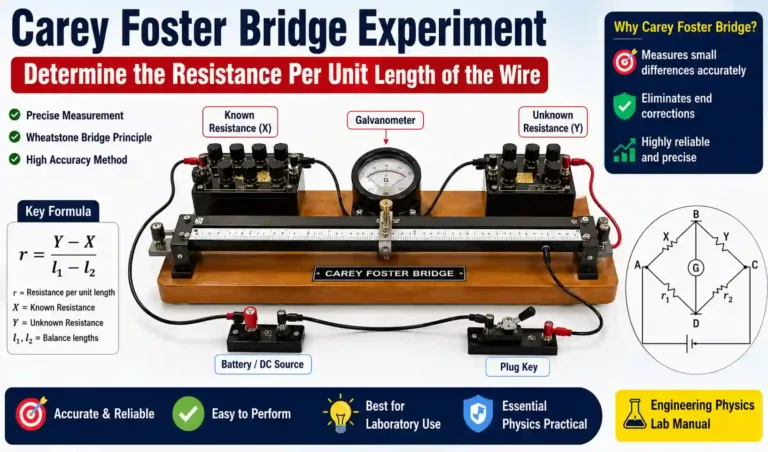
Electrical resistance measurements play a vital role in engineering laboratories because almost every electrical instrument depends on accurate resistance values. The Carey Foster Bridge Experiment is one of the most precise laboratory methods for measuring very small differences between resistances and determining the resistance per unit length of the Carey Foster bridge wire.
Unlike an ordinary Wheatstone bridge, the Carey Foster Bridge provides greater accuracy when two resistances differ only by a small amount. This makes it extremely useful in calibration laboratories, electrical industries, research laboratories, and quality control applications.
🎯 Aim of the Experiment:
To determine the resistance per unit length of the bridge wire using the Carey Foster Bridge Experiment.
💡Importance of Carey Foster Bridge Experiment:
In Engineering Physics, this experiment helps students understand bridge circuits, null-deflection methods, precision measurements, and the importance of minimizing experimental errors.
The principles learned here are also applied in sensor calibration, resistance standards, electrical instrumentation, and measurement systems.
If you have already studied the Wheatstone Bridge, Meter Bridge Experiment, or Electrical Resistance Measurement Techniques, you will notice that the Carey Foster Bridge offers significantly higher accuracy for measuring small resistance differences.
📋 Experiment Summary (Quick Revision Table):
Whether you’re preparing for a practical exam, viva voce, or semester test, this one-page summary gives you all the essential information at a glance.
Review the key formulas, principles, and results quickly to boost your confidence before entering the laboratory.
| S. No. | Tpoic | Quick Revision |
|---|---|---|
1. |
Experiment Name |
Determine the Resistance per Unit Length of the Wire using Carey Foster Bridge |
2. |
Aim |
To determine the resistance per unit length of the Carey Foster bridge wire and measure the resistance of an unknown wire. |
3. |
Principle |
Based on the Wheatstone Bridge principle. At the balance point, no current flows through the galvanometer (null-deflection method). |
4. |
Apparatus |
Carey Foster Bridge, Galvanometer, Resistance Boxes, Battery/DC Supply, Jockey, Connecting Wires. |
5. |
Known Resistance |
X |
6. |
Unknown Resistance |
Y |
7. |
Balance Lengths |
L
1
: Before interchanging resistances
L
2
: After interchanging resistances |
8. |
Formula for Resistance per Unit Length |
ρ = X/(L2 – L1)
(Ω/cm) (when Y=0) |
9. |
Formula for Unknown Resistance |
Y=X−(L2−L1)ρ |
10. |
Null Point |
Position where the galvanometer shows zero or minimum deflection. |
11. |
Why Interchange Resistances? |
To eliminate end correction and improve measurement accuracy. |
12. |
Observation |
Record L1 and L2 for different values of X. |
13. |
Calculation |
Calculate the resistance per unit length of the bridge wire and determine the unknown resistance. |
14. |
Applications |
Precision resistance measurement, calibration of standard resistors, electrical laboratories, and research work. |
15. |
Precautions |
Tight connections, clean bridge wire, gentle use of jockey, accurate null point, avoid heating of the wire. |
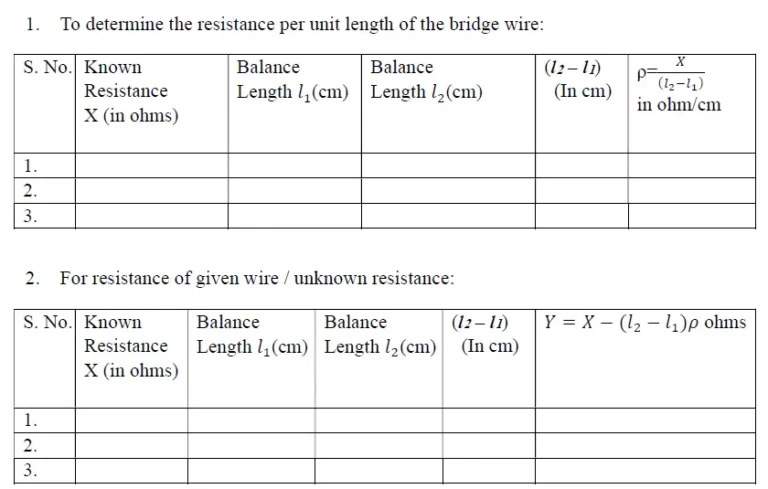
📋 Observation Table:
📂 Complete Lab Manual PDF
Teachers and students: You can view or download our complete, print-ready laboratory sheet below for quick use at your workbench.
📂 Modified Lab Manual PDF
🎯 Exam-Oriented Questions and Answers:
🎯 Exam-Oriented Questions and Answers:
## What is the Carey Foster Bridge experiment?
The Carey Foster Bridge experiment is a precision electrical experiment used to determine the resistance per unit length of a bridge wire and measure very small differences between nearly equal resistances using the null-deflection principle.
## Why is Carey Foster Bridge more accurate than the meter bridge?
The Carey Foster Bridge provides higher accuracy because it eliminates end corrections by interchanging resistances. It is specially designed to compare nearly equal resistances with minimal experimental error.
## What is the principle of Carey Foster Bridge?
The Carey Foster Bridge works on the Wheatstone Bridge principle. At balance, no current flows through the galvanometer, and the difference in resistance is proportional to the difference in balancing lengths.
## Why are resistances interchanged in the experiment?
Interchanging the resistances removes systematic errors caused by contact resistance and end corrections, leading to more precise measurements.
## What is resistance per unit length?
Resistance per unit length is the resistance offered by one unit length of the bridge wire. It is usually expressed in ohms per centimeter (Ω/cm).
## What is the material composition of the Carey Foster bridge wire, and why?
The wire is typically made from alloys like Manganin or Constantan. These materials have a near-zero temperature coefficient of resistance, ensuring the wire’s baseline resistance remains constant as room temperature fluctuates during the lab session.
## Why is this bridge more sensitive than a meter bridge for small resistances?
Because it removes the effect of unknown end resistances through the interchange technique, so even a tiny genuine resistance difference shows up clearly in the balance length shift.
## Why is this bridge more sensitive than a meter bridge for small resistances?
Because it removes the effect of unknown end resistances through the interchange technique, so even a tiny genuine resistance difference shows up clearly in the balance length shift.
🎤 Viva Questions and Answers:
Q1. What is a Carey Foster bridge?
Answer: It is a modified Wheatstone bridge used for measuring small resistance differences accurately.
Q2. Which principle does it use?
Answer: It works on the Wheatstone Bridge balance principle.
Q3. Why is a galvanometer used?
Answer: To detect the null point.
Q4. Why is the jockey pressed gently?
Answer: To avoid damaging the bridge wire.
Q5. Why are resistances interchanged?
Answer: To eliminate end-correction errors.
Q6. What is the SI unit of resistance?
Answer: Ohm (Ω).
Q7. Why should the bridge wire be uniform?
Answer: A uniform wire ensures uniform resistance per unit length.
Q8. Which instrument detects balance?
Answer: Galvanometer.
Q9. What happens at the null point?
Answer: No current flows through the galvanometer.
Q10. What is the main application of Carey Foster Bridge?
Answer: Precision resistance measurement and calibration.
Q11. What happens if the bridge wire is not uniform?
Answer: The resistance per unit length won’t be constant along the wire, introducing an error in every balance length measurement and making the final result unreliable.
Q12. Why should the balance point be near the middle of the wire?
Answer: The bridge is most sensitive to small changes in resistance when the balance point is near the center, giving sharper, more accurate null deflection readings.
Q13. What is the role of the galvanometer in this setup?
Answer: It detects the current flowing between the bridge wire and the junction of P and Q; zero deflection indicates the bridge is balanced.
Q14. Can Carey Foster’s bridge measure a resistance of 100 Ω accurately?
Answer: Not ideally — it’s specifically designed and most accurate for very small resistances (a fraction of an ohm to a few ohms); a post office box or meter bridge suits larger resistances better.
Q15. What is meant by resistance per unit length?
Answer: It is the resistance offered by one unit length of the bridge wire.
Q16. Why is the null method more accurate?
Answer: Because no current flows through the galvanometer at balance, reducing measurement errors.
Q17. Which material is generally used for the bridge wire?
Answer: Constantan or manganin.
Q18. What happens if the bridge wire is not uniform?
Answer: The calculated resistance per unit length becomes inaccurate.
Q19. Is Carey Foster’s Bridge suitable for large resistance measurements?
Answer: No. It is mainly used for comparing nearly equal low resistances.
Q20. Why is the bridge wire one meter long?
Answer: A one-meter wire provides convenient and accurate measurement of balancing lengths.
Q21. Can temperature affect the experiment?
Answer: Yes. Resistance changes with temperature, so readings should be taken at nearly constant temperatures.
Q22. Why is the bridge called a null instrument?
Answer: Because measurements are made at the condition where the galvanometer shows zero deflection.
Q23. What is the main advantage of this experiment?
Answer: It enables very precise measurement of small resistance differences.
❓FAQs (Frequently Asked Questions):
## What is the aim of the Carey Foster Bridge experiment?
The aim is to determine the resistance per unit length of the bridge wire.
## What is the formula used in the Carey Foster Bridge experiment?
ρ = (X - Y) / (l₂ − l₁), where ΔR is the known resistance difference and l₁, l₂ are the balancing lengths before and after interchange.
## Why is Carey Foster Bridge important?
It provides highly accurate measurements of small resistance differences and is widely used in calibration and laboratory measurements.
## What precautions should be taken during the experiment?
Ensure tight connections, press the jockey gently, keep the bridge wire clean, avoid heating, and locate the null point carefully.
## Where is the Carey Foster Bridge used?
It is used in engineering laboratories, electrical measurement laboratories, calibration centers, and research institutions.
## Why do we interchange the resistances X and Y in this experiment?
Interchanging cancels out the unknown end resistances introduced by connecting wires and copper strips, leaving a result that depends only on the true resistance difference.
## Why should the balance point lie near the middle of the bridge wire?
It keeps the sensitivity of the bridge at its maximum and minimizes the percentage error in reading the length.
## How is Carey Foster's bridge different from a meter bridge?
A meter bridge ignores end corrections and suits moderate resistances, while Carey Foster's bridge is designed to eliminate end corrections, making it far more precise for small resistances.
🔗 Related Experiments:
To expand your mastery over precision measurement techniques, consider reading these experiments:
- Wheatstone Bridge Experiment
- Meter Bridge Experiment
- Specific Resistance of Wire
- Verification of Ohm’s Law
- Kelvin Double Bridge Experiment
- Potentiometer Experiment
- Measurement of Low Resistance
- Electrical Conductivity Experiment
- Resistivity of a Wire
- Kirchhoff’s Laws Experiment