
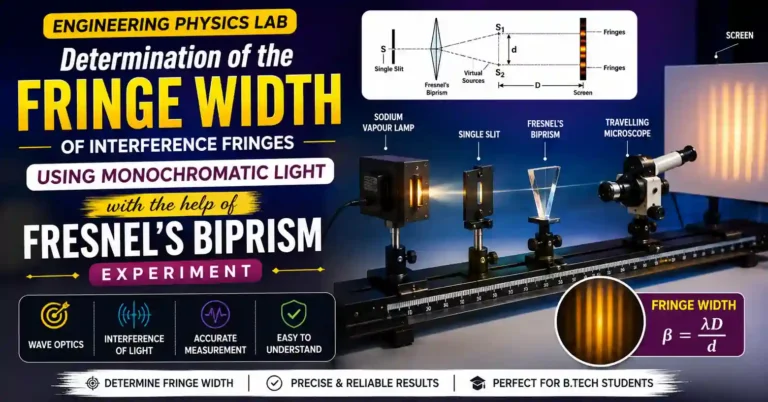
Welcome to your go-to guide for one of the most elegant setups in wave optics. Fresnel’s Biprism experiment is a cornerstone of classical physics, designed to showcase how a single wavefront can be split to create stunning interference patterns.
Contents
Toggle📖 Introduction:
Interference is one of the best examples of the wave nature of light, and Fresnel’s Biprism Experiment is a simple yet powerful way to observe it. In this experiment, a single narrow slit and a Fresnel’s biprism produce two coherent virtual light sources that form clear interference fringes.
By measuring the distance between these fringes, known as the fringe width, students gain a practical understanding of the phenomenon of interference.
If you have already studied experiments like Young’s Double Slit, Newton’s Rings, or Diffraction Grating, this practical will further strengthen your understanding of interference and its real-world applications.
But if you are new to the lab or need a refresher on how waves behave when they collide, you might want to read our comprehensive breakdown of the superposition principle of light waves before setting up your optical bench.
By the end of this practical, you’ll be able to set up the biprism, obtain a crisp fringe pattern, measure fringe width using a travelling microscope, and connect the observed pattern back to the wavelength formula—a skill tested heavily in B.Sc., B.Tech., and GATE-level wave optics questions.
Aim of the Experiment:
To determine the fringe width of interference fringes produced by monochromatic light using a Fresnel Biprism.
Importance in Engineering Physics:
This experiment is an essential part of the Engineering Physics laboratory for B.Tech first-year students. It helps develop practical skills such as optical alignment, precise measurement, observation, and data analysis, while reinforcing key concepts of wave optics.
Practical Applications:
The Fresnel Biprism experiment forms the basis of several advanced optical techniques:
- Optical interferometers
- Laser alignment systems
- Optical testing laboratories
- Precision length measurements
- Holography
- Fiber optic communication
- Optical sensor development
- Semiconductor inspection
- Surface flatness measurement
- Scientific instrumentation
📌 Experiment Summary:
Before diving into the detailed lab manual, here’s a quick summary of this experiment.
| Particular | details |
|---|---|
Experiment Type |
Wave Optics |
Objective |
Determine Fringe Width Using Fresnel’s Biprism |
Principle |
Interference of Light |
Light Source |
Monochromatic Sodium Lamp |
Optical Device |
Fresnel’s Biprism |
Measured Quantity |
Fringe Width (β) |
Formula |
β = λD / d |
Applications |
Optical Measurements, Interferometry |
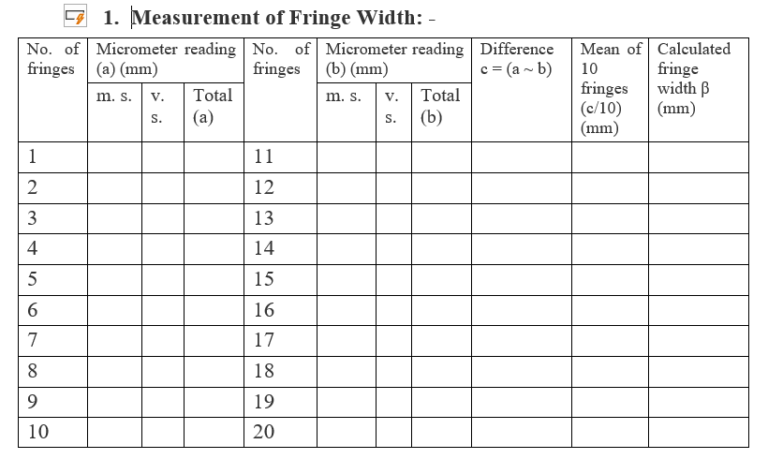
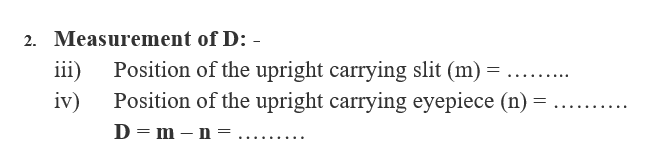
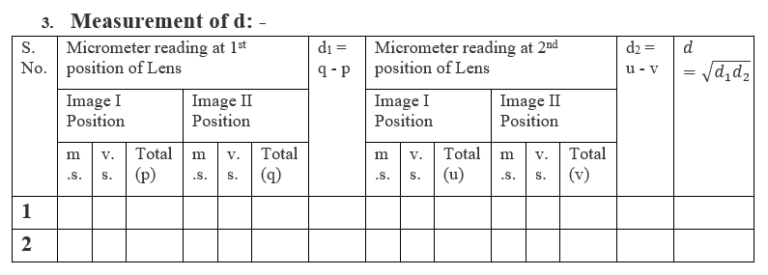
Observation Table:
💡Important Optical Adjustments for High Accuracy:
- Slit Alignment: The slit must be perfectly parallel to the refracting edge of the biprism. If your fringes look blurry, gently rotate the slit tube until the pattern snaps into focus.
Eliminating Parallax: Move your eye slightly from side to side while looking through the eyepiece. The crosswires should move exactly with the fringes. If they shift independently, adjust the eyepiece focus.
Monochromatic Purity: Ensure your sodium lamp has warmed up fully to a bright yellow hue. A cold lamp emits a reddish spectrum that broadens your fringes and ruins your calculations.
📄 Download Lab Manual PDF:
Below is the official engineering physics laboratory manual for this experiment. You can view, scroll, and download the document directly to keep next to your apparatus during your lab session.
📄 Download Modified Lab Manual PDF:
🎬 Video Explanation:
🎯 Exam-Oriented Questions and Answers:
What is the aim of Fresnel's biprism experiment?
The aim is to determine the fringe width produced by the interference of monochromatic light using Fresnel’s biprism.
What is the principle of the Fresnel biprism experiment?
A biprism refracts light from a single slit into two virtual, coherent sources. These sources overlap and produce interference fringes, since both originate from the same original wavefront and maintain a constant phase relationship.
Why is Fresnel's biprism preferred over two separate slits?
It produces two coherent virtual sources from a single slit, ensuring stable interference without requiring two perfectly identical slits.
What is fringe width?
Fringe width is the distance between the centers of two consecutive bright fringes or two consecutive dark fringes in an interference pattern.
Why are virtual sources formed in Fresnel's biprism?
The two inclined refracting surfaces of the biprism refract light differently, creating two virtual images of the original slit that act as coherent sources.
Which formula is used to calculate fringe width?
The fringe width is calculated using
β = λD / d
where β = fringe width, λ = wavelength, D = distance between virtual sources and screen, and d = separation between virtual sources.
Why is sodium vapour lamp commonly used?
It emits nearly monochromatic yellow light of known wavelength, producing clear and sharp interference fringes suitable for accurate measurements.
How do you measure the distance between the virtual sources?
Because the virtual sources cannot be measured directly, use a convex lens placed between the biprism and the eyepiece. By applying the displacement method, measure the source separation at two different lens positions (d1 and d2) and calculate the true distance using the formula $$d = \sqrt{d_1d_2}$$
What happens to the fringe width if you move the eyepiece further away from the biprism?
According to the formula $$\beta = \frac{\lambda D}{d}$$
The fringe width β is directly proportional to the distance D. Therefore, moving the eyepiece further away increases the width of the fringes.
What will you observe if you replace the sodium lamp with a white light source?
The central fringe will be completely white, surrounded by a few colored, overlapping fringes on either side, after which the field becomes uniformly illuminated.
What is the effect of changing the slit width on the interference pattern?
If the slit is made too wide, it acts as a collection of many independent narrow slits. Each produces its own independent pattern, causing the overall interference fringes to overlap and disappear.
What is the role of the convex lens in this experiment?
The convex lens does not help form the interference fringes. Its only purpose is to form real images of the virtual sources S1 and S2 on the eyepiece scale so you can measure the distance d using the displacement method.
How do I calculate fringe width if the fringes are too tight?
To minimize error, do not measure the width of just one fringe. Instead, align the crosswire with the 1st fringe, record the micrometer reading, move it to the 21st fringe, and take the reading again. Divide the total distance traveled by 20 to get an accurate, average fringe width.
🎓 Viva Questions and Answers:
Q1. What is interference?
Answer: Interference is the redistribution of light intensity produced by the superposition of two coherent light waves.
Q2. What is coherence?
Answer: Coherence is the property of two light waves having the same frequency and a constant phase difference.
Q3. Why is only one slit used?
Answer: Because Fresnel’s biprism itself creates two virtual coherent sources.
Q4. What is monochromatic light?
Answer: Light having a single wavelength.
Q5. Which prism angle is used in Fresnel’s Biprism?
Answer: A very small refracting angle, generally less than 1°.
Q6. Why are the sources called virtual?
Answer: Because they are formed by refraction and do not physically exist.
Q7. Which phenomenon proves the wave nature of light?
Answer: Interference.
Q8. What happens if slit width increases?
Answer: The fringes become less distinct due to reduced coherence.
Q9. Which instrument measures fringe positions?
Answer: Traveling microscope.
Q10. What is the SI unit of fringe width?
Answer: Metre (m).
Q11. Can white light be used?
Answer: It can produce colored fringes, but accurate measurements are difficult.
Q12. Why should the microscope be properly focused?
Answer: To eliminate parallax error.
Q13. Which theory explains this experiment?
Answer: Wave Theory of Light.
Q14. Is the fringe width constant?
Answer: Yes, under ideal conditions.
Q15. Name one application of interference.
Answer: Precision optical measurements.
❓ Frequently Asked Questions (FAQs):
What is Fresnel's Biprism experiment?
It is an interference experiment in which a biprism creates two virtual coherent light sources from a single slit to produce interference fringes.
What is the formula for fringe width?
The fringe width is given by
β = λD / d
where λ is wavelength, D is the distance to the observation plane, and d is the separation of the virtual sources.
Why are virtual sources necessary?
Virtual sources provide coherent light without requiring two separate physical slits, making interference stable and easier to observe.
Why is monochromatic light preferred?
Because a single wavelength produces clear and equally spaced interference fringes suitable for precise measurements.
What are the applications of Fresnel's Biprism?
Its principles are used in interferometers, laser systems, optical testing, fiber optics, holography, metrology, optical sensors, and precision scientific instruments.
What type of wave splitting happens in the Fresnel's Biprism experiment?
It utilizes the wavefront splitting mechanism, unlike Newton's Rings or wedge-shaped films, which rely on amplitude splitting.
Can we use a laser source for this experiment?
Yes, a helium-neon or diode laser works exceptionally well because it is highly coherent and monochromatic. Using a laser eliminates the strict need for a very narrow physical slit, making the fringes incredibly bright and easy to project.
What are the main sources of error in this setup?
The most common errors come from inaccurate leveling of the optical bench, imperfect parallelism between the slit and the biprism edge, and backlash error in the micrometer eyepiece screw.
🔗 Related Experiments:
To build a stronger understanding of wave optics, you can also study:
These experiments complement one another and provide a complete understanding of interference, diffraction, and optical measurements in engineering physics.