
Contents
Toggle📖 Introduction:
Optical fiber has transformed the field of modern communication by enabling the transmission of enormous amounts of information at the speed of light with extremely low signal loss. Today, optical fibers are widely used in high-speed internet, medical imaging, industrial sensing, defense communications, satellite communications, and telecommunications networks.
One of the most significant parameters of an optical fiber is its Numerical Aperture (NA), which indicates the light-gathering ability of the fiber. It determines the maximum angle at which light can enter the fiber and still propagate through total internal reflection.
🎯 Aim of the Experiment:
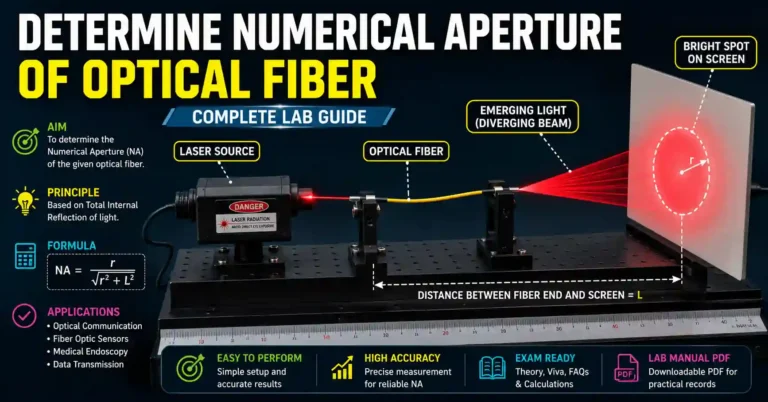
To determine the Numerical Aperture of Optical Fiber by measuring the divergence of the light emerging from the fiber.
🚀 Importance in Engineering Physics:
The experiment provides a practical understanding of light propagation, total internal reflection, acceptance angle, and light-guiding capability, making it one of the most fundamental experiments in Engineering Physics laboratories.
Understanding numerical aperture is not only essential for laboratory examinations but also forms the foundation for advanced topics in fiber optic communication, laser technology, optical sensors, and photonics.
If you have already studied total internal reflection, optical fiber construction, or types of optical fibers, this experiment will help you connect those theoretical concepts with practical observations.
🔮 Applications of the Experiment:
Determining the numerical aperture has numerous practical applications in optical engineering. It is widely used in-
- Fiber optic communication,
- Medical endoscopy,
- Laser systems,
- Optical sensors,
- Industrial inspection,
- Military communication,
- Aerospace technology and biomedical instrumentation.
Engineers use numerical aperture values to select suitable fibers for different communication distances and bandwidth requirements. Researchers also rely on these measurements while designing advanced photonic devices and high-speed data transmission systems.
📚 What is an Optical Fiber?
An optical fiber is a thin, flexible strand made of glass or plastic that transmits light from one point to another. Unlike conventional electrical cables, optical fibers carry information using light pulses instead of electrical signals.
An optical fiber mainly consists of three parts:
- Core – The central region through which light propagates.
- Cladding – A surrounding layer having a lower refractive index than the core.
- Protective Coating – An outer jacket that protects the fiber from mechanical damage and environmental conditions.
The principle behind optical fiber transmission is Total Internal Reflection (TIR).
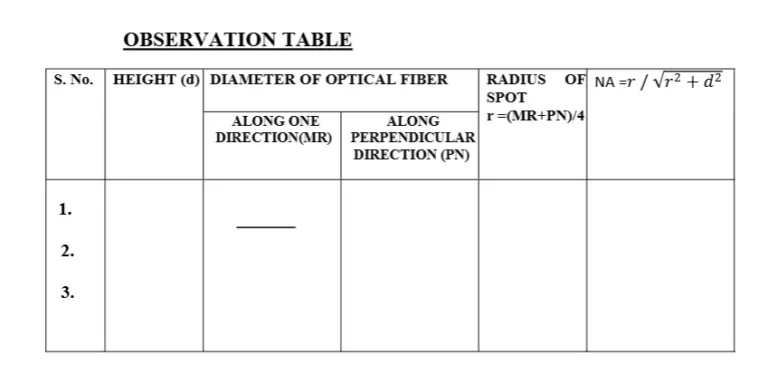
📋 Observation Table:
📝 Experiment Summary:
| Particular | Description |
|---|---|
Aim |
To determine the numerical aperture (NA) of the given optical fiber. |
Principle |
The experiment is based on the divergence of light emerging from the optical fiber due to total internal reflection. |
Apparatus Required |
Semiconductor Laser/LED Source, Optical Fiber Kit, White Screen, Measuring Scale, Power Supply |
Theory Used |
Total Internal Reflection, Acceptance Angle, Numerical Aperture |
Formula Used | NA = sin θa = r/√r2 + L2 |
Measured Quantities |
Radius of light spot (r) and distance between fiber end and screen (L) |
Result Obtained |
The numerical aperture of the given optical fiber is calculated experimentally. |
Applications |
Optical Communication, Fiber Sensors, Medical Endoscopy, Laser Systems, Networking |
📄 Download the Complete Lab Manual PDF:
If you prefer studying offline or wish to print the complete experiment for your practical record, you can access the complete Numerical Aperture of Optical Fiber Lab Manual PDF below.
📄 Modified Lab Manual PDF:
🎬 Video Explanation:
✨ Important Exam Points:
⭐ Numerical Aperture indicates the light-gathering capability of an optical fiber.
⭐ Acceptance Angle increases with Numerical Aperture.
⭐ Numerical Aperture depends on the refractive indices of the core and cladding.
⭐ Larger Numerical Aperture makes light coupling easier.
⭐ Optical fibers transmit light based on Total Internal Reflection.
⭐ Numerical Aperture is a dimensionless quantity.
⭐ It determines the efficiency of light entering the fiber.
⭐ Numerical Aperture plays a vital role in communication, sensing, and medical imaging.
💡Exam-Oriented Questions and Answers:
What is the Numerical Aperture (NA) of an optical fiber?
Numerical Aperture (NA) is the light-gathering ability of an optical fiber. It represents the maximum angle at which light can enter the fiber and still propagate through the core by total internal reflection. A higher NA allows more light to be coupled into the fiber.
What is the aim of the Numerical Aperture experiment?
The aim of this experiment is to determine the Numerical Aperture (NA) of the given optical fiber by measuring the radius of the emerging light spot and the distance between the fiber end and the screen.
What is the principle of this experiment?
The experiment is based on the principle of Total Internal Reflection (TIR). Light entering the fiber within the acceptance angle undergoes repeated total internal reflections inside the core and emerges as a diverging beam, which is used to calculate the Numerical Aperture.
What is the formula for Numerical Aperture?
The experimental formula is: $$NA = \frac{r}{\sqrt{r^2+L^2}}$$
where:
- r = Radius of the light spot
- L = Distance between the fiber end and the screen
What is the acceptance angle?
The acceptance angle is the maximum angle with respect to the fiber axis at which light can enter the optical fiber and still be guided through the core by total internal reflection.
How are Numerical Aperture and Acceptance Angle related?
Numerical Aperture and acceptance angle are related by $$NA = sin\,\theta_a$$
where θₐ is the acceptance. angle.
Why is Numerical Aperture important?
Numerical Aperture determines the amount of light that can enter an optical fiber. It directly affects coupling efficiency, signal transmission, alignment tolerance, and overall communication performance.
Why does light spread after leaving the optical fiber?
Light spreads because the guided rays diverge after emerging from the fiber end. The divergence depends on the Numerical Aperture of the optical fiber.
What happens if the Numerical Aperture increases?
A larger Numerical Aperture allows the fiber to accept light over a wider range of angles, making light coupling easier and improving illumination efficiency.
What is a Step-Index Optical Fiber?
It is a type of fiber in which the refractive index changes abruptly at the core-cladding interface, remaining uniform throughout the core.
Does the length of the optical fiber affect its numerical aperture?
No. Numerical aperture is an intrinsic structural and material property determined entirely by the refractive indices of the core and cladding, not by the length of the cable.
What is the role of cladding in an optical fiber?
Cladding serves two purposes: (1) It provides the lower refractive index boundary necessary for total internal reflection — without it, TIR cannot occur. (2) It protects the core surface from contamination and mechanical damage, which would cause scattering losses and reduce signal quality.
What is the V-number (normalized frequency) of a fiber, and how is it related to NA?
The V-number is: V = (2πa/λ) × NA, where a is the core radius and λ is the wavelength of light. It determines how many modes a fiber supports. For V < 2.405, the fiber supports only one mode (single-mode). For V > 2.405, it is multimode. So NA directly controls V and, hence, the number of guided modes.
🔍 Viva Questions and Answers:
Q1. What is an optical fiber?
Answer: An optical fiber is a thin, flexible, transparent dielectric waveguide made of glass or plastic that transmits light using total internal reflection.
Q2. What is numerical aperture?
Answer: It is the light acceptance capability of an optical fiber.
Q3. What is the SI unit of numerical aperture?
Answer: Numerical aperture is a dimensionless quantity, so it has no SI unit.
Q4. What is the principle of optical fiber?
Answer:
Total Internal Reflection.
Q5. Which part of the optical fiber carries light?
Answer: The core carries light.
Q6. Why is cladding used?
Answer: Cladding has a lower refractive index than the core, ensuring total internal reflection and reducing light loss.
Q7. What is the acceptance angle?
Answer: It is the maximum angle at which light can enter the fiber and still be guided through the core.
Q8. Which instrument is used as the light source?
Answer:
A semiconductor laser or LED.
Q9. Which quantity is measured on the screen?
Answer: The diameter (or radius) of the emerging light spot.
Q10. Why is the screen kept perpendicular to the fiber?
Answer: To obtain a true circular light spot and reduce measurement errors.
Q11. What is the relation between NA and refractive indices?
Answer: $$NA =\sqrt{n_1^2-n_2^2}$$
Q12. Why should the optical fiber be clean?
Answer: Dust and scratches increase scattering losses and affect the accuracy of measurements.
Q13. What is meant by “total internal reflection”?
Answer: It is the complete reflection of light at the interface when it travels from a denser to a rarer medium at an angle greater than the critical angle.
Q14. Why should the laser beam be properly aligned?
Answer: Proper alignment ensures maximum light enters the fiber core and produces a clear output spot.
Q15. Which parameter indicates the light-gathering ability of a fiber?
Answer: Numerical Aperture.
Q16. Which type of wave propagates through an optical fiber?
Answer: Electromagnetic (light) waves.
Q17. Can numerical aperture be greater than 1?
Answer: For fibers operating in air, the numerical aperture is generally less than or equal to 1.
Q18. What are the applications of optical fibers?
Answer: Optical communication, internet networks, medical endoscopy, industrial inspection, fiber optic sensors, and defense communication.
Q19. What causes light loss in an optical fiber?
Answer: Absorption, scattering, bending losses, and imperfect coupling.
Q20. Why are multiple observations taken?
Answer: To reduce random errors and improve the accuracy of the calculated numerical aperture.
❓ FAQs:
1. What is Numerical Aperture in simple words?
Numerical aperture is the ability of an optical fiber to collect and guide light. A larger numerical aperture means the fiber can accept light from a wider range of angles.
2. Why is Numerical Aperture measured in the laboratory?
It is measured to evaluate the light acceptance capability of an optical fiber and to understand its performance in optical communication systems.
3. Which principle is used in the Numerical Aperture experiment?
The experiment is based on the principle of Total Internal Reflection (TIR), which allows light to propagate through the fiber core with minimal loss.
4. What factors affect the Numerical Aperture of an optical fiber?
The numerical aperture depends mainly on the refractive indices of the core and cladding. It can also be affected by improper alignment, fiber damage, and measurement errors during the experiment.
5. Why is Numerical Aperture important in optical communication?
A suitable Numerical Aperture improves light coupling efficiency, reduces alignment difficulties, and ensures reliable signal transmission in optical communication systems.
6. What is a typical NA value for a single-mode fiber?
A typical single-mode communication fiber generally has a very small numerical aperture, often ranging between 0.1 and 0.15, optimized to minimize signal distortion.
7. What is the typical Numerical Aperture of multimode f
It generally lies between 0.20 and 0.30, depending on the fiber design.
📑 Related Experiments:
If you are preparing for your end-of-semester physics practical exam, make sure to read through our detailed breakdown guides for these essential curriculum experiments:
- Determine the Wavelength of a Laser Using a Diffraction Grating
- Determine the grating element of the diffraction grating using a Laser Beam
- Determine the Acceptance Angle of an Optical Fiber
- Study Total Internal Reflection in an Optical Fiber
- Determine the Energy Band Gap of a Semiconductor
- Determine the Radius of Curvature of a Plano-Convex Lens by Newton’s Rings
- Determine the Surface Tension of Water by the Capillary Rise Method
- Fresnel’s Biprism Experiment
You are so interesting! I do not believe I’ve read something like this before.
So nice to find someone with a few unique thoughts on this issue.
Really.. thank you for starting this up. This site is one thing that is
required on the web, someone with a bit of originality!