
 For High-Quality, More Free Study Notes
Visit: http://smartstudyzone.in
Contents
Toggle🚀 Introduction to Types of Dielectric Polarization
The types of dielectric polarization form one of the most important concepts in electromagnetism and material science. Whenever a dielectric material is placed inside an external electric field, charges within the material undergo a slight displacement. This displacement creates electric dipoles, resulting in a phenomenon known as dielectric polarization.
Dielectric materials are widely used in capacitors, communication systems, optical devices, power transmission equipment, and modern electronics. Understanding the various types of dielectric polarization helps engineers and scientists select suitable materials for specific electrical and electronic applications.
Polarization determines how effectively a dielectric material stores electrical energy. Therefore, it directly influences dielectric constant, capacitance, insulation performance, and energy efficiency.
By the end of this article, you will learn:
- What dielectric polarization really means at the atomic level
- All four types: electronic, ionic, orientational, and space charge polarization
- Full mathematical derivations of polarizability for each type
- How to compare them using frequency and temperature dependence
- Solved problems, exam questions, and pro tips to score high
Let’s dive in—atom by atom.
📜What is a Dielectric Material?
A dielectric is an insulating material that does not allow free movement of electric charges under normal conditions. However, when subjected to an electric field, its internal charges shift slightly.
Examples include:
- Glass
- Mica
- Plastic
- Ceramics
- Rubber
- Air
- Paper
These materials possess high electrical resistance and are capable of storing electrical energy.
Importance of Dielectrics
Dielectrics are essential because they:
- Increase capacitance
- Store electrical energy
- Reduce energy losses
- Provide insulation
- Improve device reliability
🔍 What is Polarization in Dielectrics?
At its core, dielectric polarization (P) is defined macroscopically as the net electric dipole moment induced per unit volume of a dielectric material. i.e.
$$P = \frac{Total\;Dipole\;Moment}{Volume}$$
Where P is polarization, and its unit is C/m².
The greater the polarization, the greater the ability of the dielectric to store electrical energy.
When polarization occurs:
- Positive charges shift slightly in one direction.
- Negative charges shift slightly in the opposite direction.
- A dipole moment develops.
- Internal electric fields are generated.
The degree of polarization depends on:
- Electric field strength
- Temperature
- Material structure
- Frequency of the applied field
Let us assume a dielectric sample contains N atoms or molecules per unit volume. If an external electric field E induces an average dipole moment (μ) in each atom, the total macroscopic polarization vector is expressed as:
On an atomic scale, this induced dipole moment is directly proportional to the electric field (E) acting right upon that specific atom:
Here, the constant of proportionality, α, is defined as the polarizability of the atom or molecule.
Why Polarization Occurs?
Polarization occurs because charges inside atoms and molecules experience forces from the external electric field.
The electric field causes the following:
- Electron cloud displacement
- Ion displacement
- Molecular dipole alignment
- Charge accumulation at boundaries
These mechanisms lead to different types of dielectric polarization.
🔬 Types of Dielectric Polarization:
Dielectric polarization is generally classified into four major types.
- Electronic Polarization
- Ionic Polarization
- Orientation Polarization
- Space Charge Polarization
1. Electronic Polarization:
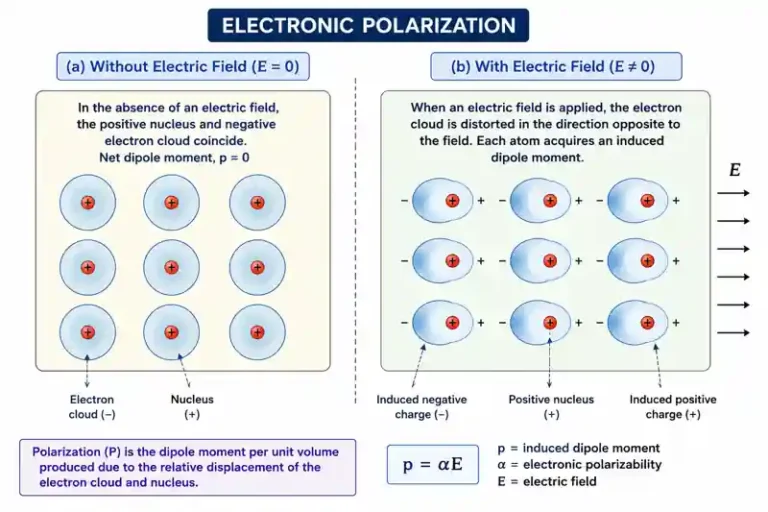
Electronic polarization is the fastest and most fundamental of all polarization mechanisms. It occurs in all dielectric materials, whether polar or nonpolar.
When an external electric field is applied, the negatively charged electron cloud of each atom is slightly displaced from the positively charged nucleus. Since the nucleus is thousands of times heavier than the electron cloud, it barely moves. The result is a tiny but measurable dipole moment, created purely by the distortion of the electron cloud. This type of polarization is called electronic polarization.
Important Features:
- Present in all dielectrics
- Independent of temperature
- Very fast process
- Exists up to optical frequencies
The mechanism of electronic polarization is illustrated in the following figure.
Expression for Electronic Polarization:
To derive the electronic polarization, let us consider an atom as a positively charged nucleus +Ze surrounded by a uniformly dense, spherical electron cloud of radius R containing a total negative charge -Ze.
The volume density of the negative charge cloud ρ is given by:
When we apply an external electric field E, the nucleus and the center of the electron cloud are displaced by a small equilibrium distance x. At equilibrium, the restoring force due to the Coulomb attraction between the electron cloud and the nucleus balances the force from the external field.
The separating force exerted by the external field on the nucleus is:
The restoring force, Fr, holding them together, is governed by Coulomb’s Law. It depends solely on the fraction of the negative charge contained within a sphere of radius x. Let us compute this internal negative charge, qin:
Using Coulomb’s Law, the attractive restoring force between the nucleus +Ze and the inner charge shell qin at distance x is:
At a steady equilibrium state, these two opposing forces must equal each other exactly (Fe = Fr):
$$\Rightarrow E = \frac{Ze x}{4\pi \varepsilon_0 R^3}$$
Therefore, the displaced distance is $$ x = \frac{4\pi \varepsilon_0 R^3 E}{Ze} $$
Now, the induced electronic dipole moment μe is defined as the product of the nuclear charge and the separation distance:
Substituting our derived expression for x into this equation:
Where $$\color{Red}{\Large \alpha_e = 4\pi \varepsilon_0 R^3}$$
It is called electronic polarizability.
This shows that electronic polarizability is directly proportional to the volume of the atom (∝ R3) and remains independent of temperature.
If N is the number of atoms per unit volume, then dielectric polarization is given by
$$\color{Red}{\Large P_e=N\alpha_e E}$$
The contribution of electronic polarization to the dielectric constant can be determined as follows:
$$\varepsilon_r=1+\chi_e=1+\frac{P_e}{\varepsilon_o E}$$
$$\Rightarrow \varepsilon_r=1+\frac{N \alpha_e E}{\varepsilon_o E}$$
$$\Rightarrow \color{Red}{\Large \varepsilon_r=1+\frac{N \alpha_e }{\varepsilon_o }}$$
2. Ionic Polarization:
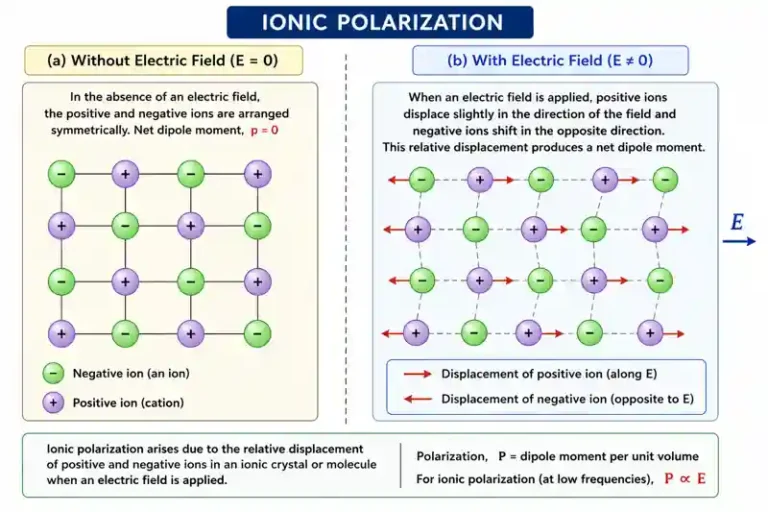
Ionic polarization occurs exclusively in ionic crystalline solids, such as sodium chloride (NaCl) or potassium chloride (KCl). When an external electric field is applied, positive ions (Na⁺) are pushed in the direction of the field, and negative ions (Cl⁻) are pulled in the opposite direction until ionic bonding forces stop the process, thereby changing their net bond length.
This stretching of the ionic bond creates an electric dipole. Since actual atoms are being displaced (not just electron clouds), this process is slower than electronic polarization.
Important Features:
- Found only in ionic solids
- Larger than electronic polarization
- Slower than electronic polarization
- Frequency-dependent
- Important in ceramics
The mechanism of ionic polarization is illustrated in the following figure.
Expression for Ionic Polarization:
Let us consider a diatomic ion (NaCl) with masses M (positive ion) and m (negative ion). Each ion is bound to its equilibrium position as if by a spring. Let the Na⁺ ion shift by x1 and the Cl⁻ ion shift by x2 in opposite directions when exposed to an electric field E.
The net displacement of the ions x = x1 + x2
The force acting on the Na⁺ ion due to the applied electric field = +eE
The force acting on the Cl⁻ ion due to the applied electric field = -eE
When the ions are displaced from their mean positions, a restoring force arises from the chemical bonds, which tends to bring the ions back to their mean position. According to Hooke’s Law,
The restoring force acting on the Na⁺ ion = – k1x1
The restoring force acting on the Cl⁻ ion = + k2x2
where k1 and k2 are the force constants. The force constant is related to the natural angular frequency of the lattice vibration ωo and the reduced mass of the ion. They are given by $$k_1=M\omega_o^2 \qquad and \qquad k_2=m\omega_o^2$$
The total relative separation between the positive and negative ion centers is the sum of both displacements:
The induced ionic dipole moment μi is given by the following:
$$\Rightarrow \mu_i = \alpha_i E$$ where αi is the ionic polarizability. hence
It is clear from the above expression for ionic polarizability that
- Ionic polarizability is inversely proportional to the square of the natural angular frequency (ωo) of the molecule.
- It is directly proportional to its reduced mass, $$\left(\frac{1}{M} + \frac{1}{m}\right)$$
- It does not depend on temperature.
3. Orientation Polarization:
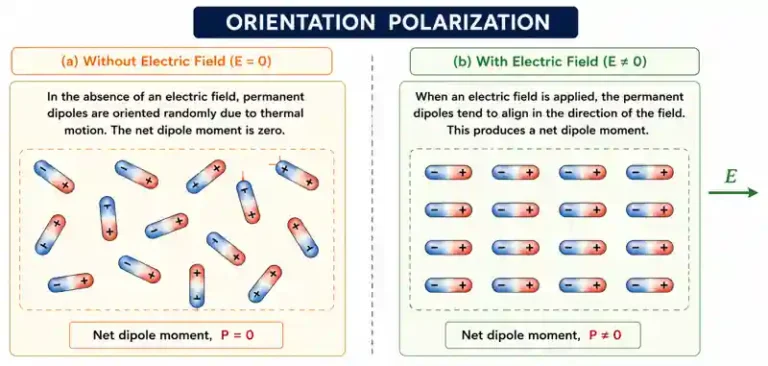
Orientation polarization occurs in dielectric materials that contain molecules with permanent electric dipole moments. Common examples of such polar molecules are water (H₂O), ammonia (NH₃), and hydrogen chloride (HCl). In the absence of an external electric field, the dipoles are randomly oriented in different directions due to thermal motion, resulting in a net dipole moment of zero.
When an external electric field is applied, the permanent dipoles experience a torque that tends to align them along the direction of the field. As a result, many of the dipoles rotate and orient themselves in the field direction.
Although complete alignment is prevented by thermal agitation, a significant number of dipoles become partially aligned, producing a net dipole moment within the material. This phenomenon is known as orientation polarization or dipolar polarization.
In orientation polarization, no restoring force exists. However, thermal agitation opposes the alignment of dipoles. Since this process involves the rotation of molecules, it is slower than electronic and ionic polarization, with a response time of about 10-10 s or more.
Important Features:
- Occurs only in polar molecules
- Responds up to microwave frequencies (~10⁹ Hz); much slower than ionic/electronic
- Strongly temperature dependent—polarizability decreases as temperature rises.
- Responsible for the heating effect in microwave ovens
- Important in liquid dielectrics
Expression for Orientation Polarization—Langevin-Debye Theory:
Consider a polar dielectric gas whose molecules possess permanent dipole moments. When an electric field is applied, these dipoles tend to align with the direction of the field. However, due to the continuous random motion caused by temperature (thermal agitation), complete alignment is not possible. As a result, only partial alignment of the dipoles is achieved at thermal equilibrium.
At equilibrium, the dipoles are oriented in various directions, making different angles θ (ranging from 0 to π radians) with the applied electric field. The potential energy U of a dipole having a dipole moment μ and making an angle θ with the electric field E is given by:
By Boltzmann statistics, the number of dipoles having orientation between θ and dθ within a specific solid angle element dΩ is
$$dN = C e^{(-U/kT)}d\Omega$$
where C is proportionality constant and $$d\Omega = 2\pi \sin\theta d\theta$$
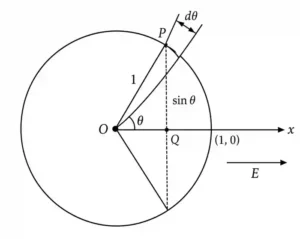
Since a dipole of moment μ inclined at an angle θ to the applied electric field contributes a component μ.cosθ in the direction of the field. This component is responsible for the net polarization.
Hence, the contribution of the dN dipoles to the orientation polarization along the field direction is
$$dP_o = dN\mu\, cos\,\theta$$
By putting the value of dN, the above equation becomes
$$dP_o = 2\pi\mu C \,e^{(\mu E\,cos\theta/kT)}\, cos\,\theta \;sin\,\theta$$
Therefore, the total effective average contribution to polarization along the direction of the field by all dipoles is given by
$$P_{ave}= \frac{Total\; polarization\; due\;to\;all\; dipoles}{Total\;number\; of\;dipoles}$$
$$P_{ave} = \frac{\int_{0}^{\pi}dP_o\;d\theta}{\int_{0}^{\pi}dN\;d\theta}$$
By putting the value of dPo and dN, we get
$$P_{ave} = \frac{\int_{0}^{\pi}2\pi\mu C \,e^{(\mu E\,cos\theta/kT)}\, cos\,\theta \;sin\,\theta\;d\theta}{\int_{0}^{\pi}2\pi C \,e^{(\mu E\,cos\theta/kT)}\;sin\,\theta\;d\theta}$$
$$P_{ave} = \frac{\mu \int_{0}^{\pi}\,e^{(\mu E\,cos\theta/kT)}\, cos\,\theta \;sin\,\theta\;d\theta}{\int_{0}^{\pi}e^{(\mu E\,cos\theta/kT)}\;sin\,\theta\;d\theta}$$
Let us simplify terms by putting μE/kT = β and cos θ = y, and hence,
$$P_{ave} = \frac{\mu \int_{+1}^{-1}y\,e^{\beta y}dy}{\int_{+1}^{-1}e^{\beta y}dy}$$
By solving the above equation, we get
$$\frac{P_{ave}} {\mu} = \frac{e^\beta+e^{-\beta}} {e^\beta-e^{-\beta}}-\frac{1}{\beta}$$
$$\Rightarrow \frac{P_{ave}}{\mu} = coth\,\beta-\frac{1}{\beta}=L(\beta)$$
where L(β) is called the Langevin function. Under standard room temperatures and modest electric fields, L(β) is given by $$L(\beta)=\frac{\beta}{3}$$
Therefore, $$P_{ave}= \frac{\mu \beta}{3}$$
$$\Rightarrow P_{ave}= \frac{\mu^2 E}{3kT}$$
The total orientation polarization of the dielectric is $$P_o = NP_{ave}$$
$$\color{Red}{\Large P_o= \frac {N\mu^2 E}{3kT}} $$
$$\Rightarrow P_o = N\alpha_oE$$
where αo is called the orientation polarizability and is given by
$$\color{Red}{\Large \alpha_o = \frac{\mu^2}{3kT}} $$
Unlike the first two types, orientational polarizability is inversely proportional to the absolute temperature (1/T). High temperatures cause intense thermal molecular collisions that disrupt the aligning power of the electric field.
4. Space Charge Polarization:
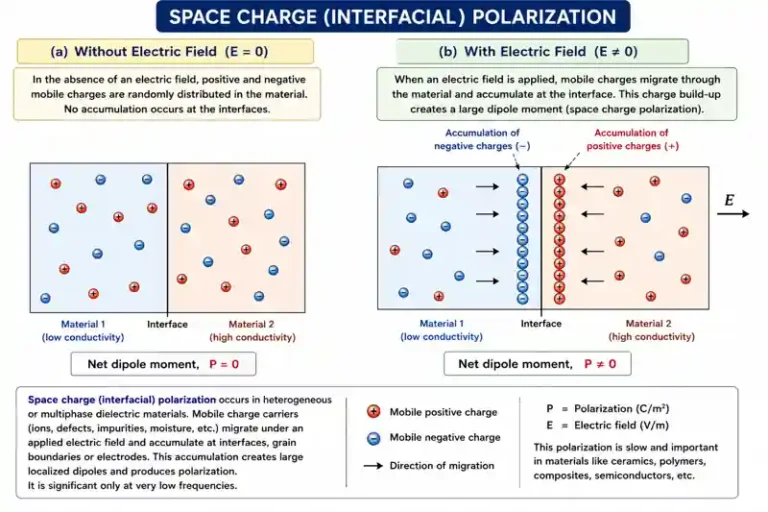
Space charge polarization, also known as interfacial polarization or migrational polarization, occurs in heterogeneous dielectric materials containing free charge carriers such as ions, impurities, defects, or moisture.
When an external electric field is applied, these charge carriers move through the material and gradually accumulate at grain boundaries, phase boundaries, interfaces, or electrodes where their movement is obstructed. This accumulation of charges creates large localized dipoles, resulting in polarization.
Since the charge carriers must travel relatively long distances, this polarization develops very slowly and is significant only at very low frequencies (typically below 10 Hz). It is commonly observed in semiconductors, ferrites, ceramics, composite materials, and multilayer capacitors.
Although it is difficult to calculate mathematically due to its complex nature, it plays an important role in determining the dielectric properties and performance of many practical devices, such as MOS transistors.
Key characteristics:
- Occurs at grain boundaries, interfaces, and defects in heterogeneous materials
- Caused by charge accumulation at interfaces
- Responds only at very low frequencies (Hz to kHz range)
- Strongly frequency dependent — vanishes completely at high frequencies
The Total Polarizability Equation:
For a complex material capable of undergoing all four polarization transformations simultaneously, the total polarization is a simple sum of each polarization. The total polarization is given by
$$P = P_e+P_i+P_o+P_{sc} $$
Since space charge polarization cannot be expressed as a simple closed-form formula, it depends heavily on the geometry and conductivity of the interfaces. It is usually characterized empirically. Thus
$$P = P_e+P_i+P_o$$
$$P = N[\alpha_e+\alpha_i+\alpha_o]E$$
The total polarizability is given by
$$\alpha = \alpha_e+\alpha_i+\alpha_o$$
$$\alpha = 4\pi\varepsilon_o R^3+\frac{e^2}{\omega_o^2}\left( \frac{1}{M} +\frac{1}{m}\right)+\frac{\mu^2}{3kT} $$
⚖️ Comparison of All Types of Polarization
| Property | Electronic Polarization | Ionic Polarization | Orientation Polarization | Interfacial Polarization |
|---|---|---|---|---|
Occurs In |
All dielectrics |
Ionic solids |
Polar molecules |
Heterogeneous materials |
Mechanism |
Electron cloud displacement |
Ion displacement |
Dipole alignment |
Charge accumulation |
Temperature Effect |
No effect |
Weak |
Strong (∝ 1/T) |
Moderate |
Frequency Range |
Very high |
High |
Medium |
Low |
Speed |
Fastest |
Fast |
Slow |
Slowest |
💡 Factors Affecting Dielectric Polarization:
There are several factors that influence polarization:
- Electric Field Strength: Higher fields generally increase polarization.
- Temperature: Temperature mainly affects orientation polarization.
- Frequency: Different polarization mechanisms respond differently to changing frequencies.
- Material Structure: Atomic arrangement significantly influences polarization behavior.
✨ Advantages and Limitations of Each Type of Polarization:
Electronic Polarization:
✅ Advantages: Universal (present in all materials), ultra-fast response (remains active even at optical frequencies), no energy loss (lossless at most frequencies), predictable from atomic radius.
⚠️ Limitations: Very small magnitude — contributes the least to the overall dielectric constant. Cannot be “tuned” in a material without changing its fundamental chemistry.
Ionic Polarization:
✅ Advantages: Significantly larger than electronic polarization. Responsible for high dielectric constants in many useful ceramics (e.g., BaTiO₃, εᵣ up to 1,000). Forms the basis of piezoelectric and ferroelectric behavior.
⚠️ Limitations: Only in ionic materials—limits material choice. Can cause dielectric loss at infrared resonance frequencies. Bond-stretching can lead to structural instability in ferroelectrics.
Orientational Polarization:
✅ Advantages: Contributes the largest polarizability per molecule (since it is large for polar molecules). Enables microwave heating, crucial for cooking, food processing, and medical applications. Highly measurable temperature dependence allows dipole moment determination.
⚠️ Limitations: Strongly temperature-sensitive — polarization degrades with heat. Slow response — useless above microwave frequencies. High dielectric loss at microwave frequencies (energy is absorbed as heat — good for ovens, bad for antennas).
Space Charge Polarization:
✅ Advantages: Produces very large apparent permittivity values at low frequencies. Relevant in biological tissues (enables impedance spectroscopy for medical diagnosis). Used in understanding the aging and degradation of insulation in high-voltage cables.
⚠️ Limitations: Only active at very low frequencies — useless for high-frequency applications. Difficult to model theoretically. Can cause catastrophic dielectric breakdown in high-voltage insulation over time.
🌍 Real-World Applications of Dielectric Polarization
Understanding types of dielectric polarization isn’t just academic—it shapes the technology around us.
1. Capacitors and Energy Storage:
When you put a dielectric material between capacitor plates, polarization aligns bound charges near each plate, effectively increasing the stored charge. The dielectric constant—which reflects the total polarizability—directly multiplies the capacitance: High-ceramics (using ionic polarization) enable compact capacitors in smartphones and power electronics.
2. Microwave Ovens:
The 2.45 GHz frequency of a microwave oven is chosen specifically to match the rotational relaxation frequency of water molecules—targeting orientational polarization. As water dipoles try to follow the rapidly reversing field, they collide with neighbors, converting electromagnetic energy into heat. Your food cooks from within, uniformly and rapidly.
3. Optical Fibers and Photonics:
At optical frequencies, only electronic polarization remains active. The refractive index at optical frequencies is determined entirely by electronic polarizability. Designing optical fibers, lenses, and waveguides requires precise control of electronic polarizability through material composition.
4. Piezoelectric Sensors and Actuators:
Ionic polarization in materials like quartz and PZT is the basis of piezoelectricity. Mechanical stress displaces ionic sublattices, creating polarization—and thus a voltage. This is how quartz watches keep time, ultrasound probes image babies, and atomic force microscopes map surfaces atom by atom.
5. Medical Impedance Spectroscopy:
Space charge polarization in biological tissues (cell membranes act as interfaces) produces frequency-dependent impedance that reveals tissue health. Impedance spectroscopy — sweeping a range of frequencies — can detect cancer cells, monitor hydration, and track wound healing without any radiation or invasive procedure.
🔮Future Trends in Dielectric Research:
Researchers are actively exploring the following field:
- Nanodielectrics
- Smart dielectric materials
- Flexible electronics
- High-energy-density capacitors
- Sustainable insulating materials
Emerging technologies are expected to improve dielectric performance significantly in the coming years
❓ Quick Answer Section
1. What are the types of dielectric polarization?
Dielectric polarization is classified into four main types: Electronic Polarization, Ionic Polarization, Orientation Polarization, and Space Charge Polarization. Each type occurs due to a different charge displacement mechanism when a dielectric material is placed in an external electric field.
2. What is electronic polarization?
Electronic polarization occurs when the electron cloud of an atom shifts slightly relative to its nucleus under an applied electric field. It is present in all dielectric materials and is independent of temperature.
3. What is ionic polarization?
Ionic polarization occurs in ionic crystals when positive and negative ions move in opposite directions under the influence of an electric field, creating an electric dipole moment within the material.
4. What is orientation polarization?
Orientation polarization occurs in polar molecules that possess permanent dipole moments. When an electric field is applied, these dipoles tend to align with the field direction, producing polarization.
5. What is the importance of dielectric polarization?
Dielectric polarization increases the charge storage capability of capacitors, improves insulation properties, influences dielectric constant, and plays an essential role in communication systems and electronic devices.
6. What is space charge polarization?
Space charge polarization occurs when mobile charges (ions or electrons) drift to and accumulate at interfaces between regions of different conductivity or permittivity in a heterogeneous material.
7. Why does orientation polarization decrease with temperature?
As the temperature increases, thermal agitation increases the random motion of molecules. This random motion opposes dipole alignment, reducing orientation polarization.
🎓 Conclusion
Understanding the types of dielectric polarization is essential for studying dielectric materials and their electrical behavior. Electronic polarization, ionic polarization, orientation polarization, space charge polarization, and interfacial polarization each contribute uniquely to the response of a dielectric material under an electric field.
These mechanisms determine dielectric constant, capacitance, insulation quality, and energy storage capability. As technology advances toward faster electronics, renewable energy systems, and smart materials, the study of dielectric polarization will remain increasingly important.
A strong understanding of the types of dielectric polarization provides the foundation for designing efficient electrical and electronic systems that power the modern world.
🎯 Most Expected Questions for Exams:
Conceptual Questions:
- Why does polarization occur in dielectric materials?
- Which polarization mechanism exists in all dielectric materials?
- Why is electronic polarization temperature independent?
- Why are ionic crystals highly polarizable?
- Why is space charge polarization important at low frequencies?
- What happens to orientation polarization at high temperatures?
- How does polarization increase capacitance?
- Why are dielectric materials used as insulators?
Derivation-Based Questions:
- Derive electronic polarizability.
- Derive ionic polarizability.
- Derive the orientation polarizability.
- Derive total dielectric polarizability.
- Derive polarization vector expression.
🔢 Solved Numerical Problems:
1. Calculate Electronic Polarizability
Question: A dielectric material contains a single-element atom with a radius of 0.15 nm. Calculate its atomic electronic polarizability αe and determine the induced dipole moment if the material is exposed to an electric field strength of 5 × 10⁵ V/m. (Take εo = 8.854 × 10⁻¹² F/m)
Solution:
Given: Radius, R = 0.15 nm = 0.15 × 10⁻⁹ m
Electric Field, E = 5 × 10⁵ V/m
Permittivity of Free Space, εo = 8.854 × 10⁻¹² F/m
Find: Electronic polarizability (αe)
Induced dipole moment (μe)
Step 1: Calculation of αe using the electronic polarizability formula:
Step 2: Computation of the induced dipole moment:
Answer: The electronic polarizability is 3.755 × 10-39 F.m2, and the induced dipole moment is 1.878 × 10⁻³³ C.m.
2. Find Total Polarizability
Question: A polar dielectric material with a structural molecular density N = 3 × 1025 molecules/m3 exhibits an electronic polarizability of 2 × 10-39 F.m2. Each molecule possesses an inherent permanent dipole moment of 4 × 10-30 C.m. Calculate the total polarizability of the material at a room temperature of 300 K, neglecting ionic and space charge effects. (Take k = 1.38 × 10⁻²³ J/K).
Solution:
Given:
Molecular Density, N = 3 × 1025 m3
Electronic Polarizability, αe = 2 × 10-39 F.m2
Permanent Dipole Moment, μ = 4 × 10-30 C.m
Temperature, T = 300 K
Boltzmann Constant, k = 1.38 × 10⁻²³ J/K
Find: Total polarizability (α)
Step 1: Calculation of the orientational polarizability (αo):
Step 2: Sum the active polarizability modes:
Answer: The total polarizability of the dielectric material at 300 K is 3.288 × 10-39 F.m2
3. Calculate the electronic polarizability of an atom
Question: An atom has an effective radius of 0.53 Å. Calculate its electronic polarizability.
Solution:
Given:
- Atomic radius, R = 0.53 Å = 0.53 × 10⁻¹⁰ m
- Permittivity of Free Space, εo = 8.854 × 10⁻¹² F/m
Find: Electronic polarizability αe
4. Calculate the orientational polarizability of a polar molecule
Question: A polar liquid has a permanent dipole moment of 2.0 Debye ( 1 D = 3.336 × 10⁻³⁰ C·m). Calculate its orientational polarizability at 350 K.
Solution:
Given:
- The dipole moment μ = 2.0 × 3.336 × 10-30 = 6.672 × 10⁻³⁰ C·m
- Boltzmann constant, k = 1.38 × 10⁻²³ J/K, T = 350K
Find: Orientation polarizability αo
5. Calculate temperature effect on orientational polarizability
Question: A molecule has a permanent dipole moment of 1.5 D. Its orientational polarizability at 300 K is αo(300). Find the percentage decrease in αo when the temperature is raised to 600 K.
Solution:
Given: μ = 1.5 D, T1 = 300 K, T2 = 600 K
6. Calculate Ionic polarizability from resonance frequency
Question: An ionic crystal has a reduced mass ν = 1.8 × 10⁻²⁶ kg and a transverse optical phonon frequency ωo = 5 × 10¹³ rad/s. Find its ionic polarizability (charge 1.6 × 10⁻¹⁹ C).
Solution:
Given: A reduced mass ν = 1.8 × 10⁻²⁶ kg
A transverse optical phonon frequency ωo = 5 × 10¹³ rad/s
charge e = 1.6 × 10⁻¹⁹ C
Find: Ionic polarizability αi
7. Find Total Polarizability
Question: A dielectric develops a dipole moment of 4 × 10-30 C m when subjected to an electric field of 2 × 10⁵ V/m. Calculate polarizability.
Solution:
Using the formula μ = α E
Therefore, $$\alpha = \frac{\mu}{E}$$
Substituting values, $$\alpha = \frac{4 \times 10^{-30}}{2\times 10^5}$$
$$\alpha = 2 \times 10^{-35}Cm^2/V$$
❓ FAQs (People Also Ask)
1. What is polarizability in dielectric materials?
Polarizability is the ability of an atom, ion, or molecule to develop an induced dipole moment when subjected to an external electric field. It indicates how easily a material can be polarized.
2.What is the SI unit of polarizability?
The SI unit of polarizability is: Cm2/V. It represents the induced dipole moment produced per unit electric field.
3. Which type of polarization is temperature dependent?
Orientation polarization is strongly temperature dependent because thermal motion opposes the alignment of permanent dipoles.
4. Can more than one polarization mechanism occur simultaneously?
Yes. Most dielectric materials exhibit multiple polarization mechanisms at the same time. The total polarization is the sum of all individual polarization contributions.
5. Which polarization is dominant at optical frequencies?
Electronic polarization is dominant at optical frequencies because electrons can respond rapidly to very high-frequency electric fields.
6. What is interfacial polarization?
Interfacial polarization occurs when charges accumulate at the boundary between two different dielectric materials having different electrical conductivities or permittivities.
7. Why are dielectric materials used in capacitors?
Dielectric materials increase capacitance by reducing the effective electric field between capacitor plates, allowing more electrical charge to be stored.