The temperature and frequency dependence of polarization is one of the most important topics in electromagnetism and materials science. Dielectric materials are widely used in capacitors, sensors, communication devices, transformers, and electronic circuits. Their behavior under changing temperature and frequency conditions determines the efficiency and reliability of many electrical systems.
When a dielectric material is placed in an electric field, its positive and negative charges shift slightly in opposite directions. This phenomenon is known as dielectric polarization. However, polarization is not constant. It changes significantly with temperature and the frequency of the applied electric field.
Understanding the temperature and frequency dependence of dielectric polarization helps engineers design better insulating materials, improve energy storage systems, and develop high-performance electronic devices.
How they influence practical engineering applications.
⚙️ Mechanisms of Dielectric Polarization
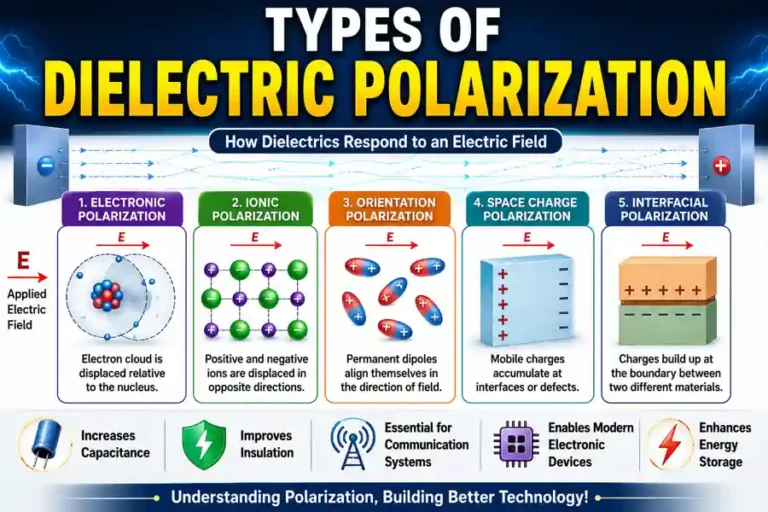
Before evaluating external dependencies, let us categorize the four fundamental mechanisms that contribute to the total polarization (Ptotal) of a dielectric material.
1. Electronic Polarization (Pe):
This occurs in all materials. When an external electric field is applied, the light, negatively charged electron cloud shifts relative to the heavy, positive nucleus. Because electrons are incredibly light, this adjustment happens almost instantaneously.
Observed primarily in ionic solids (such as NaCl crystals), this mechanism involves the physical displacement of adjacent positive and negative ions in opposite directions under an applied electric field.
This occurs only in polar dielectrics (such as water or polymers) that possess permanent, built-in molecular dipoles. In the absence of an external field, these dipoles point randomly due to thermal agitation. When a field is applied, they attempt to rotate and line up parallel to the electrical lines of force.
This happens in heterogeneous materials where free mobile charge carriers accumulate at structural interfaces, grain boundaries, or impurities, creating macroscopic dipole moments.
Total Polarization (P):
In a material that can experience all forms of polarization, the total polarization is equal to the sum of all types of dielectric polarization. The total polarization is given by
$$P=P_e+P_i+P_o+P_s$$
🌡️Temperature Dependence of Polarization:
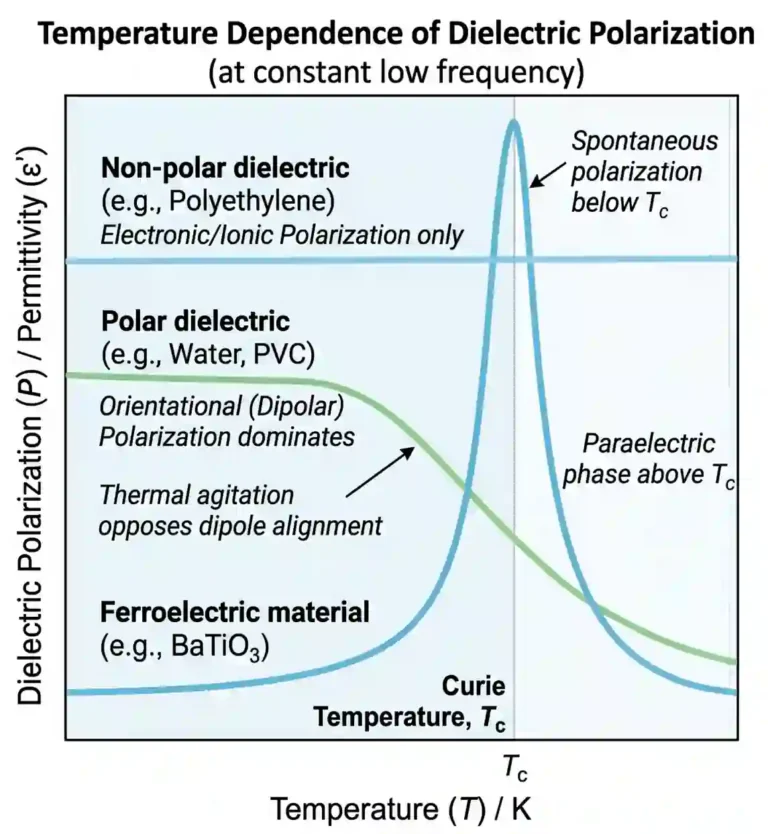
Temperature influences dielectric polarization by affecting the motion of atoms, ions, and molecules inside a dielectric material. However, each polarization mechanism responds differently to changes in temperature, as shown in the following figure.
1️⃣ Electronic and Ionic Polarization
Electronic and ionic polarizations are almost independent of temperature.
In electronic polarization, only the electron cloud shifts slightly relative to the nucleus, while in ionic polarization, positive and negative ions undergo very small displacements. These movements are controlled by strong internal atomic forces. Therefore, the thermal energy available at ordinary temperatures is not sufficient to significantly affect these processes.
As shown in the graph, non-polar dielectrics (such as polyethylene), where electronic and ionic polarizations dominate, exhibit nearly constant polarization with increasing temperature.
2️⃣ Orientational Polarization:
Orientational polarization is strongly dependent on temperature and is commonly observed in polar dielectrics such as water and PVC.
When an external electric field is applied, permanent molecular dipoles tend to align themselves along the field direction. However, as the temperature increases, thermal agitation becomes stronger and continuously disturbs this alignment.
As a result, fewer dipoles remain aligned with the electric field, causing the polarization to decrease with increasing temperature.
Mathematically, $$P_o\propto \frac{1}{T}$$ Thus, orientational polarization decreases approximately inversely with absolute temperature.
This behavior is represented by the downward-sloping curve in the graph for polar dielectrics.
3️⃣ Space Charge Polarization:
Space charge polarization arises due to the accumulation of mobile charges at interfaces, grain boundaries, defects, or impurities within a dielectric material.
As temperature increases, the mobility of these charges generally increases, allowing them to migrate more easily and accumulate at suitable locations. Therefore, space charge polarization usually increases with temperature over a certain range.
At very high temperatures, however, excessive thermal motion may disperse the accumulated charges, reducing the effectiveness of charge buildup.
4️⃣ Ferroelectric Materials and Curie Temperature:
Ferroelectric materials such as Barium Titanate (BaTiO₃) show a unique temperature dependence.
As the temperature approaches the Curie temperature (TC), the dielectric polarization and dielectric constant increase rapidly and reach a maximum value.
Below TC, the material possesses spontaneous polarization, meaning it remains polarized even without an external electric field.
Above TC, the material loses its spontaneous polarization and changes into a paraelectric state, causing the polarization to decrease sharply.
This behavior produces the characteristic peak observed in the graph at the Curie temperature.
✨ Short Answer for Exam:
The temperature dependence of dielectric polarization varies with the polarization mechanism: electronic and ionic polarizations remain nearly constant, and orientational polarization decreases with increasing temperature due to thermal agitation.
Space charge polarization generally increases because of enhanced charge mobility, while ferroelectric materials exhibit a sharp maximum in polarization at the Curie temperature.
5. Temperature dependence of total polarization:
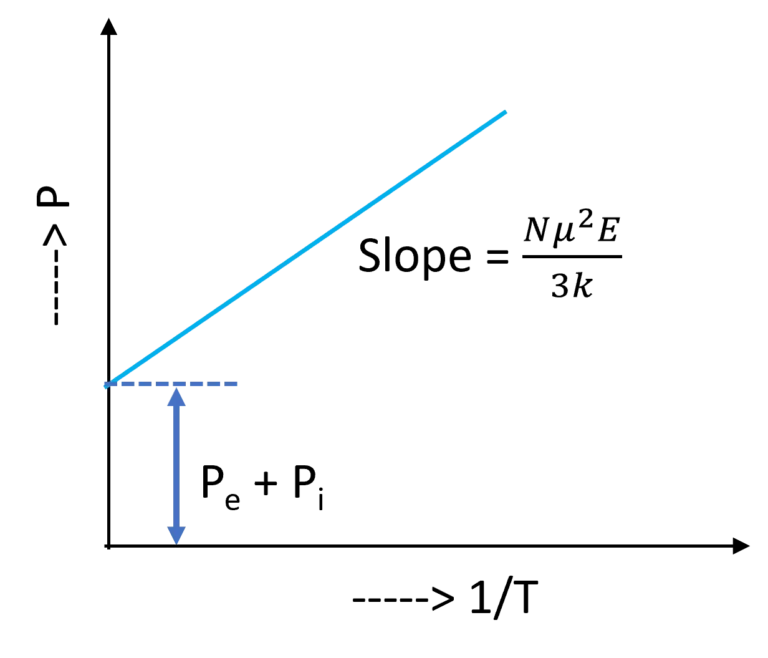
Since electronic and ionic polarizations are nearly independent of temperature, while orientation polarization is proportional to 1/T, the total polarization varies linearly with 1/T. Hence, a plot of P versus 1/T is a straight line having intercept (Pe + Pi) and slope Nμ2E/3k.
It is shown in the following graph.
Temperature dependence of Total Polarization
📡 Frequency Dependence of Dielectric Polarization
When a dielectric material is subjected to an alternating electric field, the electric field continuously changes its direction. To maintain polarization, the charges and dipoles inside the dielectric must continuously reorient themselves along the changing field.
However, every polarization mechanism requires a certain amount of time to respond to the applied field. This response time is called the relaxation time (τ).
Relaxation Time and Relaxation Frequency:
The average time required by dipoles to align themselves with the applied electric field is called the relaxation time (τ).
The reciprocal of relaxation time is known as the relaxation frequency.
If the frequency of the applied field is lower than the relaxation frequency, the dipoles can easily follow the field.
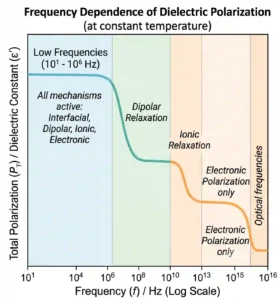
If the frequency becomes much higher than the relaxation frequency, the dipoles fail to respond, and the corresponding polarization mechanism disappears, as shown in the following graph.
Frequency Dependence of Polarization
Let us analyze the effect of frequency across the different polarization mechanisms:
1️⃣ Low Frequency Region (Up to about 106 Hz):
At low frequencies, the electric field changes slowly. Therefore, all charges and dipoles get sufficient time to align themselves with the field.
The following polarization mechanisms are active in this frequency range:
This corresponds to the second decrease shown in the graph.
Real-Life Example:
This dipolar lag causes dielectric heating, which is the basic principle behind microwave ovens.
4️⃣ Infrared Frequency Region (1011 – 1014 Hz):
At even higher frequencies, ions become unable to oscillate with the electric field. As a result, ionic polarization disappears.
Result:
Only electronic polarization remains active.
The dielectric constant decreases further.
This region corresponds to the third drop in the graph.
5️⃣ Optical and Ultraviolet Frequency Region (>1015 Hz):
At optical frequencies, only the extremely light electron clouds can respond to the alternating field. Therefore, electronic polarization alone survives.
Result:
Minimum dielectric polarization.
Minimum dielectric constant.
No contribution from ionic, orientation, or space charge polarization.
This corresponds to the final plateau of the graph.
This frequency-dependent dielectric behavior is explained in the following table.
S. No.
Frequency Range
Active Polarization Mechanisms
1.
Low Frequency
Electronic + Ionic + Orientation + Space Charge
2.
Radio Frequency
Electronic + Ionic + Orientation
3.
Microwave Frequency
Electronic + Ionic
4.
Optical Frequency
Electronic Polarization Only
📝 Short Answer for exam:
Frequency Dependence of Dielectric Polarization
When an alternating electric field is applied to a dielectric material, the dipoles and charges inside the material attempt to follow the changing direction of the field. At low frequencies, all polarization mechanisms—electronic, ionic, orientation, and space charge polarization—can respond effectively, producing maximum polarization and dielectric constant.
As the frequency increases, heavier charge carriers and dipoles fail to follow the rapidly changing field. Space charge polarization disappears first, followed by orientation polarization and ionic polarization. At optical frequencies, only electronic polarization remains active. Therefore, the total dielectric polarization and dielectric constant decrease with increasing frequency.
The order of disappearance is:
Hence, dielectric polarization is maximum at low frequencies and minimum at very high frequencies, where only electronic polarization survives, as shown in the above figure.
⚡ Combined Effect of Temperature and Frequency:
The temperature and frequency dependence of dielectric polarization becomes especially important when both factors change simultaneously.
S. No.
Condition
Polarization Behavior
1.
Low Temperature + Low Frequency
Maximum polarization
2.
High Temperature + Low Frequency
Reduced orientation polarization
3.
Low Temperature + High Frequency
Frequency limits dipole response
4.
High Temperature + High Frequency
Minimum polarization
Key observations:
Temperature mainly affects orientation polarization.
Frequency affects all polarization mechanisms.
High frequencies suppress slow polarization processes.
Thus, dielectric properties depend on both variables simultaneously.
🌟 Dielectric Constant Variation with Temperature & Frequency:
The dielectric constant εr is directly related to polarization.
Generally:
With Increasing Temperature:
Polar dielectrics show decreasing dielectric constant.
Nonpolar dielectrics show little change.
With Increasing Frequency:
Dielectric constant decreases.
Different polarization mechanisms stop contributing sequentially.
✅ Advantages of Understanding Polarization Behavior
Studying the temperature and frequency dependence of dielectric polarization offers several benefits:
Improved capacitor design
Better insulation systems
Enhanced communication technologies
Reduced dielectric losses
Increased device efficiency
Longer equipment lifespan
Better energy storage materials
Improved electronic reliability
As technology advances toward higher frequencies and smaller devices, understanding dielectric polarization becomes increasingly important.
🔍 Quick Answer Section
1. Why does orientation polarization decrease with temperature?
Increasing temperature causes random molecular motion. As a result, permanent dipoles lose alignment with the electric field, reducing orientation polarization.
2. Which polarization survives at the highest frequency?
Electronic polarization survives at the highest frequencies, extending into the optical region around 1015 Hz.
3. Why does dielectric constant decrease with frequency?
At high frequencies, dipoles cannot follow rapid field reversals. Consequently, polarization decreases, causing a reduction in dielectric constant.
4. What is Debye relaxation?
Debye relaxation describes the delay in dipole alignment under an alternating electric field, leading to frequency-dependent polarization.
5. Which polarization dominates at low frequency?
Space charge polarization dominates at very low frequencies because charges have sufficient time to accumulate at interfaces.
6. What is dielectric relaxation?
Dielectric relaxation is the delay in the response of a polarization mechanism (especially orientational) to a changing electric field. It is characterized by a relaxation time τ, the time constant for the polarization to decay after the field is removed.
7. What is the frequency dependence of dielectric polarization?
Dielectric polarization frequency dependence describes how a material’s capacity to polarize drops as the frequency of an alternating electric field increases. Because different polarization mechanisms require distinct time frames to shift mass, they successively fail to track high-frequency fields, systematically reducing the overall dielectric constant.
8. How does temperature affect dielectric polarization?
Temperature primarily affects orientational polarization, where rising thermal energy disrupts the alignment of permanent molecular dipoles, reducing total polarization. Conversely, electronic and ionic polarizations remain unaffected by temperature changes, while space charge polarization typically increases due to thermally activated carrier mobility.
9. Why does orientational polarization decrease with temperature?
Orientational polarization decreases with temperature because higher thermal kinetic energy causes violent, random molecular collisions. This thermal agitation actively fights against the aligning influence of an external electric field, dispersing the ordered alignment of permanent molecular dipoles.
10. What happens to dielectrics at optical frequencies?
At optical frequencies (1015 Hz), the alternating electric field flips too quickly for space charges, ions, or molecular structures to move. Only light electrons can track the field, meaning electronic polarization is the sole active mechanism operating at optical frequencies.
🎓 Conclusion:
The temperature and frequency dependence of dielectric polarization plays a fundamental role in determining the electrical behavior of dielectric materials. Different polarization mechanisms respond differently to temperature and frequency changes. Electronic polarization remains almost unaffected, while orientation polarization strongly depends on temperature and frequency.
A thorough understanding of these effects enables scientists and engineers to design efficient capacitors, communication devices, insulating materials, sensors, and advanced electronic systems. As modern technologies continue to operate at higher frequencies and under diverse environmental conditions, the study of dielectric polarization remains more important than ever.
📝 PYQs / Most Expected Exam Questions
Explain temperature dependence of dielectric polarization.
Explain the frequency dependence of dielectric polarization.
Compare different polarization mechanisms.
🧮 Solved Numericals:
A dielectric material under an alternating field exhibits a relaxation time (τ) of 2 × 10⁻¹⁰ seconds for its orientational polarization mechanism. Determine whether this mechanism will contribute to the total dielectric constant when operating at a frequency of 50 MHz versus a frequency of 20 GHz.
Solution:
Given: τ = 2 × 10⁻¹⁰ seconds
Find: Evaluate mechanism functionality at f1 = 50 MHz = 5 × 10⁷ Hz and f2 = 20 GHz = 2 × 10¹⁰ Hz.
Calculation:
Let us find the critical cutoff frequency (fc) above which the dipoles cannot follow the field oscillations:
For Case 1(f1 = 50 MHz): 50 MHz << 796 MHz. The field alternates slowly enough that the dipoles have ample time to align.
For Case 2(f2 = 20 GHz):20 GHz >> 796 MHz. The field alternates much faster than the relaxation time, meaning the dipoles stay locked in position.
Answer: The orientational polarization mechanism will fully contribute at 50 MHz, but it drops out completely at 20 GHz.
❓ FAQs (People Also Ask)
1. What happens to the dielectric constant of water at very high frequencies?
At very high frequencies (above about 100 GHz), the orientational polarization of water molecules can no longer follow the rapidly oscillating field. The dielectric constant drops from its static value of about 80 at low frequencies to around 1.8 at optical frequencies, which corresponds only to the electronic polarization contribution.
2. What is the difference between dielectric relaxation and resonance?
Dielectric relaxation occurs when orientational or space charge polarization cannot follow a rapidly changing electric field due to molecular friction or charge migration delays. It is a non-oscillatory, frequency-dependent process.
Dielectric resonance occurs in ionic or electronic polarization when the applied frequency matches the natural frequency of bound charges, producing strong oscillations and a sharp energy absorption peak.
3. What industries use dielectric polarization studies?
Electronics, telecommunications, power engineering, sensor technology, aerospace, and materials science all rely on dielectric polarization research.
4. Can electronic polarization ever fail at extreme frequencies?
Yes, but only at extreme frequencies beyond the ultraviolet spectrum (above 1016 Hz). At these frequencies, even light electrons cannot keep pace with the alternating field, causing the dielectric constant of all materials to approach the permittivity of a vacuum (ε0).
5. How does moisture affect the dielectric properties of an insulating material?
Water is a highly polar molecule with an exceptionally large orientational polarization response. When moisture seeps into an insulator, it introduces significant orientational and space charge factors, raising the dielectric constant but heavily increasing unwanted thermal power losses.
6. Is dielectric polarization reversible?
Yes. In most dielectric materials, polarization disappears when the electric field is removed.
Message: Thank you for reading this comprehensive guide on temperature and frequency dependence of dielectric polarization.

 For High-Quality, More Free Study Notes