Imagine throwing a ball across a playground. The ball follows a predictable path because gravity acts on it. Now imagine a tiny charged particle, such as an electron, moving through an electric or magnetic field. Instead of gravity alone controlling its motion, invisible electric and magnetic forces continuously guide its path.
Understanding the motion of charged particle in electric and magnetic fields helps us understand how electrons move inside electronic devices, how particles are accelerated in laboratories, and how many advanced scientific instruments work.
This fascinating behavior forms the foundation of many modern technologies, including particle accelerators, cathode ray tubes, mass spectrometers, cyclotrons, electron microscopes, and plasma devices.
In this article, we will explore the motion of charged particles in an electric and magnetic field in a detailed yet easy-to-understand manner. Hence, by the end of this article, you will master the concept of:
Motion in an electric field Motion in a magnetic field Motion in combined electric and magnetic fields Mathematical derivations Applications Solved numericals Exam-oriented concepts
⚙️ Understanding Electric and Magnetic Fields:
Before studying the motion of charged particle, it is essential to understand the fields responsible for that motion. So let us first know about electric and magnetic fields.
What is an Electric Field?
An electric field is the region around a charged object where another charge experiences an electric force.
The force experienced by a unit charge at any point in the electric field is called the electric intensity at that point. It is given by $$E=\frac{F}{q}$$
Where:
E = Electric field intensity
F = Force experienced
q = Charge
The electric field can exist even when charges are stationary.
The unit of electric field is Newtons per Coulomb (N/C) or, equivalently, Volts per metre (V/m). The electric field exists regardless of whether a test charge is present—it is a property of the space itself, created by source charges or by a changing magnetic field.
Uniform Electric Field:
A uniform electric field is an electric field in which both the strength (magnitude) and direction remain the same at every point.
This means that a charged particle placed anywhere inside the field experiences the same electric force in the same direction.
A uniform electric field can be produced by placing two large parallel metal plates carrying opposite charges, as shown in the following figure. The electric field lines between the plates are straight, parallel, and equally spaced.
Uniform electric field produced by two oppositely charged parallel plates
The electric field intensity E between the plates is given by $$E=\frac{V}{d}$$
where V (= Va – Vb) is the potential difference between the two plates.
What is a Magnetic Field?
A magnetic field is the region around a magnet or moving charge where magnetic forces can be detected. It is represented by B.
Unlike the electric field, the magnetic force on a charge depends on the particle’s velocity. A charge sitting still in a magnetic field feels nothing. The moment it starts moving, it feels a force—and crucially, that force is always perpendicular to the velocity. The SI unit of magnetic field strength is the Tesla (T).
Uniform Magnetic Field:
A uniform magnetic field is a magnetic field in which the magnitude and direction of the magnetic field remain the same at every point in a given region. In such a field, the magnetic field lines are parallel and equally spaced. It is also known as a homogeneous magnetic field.
A nearly uniform magnetic field can be produced inside a long solenoid or by using an electromagnet.
SI Unit of Magnetic Field:
The SI unit of magnetic field is tesla (T), which is equivalent to weber per square metre (Wb/m²).
CGS Unit of Magnetic Field:
The CGS unit of magnetic field is gauss (G). The relation between tesla and gauss is:
What is a Charged Particle?
A charged particle is a particle that carries an electric charge. The charge may be positive or negative. When a charged particle enters an electric field, a magnetic field, or both, it experiences a force that changes its motion.
Types of Charged Particles:
Positive Charged Particles:
Examples:
Proton
Alpha particle
Positive ions
These particles move in the direction of the electric field.
2. Negative Charged Particles:
Examples:
Electron
Negative ions
These particles move opposite to the direction of the electric field.
Factors Affecting the Motion of a Charged Particle:
The motion of a charged particle depends on the following:
Magnitude of charge (
Mass of the particle (m)
Electric field strength (E)
Magnetic field strength (B)
Initial velocity of the particle (v)
👉 Therefore, understanding the type of charge and these factors helps us predict how a charged particle will move in electric and magnetic fields.
⚡ Motion of a Charge Particle in a Uniform Electric Field:
When a charged particle enters an electric field, it experiences an electrostatic force and gets accelerated. This force depends solely on the magnitude of the charge and the field strength, regardless of whether the particle is at rest or in motion.
If the particle is positively charged, it accelerates directly along the field lines; if negatively charged, it flies in the exact opposite direction.
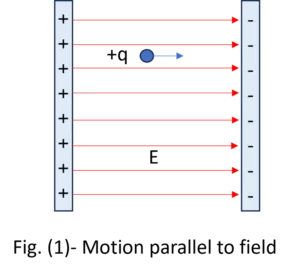
Motion of Charge Particle Parallel to Electric Field:
Consider a positively charged particle of mass m and charge q entering a uniform electric field E. The force acting on the particle is $$F_e = qE \qquad … (1)$$
As a result, the charged particle moves with the acceleration 𝑎 in the field direction. According to Newton’s second law, $$F_e = ma \qquad … (2)$$
Therefore, from eq. (1) and (2), we get $$ma= qE$$
$$a=\frac{qE}{m}\qquad … (3)$$
As the parameters m, q, and E are constant, the charged particle moves with constant acceleration along the field direction.
The equation of kinematics for rectilinear motion can now be applied to the motion of the charged particle in the electric field. For convenience, let us assume the charged particle is moving along the positive x-axis.
The distance covered by the charged particle in time t is $$x= v_ot+\frac{qE}{2m}t^2$$
The velocity of the particle after time t is given by $$v=v_o+\frac{qE}{m}t$$
and $$v^2=v_o^2+\frac{2qE}{m}x$$
The kinetic energy of the particle after time t is $$K.\,E.=\frac{1}{2} mv^2=\frac{1}{2} mv_o^2+\frac{1}{2} m\cdot \frac{2qEx}{m}$$
$$\Rightarrow K.\,E.=\frac{1}{2} mv_o^2+qEx$$
If the particle is initially at rest, vo = 0, then $$K.\, E. = qEx$$
When the particle moves from one potential to another, then $$E=\frac{V}{x}$$
Therefore, $$K.\,E. = qV$$
$$\Rightarrow \frac{1}{2} mv^2= qV$$
$$\Rightarrow v=\sqrt{\frac{2qV}{m}} $$
$$\Rightarrow v\propto \sqrt{V}$$
Thus, the velocity acquired by the charged particle in a uniform electric field is proportional to the square root of the potential difference V through which it is accelerated.
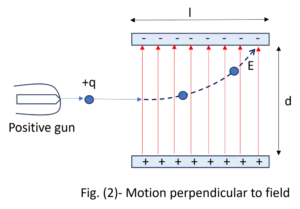
Motion of a Charge Particle Perpendicular to Electric Field:
Consider a charged particle having mass m and charge q entering a uniform electric field E. The particle initially moves along the x-axis with a velocity vo, while the electric field is directed along the y-axis.
Since the particle’s initial motion is only along the x-axis, its initial velocity in the y-direction is zero.
When the particle enters the electric field, it experiences an electric force in the direction of the field. As a result, the particle starts accelerating upward along the y-axis and gradually deviates from its original straight path.
Therefore, the acceleration of the particle in the y-direction is given by:
$$a_y=\frac{qE}{m}$$
Therefore, the velocity of the particle along the y-direction after time t is $$v_y=\frac{qE}{m}t$$
and the distance traveled in the y-direction in time t is $$y=\frac{qE}{2m}t^2\qquad … (4)$$
Since the electric field acts only along the y-axis, the particle experiences no force in the x-direction. Therefore, the particle continues to move with its initial velocity vo in the x-direction.
As a result, the distance traveled by the particle along the x-axis in time t is given by: $$x=v_ot$$
Here t is called transit time and is given by $$t=\frac{x}{v_o}$$
Putting this value of t in equation (4), we get $$y=\left( \frac{qE}{2m} \right)\left( \frac{x}{v_o} \right)^2$$
where A is a constant and is equal to $$A=\frac{qE}{2mv_o^2}$$
Equation (5) is an equation of a parabola. Hence, it is clear that a charged particle moving with uniform velocity follows a parabolic path when it passes through a transverse uniform electric field.
Motion of Charged Particle at an Angle to an Electric Field:
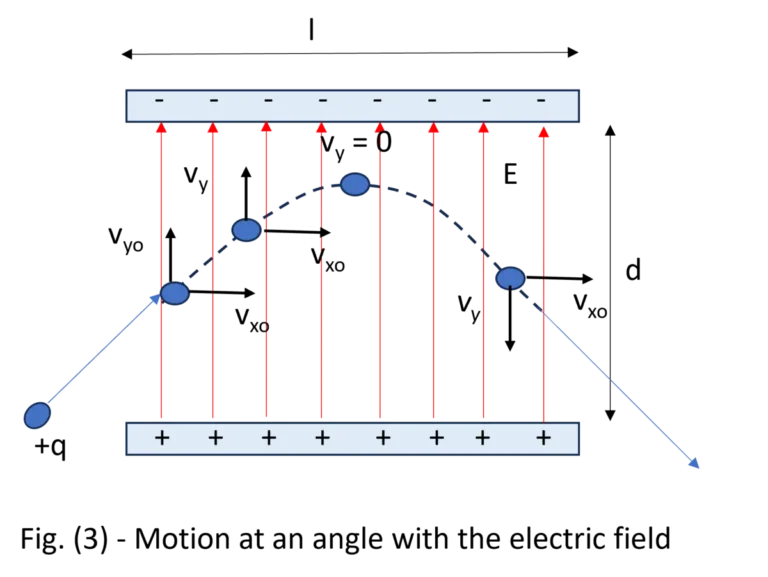
Consider a charged particle entering a uniform electric field with an initial velocity vo at an angle θ to the horizontal, as shown in the figure.
Since the electric field is directed along the negative y-axis, the particle experiences an electric force in the same direction. As a result, the particle accelerates downward along the y-axis.
The acceleration produced by the electric field is constant and is given by: $$a=\frac{qE}{m} \qquad … (6)$$
where q is the charge of the particle, E is the electric field strength, and m is the mass of the particle.
In this situation, the motion of the charged particle is very similar to the motion of a projectile under the influence of gravity. Just as gravity causes a projectile to follow a curved path, the electric field causes the charged particle to move along a parabolic trajectory.
The initial velocity v0 of the charged particle can be resolved into two mutually perpendicular components:
Along the x-axis: vx0 = v0 cos θ
Along the y-axis: vy0 = v0 sin θ
The horizontal component v0 cos θ remains constant because no force acts along the x-axis.
While the vertical component v0 sin θ changes with time. It gradually decreases as the particle moves upward, becomes zero at the highest point, and then increases again in the opposite direction as the particle moves downward.
Hence, the velocity of the charged particle after time t in the x and y directions is given by
Since equation (9) represents a parabola, the charged particle follows a parabolic path in a uniform electric field.
Similar to projectile motion, we can determine important quantities such as the maximum height, time of flight, and horizontal range in a similar way.
The maximum height is
$$H=\frac{v_0^2\,sin^2\theta}{2a}$$
The time of flight is $$T=\frac{2v_0\,\sin\,\theta}{a}$$ and the horizontal range is $$R=\frac{v_0^2\,\sin\,2\theta}{a}$$.
🧲 Motion of Charged Particle in a Uniform Magnetic Field:
Consider a charged particle entering a uniform magnetic field of strength B with an initial velocity v. Let θ be the angle between the direction of the particle’s velocity and the magnetic field.
When the particle moves through the magnetic field, it experiences a magnetic force. The magnitude of this force depends on the charge of the particle, its velocity, the magnetic field strength, and the angle θ.
The magnetic force acting on the particle is given by:
$$\mathbf F = q\,(\mathbf v\times \mathbf B)$$
$$F= qvB\,sin\,\theta \qquad … (10)$$
The direction of the magnetic force is determined using the Right-Hand Rule for positive charges as follows:
Point out your right-hand fingers in the direction of the particle’s velocity (v).
Now curl your fingers toward the direction of the magnetic field (B).
Your thumb points in the direction of the magnetic force (F) on a positive charge.
For a negative charge (such as an electron), the force direction is opposite to the direction obtained for a positive charge.
The magnetic force F acting on a charged particle is always perpendicular to both the particle’s velocity v and the magnetic field B.
Since work done is given by the dot product of force and displacement (or velocity), $$\mathbf F \cdot \mathbf v = Fv\, \cos\,90^\circ=0$$
This means that the magnetic force does no work on the charged particle.
Therefore, the particle neither gains nor loses energy while moving in a magnetic field.
As a result, a magnetic field cannot change the speed of a charged particle. It can only change the direction of motion of the particle.
Motion of a Charge Particle Parallel to a Magnetic Field:
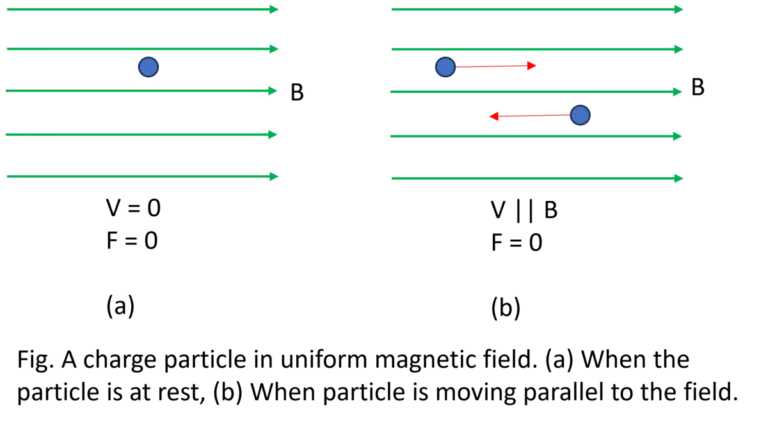
If v = 0, F = 0. Hence, a magnetic field does not act on a charged particle that is at rest.
When a charged particle enters the magnetic field parallel (θ = 0 or π) to the direction of the magnetic field, F = 0.
Therefore, the charged particle continues to move along the initial direction of motion without changing its speed or direction of motion.
Motion of a Charge Particle Perpendicular to a Magnetic Field:
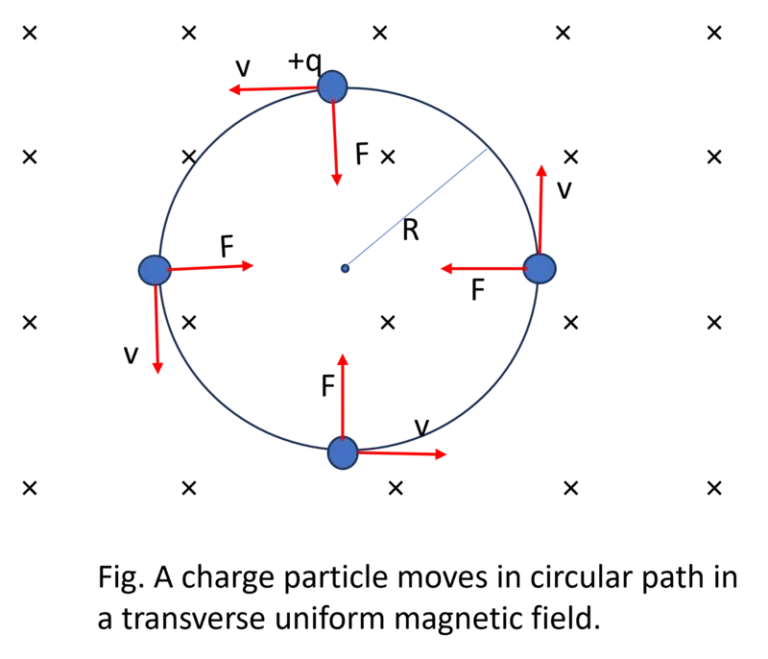
Let us consider a positively charged particle of charge q and mass m that enters a uniform magnetic fieldB with a velocityv perpendicular to the magnetic field; the angle betweenv and B is 90o. Therefore, the magnetic force acting on the particle is maximum and is given by: $$F=qvB \qquad … (12)$$
As the particle moves through the magnetic field, its direction of velocity changes continuously. Since the magnetic force is always perpendicular to the velocity, it also keeps changing its direction at every point along the path.
Although the direction of the velocity changes, its magnitude remains unchanged because the magnetic force does not change the particle’s speed. It only turns the particle’s direction of motion.
As a result, the particle keeps changing its direction continuously while moving with the same speed. This continuous turning of the velocity causes the particle to follow a curved path, which eventually becomes a circular path in a uniform magnetic field, as shown in the figure.
And the magnetic force is obviously a centripetal force, which is given by
$$F = \frac{mv^2}{R} \qquad … (13)$$
Comparing equations (12) and (13), we get
$$qvB= \frac{mv^2}{R}$$
$$\Rightarrow R = \frac{mv}{qB} \qquad … (14)$$
$$\Rightarrow R\propto mv$$
Hence, the radius of the orbit of a charge particle moving at a right angle to the magnetic field is proportional to its momentum.
and the frequency of revolution in the orbit is given by
$$\nu = \frac{1}{T}=\frac{qB}{2\pi m}$$
Motion of a Charge Particle at an Angle to a Magnetic Field:
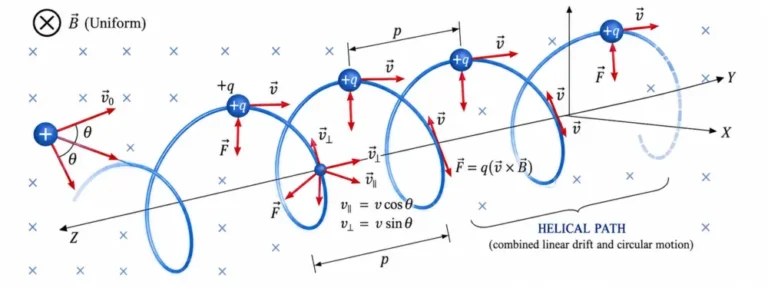
Consider a charged particle of charge q and massm entering a uniform magnetic field Bwith an initial velocity v making an angle θ with the magnetic field, as shown in the figure.
Motion of a charge particle at an angle to a magnetic field
In this situation, the velocity of the particle is neither completely parallel nor completely perpendicular to the magnetic field. Therefore, the velocity can be resolved into two mutually perpendicular components:
$$v_\parallel =v\,cos\,\theta$$
$$v_\bot =v\,sin\,\theta$$
where:
v∥ = component of velocity parallel to the magnetic field
v⊥ = component of velocity perpendicular to the magnetic field
The component v∥ acts along the direction of the magnetic field. Since the magnetic force depends only on the component of velocity perpendicular to the magnetic field, no magnetic force acts on v∥. Therefore,
$$F_\parallel = 0$$
As a result, v∥ remains constant throughout the motion and causes the particle to move forward along the magnetic field lines.
On the other hand, the perpendicular component v⊥ experiences a magnetic force given by
$$F_\bot = qv_\bot B$$
This force is always perpendicular to the velocity and acts as a centripetal force. Consequently, the particle performs circular motion due to the component v⊥.
Since the particle simultaneously has a constant velocity v∥ along the magnetic field and a circular motion due to v⊥, the combined motion results in a helical (spiral) path.
You can think of it as a particle moving forward while continuously rotating around the magnetic field lines. This combination of linear and circular motion produces the helix shown in the figure.
Radius of the Helical Path
Since the magnetic force acts as the centripetal force, hence
$$qv_\bot B = \frac{mv_\bot ^2}{r}$$
$$\Rightarrow r= \frac{mv_\bot}{qB}$$
Substituting the value of v⊥, the radius of the helix is,
$$r= \frac{mv\,sin\,\theta}{qB}$$
Time Period of Revolution:
The time period of circular motion is
$$T= \frac{2\pi r}{v_\bot }$$
Substituting the value of r, we get
$$T= \frac{2\pi m}{qB}$$
Pitch of the Helix:
The pitch is the distance traveled by the particle along the magnetic field during one complete revolution. Hence, the pitch is given by
$$p=v_\parallel T$$
Substituting the value of v∥ and the time period T, we get the pitch of the helix,
$$p =\frac{2\pi mv\,cos\,\theta}{qB}$$
✨ Motion of Charged Particle in Crossed Electric and Magnetic Fields:
When a charged particle moves through a region where both an electric field E and a magnetic field B are present and are perpendicular to each other, the fields are called crossed electric and magnetic fields.
This arrangement is widely used in devices such as velocity selectors, mass spectrometers, and particle accelerators.
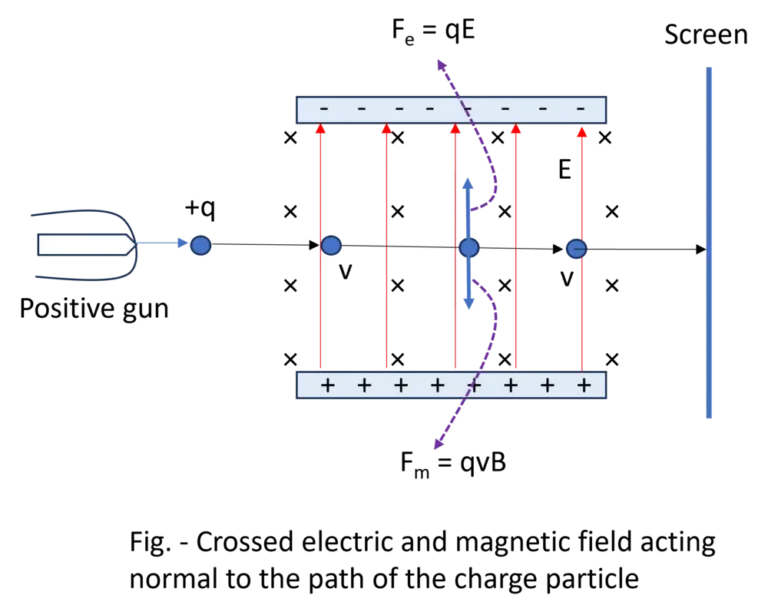
Let us consider the charged particles that horizontallyenter the region between two parallel plates with a velocity v, as shown in the following figure. The lower plate is positively charged, while the upper plate is negatively charged, creating a uniform electric field E directed upward. A uniform magnetic field B acts perpendicular outward to the plane of the paper.
As the particle moves through the crossed fields, it experiences both electric and magnetic forces simultaneously.
Electric Force: The electric field exerts a force on the charged particle, which is given by
$$F_e= qE$$
For a positive charge, the electric force acts in the direction of the electric field, and for a negative charge, the electric force acts in the direction opposite to the electric field.
Here, the electric force deflects the particle vertically upward.
Magnetic Force: The magnetic force acting on the moving charged particle is
$$F_m=qvB$$
The magnetic force acts on the particle vertically downward.
Since both electric and magnetic forces act simultaneously on the charge particle in opposite directions, the resultant force acting on the particle is
$$F_r=F_e-F_m$$
The particle’s path depends on the relative magnitudes of these forces. Hence, three cases are possible.
Case 1: Electric Force Greater than Magnetic Force: If Fe > Fm, the particle is deflected upward.
Case 2: Magnetic Force Greater than Electric Force: If Fm > Fe, the particle is deflected downward.
Case 3: Electric Force Equals Magnetic Force: This is the most important case. When
$$F_e=F_m$$
$$qE = qvB$$
Therefore $$v=\frac{E}{B}$$
In this condition, the electric and magnetic forces exactly balance each other, and the net force becomes zero.
Hence, the particle travels through the crossed fields without any deflection and follows a straight-line path.
This principle forms the basis of a velocity selector. It is used to separate the particles of different velocities. J. J. Thomson used exactly this principle to measure the electron’s charge-to-mass ratio.
📊 Electric Field vs Magnetic Field on a Charged Particle:
S. No.
Feature
Electric Field (E)
Magnetic Field (B)
1.
Force Formula
F = qE
F = qvB
2.
Direction of force
Along E (for positive charge)
Perpendicular to both v and B
3.
Acts on
Stationary or moving charges
Moving charges only
4.
Work done
Yes—changes kinetic energy
No—only changes direction
5.
Speed change
Yes
No
6.
Path shape
Parabola (if v ⊥ E) or straight line (if v ∥ E)
Circle (if v ⊥ B) or helix (if oblique)
7.
Key application
CRT displays, particle accelerators
Cyclotron, MRI, mass spectrometer
🎯 Practical Applications:
The motion of a charge particle in an electric and magnetic field has numerous technological applications.
Particle Accelerators: Used to accelerate charged particles to high energies for research.
Cyclotron: Accelerates ions using electric and magnetic fields.
Mass Spectrometer: Separates ions according to mass-to-charge ratio.
Cathode Ray Tube: Uses electron beams controlled by electric fields.
Plasma Devices: Charged particle motion helps control plasma behavior.
Magnetic Confinement Systems: Used in fusion reactors for trapping high-energy particles.
🔍 Quick Answer Section:
1. What happens when a charged particle enters an electric field?
A charged particle experiences an electric force equal to qE. This force causes acceleration and changes both speed and direction depending on the particle’s initial velocity and field orientation.
2. Why does a magnetic field not change speed?
The magnetic force acts perpendicular to the particle’s velocity. Since the force does no work, kinetic energy remains constant and only the direction changes.
3. What is Lorentz force?
The Lorentz force is the total force experienced by a charged particle in electric and magnetic fields and is expressed as F = q(E + v × B).
4. Why does circular motion occur in a magnetic field?
Circular motion occurs in a magnetic field because the magnetic force acts as a centripetal force, continuously changing the direction of the particle’s velocity while keeping its speed constant.
5. What is helical motion?
Helical motion is the spiral motion of a charged particle in a magnetic field, produced by the combination of circular motion due to the perpendicular velocity component and straight-line motion due to the parallel velocity component.
6. What is cyclotron frequency?
Cyclotron frequency is the number of revolutions per second made by a charged particle moving in a uniform magnetic field and is given by f = qB/2πm.
7. What is the path of a charged particle in a uniform electric field?
The path of a charged particle injected perpendicularly into a uniform electric field is parabolic. This occurs because the constant electric force accelerates the particle along the field line axis while its orthogonal velocity remains completely unchanged, mimicking a projectile in gravity.
8. What is the path of a charged particle in a uniform magnetic field?
If the particle enters perpendicularly (90o), its path is circular. If it enters at an acute angle (θ), its path is helical. The magnetic force continuously acts perpendicular to the velocity, functioning as a centripetal force that curves the trajectory without changing speed.
🎓 Conclusion:
The motion of a charge particle in an electric and magnetic field is a fundamental concept that connects theoretical physics with real-world technology. Electric fields change the speed of charged particles by exerting forces along their motion, whereas magnetic fields primarily alter the direction of motion. When both fields act together, fascinating phenomena such as velocity selection, circular motion, and helical trajectories emerge.
📝PYQs / Most Expected Questions
Derive the radius of circular motion of charged particle in a magnetic field.
Explain the helical motion of charged particle.
Derive the time period of revolution in a magnetic field.
Derive the expression for acceleration in an electric field.
Discuss applications of charged particle motion.
🧮 Solved Numericals:
Circular Orbit Metrics
Question 1. An alpha particle (q = 3.2 × 10⁻¹⁹ C, m = 6.64 × 10⁻²⁷ kg enters a uniform magnetic field of 0.5 T perpendicularly at a velocity of 2.0 × 10⁶ m/s. Find the radius of its circular orbit.
Answer: The radius of the circular orbit is 0.083 meters.
Tuning a Velocity Selector
Question 2. A velocity selector uses a magnetic field of strength 0.4 T. What electric field magnitude must be applied perpendicularly to filter out electrons traveling at exactly 5.0 × 10⁵ m/s without deflection?
Answer: The required electric field strength is 2.0 × 10⁵ V/m.
Parabolic Deflection in an Electric Field
Question 3. An electron enters a uniform electric field of E = 8.0 × 10³ V/m directed vertically downward with a horizontal velocity of vo = 5.0 × 10⁶ m/s. Find the vertical deflection after the electron has traveled a horizontal distance of 0.12 m.
Solution:
Given: E = 8.0 × 10³ V/m, vo = 5.0 × 10⁶ m/s, x = 0.12 m Find: Vertical deflection y
$$\Rightarrow y = \frac{1.28\times10^{-15}}{4.555\times10^{-18}}(0.0144)$$
$$\Rightarrow y = 4.04\; m$$
Answer: Vertical deflection y = 4.04 m.
Cyclotron Frequency for an Alpha Particle
Question 4. An alpha particle (m = 6.64 × 10⁻²⁷ kg, q = 3.2 × 10⁻¹⁹ C) is injected into a cyclotron that uses a magnetic field of B = 1.2 T. Calculate the cyclotron frequency and the maximum radius if the particle reaches a maximum speed of vmax = 1.8 × 10⁷ m/s.
Solution:
Given: m = 6.64 × 10⁻²⁷ kg, q = 3.2 × 10⁻¹⁹ C, B = 1.2 T, and vmax = 1.8 × 10⁷ m/s
Question 5. An electron moves with speed v = 3.0 × 10⁶ m/s at an angle of 30o to a uniform magnetic field of B = 0.04 T. Find the radius and pitch of the resulting helical path.
Solution:
Given: v = 3.0 × 10⁶ m/s, θ = 30o, B = 0.04 T
Find: Radius (r) pitch of helix (p)
Calculation:
Perpendicular and parallel components of velocity:
Answer: Radius (r) = 0.213 mm, and pitch of helix (p) = 2.32 mm.
❓ FAQs (People Also Ask)
1. What is cyclotron motion?
Cyclotron motion is the circular motion of a charged particle moving perpendicular to a uniform magnetic field.
2. What is a velocity selector?
A velocity selector is a device that allows only particles with velocity E/B to pass without deflection.
3. Which field changes the kinetic energy of a charged particle?
The electric field can change kinetic energy because it can do work on the particle. A magnetic field alone cannot change kinetic energy.
4. Why is the radius of circular motion larger for faster particles?
The radius is directly proportional to velocity. Therefore, higher velocity results in a larger circular path.
5. What factors affect the radius of motion of charged particle?
The radius of motion of a charged particle in a magnetic field depends on its mass, velocity, charge, and magnetic field strength, according to r = mv/qB.
6. What are crossed fields?
Crossed fields are mutually perpendicular electric and magnetic fields acting simultaneously on a charged particle, causing it to experience both electric and magnetic forces.

 For High-Quality, More Free Study Notes
 Motion in an electric field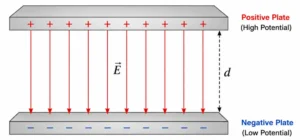
 Electric Force: The electric field exerts a force on the charged particle, which is given by
 Magnetic Force: The magnetic force acting on the moving charged particle is