
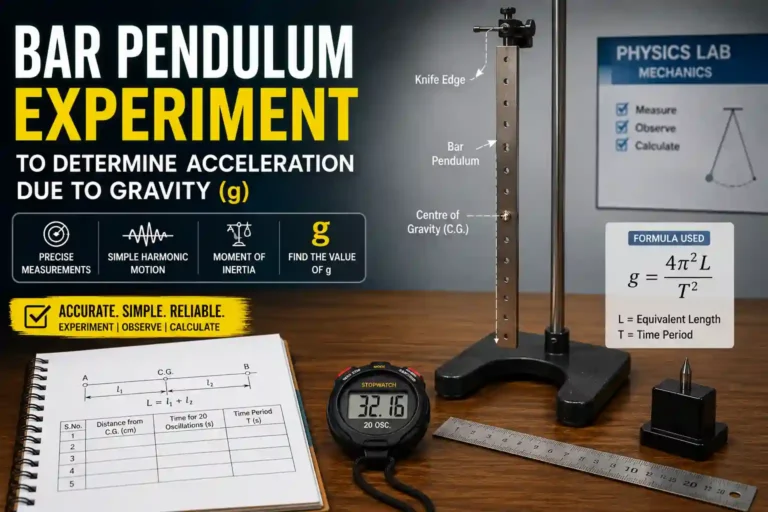
Hey everyone! Welcome back to your favorite physics corner. If you are an engineering or physics undergraduate student, chances are you’ve run into the bar pendulum experiment in your first-year lab. Let’s be honest: looking at a long iron bar with dozens of holes can feel a bit intimidating at first. But don’t worry! Today, we are going to break down how to determine acceleration due to gravity using bar pendulum setups without the usual textbook headache.
By the end of this guide, you won’t just understand the math behind it—you’ll be ready to ace your lab practical and crush your upcoming viva exam. Let’s dive in!
Contents
Toggle📖 Introduction
The Bar Pendulum Experiment is one of the most fundamental experiments in Engineering Physics that helps students determine the value of the acceleration due to gravity using a bar pendulum.
Unlike a simple pendulum, a bar pendulum (also called a compound or physical pendulum) is a rigid body that oscillates about a horizontal axis. By measuring the time period of oscillations about different pivot points, students can accurately calculate the value of gravitational acceleration (g).
This experiment not only strengthens the understanding of rotational dynamics and oscillatory motion but also develops practical skills such as precise measurement, graph plotting, error analysis, and data interpretation.
For engineering students, the concepts learned here form the foundation for subjects like machine dynamics, vibration analysis, robotics, structural engineering, aerospace engineering, and precision instrument design.
🎯 Aim of the Experiment
Determine the acceleration due to gravity using a bar pendulum.
🌍 Importance in Engineering Physicse
Although this experiment appears to be a basic laboratory exercise, the principles behind it are extensively used in modern engineering.
Students learn:
- Experimental determination of physical constants
- Rotational motion of rigid bodies
- Moment of inertia concepts
- Radius of gyration
- Experimental graph analysis
- Oscillatory systems
These concepts later become essential while studying the vibration of machines, the balancing of rotating systems, suspension systems, robotics, earthquake-resistant structures, and aerospace engineering.
🚀 Real-World Applications:
The principles of the bar pendulum experiment are applied in:
- Structural vibration analysis
- Earthquake engineering
- Mechanical balancing systems
- Robotics
- Aerospace engineering
- Precision measuring instruments
- Pendulum-based sensors
- Seismometers
- Gravimeters
- Educational laboratory calibration
📋 Experiment Summary:
The table below summarizes the entire experiment in a simple and organized format. It is ideal for quick revision before practical exams, viva voce, or laboratory sessions.
| Parameter | Details |
|---|---|
Aim of the Experiment |
Determination of acceleration due to gravity (g) using a bar pendulum |
Apparatus Required |
Bar pendulum, knife edge, wall bracket, stopwatch, metre scale |
Principle |
Compound pendulum oscillation (time period depends on distance of suspension point from centre of gravity) |
Formula Used |
g = 4π²L / T² |
Observation |
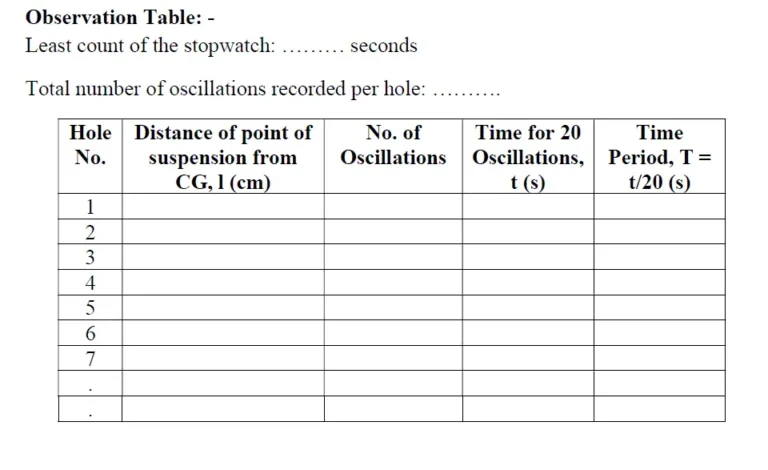
Time period for various pivot distances |
Graph Plotted |
Time period (T) vs distance from CG (l) |
Result |
Experimental value of g |
📋 Observation Table:
📂 Lab Manual PDF:
Below is the official downloadable university lab manual for this experiment. You can view the full step-by-step procedure, theory setup diagrams, calculations, and observation tables directly inside the viewer below:
📂 Modified Lab Manual PDF:
📹 Step-by-Step Video Guide:
📚 Important Points Every Student Should Know:
⭐ Why is it called a Compound Pendulum?
Because the entire rigid body oscillates instead of a concentrated point mass.
⭐ Why are two equal time periods obtained?
A bar pendulum has two conjugate points located on opposite sides of the center of gravity where the time periods become identical.
⭐ Why are small oscillations preferred?
Small oscillations satisfy the simple harmonic motion approximation, resulting in more accurate calculations.
⭐ Why is the center of gravity important?
The distance between the pivot point and the center of gravity directly affects the oscillation period.
⭐ Common Sources of Error
- Improper counting of oscillations
- Large angular displacement
- Friction at knife edge
- Human reaction time
- Incorrect distance measurement
- Air resistance
🎓 Exam-Oriented Questions and Answers:
What is Bar Pendulum?
A Bar Pendulum is a rigid body suspended from a horizontal axis that oscillates freely under gravity. It is also known as a compound pendulum and is used to determine acceleration due to gravity experimentally.
Why is bar pendulum more accurate than simple pendulum?
A Bar Pendulum provides better accuracy because its effective length can be experimentally determined using conjugate points, reducing errors associated with measuring string length.
What is the objective of the Bar Pendulum experiment?
The objective is to experimentally determine the acceleration due to gravity (g) by measuring the time period of oscillation of a rigid bar about different pivot points.
Why should oscillations be small?
Small oscillations ensure that the motion closely follows Simple Harmonic Motion (SHM), making the theoretical equations valid and improving accuracy.
What is a conjugate point in a compound pendulum?
Conjugate points are two pivot positions on opposite sides of the center of gravity that produce the same time period of oscillation when the bar is suspended from either. Their product of distances from the CG equals K², the square of the radius of gyration.
What is the effective length of a Bar Pendulum?
The effective length is the distance between two conjugate points having equal time periods and is used to calculate the value of g.
What is the radius of gyration (k) in a bar pendulum?
The radius of gyration represents the radial distance from the axis of rotation to a point where the entire mass of the bar could be concentrated without altering its moment of inertia. For a uniform bar of length L, k is mathematically equal to L/√12.
Why does the time period become infinite at the center of gravity?
At the center of gravity, the distance (l) from the axis of suspension is zero. Because the restoring torque is directly proportional to l, no restoring torque acts on the bar at this point, making the time period infinitely large.
Why does the graph between T and l show two branches?
Because the bar can be suspended from holes on either side of the CG, and by symmetry, positions equidistant from the CG on opposite sides give identical time periods, producing two mirror-image curves.
What is the physical significance of the minimum point on the T-l graph?
The minimum represents the shortest possible time period for that pendulum, occurring where l equals the radius of gyration K. It is not exactly at the CG, since the time period actually rises again very close to the CG.
Differentiate between a simple pendulum and a compound pendulum.
A simple pendulum is an idealised point mass on a massless, inextensible string, while a compound (bar) pendulum is any rigid body oscillating about a horizontal axis, with mass distributed throughout its structure.
What is meant by centre of oscillation?
It is the point on the opposite side of the CG such that if the bar were suspended from there, it would have the same time period as from the original point of suspension — essentially the second conjugate point.
Why is the knife edge used instead of a simple pivot or nail?
A knife edge minimizes frictional losses at the point of suspension, allowing the bar to swing with almost pure rotational motion and ensuring the recorded time period is accurate.
🗣️ Viva Voce Questions & Answers:
Q1. What is another name for Bar Pendulum?
Answer:
Compound Pendulum or Physical Pendulum.
Q2. Which force acts as the restoring force?
Answer:
Gravitational force.
Q3. Why is the knife edge made sharp?
Answer:
To reduce friction and obtain free oscillations.
Q4. What is the SI unit of acceleration due to gravity?
Answer:
m/s²
Q5. What is the approximate value of g?
Answer:
9.81 m/s²
Q6. Why do we measure multiple oscillations?
Answer:
To reduce stopwatch reaction error.
Q7. What happens if oscillations are large?
Answer:
The motion no longer follows SHM accurately.
Q8. What is the center of oscillation?
Answer:
It is the point corresponding to the conjugate pivot position.
Q9. What is radius of gyration?
Answer:
It is the distance from the axis at which the entire mass can be assumed concentrated without changing the moment of inertia.
Q10. What affects the time period?
Answer:
- Pivot distance
- Gravity
- Radius of gyration
Q11: What kind of motion does the bar pendulum execute?
Answer:
The bar pendulum executes simple harmonic motion (SHM) in angular displacement, provided that the initial angular displacement is kept very small.
Q12: Can we determine the mass of the Earth using this experiment?
Answer:
Indirectly, yes! Once you calculate the accurate value of g using this engineering physics lab manual procedure, you can substitute it into Newton’s universal law of gravitation (g = GME/RE2) to calculate the Earth’s mass (ME).
Q13: What will happen if you conduct this experiment on the moon?
Answer:
Since gravity on the moon is roughly one-sixth of that on Earth (gm = g/6), the denominator in our time period equation decreases significantly. As a result, the time period (T) of the oscillations will increase, making the bar swing much more slowly.
Q14. Does the time period depend on the mass of the bar?
Answer:
No
❓Frequently Asked Questions:
What is the aim of the Bar Pendulum experiment?
The aim is to determine the acceleration due to gravity experimentally using the bar pendulum.
Why is a Bar Pendulum called a compound pendulum?
Because the entire rigid body oscillates about a fixed horizontal axis instead of a point mass attached to a string.
What formula is used in the Bar Pendulum experiment?
g = 4π2L/T2
How do you find the minimum time period from the graph?
If you look closely at your T vs l graph, you will notice a distinct low point on each curve. The Y-coordinate of this minimum point represents the minimum time period (Tmin), which occurs exactly when the distance l equals the radius of gyration k.
What is the equivalent length of a simple pendulum in this experiment?
It's the distance between two conjugate points, L = l₁ + l₂, which behaves exactly like the length of a simple pendulum having the same time period as the bar.
What is the difference between a bar pendulum and a Kater's pendulum?
A bar pendulum is a simple uniform bar with one row of holes, mainly used for teaching. A Kater's pendulum is a specially built, reversible pendulum with two knife edges and adjustable weights, designed for high-precision measurement of g.
Can this method be used for any rigid body, not just a bar?
Yes, any rigid body that swings freely about a horizontal axis qualifies as a compound pendulum. A rectangular bar is chosen simply because its uniform shape makes the CG and moment of inertia easy to calculate.
🔗 Related Experiments:
To strengthen your understanding of Engineering Physics laboratory concepts, you should also study the following:
- Determination of Moment of Inertia
- Simple Pendulum Experiment
- Kater’s Pendulum Experiment
- Newton’s Rings Experiment
- Diffraction Grating Experiment
- Numerical Aperture of Optical Fiber
- Laser Angular Divergence Experiment
- Energy Band Gap of Semiconductor
- Surface Tension by Capillary Rise
- Young’s Modulus by Uniform Bending