
 For High-Quality, More Free Study Notes
Visit: http://smartstudyzone.in
Contents
Toggle🚀Introduction to Aston Mass Spectrograph:
The Aston mass spectrograph is one of the most important scientific instruments developed in the early twentieth century. Before the development of this instrument, scientists believed that all atoms of a particular element possessed exactly the same mass. However, experiments later revealed that many elements contain atoms with slightly different masses. These atoms are called isotopes.
The invention of the mass spectrograph revolutionized the study of atomic structure by enabling scientists to measure atomic masses and identify isotopes with remarkable precision. It also became the foundation of modern mass spectrometry, which is widely used today in chemistry, medicine, environmental science, and forensic investigations.
The instrument uses electric and magnetic fields to separate ions according to their mass-to-charge ratio. These ions then form separate lines on a photographic plate, allowing their masses to be measured accurately.
By the end of this article, you will fully understand the historical background of the device, its construction and working principle, the complete mathematical derivation of how masses are calculated, a step-by-step interactive simulation, solved numerical problems with exam-ready solutions, and everything else you need to score full marks on this topic.
Let us first understand how this revolutionary instrument came into existence.
📚History of the Aston Mass Spectrograph:
Francis William Aston was a student of the famous physicist J. J. Thomson. Thomson’s earlier experiments on positive rays had suggested that some elements might exist in multiple forms with different masses. Aston recognized the significance of this observation and set out to develop a more accurate instrument capable of measuring atomic masses directly.
In 1919, Aston successfully built the first practical mass spectrograph at the Cavendish Laboratory in Cambridge. His device significantly improved upon earlier experimental methods by incorporating electromagnetic focusing, which increased accuracy and resolution.
With this instrument, Aston was able to separate ions by mass-to-charge ratio and record the results photographically. For his groundbreaking work, Aston received the Nobel Prize in Chemistry in 1922.
His contributions significantly advanced the fields of atomic physics, chemistry, and nuclear science.
❓What Is a Mass Spectrograph?
A mass spectrograph is an instrument used to separate charged particles based on their mass-to-charge ratio (m/q) and record the resulting spectrum on a photographic plate. When charged particles pass through electric and magnetic fields, their paths bend by different amounts depending on their mass and charge. This allows particles with different masses to be separated and identified.
The Aston Mass Spectrograph was one of the first instruments capable of measuring atomic masses accurately. It helped scientists discover isotopes by producing separate lines for ions of different masses on a photographic plate. These lines also made it possible to determine the relative abundance of isotopes.
🌟Principle of the Aston Mass Spectrograph
The fundamental concept relies on velocity focusing. When a beam of positive ions with identical mass-to-charge ratios (m/q) but varying velocities passes through an electric field, the slower ions are deflected more than the faster ones.
If these dispersed ions are subsequently passed through a strategically positioned magnetic field that bends them in the opposite direction, the slower ions (which were deflected more by the electric field) will also experience a stronger relative bending or longer transit path in the magnetic zone.
Under specific geometric and field conditions, this secondary deflection forces the diverging paths to converge back together, focusing all ions of identical mass onto a single focal point
🏗️Construction of Aston Mass Spectrograph:
The apparatus consists of five primary sections housed within a high-vacuum chamber to prevent ion collisions with background air molecules:
Ion Source (Discharge Tube): The gas under investigation is placed inside the tube. A high applied voltage ionizes the gas, generating a stream of positively charged ions.
Collimating Slits (S1 and S2): Two narrow, parallel slits are used that collimate the positive rays into an extremely thin, well-defined ribbon.
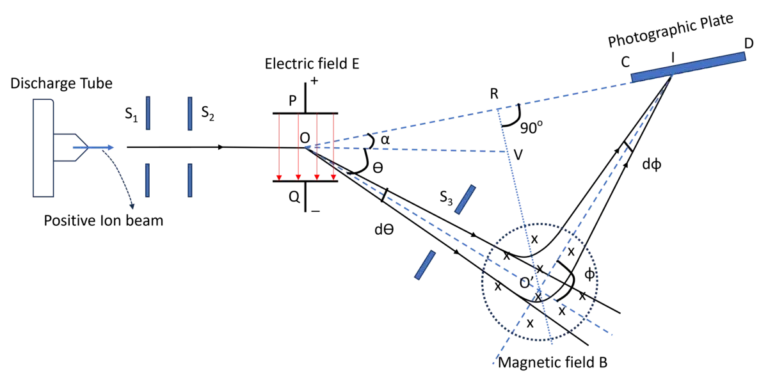
The Electric Deflection Field: A pair of parallel metallic plates (P and Q) kept at a high potential difference, which deflects the ion ribbon through a small angle θ.
The Magnetic Deflection Field: A set of circular magnetic poles that establishes a uniform magnetic field perpendicular to the plane of electric deflection, bending the rays in the opposite direction through a larger angle ϕ.
Photographic Plate: A photographic plate positioned along the focal line to record the sharp convergence of focused ion beams as distinct lines.
⚙️Working of Aston Mass Spectrograph:
Now, let us understand the working of the Aston Mass Spectrograph:
 Production of Positive Ions: The gas under study is placed in a discharge tube and ionized by applying a high voltage. This produces positively charged ions. These ions have different velocities, with some moving faster and others slower. These positive ions emerge from the ion source and move toward the narrow slit system.
 Formation of Narrow Beam: The positive ions pass through narrow slits S₁ and S₂ as shown in the figure, which produces a thin and well-defined ion beam. However, the ions still have different velocities.
 Deflection by Electric Field: After passing through the slits, the ion beam enters the electric field produced between plates P and Q. As shown in the figure, the electric field acts vertically downward. Therefore, the positive ions are deflected downward.
Since every ion has the same charge q, but not the same mass m, the force F = qE causes a transverse acceleration a = qE/m. A lighter ion accelerates more and therefore deflects more.
Slower ions remain in the electric field for a longer time and experience greater deflection, while faster ions are deflected less. Consequently, the beam spreads out and acquires an angular dispersion dθ about the mean deflection angle θ.
 Deflection by Magnetic Field: The dispersed ions then enter the magnetic field B. The magnetic force on a moving charge is F = qvB. The geometry is arranged so that the magnetic force pushes ions upward, exactly opposite to the electric deflection. Once again, heavier ions deflect less and lighter ions deflect more from the magnetic field, but in the opposite direction to the electric case.
Because the magnetic force depends on velocity, hence
- Faster ions experience a larger magnetic force.
- Slower ions experience a smaller magnetic force.
Because of this velocity dependence, the magnetic field compensates for the spreading produced by the electric field.
This effect is known as magnetic focusing.
 Focusing of Ions: As shown in Fig. (1), the ion paths pass through the magnetic field region centered at O’. Due to the combined action of the electric and magnetic fields, ions having the same mass but different velocities gradually converge.
The magnetic field produces a refocusing angle dϕ, while ϕ represents the magnetic deflection angle. This refocusing causes ions of the same mass-to-charge ratio to meet at the same point on the photographic plate.
 Recording on Photographic Plate: Finally, the focused ions strike the photographic plate CD. Each isotope forms a separate dark line on the plate. By measuring the positions of these lines, the masses of different isotopes can be determined accurately.
⚡ Aston Spectrograph Field Strength Simulator
Adjust the field strengths to see how changing E and B balances the velocity focusing condition.
🧮 Mathematical Condition for Velocity Focusing:
To understand how the Aston Mass Spectrograph focuses ions of the same mass but different velocities onto the same point on the photographic plate, let us derive the velocity-focusing condition.
As shown in Fig. (1), positive ions emerging from slit S2 enter the electric field E, where they are deflected downward. Because the ions have slightly different velocities, they emerge at slightly different angles.
Let θ be the mean electric deflection angle and dθ be the angular dispersion due to the velocity difference.
Electric Field Dispersion:
When an ion moves through the electric field, it experiences an electric force $$F_E = qE$$
For small angles, the path of the ion may be considered approximately circular with radius r.
Therefore, $$qE = \frac{mv^2}{r} \qquad or \qquad \frac{1}{r} = \frac{qE}{mv^2}$$
Since, $$\theta \propto \frac{1}{r}$$
Hence, the deflection θ is given by
$$\theta = k_1 \frac{qE}{mv^2}$$
where k1 is a constant depending on the geometry of the electric field.
To determine how the deflection changes when the velocity changes by a small amount, dv, we can differentiate this relation with respect to v:
By substituting the value of θ into this differentiated form, we get
$$\frac{d\theta}{\theta} = -2\frac{dv}{v}\qquad … (1) $$
The above equation (1) shows that the electric field produces a dispersion in the ion beam because ions with different velocities experience different deflections.
Magnetic Field Refocusing:
After leaving the electric field, the dispersed ions enter the magnetic field region B, shown around the center O′ in the figure.
The magnetic field bends the ions upward, opposite to the electric deflection, and converges the dispersed ions back together on the photographic plate.
Let ϕ be the magnetic deflection angle and dϕ be the angular refocusing produced by the magnetic field.
The equilibrium between the magnetic Lorentz force and the centripetal requirements governs the radius of curvature within a purely magnetic field. If r’ be the radius of curvature in the magnetic field, then
$$qvB = \frac{mv^2}{r’} \qquad or \qquad \frac{1}{r’} = \frac{qB}{mv}$$
Therefore, the magnetic deflection angle is
$$\phi = \frac{qBk_2}{mv}$$
where k2 is a geometrical constant. Differentiating with respect to velocity, v:
Substituting the expression for ϕ,
To determine the correct orientation of the photographic plate, consider the geometry shown in Fig. (1).
Let us draw the perpendicular O′R from the center of the magnetic field to the extension of the photographic plate CD, and ∠ROV = α. Then in the ΔROO’
⚖️ Comparison with Bainbridge Mass Spectrograph:
| S. No. | Feature | Aston Mass Spectrograph | Bainbridge Mass Spectrograph |
|---|---|---|---|
1. |
Velocity Selector |
No |
Yes |
2. |
Accuracy |
Good |
Higher |
3. |
Complexity |
Simpler |
More Complex |
4. |
Historical Importance |
First Practical Instrument |
Improved Precision |
5. |
Main Use |
Isotope Discovery |
Accurate Mass Measurement |
✅ Advantages of Aston Mass Spectrograph:
Every scientific instrument has strengths that make it valuable. Aston’s instrument offered several revolutionary advantages.
Discovery of Isotopes: The greatest achievement of the Aston Mass Spectrograph was proving that many elements contain isotopes.
Without this discovery, our modern understanding of atomic structure would be incomplete.
Accurate Mass Determination: It enabled scientists to determine atomic masses with much greater precision than earlier techniques.
Improved Atomic Theory: The instrument provided experimental evidence supporting modern atomic models.
Simultaneous Observation: Several isotopes could be observed on the same photographic plate. It simplified the analysis and comparison.
Foundation of Modern Mass Spectrometry: Today’s advanced mass spectrometers are based on the same fundamental idea introduced by Aston.
⚠️ Limitations of Aston Mass Spectrograph:
Although Aston’s invention was revolutionary, it had some limitations.
1️⃣ Limited Accuracy: Compared with modern mass spectrometers, its precision is relatively low.
2️⃣ Large Experimental Setup: The apparatus is bulky and requires careful alignment.
3️⃣ Dependence on Photographic Plates: Results must be recorded on photographic plates, making analysis slower.
4️⃣ Vacuum Requirement: A high vacuum is necessary to prevent ion collisions with air molecules.
5️⃣ Not Suitable for Complex Molecules: The instrument was mainly designed for simple ions and isotope studies.
Modern instruments are better suited for large biomolecules.
🚀 Applications of Aston Mass Spectrograph:
The significance of Aston’s work extends far beyond the laboratory. Let us connect its applications to real-world scenarios.
1️⃣ Identification of Isotopes: This is the most important application. Scientists use mass spectrographic techniques to distinguish isotopes of the same element.
Example: Chlorine exists mainly as:
- Chlorine-35
- Chlorine-37
Aston’s instrument clearly separated them.
2️⃣ Determination of Atomic Masses: Precise atomic mass values can be obtained by analyzing the positions of ion lines.
Example: The atomic masses listed in modern periodic tables originate from mass spectrometric measurements.
3️⃣ Nuclear Physics Research: Researchers use isotope data to study nuclear stability and radioactive processes.
Example: Understanding uranium isotopes is essential in nuclear energy production.
4️⃣ Chemical Analysis: Modern mass spectrometry evolved from Aston’s work and is now widely used in chemical laboratories.
Example: Identification of unknown compounds in pharmaceutical industries.
5️⃣ Space and Astrophysical Studies: Scientists analyze extraterrestrial materials using mass spectrometric techniques.
Example: Studying isotope composition in meteorites helps reveal the history of the solar system.
6️⃣ Medical Research: Mass spectrometry is widely used in biological and medical investigations.
Example: Detection of disease biomarkers in blood samples.
📌 Quick Answer Section:
❓ What is Aston Mass Spectrograph?
The Aston Mass Spectrograph is an instrument used to separate and identify positively charged ions according to their mass-to-charge ratio. It employs electric and magnetic fields to focus ions and records isotope lines on a photographic plate.
❓ Who invented Aston Mass Spectrograph?
Francis William Aston invented the Aston Mass Spectrograph in the early twentieth century. His invention led to the discovery of isotopes and earned him the Nobel Prize in Chemistry in 1922.
❓ What is the principle of Aston Mass Spectrograph?
The instrument works on the principle that charged particles experience different deflections in electric and magnetic fields depending on their mass-to-charge ratio. This allows isotopes to be separated and identified.
❓ Why is Aston Mass Spectrograph important?
It provided the first convincing evidence for isotopes and helped determine accurate atomic masses. It also laid the foundation for modern mass spectrometry techniques.
❓ What is recorded in Aston Mass Spectrograph?
The final ion positions are recorded on a photographic plate. Different isotopes produce separate lines, which can be analyzed to determine their masses.
❓ How does Aston Mass Spectrograph separate isotopes?
Isotopes have different masses but similar charges. Because of this mass difference, they experience different deflections in electric and magnetic fields and strike different positions on the photographic plate.
❓ What type of particles are used in Aston Mass Spectrograph?
The instrument uses positively charged ions generated from gases inside a discharge tube. These ions form a narrow beam that passes through electric and magnetic fields.
❓ What is meant by mass-to-charge ratio?
Mass-to-charge ratio, represented by m/q, is the ratio of an ion’s mass to its electric charge. It determines how the ion behaves in electric and magnetic fields.
❓ What is velocity focusing in Aston Mass Spectrograph?
Velocity focusing is the process in which electric dispersion and magnetic convergence are adjusted so that ions with the same mass-to-charge ratio meet at a common point.
❓ How is Aston Mass Spectrograph different from Bainbridge Mass Spectrograph?
The Aston Mass Spectrograph focuses ions using electric and magnetic fields, whereas the Bainbridge Mass Spectrograph first selects ions of a specific velocity using a velocity selector and then measures their masses more accurately.
🎓 Conclusion
The Aston Mass Spectrograph represents one of the most important milestones in modern physics. It provided the first clear evidence that elements can contain isotopes with different masses while retaining the same chemical properties.
By using carefully arranged electric and magnetic fields, the instrument separates ions according to their mass-to-charge ratio and records them on a photographic plate. This revolutionary technique enabled the accurate determination of atomic masses and transformed our understanding of atomic structure.
📝 PYQs:
The following questions are frequently asked in university examinations.
Short Answer Questions (2–3 Marks):
- Define an Aston Mass Spectrograph.
- State the principle of the Aston Mass Spectrograph.
- What is velocity focusing?
- What is the role of the photographic plate?
- Why are two slits used in the Aston mass spectrograph?
- What are isotopes?
- Who invented the Aston Mass Spectrograph?
- What is meant by mass spectrum?
Medium-Answer Questions (5 Marks):
- Explain the construction of the Aston Mass Spectrograph with a neat diagram.
- Describe the working of the Aston Mass Spectrograph.
- Discuss the principle of isotope separation in the Aston Mass Spectrograph.
- Explain velocity focusing in Aston’s instrument.
- Write a note on the importance of the Aston Mass Spectrograph.
Long Answer Questions (7–10 Marks):
- Explain the construction and working of the Aston Mass Spectrograph with a neat labeled diagram.
- Derive the focusing condition used in the Aston Mass Spectrograph.
- Discuss the applications of the Aston Mass Spectrograph in modern science.
- Compare the Aston and Bainbridge mass spectrographs.
- Explain how the Aston Mass Spectrograph led to the discovery of isotopes.
✏️ Solved Numerical Problems:
Find the distance of the photographic plate from the magnetic field:
Question 1: In an Aston mass spectrograph, an ion beam experiences an electric deflection of θ = 0.10 rad. The distance from the virtual center of the electric field to the center of the magnetic field is L = 25.0 cm. If the magnetic field is set to produce a deflection of ϕ = 0.40 rad, calculate the required distance R from the center of the magnetic field to the photographic plate to achieve velocity focusing.
Solution:
Given:
Electric deflection angle, θ = 0.10 rad
Magnetic deflection angle, ϕ = 0.40 rad
Inter-field distance, L = 25.0 cm
Find:
Focal distance, R
Calculation:
Using the derived Aston mass spectrograph focusing condition:
Substitute the given values into the equation:
Answer: The required distance from the center of the magnetic field to the photographic plate is 12.5 cm.
Find the ratio of deflection angles:
Question 2: An engineering physics student sets up an Aston mass spectrograph simulation where the inter-field length L is fixed at 30.0 cm. The focusing position on the photographic plate is measured at a distance R = 15.0 cm from the center of the magnetic field. Determine the ratio of the magnetic deflection angle to the electric deflection angle (ϕ/θ) required for sharp lines.
Solution:
Given:
Inter-field distance, L = 30.0 cm
Focal distance, R = 15.0 cm
Find:
Angle ratio, ϕ/θ
Calculation:
We begin with the focusing condition equation:
Rearranging the terms to isolate the ratio ϕ/θ gives:
Substitute our known values:
Answer: The ratio of the magnetic deflection angle to the electric deflection angle must be exactly 4 (meaning ϕ = 4θ).
Find magnetic deflection angle:
Question 3: Suppose an ion species with a mass-to-charge ratio of m/e is deflected through an electric angle θ = 0.08 rad in an Aston spectrograph configuration where L = 20.0 cm and R = 16.0 cm. Find the exact magnetic deflection angle ϕ that must be maintained by the circular pole pieces.
Solution:
Given:
Electric deflection, θ = 0.08 rad
Inter-field distance, L = 20.0 cm
Focal distance, R = 16.0 cm
Find:
Magnetic deflection angle, ϕ
Calculation:
Using the standard focusing criterion formula:
Rearranging to solve directly for ϕ:
Substitute the numerical parameters:
Answer: The magnetic deflection angle must be adjusted to 0.20 rad.
Calculate the Radius of Ion Path
Question 4. A singly ionized ion of mass 3.2 × 10⁻²⁶ kg enters a magnetic field of strength 0.4 T with a velocity of 2 × 10⁵ m/s. Calculate the radius of the circular path.
Solution:
Given: m = 3.2 × 10⁻²⁶ kg, v = 2 × 10⁵ m/s, B = 0.4 T, q = 1.6 × 10⁻¹⁹ C
Find: Radius R
Calculation: Using the formula for radius
$$R= \frac{mv}{qB}$$
Substituting the values
$$R = \frac{(3.2\times 10^{-26})(2\times 10^5)}{(1.6 \times 10^{-19})(0.4)}$$
$$R = 0.1 m$$
Answer: Thus, the ion follows a circular path of radius 10 cm.
Determine the Velocity of an Ion
Question 5. An ion enters a magnetic field of 0.5 T and moves in a circular path of radius 0.2 m. Its mass is 4.8 × 10⁻²⁶ kg. Find its velocity.
Solution:
Given: R = 0.2 m, B = 0.5 T, m = 4.8 × 10⁻²⁶ kg, q = 1.6 × 10⁻¹⁹
Calculation: Using the formula
$$v = \frac{qBR}{m}$$
Substituting the given values
$$v = \frac{(1.6 \times 10^{-19})(0.5)(0.2)} {4.8 \times 10^{-26}} $$
$$v = 3.33 \times 10^5 m/s$$
Answer: The velocity of the ion is v = 3.33 × 10⁵ m/s.
Calculate Mass-to-Charge Ratio
Question 6. An ion moves with a velocity of 3 × 10⁵ m/s in a magnetic field of 0.5 T and follows a circular path of radius 0.15 m. Determine its mass-to-charge ratio.
Solution:
Given: R = 0.15 m, B = 0.6 T, v = 3 × 10⁵ m/s
Find: Mass-to-charge ratio (m/q)
Calculation: Using the formula
$$\frac{m}{q} = \frac{BR}{v}$$
Substituting the given values, we get
$$\frac{m}{q} = \frac{(0.6)(0.15)}{3 \times 10^5}$$
$$\frac{m}{q} = 3 \times 10^{-7}$$
Answer: The required mass-to-charge ratio (m/q) is 3 × 10⁻⁷ kg/C.
Calculate Magnetic Force
Question 7. A positively charged ion of charge 1.6 × 10⁻¹⁹ C moves with a speed of 4 × 10⁵ m/s perpendicular to a magnetic field of 0.3 T. Find the magnetic force acting on it.
Solution:
Given: q = 1.6 × 10⁻¹⁹ C, v = 4 × 10⁵ m/s, B = 0.3 T
Calculation: Since
$$F = qvB$$
Substituting the given values, we get
$$F = (1.6\times 10^{-19})(4 \times 10^5)(0.3)$$
$$F = 1.92 \times 10^{-14} N$$
Answer: The magnetic force acting on the ion is F = 1.92 × 10⁻¹⁴ N.
Determine Charge of an Ion
Question 8. An ion of mass 6.4 × 10⁻²⁶ kg moves with velocity 2.5 × 10⁵ m/s in a magnetic field of 0.5 T. The radius of its circular path is 0.2 m. Calculate its charge.
Solution:
Given: m = 6.4 × 10⁻²⁶ kg, v = 2.5 × 10⁵ m/s, B = 0.5 T, R = 0.2 m
Find: Charge q
Calculation: Since
$$q = \frac{mv}{BR}$$
Substituting the given values, we get
$$q = \frac{(6.4 \times 10^{-26})(2.5 \times 10^5)} {(0.5)(0.2)} $$
$$q = 1.6 \times 10^{-19} C$$
Answer: Charge q = 1.6 × 10⁻¹⁹ C.
❓ FAQs (People Also Ask):
1. Why is Aston Mass Spectrograph called a mass spectrograph?
It is called a mass spectrograph because it records the mass spectrum of ions on a photographic plate. Different isotopes appear as separate lines, allowing scientists to determine their masses and relative abundances.
2. What is the main purpose of Aston Mass Spectrograph?
The primary purpose is to separate and identify isotopes based on their mass-to-charge ratio. It helps determine atomic masses and study the isotopic composition of elements.
3. How did Aston Mass Spectrograph help atomic theory?
The instrument provided direct evidence that many elements consist of isotopes with different masses. This discovery improved the understanding of atomic structure and nuclear composition.
4. Why are electric and magnetic fields used together?
The electric field disperses ions while the magnetic field converges them. Together they produce velocity focusing, enabling ions with the same mass-to-charge ratio to be accurately separated and recorded.
5. What is a mass spectrum?
A mass spectrum is the pattern of lines obtained on the photographic plate. Each line corresponds to ions of a particular mass-to-charge ratio and helps identify isotopes.
6. Can Aston Mass Spectrograph detect all isotopes?
It can detect many isotopes present in sufficient quantity. However, modern mass spectrometers are far more sensitive and can identify isotopes with much greater accuracy.
7. What is the difference between a mass spectrograph and a mass spectrometer?
A mass spectrograph records ion positions on a photographic plate, whereas a mass spectrometer uses electronic detectors to measure ion signals with higher precision and speed.
Message:
Thank you for reading this comprehensive guide on the Aston Mass Spectrograph. If you need articles on other physics topics, feel free to ask.