
 For High-Quality, More Free Study Notes
Visit: http://smartstudyzone.in
Contents
Toggle🔭 Introduction — Why Should You Care About This Device?
Imagine trying to sort millions of identical-looking marbles that differ only by a fraction of a milligram. Sounds impossible, doesn’t it? Yet, in the subatomic world, we need to separate isotopes—atoms of the same element that share chemical traits but hold different structural masses. How can scientists distinguish between them?
This is where the Bainbridge Mass Spectrograph becomes extremely important.
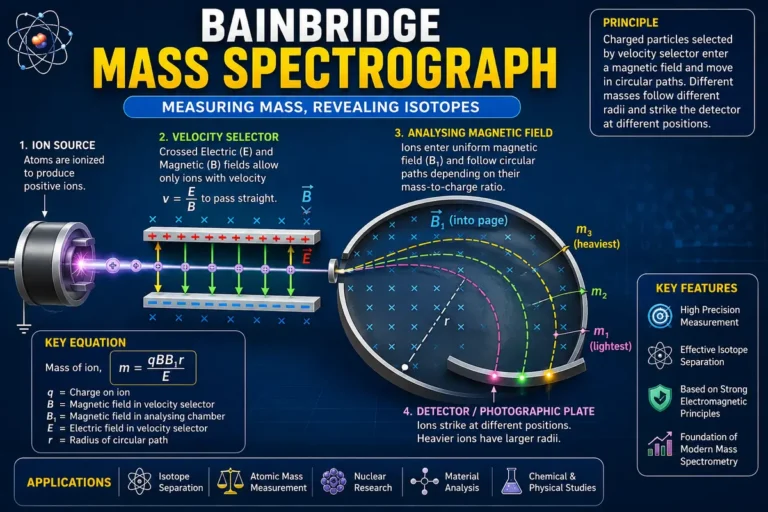
The Bainbridge Mass Spectrograph is a scientific instrument used to measure the mass of charged particles and identify isotopes accurately. It separates particles according to their mass-to-charge ratio (m/q).
Think of it like a race track. If runners start with the same speed but have different body weights, they will behave differently under certain conditions. Similarly, charged particles having different masses follow different paths inside the Bainbridge Mass Spectrograph.
This instrument played a major role in isotope identification and helped scientists understand atomic structure more deeply.
By the end of this article, you will learn:
✔ What a Bainbridge Mass Spectrograph is
✔ Its principle and construction
✔ Detailed working mechanism
✔ Complete mathematical derivation
✔ Advantages and limitations
✔ Applications in science and technology
✔ Solved numerical problems
✔ Exam-oriented questions and tips
📜 Historical Background:
The Bainbridge Mass Spectrograph was developed by the American physicist Kenneth Tompkins Bainbridge in the 1930s.
His invention significantly improved the precision of mass measurements of isotopes. Prior methods suffered from lower accuracy and limited resolution. Bainbridge’s design introduced a velocity selector that allowed particles of only a specific velocity to enter the analyzing chamber.
This innovation revolutionized isotope studies and helped physicists gain deeper insight into atomic masses.
🔍 What is a Bainbridge Mass Spectrograph?
A Bainbridge mass spectrograph is an instrument used to measure the masses of positively charged ions by separating them according to their mass-to-charge ratio.
The instrument consists primarily of:
- Ion source
- Velocity selector
- Magnetic deflection chamber
- Photographic plate or detector
The primary objective of the Bainbridge mass spectrograph is to identify isotopes and determine their masses accurately.
Importance in Modern Physics:
Although modern mass spectrometers are more advanced, the Bainbridge mass spectrograph remains important because:
- It demonstrates fundamental electromagnetic principles.
- It confirms the existence of isotopes.
- It provides accurate mass measurements.
- It serves as a foundation for modern mass analysis techniques.
- It is widely discussed in undergraduate and engineering physics courses.
Furthermore, understanding the Bainbridge mass spectrograph helps students appreciate the historical evolution of scientific instruments.
💡 Basic Concept of Bainbridge Mass Spectrograph:
The working principle of the Bainbridge mass spectrograph rests on a beautifully simple idea: when a charged particle moves through a magnetic field, the magnetic force acts as a centripetal force, causing the particle to travel in a circular arc.
The radius of this arc depends on the particle’s mass, charge, and speed. If you control the speed (using a velocity selector), and you know the charge and magnetic field strength, you can calculate the mass directly from the radius.
🏗️ Structure of Bainbridge Mass Spectrograph:
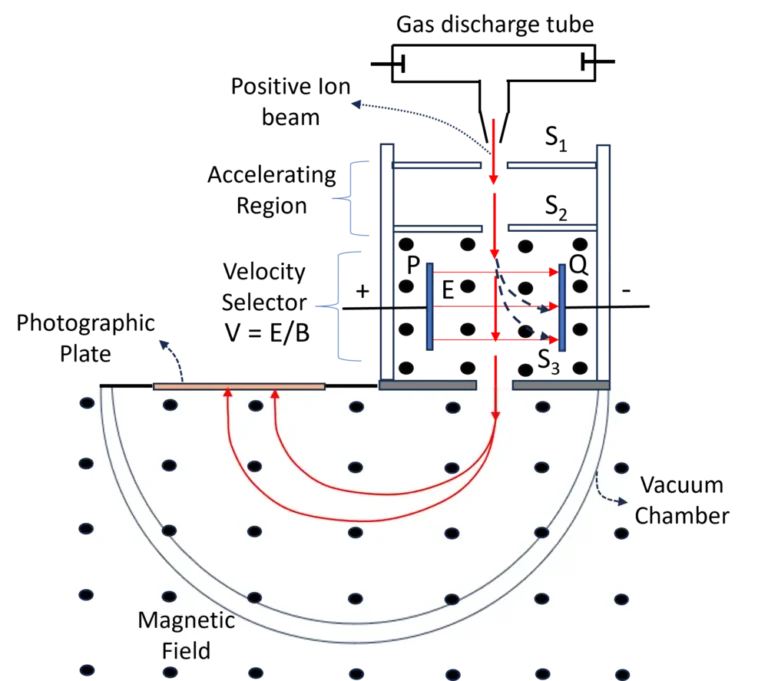
As shown in Fig. (1), the Bainbridge Mass Spectrograph consists of four main parts:
1. Ion Source: It produces positively charged ions. The slits S₁ and S₂ accelerate and collimate the ions into a narrow beam.
2. Velocity Selector: The ion beam passes through crossed electric and magnetic fields. Only ions with a specific velocity pass straight through, while others are deflected.
3. Analyzing Chamber: The selected ions pass through slit S₃ and enter a region containing a uniform magnetic field. This field bends the ions into circular paths whose radii depend on their mass-to-charge ratio.
4. Detector or Photographic Plate: The ions finally strike the photographic plate (or detector) at different positions. Since ions of different masses follow different paths, they can be identified and their masses measured accurately.
⚙️ Working of Bainbridge Mass Spectrograph:
As shown in the Fig. (1), the working of a Bainbridge Mass Spectrograph involves five main stages.
1. Ion Production:
The element to be analyzed is introduced into a discharge tube in gaseous form. Due to the applied voltage, the gas ionizes, producing positively charged ions. These ions pass through the slits S₁ and S₂, where they are accelerated and form a narrow ion beam.
2. Velocity Selection:
The ion beam then enters the velocity selector, which contains crossed electric and magnetic fields. The electric field E is produced between the parallel plates P and Q, while the magnetic field B1 acts perpendicular to both the electric field and the ion beam.
Only those ions having a velocity $$v = \frac{E}{B_1}$$
pass straight through without deflection. Ions moving with different velocities are deflected and absorbed by the plates. As a result, only ions with the same velocity emerge from the velocity selector.
3. Entry into the Analyzing Chamber:
The selected ion beam passes through the slit S₃ and enters the analyzing chamber, which is maintained under vacuum. A uniform magnetic field is present in this region.
4. Magnetic Deflection:
Inside the chamber, the magnetic field B2 bends the ions into semicircular paths. Since the ions have the same velocity but different masses, they follow circular paths of different radii. Heavier ions travel along larger-radius paths, while lighter ions follow smaller-radius paths.
5. Detection and Mass Spectrum Formation:
After completing their semicircular motion, the ions strike the photographic plate (or detector) at different positions. Ions of different masses form a separate line on the plate. It is called a mass spectrum. The number of lines obtained on the photographic plate corresponds to the number of isotopes present in the element.
Fig. (2) shows the mass spectrum for an element.
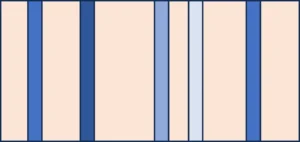
The intensities of the lines are usually different because they depend on the relative abundance of the isotopes. More abundant isotopes produce stronger lines, while less abundant isotopes produce weaker lines. Thus, line intensity provides information about the relative abundance of isotopes present in the sample.
⚡ Bainbridge Mass Spectrograph Live Simulation
Adjust the atomic mass and watch how the magnetic field affects the trajectory radius (R).
Determination of Isotopic Masses:
Consider an ion of mass M moving in the analyzing magnetic field B₂. As shown in the figure (1), the magnetic force acts as the centripetal force and makes the ion move along a circular path of radius R.
Therefore, $$qvB_2 = \frac{Mv^2}{R}$$
$$\Rightarrow R=\frac{Mv}{qB_2}$$
From the velocity selector, the velocity of the ions is
$$v=\frac{E}{B_1}$$
Substituting this value into the above equation,
$$R=\frac{ME}{qB_1B_2}$$
Now, the ions complete a semicircular path before striking the photographic plate. If x is the distance between the slit S₃ and the line formed on the photographic plate, then
$$x=2R$$
Substituting the value of R, $$x= \frac{2ME}{qB_1B_2}$$
Hence, $$M = \frac{qB_1B_2}{2E}x$$
Since q, B₁, B₂, and E remain constant for a given experiment, $$M\propto x$$
This shows that the mass of an ion is directly proportional to the distance of its spectral line from the slit S₃. Therefore, the mass scale obtained in a Bainbridge mass spectrograph is linear.
📌 Important Conclusion:
The heavier the ion, the larger the radius of its circular path and the farther its spectral line appears from the slit S₃. Thus, by measuring the position of the spectral lines on the photographic plate, the masses of different isotopes can be determined accurately.
If two isotopes have masses M₁ and M₂, and their corresponding spectral lines are located at distances x₁ and x₂ from the slit S₃, then
$$\frac{M_1}{M_2}=\frac{x_1}{x_2}$$
and the line separation on the photographic plate is given by
$$\Delta x = x_2-x_1=\frac{2E}{qB_1B_2}\left( M_2-M_1 \right) $$
⚖️ Comparison: Bainbridge Mass Spectrograph vs Aston Mass Spectrograph:
| S. No. | Feature | Bainbridge | Aston |
|---|---|---|---|
1. |
Velocity Selector |
Present |
Absent |
2. |
Accuracy |
Higher |
Lower |
3. |
Isotope Separation |
Better |
Moderate |
4. |
Principle |
Velocity Selection + Magnetic Analysis |
Magnetic Deflection |
5. |
Mass Measurement |
More Precise |
Less Precise |
✅ Advantages and Limitations:
✅ Advantages
❌ Limitations
1. High Accuracy: Provides precise mass measurement.
2. Effective Isotope Separation: Can distinguish isotopes clearly.
3. Reliable Operation: Uses well-defined electromagnetic principles.
4. Scientific Importance: Helpful in atomic and nuclear research.
5. Better Resolution: Produces clear separation of ion paths.
1. Large Instrument Size: Traditional systems occupy significant space.
2. Requires Strong Magnetic Fields: Needs carefully controlled magnetic environments.
3. Complex Alignment: Electric and magnetic fields must be accurately adjusted.
4. Limited to Charged Particles: Neutral particles cannot be analyzed directly.
🎯 Applications of Bainbridge Mass Spectrograph:
The Bainbridge mass spectrograph has numerous applications.
1. Isotope Identification: Used to separate isotopes having different masses. Example: Different isotopes of neon.
2. Atomic Mass Measurement: Provides highly accurate atomic masses.
3. Nuclear Physics Research: Helps study nuclear reactions and nuclear particles.
4. Material Analysis: Used to determine the composition of substances.
5. Foundation of Modern Mass Spectrometry: Modern mass spectrometers evolved from similar principles.
⚡ Quick Answer Section:
What is Bainbridge mass spectrograph?
A Bainbridge Mass Spectrograph is an instrument used to measure the mass-to-charge ratio of ions. It uses a velocity selector and a magnetic field to separate ions according to their masses, making isotope identification possible.
What is the principle of Bainbridge Mass Spectrograph?
The instrument works on the principle that charged particles moving through a magnetic field experience a force that causes circular motion. The radius of the circular path depends on the particle’s mass-to-charge ratio.
Why is a velocity selector used?
A velocity selector ensures that only ions having a specific velocity enter the analyzing chamber. This improves accuracy because differences in particle paths then depend only on mass.
What is the function of the magnetic field?
The magnetic field bends the path of charged particles into circular trajectories. The radius of these trajectories helps determine the mass of the ions.
How are isotopes separated?
Isotopes have different masses. When they move through the analyzing magnetic field, they follow circular paths with different radii and strike different positions on the detector.
Why do heavier ions have larger radii?
Heavier ions possess greater inertia. Therefore, they require a larger circular path radius under the same magnetic field and velocity conditions.
What is measured by a mass spectrograph?
A mass spectrograph measures the mass-to-charge ratio (m/q) of charged particles and helps identify isotopes.
What is mass spectrograph?
A mass spectrograph is a scientific instrument used to separate and measure charged particles (ions) according to their mass-to-charge ratio (m/q).
It works by passing ions through electric and magnetic fields, which deflect the ions by different amounts depending on their masses. The ions then strike a photographic plate or detector, producing a pattern called a mass spectrum.
🎓 Conclusion:
The Bainbridge mass spectrograph remains one of the most influential instruments in the history of experimental physics. By combining a velocity selector with magnetic deflection, it enables precise measurement of ion masses and effective separation of isotopes. Its development provided strong evidence for isotopic existence and significantly advanced atomic and nuclear physics.
📝 PYQs / Most Expected Questions:
Conceptual Questions:
- Define Bainbridge Mass Spectrograph.
- Explain the principle of the Bainbridge mass spectrograph.
- Why is a velocity selector used?
- How are isotopes separated using a mass spectrograph?
- Explain the role of crossed electric and magnetic fields.
Derivation Questions:
- Derive the expression v = E/B.
- Derive the equation for the radius of the ion trajectory.
- Derive the expression for mass determination in the Bainbridge mass spectrograph.
Long Answer Questions:
- Explain the construction and working of the Bainbridge mass spectrograph with a diagram.
- Compare the Bainbridge and Aston Mass Spectrographs.
🔢 Solved Numerical Problems:
Question 1. In a Bainbridge mass spectrograph, the velocity selector utilizes an electric field of 2.4 × 10⁴ V/m and a magnetic field of 0.12 T. The analyzing chamber is governed by a magnetic field of 0.25 T. Find the path radius for a singly ionized neon isotope (20Ne, mass = 3.32 × 10⁻²⁶ kg, charge q = 1.6 × 10⁻¹⁹ C.
Solution:
Given: Electric Field E = 2.4 × 10⁴ V/m, Selector Magnetic Field B1 = 0.12 T, Analyzing Magnetic Field B2 = 0.25 T, Ion Mass, m = 3.32 × 10⁻²⁶ kg, Ion Charge q = 1.6 × 10⁻¹⁹ C
Find: Path radius (R)
Calculation:
First, let us find the uniform velocity allowed through the selector slit using Eq. :
Next, determine the path radius inside the analyzing chamber using Eq. :
Answer: The path radius for the 20Ne ion is 0.166 m.
Question 2. Singly charged ions of two isotopes are fired into a Bainbridge apparatus. The velocity selector parameters yield an ion velocity of 1.5 × 10⁵ m/s. If the analyzing chamber field is 0.30 T and the impact marks on the recording plate show a spatial separation distance of 1.2 cm between the two paths, determine the mass difference between the two isotopes.
Solution:
Given: Velocity v = 1.5 × 10⁵ m/s, Analyzing Field, B2 = 0.30 T, Charge q = 1.6 × 10⁻¹⁹ C, Separation between marks, Δ x = 1.2 cm = 0.012 m
Find: Mass difference (Δm)
Calculation:
The spatial separation distance on the plate corresponds to the difference between the two circle diameters:
We rewrite our structural radius formula to express the change in mass:
Rearranging to solve for the mass difference (Δm):
Answer: The mass difference between the two isotopes is 1.92 × 10⁻²⁷ kg.
Question 3. Find the selected velocity if E = 6 × 10⁴ V/m and B = 0.3 T.
Solution: Since
$$v = \frac{E}{B}$$
Substituting the values,
$$v = \frac{6\times 10^4}{0.3}$$
$$v= 2 \times 10^5 \;m/s$$
Answer: The selected velocity is 2 × 10⁵ m/s.
Question 4. An ion of charge 1.6 × 10⁻¹⁹ C moves in a magnetic field of 0.4 T with radius 0.12 m and velocity 3 × 10⁵ m/s. Find mass.
Solution:
Since $$m = \frac{qB_2 R}{v}$$
Substituting the values,
$$m = \frac{(1.6\times 10^{-19})(0.4)(0.12)}{3 \times 10^5}$$
$$m= 2.56 \times 10^{-26} kg$$
Answer: The mass of the ion is 2.56 × 10⁻²⁶.
❓ FAQs:
What is the difference between a mass spectrograph and a mass spectrometer?
A mass spectrograph records ion trajectories on a detector or photographic plate, while a mass spectrometer measures ion signals electronically for analysis and data processing.
Who invented the Bainbridge Mass Spectrograph?
Kenneth Tompkins Bainbridge, an American physicist at Harvard University, developed his improved mass spectrograph in 1932–1933. He added a crossed-field velocity selector to existing mass spectrograph designs, dramatically improving the precision of isotopic mass measurements.
Why are crossed fields used in the velocity selector?
Crossed electric and magnetic fields allow only ions with one specific velocity to pass undeflected, ensuring accurate mass analysis.
Why is B2 separate from B1 in the Bainbridge spectrograph?
The two fields serve different purposes and must be independently adjustable. B1 works with E in the velocity selector to set the speed filter. B2 acts alone in the deflection chamber to bend the ions. If the same field served both regions, you couldn't adjust one without affecting the other, losing independent control over velocity selection and mass resolution.
Can the Bainbridge spectrograph measure the mass of molecules?
In principle, yes — any charged species can be directed through the instrument. However, molecules are far heavier than atoms, often carry charges in complex ways, and can fragment before reaching the detector. Modern mass spectrometry techniques like electrospray ionization (ESI) and matrix-assisted laser desorption (MALDI) are better suited for large molecules such as proteins.
What happens if two isotopes have the same mass-to-charge ratio?
They would land at exactly the same position on the photographic plate and couldn't be distinguished. This is called a "mass overlap." In practice, isobaric ions (same nominal mass, different elements) can be resolved only with very high-resolution mass spectrometers that measure mass differences at the fifth or sixth decimal place, beyond the capability of the basic Bainbridge design.
This is the right web site for anyone who really wants to understand this topic.
You understand a whole lot its almost hard to argue with you (not that
I actually will need to…HaHa). You definitely put a fresh
spin on a subject that has been discussed for a long time.
Excellent stuff, just excellent!
Thank you
Thank you for the kind words
thank you for kind words
Nice
than k you