
Contents
Toggle🚀 Introduction:
Have you ever wondered how scientists measure the curvature of a lens without physically touching or damaging it? One of the most elegant optical techniques used for this purpose is Newton’s Rings.
In this experiment, concentric circular interference fringes known as Newton’s rings are produced when a plano-convex lens is placed on a perfectly flat glass plate. By carefully measuring the diameters of these rings using a traveling microscope, the radius of curvature of the lens can be determined with high accuracy.
Aim of the Experiment:
To determine the radius of curvature of a plano-convex lens using Newton’s Rings method.
Importance in Engineering Physics:
Newton’s rings provide a practical demonstration of thin film interference, one of the most important phenomena in wave optics. The experiment helps students understand the relationship between wavelength, interference patterns, and lens geometry.
Applications
• Testing the quality of optical surfaces
• Determination of lens curvature
• Measurement of wavelength of monochromatic light
• Precision optical instrument calibration
• Manufacturing and testing of optical components
• Optical metrology laboratories
🎁Modified Lab Manual PDF:
🎁 Normal Lab Manual PDF:
📋 Observation Table:
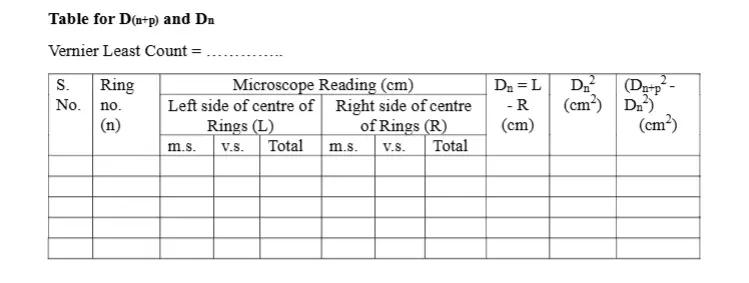
▶️ Watch on YouTube:
🎓 Experiment Summary:
| Particular | Details |
|---|---|
Experiment |
Newton’s Rings |
Objective |
Determine the radius of Curvature of a plano-convex lens |
Optical Principle |
Thin Film Interference |
Instrument Used |
Traveling Microscope |
Light Source |
Monochromatic Sodium Lamp |
Lens Used |
Plano Convex Lens |
Formula Used |
R = (Dn+p² − Dn²)/(4pλ) |
Observation |
Circular Dark and Bright Rings |
Result |
Radius of Curvature of Lens |
💡Exam-Oriented Questions and Answers:
What is Newton's Rings Experiment?
Newton’s rings experiment is an optical interference experiment used to produce concentric circular fringes by placing a plano-convex lens on a flat glass plate. The pattern helps determine the radius of curvature of the lens and study wave interference.
What is the Aim of Newton's Rings Experiment?
The aim is to determine the radius of curvature of a plano-convex lens by measuring the diameters of interference rings formed due to thin film interference.
Why Are Newton's Rings Circular?
The air film formed between the lens and glass plate has circular symmetry. Therefore, points of equal thickness form concentric circles, producing circular interference fringes.
Which Phenomenon Is Used in Newton's Rings?
Newton’s rings are based on the phenomenon of interference of light occurring in a thin air film formed between a plano-convex lens and a glass plate.
What Is the Central Spot in Newton's Rings?
The central spot is dark because the reflected light rays undergo destructive interference at the point of contact between the lens and the glass plate.
⚡ Viva Questions and Answers:
1. What are Newton's rings?
Newton’s rings are concentric circular interference fringes formed due to the interference of light in a thin air film.
2. Which phenomenon is responsible for Newton's rings?
Interference of light.
3. Why is the central ring dark?
Because destructive interference occurs at the point of contact.
4. Which lens is used in the experiment?
A plano-convex lens.
5. What is the shape of the fringes?
Concentric circular rings.
6. Why is monochromatic light used?
To obtain sharp and distinct interference fringes.
7. What instrument is used to measure ring diameters?
Traveling microscope.
8. What happens if white light is used?
Colored rings are formed instead of clear monochromatic fringes.
9. What is measured directly in the experiment?
Diameters of interference rings.
10. What is the purpose of finding ring diameters?
To calculate the radius of curvature of the lens.
11. What type of interference occurs?
Interference in reflected light.
12. What forms the thin film?
The air film between the lens and the glass plate.
13. Why are higher-order rings preferred?
They reduce percentage error and improve accuracy.
14. What is the unit of radius of curvature?
Meter (m) or centimeter (cm).
15. Name one practical application of Newton's rings.
Testing the optical flatness of surfaces.
16. What apparatus are used in the Newton's rings experiment?
The main apparatus consists of a plano-convex lens, an optically flat glass plate, a travelling microscope, a monochromatic light source (usually a sodium lamp), and Newton’s rings setup.
17. What do you understand by the interference of light?
Interference of light is the phenomenon in which two or more coherent light waves superpose to produce regions of increased intensity (bright fringes) and decreased intensity (dark fringes).
18. What will happen if the glass plate is silvered on the front surface?
If the front surface of the glass plate is silvered, most of the incident light will be reflected from that surface. As a result, interference fringes will not be clearly formed, and Newton’s rings may disappear or become indistinct.
19. Why do the rings get closer and finer as we move away from the center?
The diameter of Newton’s rings increases with the square root of the ring number. Therefore, the difference in diameter between successive rings decreases as we move outward, causing the rings to become closer and finer.
20. What will happen when a little water is introduced between the plano-convex lens and the plate?
When water is introduced, the air film is replaced by a water film having a higher refractive index. Consequently, the diameters of Newton’s rings decrease and the rings move closer to the center.
21. How does the diameter of rings change on the introduction of liquid?
The diameter of the rings decreases because the diameter is inversely proportional to the refractive index of the medium between the lens and the glass plate. A liquid with a higher refractive index produces smaller rings.
Mathematically, $$D_n^2 = \frac{4nλR}{μ}$$
where μ is the refractive index of the liquid.
22. Can you find out the refractive index of a liquid by this experiment?
Yes. By comparing the diameters of Newton’s rings formed in air and in the liquid, the refractive index of the liquid can be determined using:
$$\mu = \frac{D_{air}^2}{D_{liquid}^2}$$
where:
- Dair = Diameter of a ring in air
- Dliquid = Diameter of the same ring in the liquid
❓ FAQs:
Q1. How is the radius of curvature calculated in Newton's rings experiment?
The radius of curvature is calculated using the diameters of interference rings and the wavelength of monochromatic light through Newton's rings formula.
Q2. Why is sodium light commonly used in Newton's rings?
Sodium light produces nearly monochromatic radiation, resulting in sharp and well-defined interference rings.
Q3. What causes the formation of Newton's rings?
Newton's rings are formed due to interference between light reflected from the upper and lower surfaces of the thin air film.
Q4. Why are the rings concentric circles?
The air film thickness increases uniformly in all radial directions from the point of contact, creating circular fringes.
Q5. What are the major sources of error in Newton's rings experiment?
Improper focusing, parallax error, inaccurate diameter measurement, dust particles, and non-uniform illumination are common sources of error.
⭐ Related Experiments:
Students studying Newton’s Rings should also explore the following optics experiments:
1. Fresnel’s Biprism Experiment:
Determination of the wavelength of monochromatic light using interference fringes.
2. Diffraction Grating Experiment:
Measurement of the wavelength of light using diffraction principles.
3. Laser Diffraction Experiment:
Determination of grating element using a laser source.
4. Optical Fiber Experiment:
Determination of numerical aperture and acceptance angle.