
Have you ever noticed the beautiful rainbow colors on a soap bubble or the shimmering patterns on an oil spill floating on water? These stunning visuals are not just random—they are the result of thin film interference, one of the most elegant phenomena in wave optics.

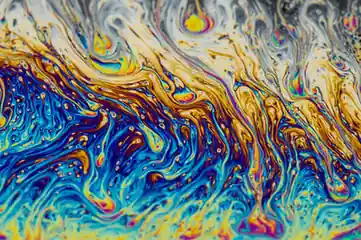
A thin film is essentially a layer of material whose thickness is comparable to the wavelength of visible light—usually in the range of a few hundred to a few thousand nanometers.
When we talk about a thin parallel film, we are referring to a medium bounded by two plane surfaces that are perfectly parallel to each other. When light falls on such a film, it undergoes multiple reflections, leading to interference.
Why should we care? Beyond the aesthetics of soap bubbles, this phenomenon is a cornerstone of modern technology. From the anti-reflection coatings on your expensive camera lenses that ensure crisp photos to the high-tech sensors used in aerospace engineering, understanding how light dances between two parallel surfaces is vital.
By the end of this journey, you won’t just learn thin film interference—you’ll start to see light in a whole new way. The beautiful colors around you will no longer feel random but perfectly explained.
You’ll clearly understand why these colors appear, how to calculate path difference, and when bright or dark fringes form. Step by step, we’ll simplify the mathematics and explore fringe patterns—so the topic feels intuitive, not complicated.
Let’s start from the very beginning.
Contents
Toggle1. Basic Concept of Interference:
Before we dive into the film itself, let’s recall the fundamental idea. Interference is the redistribution of light energy in a medium due to the superposition of two or more light waves.
1.1. The Principle of Superposition:
When two or more waves travel through the same space at once, the displacement at any point is the algebraic sum of the displacements due to each wave. This is the principle of superposition. To know more about the principle of superposition, click here.
1.2. Conditions for sustained Interference:
- Sources must be coherent
- Waves must have the same frequency (wavelength)
- Waves must have a constant phase difference
This foundation helps us understand how thin films produce colorful patterns.
2. Formation of Thin Film Interference:
Let’s now visualize what happens when light strikes a thin parallel film.
Consider a thin film of uniform thickness t and refractive index μ. A monochromatic ray of light AB is incident on the upper surface at an angle of incidence i.
At point B, the ray is partially reflected along BR1 and partially refracted along BC at an angle of refraction r. At point C on the bottom surface, the ray is partially reflected toward D on the top surface and partially refracted along CT1. Similarly, at points D and E, it again suffers partial reflection and refraction, as shown in the figure below.
Finally, we obtain two light rays, BR1 and DR2, from reflection and CT1 and ET2 from transmission. These light rays are of approximately equal amplitude and interfere to produce an interference pattern.
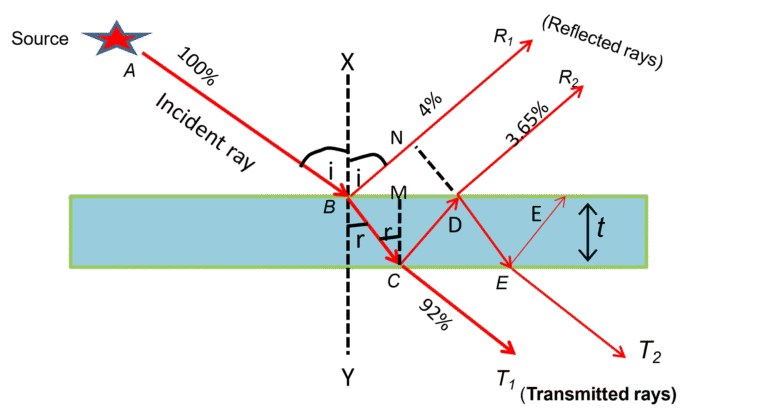
The interference pattern observed from the same side of a thin film, where the light is incident, is often termed “interference due to reflected light,” while the pattern seen from the other side is termed “interference due to transmitted light.”
2.1. Thin film Interference due to Reflected light:
The optical path difference Δ between the two reflected rays, BR1 and DR2, is calculated by looking at the extra distance traveled by the second ray inside the medium compared to the first ray in the air.
The path difference between the two reflected rays:
$$\Delta=\left( BC+CD \right)_{in\ film}-\left( BN \right)_{in\ air}$$
$$\Rightarrow \Delta=\mu\left( BC+CD \right)-BN \qquad ……….(1)$$
Here, BN is the projection of the reflected ray in air. From the geometry of the parallel film, we can derive the following results:
$$BC=CD=\frac{t}{cos\,r} \qquad … (2)$$
Now, from the figure,
$$sin\,i=\frac{BN}{BD}= \frac{BN}{BM+MD}$$
$$\Rightarrow BN =\left( BM+MD \right)sin\,i$$
$$\Rightarrow BN =\left( CM\,tan\,r+CM\, tan\,r \right)sin\,i$$
$$\Rightarrow BN =2t\,tan\,r\;sin\,i$$
$$\Rightarrow BN =2t\,tan\,r\;\mu sin\,r \qquad\left[ Since\; \mu=\frac{sin\,i}{sin\,r} \right]$$
$$\Rightarrow BN=2\mu t\; \frac{sin^2r}{cos\,r}\qquad ………… (3)$$
Now putting the value from eq. (2) and (3) in eq. (1), the path difference is
$$\Delta=\frac{2\mu t}{cos\,r}-2\mu t\frac{sin^2r}{cos\,r}$$
$$\Rightarrow \Delta=\frac{2\mu t}{cos\,r}(1-sin^2r) $$
$$\Rightarrow \Delta=2\mu t\;cos\,r\qquad …………(4)$$
2.1.1. The "Stoke’s Treatment" Correction:
When light reflects off a medium that is denser than the one it is currently in (like air to glass), it undergoes a phase change of π, which is equivalent to adding or subtracting a path difference of λ/2.
Therefore, the effective path difference between reflected lights is
$$\Delta=2\mu t\,cos\,r+\frac{\lambda}{2} \qquad …………..(5)$$
2.1.2.  Conditions for Interference by thin parallel film:
 Conditions for Interference by thin parallel film:
- For Constructive Interference (Bright Fringes):
For a bright fringe, the total path difference must be an integral multiple of wavelengths. Hence
$$2\mu t\,cos\,r+\frac{\lambda}{2}=n\lambda$$
$$\Rightarrow 2\mu t\,cos\,r=\left(2n-1 \right)\frac{\lambda}{2}\qquad ……..(6)$$
This equation is the condition for maxima in reflected light.
- For Destructive Interference (Dark Fringes):
For a dark fringe, the total path difference must be a half-integer multiple of λ. Hence,
$$2\mu t\,cos\,r+\frac{\lambda}{2}=\left( 2n+1 \right)\frac{\lambda}{2}$$
$$\Rightarrow 2\mu t\,cos\,r=n\lambda\qquad …….(7)$$
This is the condition for minima in reflected light.
2.2. Thin film Interference due to Transmitted light:
Similarly, as in reflected light, we can derive the conditions for bright and dark fringes in transmitted light. Here, the conditions are
- The conditions for bright fringes:
$$2\mu t\,cos\,r=n\lambda$$
- The conditions for dark fringes:
$$2\mu t\,cos\,r=\left( 2n-1 \right)\frac{\lambda}{2}$$
- Therefore, the conditions for maxima and minima in the reflected light are just the reverse of those in the transmitted light.
- Hence, the film, which appears bright in reflected light, will appear dark in transmitted light and vice versa.
- Hence, the reflected and transmitted interference patterns are complementary.
3. 🎨 Why Do Thin Films Show Colors?
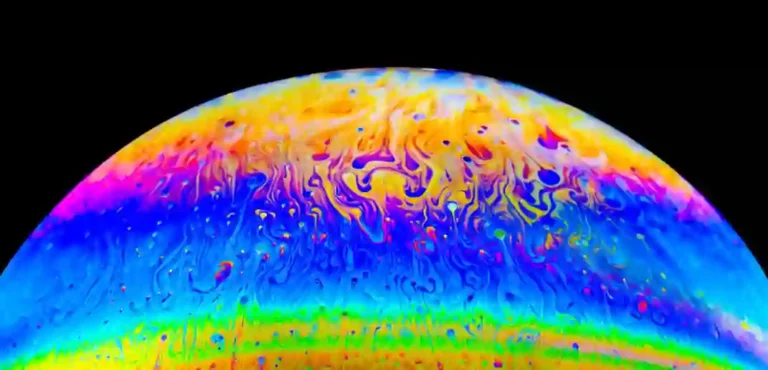
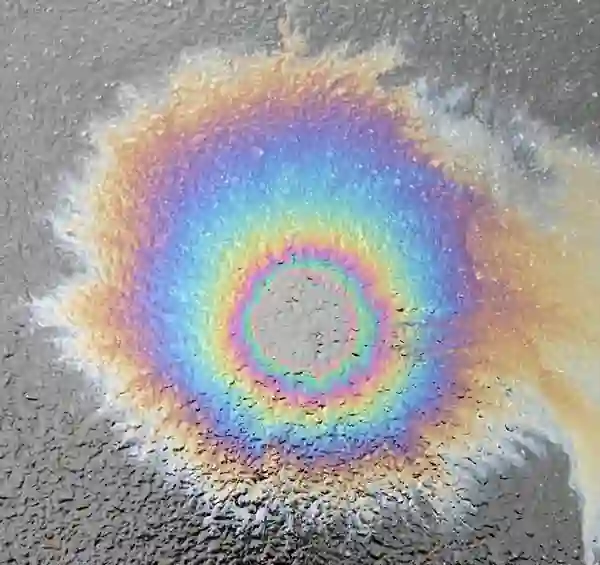
Thin films show colors due to the interference of light waves reflected from their upper and lower surfaces. When white light falls on a thin film, different wavelengths interfere differently: some undergo constructive interference and are strongly reflected, while others undergo destructive interference and are canceled. As a result, only certain wavelengths (colors) are visible.
Since the condition for interference depends on the film’s thickness and viewing angle, different regions of the film may reflect different colors. This is why soap bubbles and oil films display beautiful, shifting rainbow patterns. This effect is known as iridescence.
4. 🔄 Types of Fringes in Thin Films:
The beautiful interference patterns formed in thin films come in two varieties, and understanding the distinction between them is important for both theory and application.
1. Fringes of Equal Thickness
- Produced when film thickness varies
- Example: wedge-shaped film
- Fringes appear parallel
2. Fringes of Equal Inclination
- Produced in films of uniform thickness
- Observed at different viewing angles
- Fringes appear circular
| S. No. | Feature | Fringes of Equal Thickness | Fringes of Equal Inclination |
|---|---|---|---|
1. |
Film Geometry |
Variable thickness (Wedge) |
Constant thickness (Parallel) |
2. |
Variable Factor |
Thickness (t) |
Angle of incidence (i) |
3. |
Fringe Shape |
Straight lines (usually) |
Concentric circles |
4. |
Localization |
Near the film surface |
At infinity |
5. 🛠️ Applications of Thin Film Interference:
Anti-Reflection (AR) Coatings: By applying a thin film of MgF₂ to a lens such that 2μt = λ/2, we create destructive interference for reflected light. This forces the light to be transmitted rather than reflected, making the lens “invisible.”
Optical Testing: Engineers use thin-film interference to verify the flatness of optical surfaces. If a surface isn’t perfectly flat, the interference fringes will be distorted.
Interference Filters: These allow only a very narrow band of color to pass through, used in spectroscopy and laser applications.
Oil Slick Detection: Environmental scientists use the interference patterns captured in aerial photography to identify and measure the thickness of oil spills in the ocean.
6. ⚠️ Important Points to Remember:
- One reflection (from a denser medium) causes phase reversal (π shift).
- The thickness of the film is crucial in determining interference.
- Works for both reflected and transmitted light.
- Color depends on wavelength and viewing angle.
7. Quick Answers Section:
What is thin film interference?
Thin film interference occurs when light reflects from the top and bottom surfaces of a thin transparent layer, producing two coherent rays. These rays interfere due to path differences and phase changes, creating bright and dark patterns or colors depending on wavelength, thickness, and refractive index.
How is path difference calculated in thin film interference?
The path difference in thin film interference is given by Δ = 2μt cosr, where μ is the refractive index, t is the thickness, and r is the angle of refraction. An additional λ/2 is included if reflection occurs from a denser medium, accounting for phase reversal.
What factors affect thin film interference patterns?
Thin film interference patterns depend mainly on thickness (t), wavelength (λ), refractive index (μ), and angle of incidence (i). These variables control path difference and phase change, which determine whether constructive or destructive interference occurs, affecting brightness and color distribution.
What is the condition for constructive interference in thin films?
Constructive interference occurs when the effective path difference equals an integer multiple of the wavelength. For reflected light, the condition is 2μt cos r = (2n-1)λ/2, where n is an integer. Phase changes at boundaries must also be considered for accurate results.
What is the condition for destructive interference in thin films?
Destructive interference occurs when the path difference equals an odd multiple of half-wavelengths. The condition is 2μt cos r = nλ. This results in cancellation of waves, producing dark regions or missing colors in thin film patterns.
What is the formula for path difference in thin films?
The path difference is given by Δ = 2μt cos r, where μ is the refractive index, t is the thickness, and r is the angle of refraction. If a phase change occurs during reflection, an additional λ/2 term must be included in calculations.
What are fringes of equal thickness?
Fringes of equal thickness are interference patterns formed when the thickness of the film varies gradually. These fringes appear as parallel bands and are commonly observed in wedge-shaped films where thickness changes along one direction.
What causes phase change in thin film interference?
A phase change occurs when light reflects from a boundary where the second medium has a higher refractive index. This introduces a phase shift of half a wavelength (λ/2), which significantly affects whether interference becomes constructive or destructive.
Why do oil films on water show rainbow colors?
Oil films create colorful patterns due to thin film interference. Light reflecting from different layers interferes, enhancing some wavelengths and canceling others. Since film thickness varies across the surface, different colors appear at different positions, creating a rainbow-like effect.
Why do thin films appear colored under white light?
White light contains many wavelengths. In a thin film, different wavelengths interfere differently due to varying path differences. Some colors are reinforced while others cancel out, resulting in the vivid colors observed in soap bubbles or oil films.
How does thickness affect thin film interference?
Thickness determines the path difference between reflected rays. As thickness increases, interference conditions change, shifting colors and fringe spacing. Even slight variations in thickness can produce noticeable changes in the observed pattern.
8. ✍️ Conclusion:
Interference by a thin parallel film is a beautiful marriage of geometry and wave physics. We’ve seen how a simple delay in a light ray’s journey can lead to the vivid colors of a soap bubble or the high-performance capabilities of a telescope lens.
Key Takeaways:
Interference occurs via the division of amplitude between the top and bottom surfaces.
The fundamental equation for path difference is Δ = 2μt cosr.
A phase shift of λ/2 must be accounted for in reflected light (Stokes’ Law).
The phenomenon is thickness and angle-dependent.
9.❓Important Questions for Exam Preparation:
- Derive the condition for thin film interference.
- Explain phase change on reflection.
- What are fringes of equal thickness?
- Why do soap bubbles show colors?
Why does a very thin film (thickness << λ) appear dark in reflected light?
Derive the expression for the path difference in a thin parallel film for transmitted light. How does it differ from the reflected case?
10. 🧠 Solved Problems on Thin Film Interference:
Find Minimum Thickness for Destructive Interference:
Question: A soap film (μ = 1.33) is illuminated with light of wavelength 600 nm. Find the minimum thickness of the film for destructive interference in reflected light.
Solution:
For destructive interference in reflected light:
For minimum thickness, n = 1
∴ t = λ / 2μ
Substitute values:
Answer: Minimum thickness = 225.56 nm
Path Difference Calculation:
Question: A thin film has a thickness of 300 nm and a refractive index of 1.4. Calculate the path difference for normal incidence.
Solution:
Answer: Path difference = 840 nm
11. ❓ Frequently Asked Questions (FAQs):
Q1: Why do soap bubbles show different colors?
As the soap bubble drains due to gravity, its thickness changes from top to bottom. Different thicknesses interfere constructively with different colors of the white light spectrum.
Q2: Is interference observed in thick films?
Generally, no. In thick films, the path difference becomes much larger than the coherence length of the light, causing the interference patterns to overlap and wash out in uniform illumination.
Q3: What happens to the energy during destructive interference?
Energy is not destroyed. It is simply redistributed. If light interferes destructively in reflection, it interferes constructively in transmission.
Q4: Does the color change if I tilt the film?
Yes. Changing the angle of inclination changes the value of cosr in the path difference equation, which shifts the condition for constructive interference to a different wavelength.
Q5: What is the phase change on reflection?
When light reflects from a denser medium, it undergoes a 1800 (π radians) phase shift, equivalent to a path difference of λ/2.
Q6: Where is thin film interference used?
In coatings, optics, and sensors.