
 For High-Quality, More Free Study Notes
Visit: https://smartstudyzone.in
Contents
Toggle1. 📘 Introduction to Optical Fibre:
In today’s digital world, communication technology is advancing at lightning speed. From streaming ultra-HD videos to connecting entire continents through the internet, optical fibre technology plays a major role in modern communication systems. The different types of optical fibre are designed to meet various transmission needs, ensuring faster, more reliable, and efficient data transfer.
Optical fibres are thin strands made of glass or plastic that carry information using light signals. Unlike traditional copper wires, they provide extremely high bandwidth and very low signal loss. That’s why telecom companies, hospitals, industries, and even military organizations rely heavily on optical fibre networks.
As technology evolves, the demand for advanced optical fibre systems keeps increasing. Different environments require different fibre characteristics. Some fibres are suitable for long-distance communication, while others are ideal for short-range networking or medical instruments.
In this article, you will learn:
- What optical fibre is
- Different classifications of optical fibre
- Construction and working of each type
- Advantages and limitations
- Real-world applications
- Comparison between different fibres
- Solved numericals and exam questions
By the end of this article, you will have a crystal clear understanding of optical fibre types in a simple and engaging way.
2. 📜 Historical Background of Fibre optics:
The idea of transmitting light through a medium was first demonstrated by John Tyndall in the 19th century using the principle of total internal reflection.
Later, scientists developed thin transparent glass fibres capable of carrying light signals efficiently. In the 1960s, Charles K. Kao proposed the use of optical fibres for communication. Due to his revolutionary contribution, he is known as the Father of Fibre Optics and received the Nobel Prize in Physics.
Today, fibre optics forms the foundation of modern digital communication systems.
3. ⚙️ Basic Concepts of Optical Fibre:
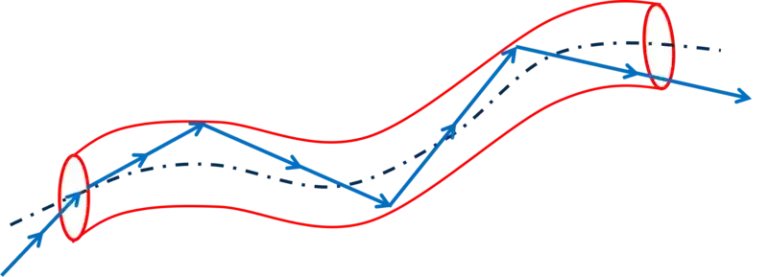
An optical fibre is a thin, flexible, transparent fibre made of glass or plastic that transmits light from one end to another using the principle of total internal reflection.
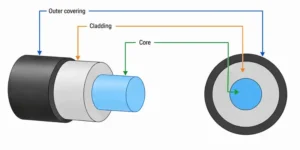
It mainly consists of:
- Core – Central region through which light travels
- Cladding – Surrounds the core and has a lower refractive index
- Protective Coating – Protects the fibre from damage
The core has a higher refractive index than the cladding. Because of this difference, light remains trapped inside the core and propagates through it by total internal reflection.
4. 🔬 Why Different Types of Optical Fibre Are Needed?
Not all communication systems have identical requirements. Some need high bandwidth over thousands of kilometres, while others prioritise low cost or flexibility.
Different types of optical fibre exist because:
- Communication distances vary
- Signal bandwidth requirements differ
- Industrial conditions change
- Installation costs matter
- Data transmission speed requirements vary
For example:
- Internet backbones use single-mode fibres.
- Home networks often use multimode fibres.
- Medical equipment may use specialised fibres.
This variety helps engineers select the most efficient fibre for a specific application.
5. 🧮 Classification of Optical Fibre:
Optical fibres are mainly classified based on:
- Mode of Propagation
- Refractive Index Profile
- Material Used
5.1. Types of Optical Fibre Based on Modes:
1. Single Mode Fibre:
Single-mode optical fibre is one of the most important types of optical fibre used in modern telecommunication systems.
It has a very small core diameter, typically around 8–10 micrometers. Because of this narrow core, only one light path or mode can propagate through the fibre.
2. Multimode Optical Fibre:
Multimode optical fibre allows multiple light paths or modes to travel simultaneously through the core. Its core diameter is much larger than single mode fibre, typically around 50–100 micrometers.
5.2 Types of Optical Fibre Based on Refractive Index:
1. Step Index Optical Fibre:
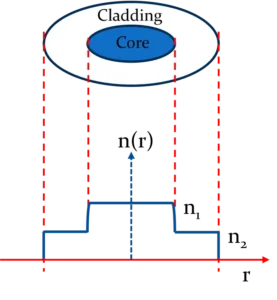
Step-index optical fibre gets its name because the refractive index of the core is constant in the radial direction and drops suddenly to a lower value at the cladding-core boundary. The refractive index profile looks like a step. $$n_1 \gt n_2$$ Here, n1 is the refractive index of the core, and n2 is the refractive index of the cladding.
In this type of optical fibre, light propagates in the form of meridional rays, which cross the fibre axis during every reflection at the core-cladding interface.
The variation of the refractive index of a step-index fibre as a function of radial distance can be mathematically represented as
$$n(r)= \begin{Bmatrix}
n_1 \qquad(When \;r < a, in\; the\; Core) \\ n_2 \qquad(When\; r > a, in\; cladding)\end{Bmatrix}$$
Here, 𝑎 is the core radius, and r is the radial distance from the axis.
Working Principle: Light rays reflect sharply at the core-cladding boundary.
Types: Step-index optical fibre is of two types.
- Single Mode Step Index Fibre
- Multimode Step Index Fibre
1.1. Single Mode Step Index Fibre (SMSIF):
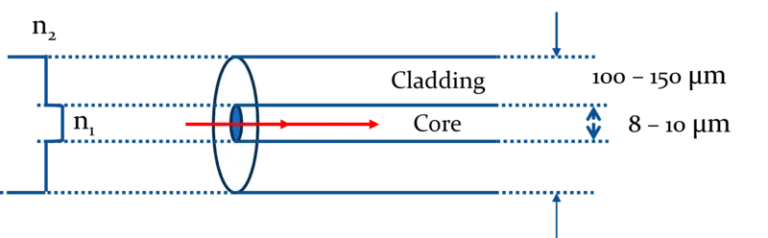
In a single-mode step-index fibre,
- The refractive index of the core (n1) is uniform throughout the cross-section, and it drops sharply to n2 at the core-cladding boundary.
- The core diameter is extremely small—typically between 8 µm and 10 µm, while the cladding diameter is around 125 µm.
- Because of this narrow core, only a single mode can propagate through it. This mode is parallel to the fibre axis (zero-order mode).
- Both Δ and NA are very small for single-mode fibres.
- This small value is obtained by reducing the fibre radius and by making Δ small.
- The low NA means a low acceptance angle. Therefore, light coupling into the fibre becomes difficult.
It is designed to have a V number between 0 and 2.4.
It requires a monochromatic and coherent light source. Therefore, laser diodes are used along with single mode fibres.
(i) Advantages of SMSIF:
- Exceptionally low signal loss over long distances,
Because of a single mode of propagation, loss due to intermodal dispersion does not exist.
- Massive data bandwidth.
- Attenuation: Very low (~0.2 dB/km at 1550 nm)
- It can carry information across oceans without losing signal clarity.
(ii) Disadvantages of SMSIF:
- The tiny core makes connecting and splicing fibers difficult and requires highly precise, expensive laser alignment systems.
Manufacturing and handling of SMF are more difficult.
The fiber is costly.
Launching light into a fibre is difficult
(iii) Applications of SMSIF:
Single-mode optical fibres are widely used in:
- Telecommunication systems
- Internet infrastructure
- Cable television networks
- Military communication
- Long-distance networking
These fibres form the backbone of global internet connectivity.
1.2. Multimode Step Index Fibre (MMSIF):
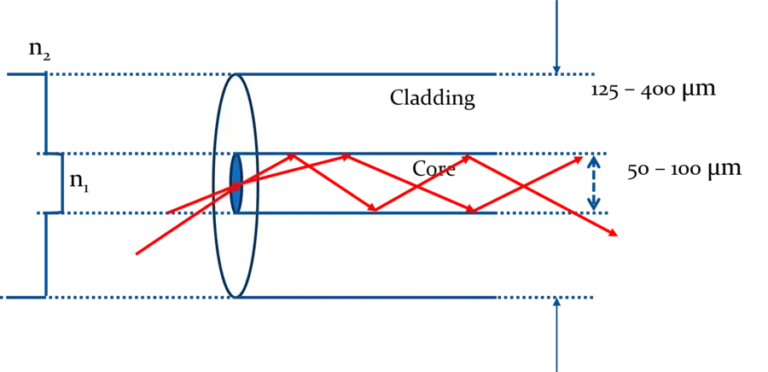
In the multimode step-index fiber,
- The refractive index profile is identical in shape to the single-mode step-index fibre, but the core diameter is much larger.
- The core diameter is typically 50 µm to 200 µm, and the external diameter of cladding is about 150 to 250 µm.
- The larger core allows many rays to enter at different angles and travel along different paths inside the fibre simultaneously.
- Each such ray path is called a mode, and hundreds or even thousands of modes can propagate in a large-core multimode fibre.
- The numerical aperture is larger.
(i)Advantages of MMSIF:
- Very easy to align, couple, and connect due to the large core.
- It works reliably with cheap LED light sources, keeping installation costs down.
Launching light into a fibre is easier.
(ii) Disadvantages of MMSIF:
- Light rays traveling at wider angles take longer paths than rays traveling straight down the center, causing data pulses to blur over long distances. This limits its use to short runs.
- Suffers heavily from intermodal dispersion.
It has a smaller bandwidth.
Due to higher dispersion, the data rate is lower and transmission is less efficient.
It is less suitable for long-distance communications.
(iii) Applications of MMSIF:
Used in,
- Local area networks
- Short-distance communication
- Educational laboratories
2. Graded-Index Fibre (GIF):
Graded-Index fibers address a major limitation of multimode step-index fibers called intermodal dispersion (where different light rays arrive at different times, blurring the signal).
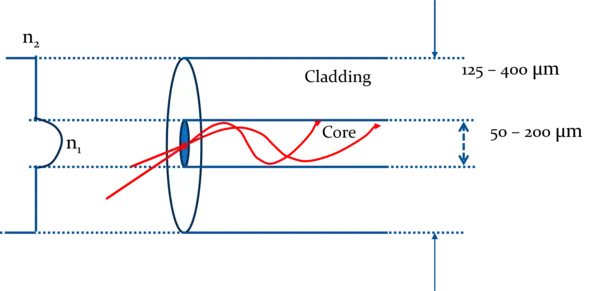
In a GRIN fibre, the refractive index of the core is not uniform. It has a maximum value at the centre of the core and decreases gradually towards the outer edge of the core. This gradual variation causes light rays to follow curved paths instead of zigzag reflections.
At the core-cladding interface, the refractive index of the core matches the refractive index of the cladding. The refractive index of the cladding is constant.
In this type of optical fibre:
- Core diameter is in the range of 50-100 μm.
- The numerical aperture is smaller than that of a step-index multimode fibre.
- The number of modes in a graded-index fibre is about half that in a similar multimode step-index fibre.
- The light rays propagate through it in the form of skew rays or helical rays. They do not cross the fibre axis at any time.
The variation of the refractive index of a graded-index fibre as a function of radial distance can be mathematically represented as
$$n(r)= \begin{Bmatrix}
n_1\sqrt{1-2\Delta\left( \frac{r}{𝑎} \right)^\alpha} \qquad for \;r \le a, \\ n_2 \qquad\qquad\qquad\qquad for\; r \gt a,\end{Bmatrix}$$
Here, α is the profile exponent. When α = 2, the profile is perfectly parabolic, and this is the optimal condition that minimizes intermodal dispersion. When α –> ∞, the profile approaches a step-index profile. The parabolic case (α = 2) is therefore the standard for graded-index fibres.
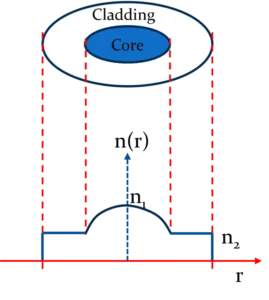
Working Principle: Light rays near the outer region travel faster because the refractive index is lower there. This compensates for longer travel paths and reduces dispersion.
(i)Advantages of GRIN Fibre:
- It has minimum attenuation.
- Intermodal dispersion is zero, but material dispersion is present.
- It has better bandwidth than multimode step-index fibre.
- Either an LED or a laser can be used as the source of light with GRIN fibres.
- Light at the fibre edges moves faster and compensates for its longer path, so all rays arrive almost simultaneously. Hence, improved signal quality.
(ii) Disadvantages of GRIN Fibre:
- More complex and expensive to manufacture due to the precisely graded chemical doping required to create the parabolic index curve.
It is expensive.
Coupling the fibre to the light source is difficult.
(iii) Applications of MMSIF:
These types of optical fibres are used in:
- High-speed local networks
- Medium-distance communication
- Video transmission systems
5.3. Types of Optical Fibre Based on Material:
These types of optical fibres are classified into three categories that deal with the materials used for the core and cladding:
- Glass-glass fibre
- Plastic – plastic fibre
- PCS (Plastic Clad Silica)
1. Glass-glass optical fiber
Glass optical fibres are a type of optical fibres that uses silica as the base material, and by adding different dopants, the refractive index of the core and cladding can be adjusted to guide light efficiently through the fibre.
Pure silica has a refractive index of about 1.458 at a wavelength of 850 nm. To obtain different refractive indices, silica is mixed with small amounts of other materials, a process called doping.
Increasing the Refractive Index:
- When silica is doped with germanium dioxide (GeO₂) or phosphorus pentoxide (P₂O₅), its refractive index increases.
- These materials are usually used to make the core of the optical fibre, while pure silica is used as the cladding.
Decreasing the Refractive Index:
- When silica is doped with boron oxide (B₂O₃) or fluorine (F), its refractive index decreases.
- In this case, pure silica is often used as the core, and the doped material is used as the cladding.
Common Examples of Glass Optical Fibres:
- SiO₂ Core – B₂O₃·SiO₂ Cladding
- GeO₂·SiO₂ Core – SiO₂ Cladding
Advantages:
- Very low attenuation
- Suitable for long-distance communication
- High bandwidth
Limitations:
- Expensive
- Fragile
Applications:
- Internet backbone
- Undersea communication cables
- Medical imaging
2. Plastic - plastic optical fiber:
In these types of optical fibres, plastic materials are used for the core and cladding rather than glass.
Core Material:
- The core is usually made of PMMA (Polymethyl Methacrylate), also known as Perspex, or Polystyrene.
- These materials have relatively high refractive indices, which help guide light through the fibre.
Cladding Material:
- The cladding is commonly made of a fluorocarbon polymer or silicone resin.
- These materials have a lower refractive index than the core, creating a large refractive-index difference between the core and the cladding.
Light Acceptance:
- Because of this large refractive index difference, plastic optical fibres have:
- High Numerical Aperture (NA), typically around 0.5
- Large acceptance angle, up to about 77°
- This allows the fibre to collect and transmit light more easily.
Advantages of Plastic Optical Fibre:
- Low cost compared to glass fibres
- Highly flexible and durable
- Easy to install and handle
- Suitable for short-distance communication
Limitations:
- Higher signal loss
- Lower bandwidth
Applications:
- Decorative lighting
- Short-distance communication
- Automotive systems
3. PCS Fibres:
Plastic-Clad Silica (PCS) fibre is a type of optical fibre that combines the advantages of both glass and plastic fibres. It consists of a high-purity silica (quartz) core surrounded by a plastic cladding with a lower refractive index.
The cladding is usually made of silicone resin or Teflon-based polymers, which help keep light confined within the core through the principle of total internal reflection. Since the core is made of silica, PCS fibres transmit light more efficiently than all-plastic fibres. At the same time, the plastic cladding makes them more flexible, durable, and easier to handle than all-glass fibres.
PCS fibres generally have lower transmission loss than plastic optical fibres, but higher loss than all-glass fibres. They are also less expensive than glass fibres and offer a relatively large acceptance angle, making light coupling easier. However, their higher attenuation limits their use in long-distance communication.
Advantages of PCS Fibre:
- Better light transmission than plastic fibres
- More flexible and durable than glass fibres
- Easy to install and handle
- Lower cost than all-glass fibres
- Good resistance to bending and mechanical stress
Limitations of PCS Fibre:
- Higher attenuation than all-glass fibres
- Lower bandwidth for long-distance communication
- Mainly suitable for short and medium transmission distances
Applications of PCS Fibre:
- Industrial control and automation systems
- Medical instruments and sensors
- Automotive communication systems
- Data transmission over short distances
- Instrumentation and monitoring systems
6. ⚖️ Comparison b/w Different Types of Optical Fibre:
| S. No. | Feature | Single-Mode Step-Index | Multimode Step-Index | Multimode Graded-Index |
|---|---|---|---|---|
1. |
Core Diameter |
8–10 µm |
50–200 µm |
50–62.5 µm |
2. |
Cladding Diameter |
125 µm |
125–250 µm |
125 µm |
3. |
Index Profile |
Step (uniform core) |
Step (uniform core) |
Parabolic (graded) |
4. |
Number of Allowed Modes |
1 |
Hundreds to thousands |
Hundreds (≈ half of MMSIF) |
5. |
Intermodal Dispersion |
None |
Very High |
Very Low |
6. |
Bandwidth |
Extremely High (THz) |
Low (10–100 MHz·km) |
High (200 MHz–few GHz·km) |
7. |
Attenuation |
~0.2 dB/km |
~3–5 dB/km |
~1–3 dB/km |
8. |
Numerical Aperture |
0.10–0.15 |
0.20–0.50 |
0.20–0.30 |
9. |
Light Source |
Laser (coherent) |
LED or laser |
LED or laser |
10. |
Coupling |
Difficult (tiny core) |
Easy (large core) |
Moderate |
11. |
Cost |
Higher |
Lower |
Moderate |
12. |
Typical Applications |
Telecom, submarine cables |
LAN, sensors, short-links |
Gigabit LAN, data centres |
7. Working Mechanism of Optical Fibre:
The operation of optical fibre involves converting electrical signals into light signals. The process occurs in several stages:
- Electrical signals are generated.
- A transmitter converts them into light pulses.
- Light travels through the fibre core.
- Total internal reflection keeps light confined.
- A receiver converts light back into electrical signals.
This mechanism allows incredibly fast and reliable communication.
8. 🧠Quick Answer Section
1. Why graded-index fiber have less dispersion than step-index multimode fiber?
Graded-index fiber features a parabolic core profile where the refractive index decreases outward from the center. Light rays traveling along outer paths pass through lower-index glass and speed up, balancing out the longer physical distance they travel. As a result, all modes arrive together, minimizing pulse broadening.
2. What is the function of cladding in an optical fiber?
The cladding is an outer glass or plastic layer with a lower refractive index than the inner core. This difference in refractive indices creates a sharp boundary that enables total internal reflection, trapping light inside the core and allowing it to travel long distances without escaping.
3. What are the main types of optical fibre?
The main types of optical fibre are single-mode fibre, multimode fibre, step-index fibre, graded-index fibre, glass fibre, plastic fibre, and plastic-clad silica (PCS) fibre. These fibres differ in their material, refractive index profile, core size, and mode of light propagation.
4. What is single-mode optical fibre?
Single-mode optical fibre is a fibre with a very small core diameter (about 8–10 μm) that allows only one light path to travel. It offers high bandwidth, low signal loss, and minimal dispersion, making it ideal for long-distance communication and high-speed internet networks.
5. What is multimode optical fibre?
Multimode optical fibre has a larger core diameter (typically 50–100 μm) that allows multiple light rays to travel simultaneously. It is easier to connect and less expensive than single-mode fibre, but it experiences higher dispersion and is mainly used for short-distance communication.
6. What is the difference between step-index and graded-index fibre?
In a step-index fibre, the refractive index changes abruptly between the core and cladding. In a graded-index fibre, the refractive index gradually decreases from the centre of the core toward the cladding. This gradual change reduces dispersion and improves signal quality.
7. Why is graded-index fibre better than step-index fibre?
Graded-index fibre reduces modal dispersion because light rays near the outer edge travel faster than those near the centre. As a result, different light rays reach the end of the fibre almost simultaneously, providing better signal quality and higher transmission speed.
8. What is Plastic-Clad Silica (PCS) optical fibre?
Plastic-Clad Silica (PCS) fibre is a hybrid optical fibre that uses a silica glass core and a plastic cladding. It combines the good transmission properties of glass fibres with the flexibility and lower cost of plastic fibres, making it suitable for short- and medium-distance applications.
9. Which optical fibre is used for long-distance communication?
Single-mode fibre is the most widely used optical fibre for long-distance communication. Its small core allows only one mode of light to propagate, minimizing dispersion and signal loss over long distances.
10. What are the advantages of plastic optical fibre?
Plastic optical fibre is lightweight, flexible, inexpensive, and easy to install. It has a large numerical aperture and acceptance angle, allowing efficient light coupling. These advantages make it suitable for short-distance communication, automotive systems, and decorative lighting.
11. Which type of optical fibre has the highest bandwidth?
Single-mode optical fibre has the highest bandwidth because only one light mode travels through its core. This eliminates modal dispersion and enables the transmission of large amounts of data at very high speeds over long distances.
12. Which optical fibre is best for communication?
The best optical fibre for communication depends on the application. Single-mode fibre is best for long-distance and high-speed communication, while multimode fibre is preferred for short-distance networks. PCS fibre provides a balance between performance, flexibility, and cost for medium-distance applications.
9. 🧠 Conclusion:
Optical fibre technology has revolutionized the modern communication world. Understanding the types of optical fibre is essential because different fibres serve different purposes. Single mode fibres dominate long-distance communication, while multimode fibres are suitable for short-range systems. Similarly, graded index fibres improve signal quality by reducing dispersion.
From internet communication and medicine to defence and industrial automation, optical fibre has become an inseparable part of modern life. As technology continues to advance, fibre optics will play an even bigger role in building faster and smarter communication networks.
10. 📝 PYQs / Most Expected Questions:
- Describe optical fibre and its principle.
- Differentiate between single-mode and multimode fibre.
- Explain the graded-index fibre with a diagram.
- Write the advantages and applications of optical fibre.
- Compare step-index and graded-index fibres.
11.❓ FAQs:
1. Which optical fibre is best for long-distance communication?
Single-mode fibre is best for long-distance communication because it has very low attenuation and minimal dispersion.
2. What is the difference between glass and plastic optical fibre?
Glass fibre offers lower loss and higher bandwidth, while plastic fibre is cheaper and more flexible but has higher attenuation.
3. Why is cladding used in optical fibre?
Cladding prevents light from escaping the core and helps maintain total internal reflection.
4. What material is used in optical fibre?
Optical fibres are mainly made from silica glass or plastic materials.
5. Does optical fibre use electricity?
No, optical fibre transmits information using light signals instead of electrical currents.
6. Where are optical fibres used?
Optical fibres are used in telecommunications, internet networks, medicine, military systems, industries, and scientific research.