
Visit:  https://smartstudyzone.in
For High-Quality, More Free Study Notes
Contents
Toggle1. 📘 Introduction to Optical Fibre
In today’s digital world, communication has become extremely fast. Whether you are watching videos, attending online classes, or making video calls, there’s a high chance that optical fibre technology is working behind the scenes.
An optical fibre is a thin, flexible strand of glass or plastic that carries light signals from one point to another using the principle of Total Internal Reflection.
Unlike copper wires, it transmits data much faster with very low signal loss. Due to its high speed and reliability, optical fibre is widely used in internet communication, medical imaging, military systems, and underwater cables.
By the end of this comprehensive guide, you will master:
- The structure of optical fibre
- Principle of optical fibre
- Total internal reflection and critical angle
- Construction and working mechanism
- Easy derivations of numerical aperture and acceptance angle
- V-number and number of modes
- Advantages and limitations
- Applications of optical fibre
- Solved numerical problems
- Exam-oriented questions and FAQs
Whether you are preparing for your B.Tech or B.Sc. exams, JEE Advanced, or simply curious about optical fibre technology, this article is completely for you.
2. 📜 Historical Background of Optical Fibre
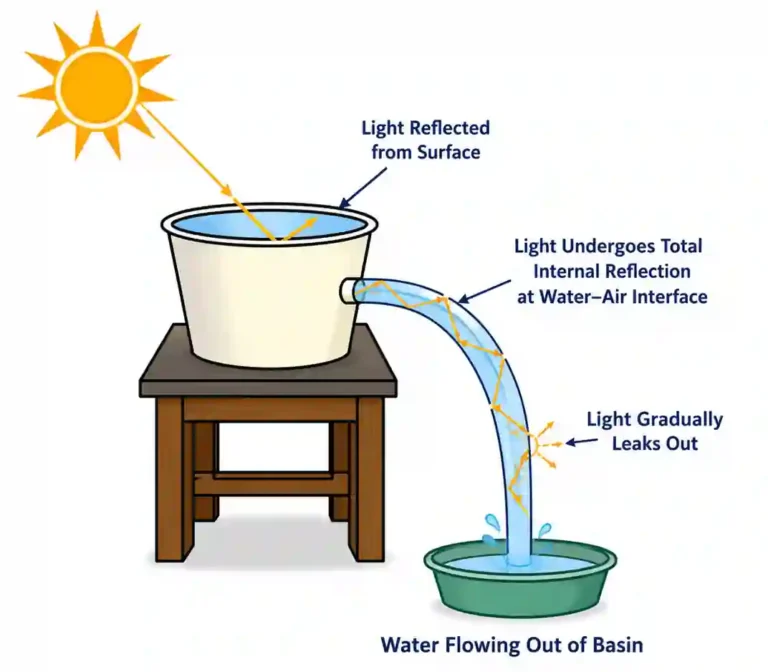
The concept of optical fibre began with experiments related to the transmission of light through transparent materials. The first important demonstration was performed in 1870 by John Tyndall. He showed that light could travel through a curved stream of flowing water because of total internal reflection. This experiment proved that light can follow a bent path without escaping outside the medium.
This discovery later became the basic principle used in optical fibre technology.
Afterwards, many scientists worked on improving light transmission through glass materials. The development of lasers and high-purity glass in the 20th century made fibre optic communication practically possible.
A major breakthrough came in 1966 when Charles K. Kao explained that highly purified glass fibres could carry light signals over very long distances with extremely low energy loss. His research laid the foundation of modern optical fibre communication systems and earned him the Nobel Prize in Physics in 2009.
Today, optical fibres are widely used in internet communication, medical instruments, military systems, cable television, and global submarine communication networks.
3. ⚙️ Basic Concept of Optical Fibre:
3.1. Definition:
An optical fibre is a thin, flexible, transparent fibre made of glass or plastic that carries light from one end to another through the principle of total internal reflection.
The diameter of an optical fibre is usually very small, often comparable to a human hair. Despite being tiny, it can transmit enormous amounts of data over long distances with minimal loss.
In simple words, optical fibre acts like a pipeline for light signals.
3.2. Structure and Construction of Optical Fibre:
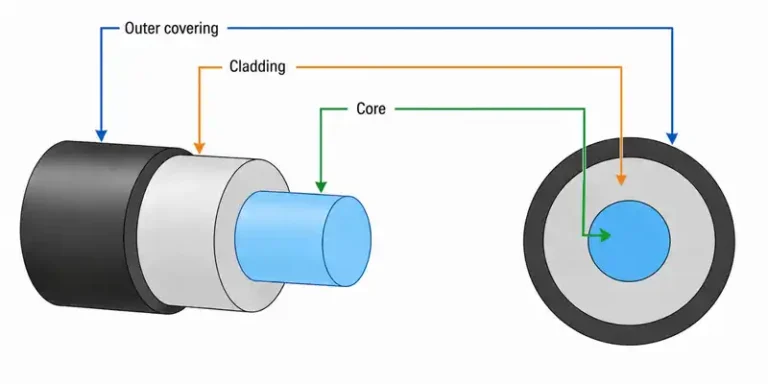
An optical fibre consists of three main concentric layers.
1. Core:
The core is the innermost cylindrical region through which the light actually travels. It is made of high-purity silica glass (SiO₂) doped with germanium or phosphorus to increase its refractive index. The core diameter ranges from about 8 µm (in single-mode fibres) to 50–62.5 µm (in multi-mode fibres). Think of the core as the actual road the light drives on.
Features of the core:
- Made of glass or plastic
- Has a high refractive index
- Determines transmission capacity
The size of the core differs depending on the type of optical fibre.
2. Cladding:
Surrounding the core is the cladding — a layer of glass or plastic with a slightly lower refractive index than the core. This difference, though tiny (often less than 1%), is entirely responsible for total internal reflection. Without the cladding, light would leak out in all directions. The cladding diameter is typically 125 µm for standard telecommunication fibres.
Functions of cladding:
- Prevents light from escaping
- Has a lower refractive index than the core
- Helps maintain total internal reflection
Without cladding, efficient transmission wouldn’t be possible.
3. Protective Coating/Sheath:
The outer protective layer protects the fibre from:
- Moisture
- Physical damage
- Environmental effects
This coating increases the durability and lifespan of optical fibre cables.
4. 🔬 Principle of Optical Fibre:
The working principle of optical fibre is based on Total Internal Reflection (TIR).
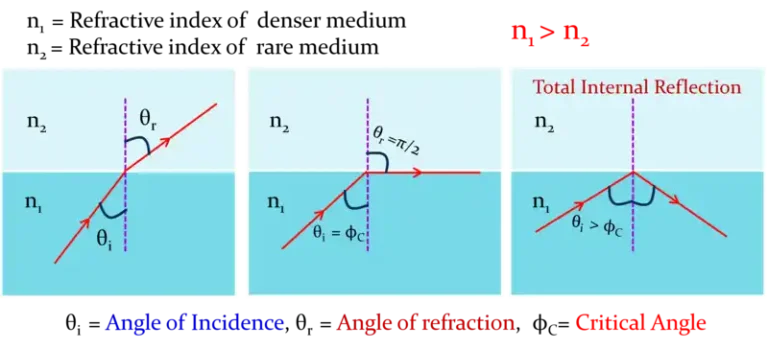
When light travels from a denser medium (core, n1) to a rarer medium (cladding, n2) at an angle greater than the critical angle (ϕc), the light gets completely reflected back into the core.
In this way, light continuously reflects inside the core. As a result, signals can travel long distances with very little loss.
4.1. Total Internal Reflection:
Total internal reflection occurs when:
- Light travels from a denser medium to a rarer medium
- The angle of incidence is greater than the critical angle
Under these conditions, the refracted ray disappears, and the entire light reflects back into the denser medium, as shown in the following figure.
From the figure, applying Snell’s law at the air-core interface:,
$$n_1 sin\,\theta_i = n_2\, sin\,\theta_r \qquad … (1)$$
4.2. Critical Angle:
The critical angle is the minimum angle of incidence in the denser medium for which the angle of refraction becomes 90°.
At θi = ϕc, θr = 90°, from the above equation (1)
$$n_1 sin\,\phi_c = n_2\, sin\,90^0$$
$$sin\,\phi_c = \frac{n_2}{n_1 }\qquad … (2)$$
Where: ϕc = Critical angle, n1 = Refractive index of denser medium, n2 = Refractive index of rarer medium
5. 🧮 Working Principle of Optical Fiber:
- Entry of Light Signal: A laser or LED source sends light into the core of the optical fibre.
- Total Internal Reflection: The light ray strikes the core-cladding interface at an angle greater than the critical angle and reflects completely back into the core.
- Multiple Reflections: The light continues reflecting repeatedly inside the core while moving forward.
- Signal Reception: At the receiving end, the optical detector converts light signals into electrical signals.
Thus, information is transmitted rapidly and efficiently.
6. 🧮 Difference between optical fiber and copper cable:
| S. No. | Feature | Optical Fibre | Copper Cable |
|---|---|---|---|
1. |
Transmission Medium |
Light |
Electrical Signals |
2. |
Speed |
Very High |
Moderate |
3. |
Bandwidth |
Large |
Limited |
4. |
Signal Loss |
Very Low |
Higher |
5. |
Weight |
Light weight |
Heavy |
6. |
Security |
High |
Moderate |
7. |
Cost |
Higher Initial Cost |
Lower Initial Cost |
7. 🧮 Optical Fibre Parameters:
Optical fiber parameters are the important physical and optical quantities that determine the performance and efficiency of an optical fiber communication system. These parameters affect light propagation, signal transmission, bandwidth, and communication quality.
The main optical fibre parameters are:
- Acceptance Angle
- Acceptance Cone
- Relative Refractive Index Difference
- Numerical Aperture (NA)
- Modes of Propagation
- V-Number (Normalized Frequency)
- Attenuation
- Dispersion
7.1. Acceptance Angle:
The acceptance angle is the maximum angle at which light can enter the fibre and still propagate through it successfully. A larger acceptance angle means easier light coupling into the fibre.
Let us derive the expressions for the Acceptance Angle (θmax)
Consider an optical fibre with core refractive index n1 and cladding refractive index n2. Let the medium outside the fibre (usually air) be n0.
A ray of light enters the core at an angle θi with the axis of the fibre. It is then refracted into the core at an angle θr and strikes the core-cladding interface at an angle ϕ.
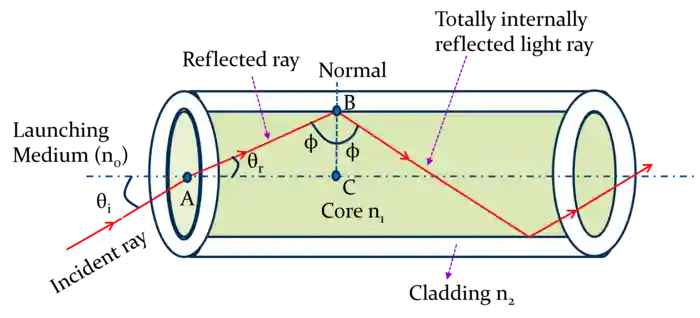
Applying Snell’s law to the launching face of the fibre, we get
$$n_0 sin\,\theta_i = n_1 sin\,\theta_r \qquad … (3)$$
In ΔABC, $$\theta_r = 90^0-\phi$$
$$\Rightarrow sin\,\theta_r = sin(90^0-\phi)$$
$$\Rightarrow sin\,\theta_r = cos\,\phi \qquad … (4) $$ Using eq. (3) and (4), we get
$$sin\,\theta_i = \frac{n_1}{n_0} cos\,\phi$$
If θi is increased beyond a limit, ϕ will drop below the critical value ϕc, and the ray escapes from the sidewalls of the fibre.
The largest value of θi occurs when ϕ = ϕc; hence,
$$sin\,\theta_{max} = \frac{n_1}{n_0} cos\,\phi_c \qquad … (5) $$
Using the trigonometric identity $$\cos \phi_c = \sqrt{1 – \sin^2 \phi_c}$$
Using eq. (2), we get
Substituting eq. (6) into eq. (5):
If the external medium is air ( n0 ≈ 1), then:
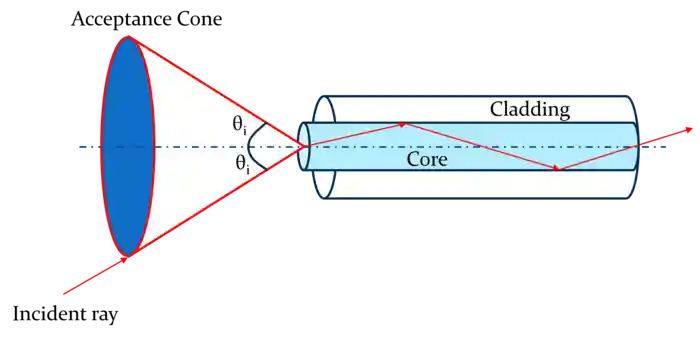
7.2. Acceptance Cone:
The acceptance cone is the imaginary cone formed by rotating the acceptance angle around the fibre axis. Any light ray entering within this cone can propagate through the fibre successfully.
Features of Acceptance Cone:
- Defines the allowable region for light entry.
- Depends on the numerical aperture.
- A larger cone means better light acceptance.
7.3. Fractional Refractive Index Change (Δ):
The fractional refractive index change is the ratio of the difference between the refractive indices of the core and the cladding to the refractive index of the core. It measures the relative “drop” in refractive index at the core-cladding boundary. Hence
$$\Delta = \frac{n_1-n_2}{n_1} \qquad … (9) $$
For total internal reflection to occur efficiently without causing excessive signal dispersion, Δ must be kept very small—typically on the order of 0.01 to 0.001 (1% to 0.1%) for standard telecommunication fibres.
7.4. Numerical Aperture (NA):
Numerical aperture is a dimensionless parameter that quantifies the light-gathering ability of an optical fiber. It determines how much light can enter the fibre core and propagate successfully.
The numerical aperture NA is defined as the sine of the acceptance angle. Hence
$$NA = sin\, \theta_{max}$$
$$\Rightarrow \color{Red}{\Large NA = \sqrt{n_1^2 – n_2^2}}$$
High NA: The fibre can capture more light from broader angles (useful for short-distance applications using cheaper light sources like LEDs).
Low NA: The fibre accepts a narrower cone of light but reduces pulse spreading, making it ideal for high-speed, long-distance communication using lasers.
7.5. Modes of Propagation:
When we study the propagation of light in an optical fiber using wave theory, we come across the concept of modes of propagation.
As light travels through the fibre core, it continuously reflects from the core-cladding boundary. Some light waves combine in phase and strengthen each other due to constructive interference. These waves can travel successfully through the fibre. On the other hand, some waves become out of phase and weaken because of destructive interference.
The specific paths along which light waves remain in phase and propagate through the fibre are called modes.
The number of modes in an optical fiber depends on several factors:
- Increasing the refractive index of the core increases the number of propagating modes.
- Increasing the refractive index of the cladding decreases the number of modes.
- The number of modes also depends on the ratio d/λ, where d is the diameter of the fibre core, and λ is the wavelength of light.
A larger core diameter or smaller wavelength allows more modes to propagate through the optical fiber.
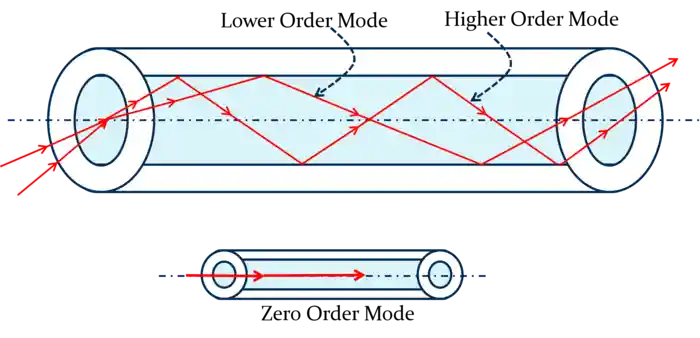
7.5.1. Types of modes:
1. Zero-Order Mode (The Fundamental Mode):
The zero order mode is the simplest mode of propagation.
In this mode:
- Light travels almost parallel to the fibre axis
- The ray undergoes very few reflections
- Path length is minimum
- Signal distortion is very small
This mode is usually found in single-mode fibres.
Characteristics of Zero-Order Mode:
- Highest transmission efficiency
- Lowest attenuation
- Very high bandwidth
- Minimal pulse spreading
2. Lower-Order Modes:
Lower-order modes are the light paths that make small angles with the fibre axis. In this mode:
- Rays undergo fewer reflections
- Path length is shorter
- Transmission loss is low
- Signals reach faster than higher modes
Features of Lower-Order Modes:
- Better signal quality
- Reduced dispersion
- Less delay in communication systems
These modes are more stable compared to higher-order modes.
3. Higher-Order Modes:
Higher-order modes are the light rays that travel at larger angles relative to the fibre axis. These rays undergo many reflections inside the core.
Characteristics of Higher-Order Modes:
- Longer propagation path
- More reflections
- Larger signal delay
- Increased dispersion
Since higher-order modes travel longer distances within the fibre, they reach the output later than lower-order modes. This creates pulse broadening, which reduces communication quality.
7.6. V-Number (Normalized Frequency):
The V-number determines the number of modes that can propagate through the optical fiber.
7.7. Attenuation:
Attenuation is the gradual loss of optical power during transmission through the fibre. It is usually measured in decibel per kilometer (dB/km).
Causes of Attenuation:
- Absorption losses
- Scattering losses
- Bending losses
Importance:
- Lower attenuation improves communication distance.
- High attenuation reduces signal strength.
7.8. Dispersion:
Dispersion is the spreading of light pulses as they travel through the optical fiber. It causes pulse broadening and signal distortion.
Importance:
- Dispersion limits bandwidth.
- Excessive dispersion reduces communication quality.
8. ⚖️ Summary of Optical Fiber Parameters
| S. No. | Parameter Name | Symbol | Dimension / Unit | Physical Meaning |
|---|---|---|---|---|
1. |
Fractional Index Change |
Δ |
Dimensionless |
Index step contrast between core & cladding |
2. |
Numerical Aperture |
NA |
Dimensionless |
Light-gathering efficiency and acceptance cone |
3. |
V-Number |
V |
Dimensionless |
Total mode capacity index |
4. |
Cutoff Wavelength |
λc |
Meters (μm or nm) |
Boundary below which multi-mode behavior begins |
5. |
Attenuation |
α |
dB/km |
Power loss per unit distance |
9. Types of Rays:
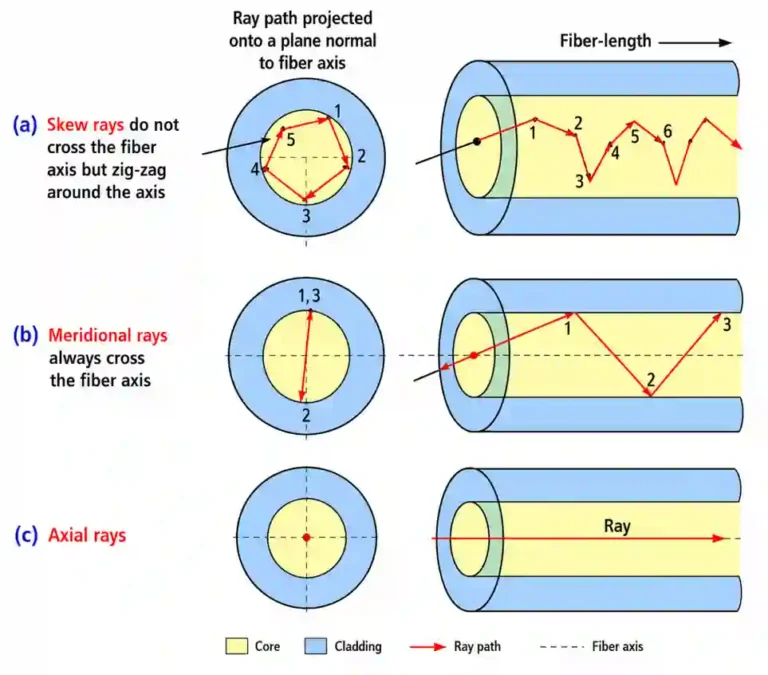
While “modes” describe light as a wave, we often use Ray Theory to visualize the path light takes. Based on their path, rays are classified into two main categories: Meridional Rays and Skew Rays.
1. Meridional Rays:
Meridional rays are the rays of light that pass through the central axis of the optical fibre during propagation.
These rays repeatedly reflect at the core-cladding boundary while always crossing the fibre axis.
Characteristics of Meridional Rays:
- Pass through the fibre axis
- Follow the zig-zag path
- Undergo total internal reflection
- Common in multimode fibres
2. Skew Rays:
Skew rays are the rays that propagate through the optical fibre without crossing the central axis.
Instead of moving in a single plane, these rays follow a helical or spiral path around the fibre axis.
Characteristics of Skew Rays:
- Do not cross fibre axis
- Travel in a spiral path
- Undergo continuous total internal reflection
- Path length is longer than the meridional rays
10. ✅ Advantages of Optical Fibre:
Optical fiber offers numerous benefits over traditional cables.
1. High Speed: Optical fiber supports extremely high data transfer rates. Modern fibre networks can deliver gigabit internet speeds with ease.
2. Large Bandwidth: More information can travel simultaneously through optical fiber. This makes it ideal for:
- Streaming
- Video conferencing
- Cloud computing
3. Low Signal Loss: Signal attenuation in optical fibre is very low. As a result:
- Long-distance communication becomes possible
- Fewer repeaters are needed
4. Immunity to Electromagnetic Interference: Unlike copper wires, optical fibre is unaffected by electromagnetic fields. Therefore, signal quality remains stable.
5. Lightweight and Flexible: Optical fibre cables are:
- Thin
- Lightweight
- Easy to install
This simplifies infrastructure development.
6. Enhanced Security: Tapping optical fibre is difficult. Hence, it provides better data security.
11. ✅ Disadvantages of Optical Fibre:
Despite many advantages, optical fiber also has some limitations.
1. High Initial Cost: Installation and equipment costs can be expensive.
2. Fragility: Glass fibres can break if bent excessively. Careful handling is necessary.
3. Complex Installation: Joining optical fibres requires skilled technicians and specialized tools.
4. Difficult Repair Process: Repairing damaged fibre cables can be time-consuming. Still, the long-term benefits usually outweigh these drawbacks.
12. 🚀Applications of Optical Fibre
Optical fibre technology is used in numerous fields.
- Telecommunications: The telecom industry heavily depends on optical fibre.
Applications include:
- Telephone communication
- Internet services
- Television broadcasting
Submarine optical fiber cables connect continents worldwide.
2. Medical Field: Doctors use optical fiber in:
- Endoscopy
- Laser surgeries
- Medical imaging
Flexible fibres help doctors view internal organs without major surgery.
3. Military and Defense: Optical fibre provides secure communication systems for defense operations. Benefits include:
- Resistance to interference
- High security
- Reliable transmission
4. Industrial Uses: Industries use optical fibre for:
- Sensors
- Automation systems
- Quality inspection
Fibre optic sensors can monitor temperature, pressure, and strain accurately.
5. Internet and Networking: Modern broadband connections rely on optical fibre. Popular technologies include:
- FTTH (Fibre to the Home)
- Fibre broadband
- Data centers
This has revolutionized global internet connectivity.
13. 🧠 Quick Answer Section:
1. What is optical fibre?
Optical fibre is a thin transparent strand of glass or plastic that transmits light signals using total internal reflection for communication purposes.
2. What is the principle of optical fibre?
The principle of optical fibre is total internal reflection, where light reflects completely within the fibre core without escaping.
3. What is total internal reflection?
Total internal reflection is the complete reflection of light back into a denser medium when the angle of incidence exceeds the critical angle.
4. What is the use of optical fibre?
Optical fibre is used in internet communication, medical imaging, cable television, industrial inspection, and military communication.
5. Why is optical fibre faster than copper cable?
Optical fibre transmits information using light signals, which travel faster and experience lower energy loss than electrical signals in copper wires.
6. What is numerical aperture of an optical fibre?
Numerical Aperture (NA) is a dimensionless number that characterizes the light-gathering capability of an optical fibre. Mathematically, it is the sine of the acceptance angle, calculated as NA = √n12 – n22, where n1 and n2 are the refractive indices of the core and cladding.
7. What is acceptance angle in optical fibre?
The acceptance angle is the maximum angle at which a light ray can enter the fibre face (measured from the fibre axis) and still undergo total internal reflection inside the core. Rays entering within this angle are guided; rays outside it escape into the cladding and are lost.
8. What is the V-number in optical fibre?
The V-number (normalised frequency) is V = (πd/λ)NA.
9. Why is cladding used in optical fibre?
Cladding is essential because it provides a lower refractive index medium surrounding the core. This creates the interface necessary for total internal reflection to occur. It also protects the core from surface contaminants and reduces signal “leakage” between adjacent fibres in a bundle.
10. What is the fractional refractive index change?
It is the ratio of the difference between the core and cladding indices to the core index. It’s a measure of the “strength” of the waveguide.
14. 🧠 Conclusion:
Optical fibre has completely transformed modern communication systems. Thanks to its high speed, low signal loss, large bandwidth, and excellent security, it has become essential in today’s connected world.
From internet services to healthcare and defense systems, optical fibre technology continues to shape the future. Although installation costs can be high, its long-term advantages make it one of the most valuable innovations in communication engineering.
As technology advances further, optical fibre will continue powering faster internet, smarter cities, and next-generation communication networks across the globe.
15. 📝PYQs / Most Expected Questions:
- Define optical fibre and explain its principle.
- Explain total internal reflection with conditions.
- Derive an expression for the numerical aperture of an optical fibre.
- Explain the construction and working of optical fibre.
- Explain applications of optical fibre communication.
- Define critical angle and derive its formula.
- Write the advantages and limitations of optical fibre.
- Define the mode in an optical fibre.
- Differentiate between lower-order and higher-order modes.
- Explain meridional rays with a diagram.
- What are skew rays in optical fibre?
- Differentiate between meridional rays and skew rays.
16. 🔢 Solved Numerical Problems:
1. Finding Acceptance Angle and Numerical Aperture:
Question: A fibre has a core refractive index of 1.6 and a cladding refractive index of 1.4. Calculate the numerical aperture and the acceptance angle.
Solution:
Given: n1 = 1.6, n2 = 1.4, n0 = 1.0(air).
Find: NA, θmax.
$$NA = \sqrt{n_1^2 – n_2^2} = \sqrt{1.6^2 – 1.4^2} = \sqrt{2.56 – 1.96} = \sqrt{0.6} \approx 0.774$$
$$\theta_{max} = \sin^{-1}(NA) = \sin^{-1}(0.774) \approx 50.7^\circ$$
Result: The Numerical Aperture is 0.774, and the Acceptance Angle is 50.7°.
2. Calculate the critical angle at the core-cladding interface:
Question: Calculate the critical angle at the core-cladding interface if n1 = 1.5 and n2 = 1.45.
Solution:
Given: n1 = 1.5, n2 = 1.45
Find: θc
$$\theta_c = \sin^{-1}(n_2 / n_1) = \sin^{-1}(1.45 / 1.5) = \sin^{-1}(0.966)$$
Result: The critical angle is 75.16°.
3. Calculate V-number:
Question: A step-index optical fibre has a core radius of 4μm, a core refractive index of 1.50, and a cladding refractive index of 1.48. If it operates at a communication wavelength of 1.31 μm, calculate its numerical aperture (NA) and V-number (V). Will it operate as a single-mode or multi-mode fibre?
Solution:
Given: a = 4 × 10⁻⁶ m
n1 = 1.50, n2 = 1.48, λ = 1.31 × 10⁻⁶ m
Find: NA, V, and mode operation type.
Calculate NA: Since
$$NA = \sqrt{n_1^2 – n_2^2} = \sqrt{(1.50)^2 – (1.48)^2}$$$$= \sqrt{2.25 – 2.1904} = \sqrt{0.0596} \approx 0.244$$Calculate V: Since
$$V = \frac{2\pi a}{\lambda} \cdot NA = \frac{2 \times 3.1416 \times (4\,\mu\text{m})}{1.31\,\mu\text{m}} \times 0.244$$$$V = \frac{25.1328}{1.31} \times 0.244 \approx 19.185 \times 0.244 \approx 4.68$$
Result: The numerical aperture is 0.244, and the V-number is 4.68. Because V = 4.68 is strictly greater than the single-mode cutoff limit of 2.405, the fibre will operate as a Multi-Mode Fibre.
17. ❓ FAQs:
1. Why is optical fibre preferred in communication systems?
Optical fibre provides high bandwidth, low signal loss, fast transmission speed, and secure communication, making it ideal for modern communication networks.
2. Can optical fibre bend?
Yes, optical fibre can bend to some extent while still transmitting light due to total internal reflection inside the core.
3. What is the difference between optical fibre and copper cable?
Optical fibre uses light signals, while copper cable uses electrical signals. Optical fibre offers higher speed and lower loss.
4. Is optical fibre expensive?
Initial installation is costly, but long-term maintenance and performance benefits make it economical.
5. Which light source is used in optical fibre?
LEDs and lasers are commonly used as light sources in optical fibre communication.
6. What are fibre optic cables made of?
They are mainly made of highly purified silica glass or plastic materials.
7. What are the main types of optical fibre?
The main types are:
- Single-mode fibre
- Multi-mode fibre
- Step-index fibre
- Graded-index fibre
8. What is FTTH?
FTTH stands for Fibre to the Home, a broadband technology that delivers internet directly through optical fibre cables.
Message:
Thank you for reading this comprehensive guide on optical fibre. Stay curious, keep learning, and explore more fascinating topics in physics and modern technology!