
Visit:  https://smartstudyzone.in
For High-Quality, More Free Study Notes
📘 Introduction
Contents
ToggleThe types of semiconductor laser available today have transformed the modern world of communication, medicine, entertainment, and industrial automation. They are used in fiber-optic communication, barcode scanners, Blu-ray players, and many other everyday devices. Their small size, high efficiency, and low power consumption make them very important in electronics and photonics.
Unlike ordinary lasers, semiconductor lasers use materials like gallium arsenide and indium phosphide as the active medium. They produce coherent light through stimulated emission and are widely used because they are compact, fast, and affordable.
The study of the types of semiconductor laser is important not only for physics students but also for engineers working in communication systems, medical devices, defense technology, robotics, and optical computing.
In this article, you will learn:
- What semiconductor lasers are
- Different types of semiconductor lasers
- Construction and working principles
- Energy band diagrams
- Advantages and limitations
- Real-world applications
- Exam-oriented questions
By the end of this guide, you will clearly understand why semiconductor lasers are often called the “heart of modern optical technology.”
📜 History and Development of Semiconductor Lasers
The development of semiconductor lasers began shortly after the invention of the first laser in 1960.
Important milestones include:
- In 1962, the first semiconductor laser diode was demonstrated independently by researchers at IBM and General Electric.
- Early semiconductor lasers operated only at very low temperatures.
- The invention of heterojunction lasers greatly improved efficiency and enabled room-temperature operation.
- Later developments such as quantum well lasers and quantum cascade lasers, revolutionized fiber optics and high-speed communication.
Today, semiconductor lasers are found in smartphones, internet cables, laser printers, barcode scanners, and even autonomous vehicles.
⚙️ Basic Concept of Semiconductor Laser
The operation of a semiconductor laser is based on three important physical processes:
- Carrier Injection
- Population Inversion
- Stimulated Emission
When a strong forward bias is applied across the p-n junction:
- Electrons move from the n-region to the p-region
- Holes move from the p-region to the n-region
- Recombination occurs in the active region
- Energy is released as photons
If the optical gain exceeds losses, laser oscillation begins.
⚙️Construction of Semiconductor Laser
A typical semiconductor laser consists of:
1. Active Medium: The active medium is generally a direct-bandgap semiconductor, such as:
- Gallium Arsenide (GaAs)
- Indium Gallium Arsenide
- Gallium Nitride
This region is where electron-hole recombination occurs.
2. Energy Source: The pumping mechanism is usually:
- Electrical pumping
- Forward bias current injection
Unlike ruby or CO₂ lasers, no external optical pumping is needed.
3. Optical Resonator: The polished end faces of the semiconductor crystal act as mirrors. One surface is fully reflecting, while the other is partially reflecting to allow laser output. This forms a Fabry–Perot resonator.
Energy Band Diagram of Semiconductor Laser
In semiconductor lasers:
- Electrons occupy the conduction band
- Holes occupy the valence band
- Photon emission occurs during recombination
The emitted photon energy is approximately:
E = hν = Eg
where:
- Eg= band gap energy
- h = Planck’s constant
- ν = frequency of emitted radiation
This relation shows that the wavelength depends directly on the semiconductor band gap.
Types of Semiconductor Laser
Semiconductor lasers are classified based on structure, confinement mechanism, and active region design. It is classified as:
- Homojunction Laser
- Heterojunction Laser
- Double Heterojunction Laser
- Quantum Well Laser
- Distributed Feedback Laser
- VCSEL
- Quantum Cascade Laser
Each type has unique advantages and applications.
1. Homojunction Semiconductor Laser
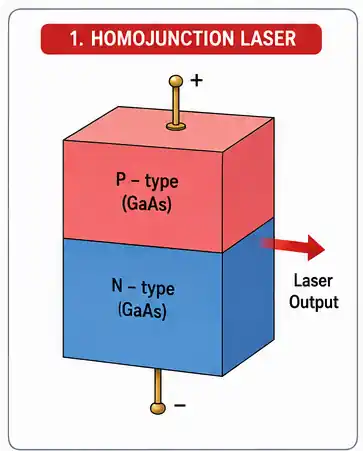
A homojunction semiconductor laser is a laser diode made using the same semiconductor material on both sides of the p-n junction, usually gallium arsenide (GaAs).
Construction:
It consists of a simple p-type and n-type semiconductor layer joined together to form a p-n junction. The active region is formed near the junction where recombination takes place.
Working Principle:
When a strong forward bias is applied, electrons and holes recombine in the junction region and emit photons. If the current is high enough, stimulated emission occurs, and laser light is produced.
Characteristics:
- It has a simple structure
- It is easy to fabricate
- Its manufacturing cost is low.
Limitations:
- Has very high threshold current
- Low efficiency compared to modern lasers
- Poor optical confinement
- Produces excessive heat
- Usually requires low-temperature operation
Applications:
- Basic laser research
- Educational demonstrations
- Early laser diode technology
2. Heterojunction Semiconductor Laser
A heterojunction semiconductor laser uses two different semiconductor materials with different band-gap energies (like GaAs and AlGaAs) to improve laser performance.
Types of Heterojunction Lasers:
(a) Single Heterojunction Laser
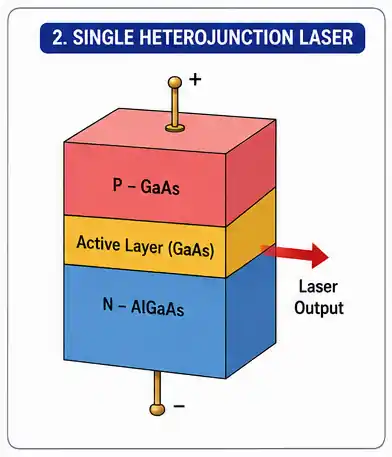
It contains one junction between two different semiconductor materials having different band-gap energies.
Construction:
It consists of a p-type and n-type semiconductor made from different materials, such as GaAs and AlGaAs. One heterojunction is formed at the interface of these materials, and the active region is located near this junction.
Working Principle:
When forward bias is applied, electrons and holes move into the active region and recombine to produce photons. The heterojunction helps confine charge carriers in the active region, increasing the efficiency of stimulated emission and laser action.
Advantages:
- Better carrier confinement than homojunction lasers
- Lower threshold current
- Improved efficiency
- Can operate at higher temperatures
Limitations:
- Optical confinement is still limited
- Efficiency is lower than that of double heterojunction lasers
- Heat generation may reduce performance
- Fabrication is more complex than homojunction lasers
Applications:
- Optical communication systems
- Laser pointers
- Scientific research
- Early semiconductor laser devices
(b) Double Heterojunction Laser
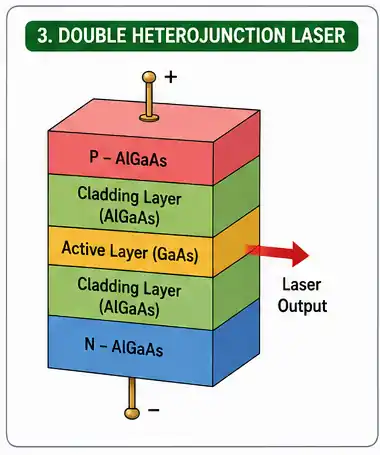
It contains two heterojunctions surrounding the active layer. This is the most commonly used structure.
Construction:
It consists of a thin active layer of low band-gap material placed between two high band-gap semiconductor layers. Commonly used materials are GaAs and AlGaAs. The two heterojunctions provide strong carrier and optical confinement.
Working Principle:
When forward bias is applied, electrons and holes are injected into the thin active region. The double heterojunction traps both carriers and photons inside the active layer, increasing stimulated emission and producing highly efficient coherent laser light.
Advantages:
- Very high efficiency
- Excellent optical confinement
- Low threshold current
- Stable room-temperature operation
- Reduced power loss
Limitations:
- The fabrication process is complicated
- Requires precise layer thickness control
- Production cost is higher
- Sensitive to defects during manufacturing
Applications:
- Fiber optic communication
- CD/DVD and Blu-ray devices
- Barcode scanners
- Medical instruments
- High-speed optical networks
3. Quantum Well Laser:
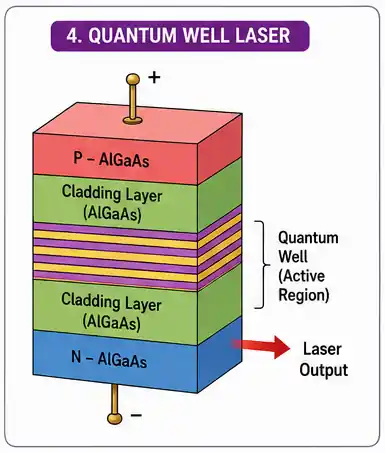
A quantum well laser is a semiconductor laser that uses an extremely thin active layer where charge carriers are confined in a very small region.
Construction:
It consists of very thin semiconductor layers, usually only a few nanometers thick, sandwiched between barrier layers.
Working Principle:
The thin active layer creates quantum confinement, which increases recombination efficiency and produces laser light with lower power consumption.
Advantagese:
- Very high efficiency
- Faster operation
- Low power requirement
- Stable output
Limitations:
- Manufacturing requires advanced nanotechnology
- Difficult to fabricate accurately
- Sensitive to temperature changes
- High production cost
Applications:
- High-speed internet communication
- Fiber optic systems
- Optical transmitters
4. Distributed Feedback (DFB) Laser:
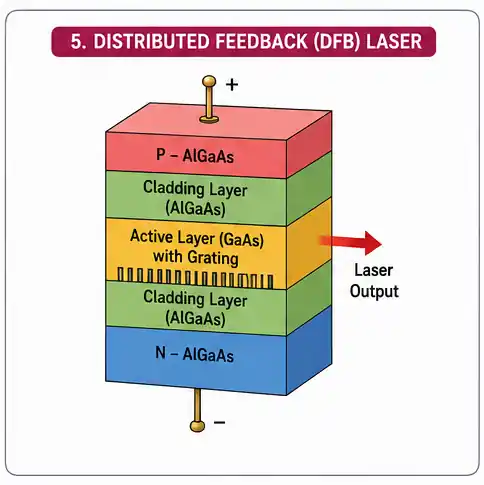
A DFB laser is a semiconductor laser that uses a built-in grating structure to provide optical feedback and produce a single stable wavelength.
Construction:
It contains a periodic diffraction grating inside the active region along with semiconductor layers and reflective surfaces.
Working Principle:
The grating reflects only a specific wavelength back into the active region, resulting in stable single-mode laser output.
Advantages:
- Very stable wavelength
- High spectral purity
- Excellent communication performance
Limitations:
- Expensive compared to ordinary laser diodes
- A complex grating structure increases fabrication difficulty
- Sensitive to temperature variations
- Requires precise wavelength control
Applications:
- Optical communication systems
- Dense wavelength division multiplexing (DWDM)
- Long-distance data transmission
5. Vertical Cavity Surface Emitting Laser (VCSEL):
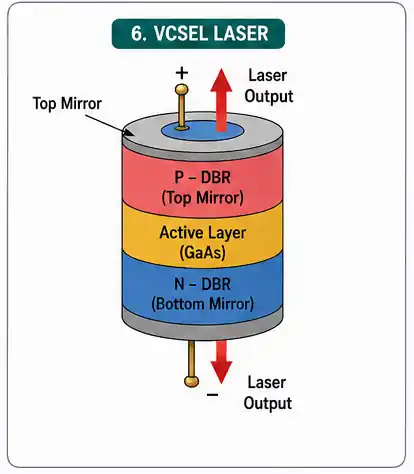
VCSEL is a semiconductor laser that emits light perpendicular to the surface of the semiconductor chip.
Construction:
It contains multiple thin semiconductor layers with highly reflective mirrors placed above and below the active region.
Working Principle:
When current flows through the active region, stimulated emission occurs and light is emitted vertically through the surface.
Advantages:
- Low power consumption
- Circular output beam
- Easy testing and fabrication
- Compact size
Limitations:
- Limited output power
- Shorter transmission distance in some applications
- Performance can be affected by heat
- Complex mirror fabrication process
Applications:
- Optical mouse
- Face recognition systems
- Data communication
- Sensors
6. Quantum Cascade Laser (QCL):
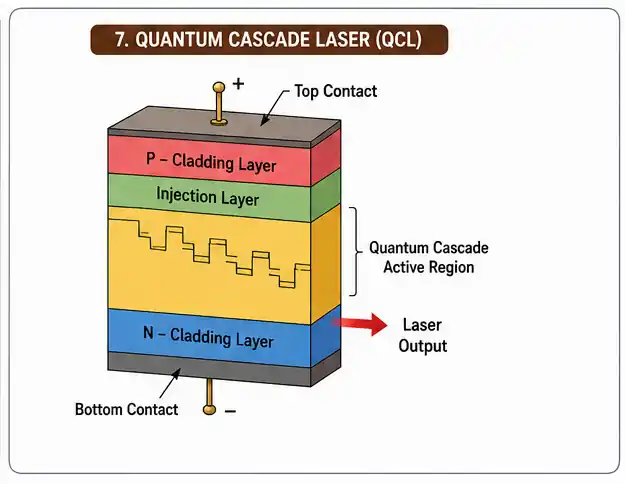
A quantum cascade laser is a special semiconductor laser that produces light through transitions between quantum energy levels instead of electron-hole recombination.
Construction:
It consists of many thin semiconductor layers arranged in a repeated structure called a superlattice.
Working Principle:
Electrons move through multiple quantum wells and emit photons at each stage, producing infrared laser radiation.
Advantages:
- High output power
- Operates in the infrared region
- Tunable wavelength
Limitations:
- Very expensive to manufacture
- Requires complex layer structures
- Generates significant heat during operation
- Needs advanced cooling systems in some cases
Applications:
- Gas sensing
- Spectroscopy
- Environmental monitoring
- Military systems
7. External Cavity Semiconductor Laser:
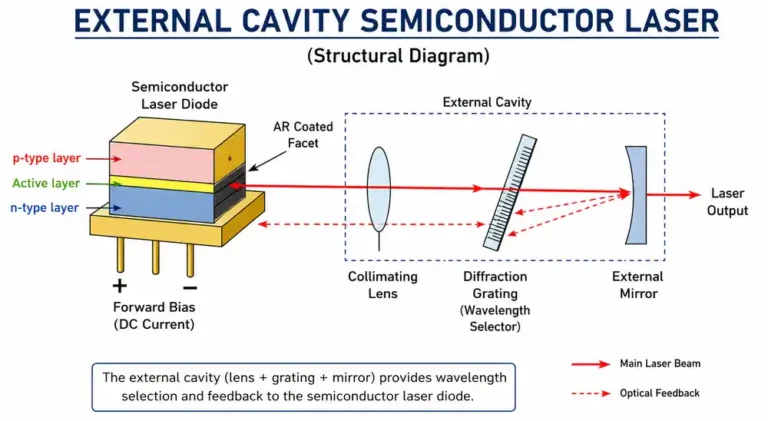
An external cavity semiconductor laser uses an additional external optical cavity to improve wavelength control and coherence.
Construction:
It includes a semiconductor laser diode connected with external mirrors or diffraction gratings outside the chip.
Working Principle:
The external cavity reflects selected wavelengths back into the laser diode, producing highly stable and tunable laser output.
Advantages:
- Narrow linewidth
- Tunable wavelength
- Very stable output.
Limitations:
- Larger size due to external cavity components
- More expensive than ordinary semiconductor lasers
- Alignment of optical components is difficult
- Mechanical vibrations may affect stability
Applications:
- Scientific research
- Precision measurement
- Optical testing
- Spectroscopy
🔬 Working Principle of Semiconductor Laser
The complete working process for all the above lasers occurs as follows:
Carrier Injection: A forward bias injects electrons and holes into the junction.
Population Inversion: At high current density, carrier concentration becomes extremely high. Population inversion is established.
Stimulated Emission: Incoming photons stimulate recombination. Additional photons of the same frequency, phase, and direction are emitted.
Optical Amplification: Photons reflect repeatedly between mirrors. Light intensity grows rapidly.
Laser Output: Coherent laser light emerges from a partially reflecting surface.
⚖️ Comparison of Semiconductor Laser Types
| S. No. | Types | Efficiency | Cost | Output Stability | Applications |
|---|---|---|---|---|---|
1. |
Homojunction |
Low |
Low |
Poor |
Historical importance |
2. |
Heterojunction |
High |
Moderate |
Good |
Communication |
3. |
Quantum Well |
Very High |
Moderate |
Excellent |
Fiber optics |
4. |
VCSEL |
High |
Low |
Excellent |
Sensors |
5. |
DFB Laser |
Very High |
High |
Extremely Stable |
Telecom |
6. |
QCL |
High |
Expensive |
Good |
Spectroscopy |
🧠 Quick Answer Section:
Which material is commonly used in semiconductor lasers?
Gallium arsenide (GaAs) is one of the most commonly used semiconductor laser materials because it has a direct band gap and high efficiency.
What is the main advantage of semiconductor lasers?
The main advantage is their compact size and high efficiency. They can also be directly electrically pumped and integrated into electronic circuits.
What is a VCSEL?
VCSEL stands for “vertical cavity surface-emitting laser.” It emits light perpendicular to the semiconductor surface and is widely used in optical communication and sensors.
Why are heterojunction lasers better?
Heterojunction lasers provide better carrier and optical confinement, resulting in lower threshold current and higher efficiency.
What are the main types of semiconductor lasers?
The seven main types of semiconductor laser are: (1) Homojunction laser, (2) Single heterostructure laser, (3) Double heterostructure laser, (4) Quantum well laser, (5) Distributed feedback (DFB) laser, (6) VCSEL, and (7) Quantum cascade laser. Each type differs in structure, threshold current, and application domain.
What is the threshold current density in a semiconductor laser?
Threshold current density (Jth) is the minimum current density at which the optical gain in the active region exactly compensates for all cavity losses, initiating laser oscillation. It depends on internal losses, mirror reflectivity, confinement factor, and active-region material. For a double heterostructure, it is typically ~500 A/cm².
How does a DFB laser produce a single-frequency output?
A DFB laser incorporates a Bragg diffraction grating along the active layer. The grating provides wavelength-selective optical feedback: only the wavelength satisfying the Bragg condition λB = 2neff Λ/m receives sufficient reflection to sustain lasing. All other wavelengths are suppressed, giving a single-mode output with a side-mode suppression ratio >30 dB.
🧠 Conclusion
The types of semiconductor laser form one of the most important topics in modern laser physics and electronics. From simple homojunction lasers to advanced quantum cascade lasers, semiconductor laser technology has evolved tremendously.
These lasers are now deeply connected with communication systems, medical technology, industrial automation, and consumer electronics. Their compact size, high efficiency, and fast operation make them indispensable in the modern technological world.
Understanding their construction, working principles, and applications not only helps students score better in examinations but also builds a strong foundation for advanced studies in photonics and optoelectronics.
📝 PYQs / Most Expected Questions
- Explain the working principle of semiconductor laser.
- Differentiate between homojunction and heterojunction lasers.
- Draw and explain the energy band diagram of a semiconductor laser.
- Explain VCSEL with its advantages and applications.
- What is a quantum well laser?
- Derive the relation between wavelength and band-gap energy.
- Explain the DFB laser with a suitable diagram.
- Write advantages and limitations of semiconductor lasers.
❓ FAQs (People Also Ask)
Why are semiconductor lasers widely used?
Semiconductor lasers are compact, efficient, inexpensive, and easy to integrate with electronic systems, making them ideal for communication and sensing technologies.
What is the difference between LED and laser diode?
An LED emits incoherent light in multiple directions, while a laser diode emits coherent, monochromatic, and highly directional light.
Which semiconductor laser is used in fiber optics?
Quantum well lasers and DFB lasers are widely used in optical fiber communication because of their stable wavelength and high efficiency.
Why is GaAs preferred in semiconductor lasers?
GaAs has a direct band gap, which enables efficient light emission and high optical gain.
What materials are used in semiconductor lasers?
Common materials include gallium arsenide, indium phosphide, and aluminum gallium arsenide.