
Visit:  https://smartstudyzone.in
For High-Quality, More Free Study Notes
Contents
Toggle📘 Introduction
Imagine a light beam so precise it can perform surgery on a human eye, so powerful it can cut through thick steel plates, and so focused it can bounce off a mirror left on the Moon to measure the distance to Earth within centimeters. This isn’t science fiction; it is the reality of the laser principle.
We encounter lasers every single day—whether it’s the barcode scanner at your local grocery store, the fiber-optic cables bringing high-speed internet to your home, or the simple laser pointer used in a classroom.
Unlike ordinary light that spreads in all directions, the laser produces a highly focused beam where all photons move in perfect synchronization, like a disciplined marching band.
The word “LASER” is actually an acronym for Light Amplification by Stimulated Emission of Radiation. Each word in that full form carries deep physical meaning, and by the end of this article, you’ll understand exactly what each word means — not just as a definition, but as a physical story happening inside the device.
In this article, you will learn:
- The core principle behind laser-stimulated emission
- What population inversion is and why it’s essential
- The three key components every laser system needs
- How a laser actually works, step by step
- Types of lasers and their unique characteristics
- Real applications, and exam-ready answers
Whether you’re a B.Sc. physics student preparing for exams or an engineering student trying to build intuition, this guide is your one-stop resource on the laser principle.
Let’s dive in.
📜 Historical Background
The theoretical foundation of lasers was laid down by Albert Einstein in 1917 when he proposed the concept of “stimulated emission”—the idea that an incoming photon could nudge an excited atom to release a second, identical photon.
However, it took decades for engineering to catch up with theory. In 1954, Charles Townes developed the MASER (microwave version), and finally, in 1960, Theodore Maiman built the first functioning laser using a synthetic ruby crystal. Since then, lasers have evolved from “a solution looking for a problem” to an indispensable tool in modern engineering and medicine.
📖 What is Laser?
LASER stands for:
👉 Light Amplification by Stimulated Emission of Radiation
In simple words, a laser is a device that produces a highly directional, coherent, and monochromatic beam of light.
What is the laser principle?
At its core, the Laser Principle is the process of generating a coherent, monochromatic, and highly directional beam of light through the process of stimulated emission. The laser principle is based on three key processes:
1. Absorption
An atom in a lower energy state (E1) absorbs a photon and jumps to a higher energy state (E2). If the photon has energy E = hν, where h is Planck’s constant and ν is the frequency, and is equal to the energy gap ΔE, the photon is absorbed.
$$\Delta E= E_2 – E_1 = h\nu$$

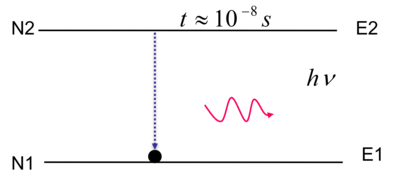
2. Spontaneous Emission
After a short time (typically 10-8 seconds), the excited electron drops back to the ground state on its own and releases a photon. This emitted photon goes out in a random direction with a random phase — it is incoherent. This is what ordinary light bulbs and LEDs do.
3. Stimulated Emission
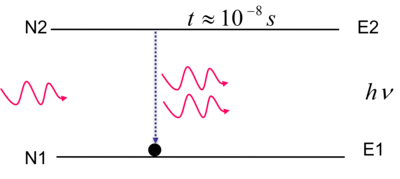
Here’s where laser magic begins. If an incoming photon of exactly the right energy hν encounters an atom that is already in the excited state, it stimulates (triggers) the atom to immediately drop back to the lower state and release a photon.
The released photon is absolutely identical to the incoming one — same frequency, same phase, same direction, same polarization. In this way, two identical photons are produced. Those two can stimulate two more atoms, producing four identical photons—and so on. This is the amplification chain that gives a coherent laser beam.
This is the principle of stimulated emission, and it is the backbone of laser operation.
Population Inversion: The Essential Prerequisite
To understand why a laser is so much more powerful than a flashlight, you have to understand a concept that actually defies the natural laws of thermodynamics: Population Inversion.
In normal thermal equilibrium conditions, most atoms stay in the ground state, so :$$N_1>N_2$$
where N1 is the number of atoms in the lower energy level, and N2 is in the higher level. In this situation, atoms mostly absorb light instead of emitting it, so no laser beam is produced.

What is Population Inversion?
Population inversion is a non-equilibrium state where the “population” of the higher energy level (N2) becomes greater than the population of the lower energy level (N1).
$$N_2 > N_1$$
Population inversion is like convincing the majority of the audience to climb up and stand on the balcony at the same time. This is an “inverted” state.

Why Not Use Just Two Energy Levels?
We cannot achieve population inversion using only two energy levels. In such a system, even if you supply energy, atoms quickly return to the ground state, and at best you get an equal distribution (N₁=N₂), but never
To overcome this, we use three-level or four-level systems, which introduce an intermediate step that is called a metastable level.
How Do We Achieve It?
Population inversion is achieved through optical pumping, wherein atoms in the ground state are elevated to higher energy levels via the absorption of pump light. These excited atoms are collected in a metastable state.
A metastable state is a special energy level where atoms stay longer than usual. Normally, atoms stay excited for a very short time, but here they “wait,” allowing more atoms to collect.
Why is it Necessary?
Population inversion is necessary because it enables light amplification, which is the core of the laser principle. In normal conditions (N1>N2), most atoms are in the ground state, so incoming light is more likely to be absorbed rather than amplified. As a result, no laser beam is produced.
When population inversion is achieved (N₂>N₁), more atoms are in the excited state, and incoming photons trigger stimulated emission instead of absorption. This creates a chain reaction where photons multiply rapidly, producing a strong, coherent, and highly directional laser beam.
🔧 Components of a Laser System
Every laser, regardless of its size, requires three essential components:
1. Active Medium
This is the material where laser action occurs. It could be:
- A solid crystal (ruby, Nd: YAG)
- A gas mixture (helium-neon, CO₂, argon)
- A liquid (dye lasers)
- A semiconductor (laser diodes in your CD player)
2. Pumping Mechanism (Energy Source)
This is the external energy source (light or electricity) that excites the atoms.
To achieve population inversion, energy must be continuously supplied to excite atoms from the ground state. This is called pumping. Common pumping methods are the following:
- Optical pumping: Intense light (like a flash lamp or another laser) is used to excite atoms. It is used in ruby and Nd:YAG lasers
- Electrical pumping: An electric current or discharge is passed through a gas. It is used in gas lasers.
- Chemical pumping: Energy from a chemical reaction is used in some military lasers to excite atoms.
- Semiconductor injection: In a semiconductor laser, with the help of forward-biasing of a p-n junction, stimulated emission is achieved.
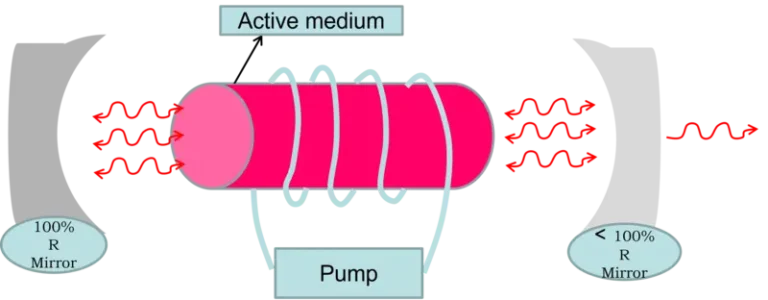
3. Optical Resonator (Optical Cavity)
It consists of two mirrors placed on either side of the active medium:
- Mirror M₁: Fully reflective (reflectivity ~100%)
- Mirror M₂: Partially reflective (reflectivity ~90–95%), which allows some laser light to escape as the output beam
The light bounces back and forth between these mirrors, passing through the active medium repeatedly. Each pass triggers more stimulated emission, building up an intense, coherent beam through optical feedback.
The resonator also ensures that only light traveling exactly along the optical axis (the line between the two mirrors) is amplified. Light going off-axis quickly escapes without being amplified—this is what gives laser light its extreme directionality.
Laser Principle and Working Animation
Working of a Laser — Step by Step
Now that you know the three pillars—active medium, pumping, and resonator—let’s walk through exactly how a laser produces its beam:
Step 1 — Pumping: The pumping source excites atoms in the active medium from the ground state E₁ to a higher excited state E₃.
Step 2 — Non-Radiative Decay to Metastable State: Atoms quickly lose a bit of energy as heat and drop to the metastable state E₂. They accumulate here because the lifetime is long.
Step 3—Population Inversion: As more and more atoms pile up at E₂ while fewer remain at E₁, population inversion is established.
Step 4 — Spontaneous Emission Initiates the Process: A few atoms spontaneously emit photons. Most of these go off in random directions and are lost. But some travel along the optical axis—and these trigger a chain reaction of stimulated emissions.
Step 5 — Stimulated Emission & Amplification: The stimulated emission produces identical photons. The process cascades—1 photon becomes 2, 2 becomes 4, 4 becomes 8, and so on. The beam grows exponentially inside the cavity.
Step 6 — Optical Feedback: The mirrors of the resonator reflect these photons back into the medium, causing even more stimulated emissions (amplification).
Step 7—Laser Output: Once the light is intense enough, a fraction of the light escapes through the partially reflective mirror as a laser beam.
🔬 Types of Lasers
(A) By active medium:
To understand the different types of lasers, we must look at what is happening inside the “active medium.” In engineering physics, we generally classify lasers into four major categories based on the material of the active medium:
| S. No. | Type | Active Medium | Pumping Method | Output type | Example Use |
|---|---|---|---|---|---|
1. |
Solid-State Laser |
Ruby crystal, Nd:YAG |
Pulsed/CW, Red/IR |
Optical (Flash lamp) |
Surgery, material cutting |
2. |
Gas Laser |
He-Ne, CO₂, Argon |
Electric Discharge |
CW, Various wavelengths |
Holography, cutting |
3. |
Liquid (Dye) Laser |
Organic dyes in solution |
Laser Pumping |
Tunable wavelength |
Spectroscopy |
4. |
Semiconductor Laser |
GaAs, InGaAsP |
Direct Current |
IR to visible |
Fiber optics, barcode |
5. |
Free Electron Laser |
Relativistic electrons |
Electron beam |
Broadly tunable |
Research |
(B) By mode of operation:
- Continuous Wave mode laser
- Pulsed mode laser
(C) By pumping and laser levels:
- 3-level laser
- 4-level laser
✨Characteristics of Laser Light
Laser light has unique properties that make this beam so special:
1. Monochromaticity: Laser light has a single wavelength (single color/frequency).
2. Coherence: This is the laser’s most unique property. All photons in a laser beam are in phase with each other — they march in perfect lockstep. This has two aspects:
- Temporal coherence: The phase relationship is maintained over time (long coherence length)
- Spatial coherence: All points across the beam’s cross-section maintain a fixed phase relationship
3. Directionality: A laser beam diverges extremely little.
4. High Intensity (Brightness): Because all the energy is concentrated into a very narrow beam of a single wavelength, the power per unit area (intensity) of a laser is enormous compared to conventional sources.
⚖️ Comparison: Laser vs Ordinary Light
| S. No. | Property | Laser Light | Ordinary Light |
|---|---|---|---|
1. |
Direction |
Highly directional |
Scattered |
2. |
Coherence |
Coherent |
Incoherent |
3. |
Wavelength |
Single |
Multiple |
4. |
Intensity |
High |
Low |
5. |
Source |
Spontaneous Emission |
Stimulated Emission |
✅ Advantages and Limitations
✅ Advantages
❌ Limitations
- High precision
- Long-distance transmission
- Minimal energy loss
- Highly focused beam
- Expensive equipment
- Requires careful handling
- Can be dangerous (eye damage)
🚀 Applications of Laser
1. Medical Field: Used in surgeries like LASIK for precise cutting.
2. Communication: Optical fibers use lasers for fast data transfer.
3. Industry: Cutting, welding, and engraving materials.
4. Defense: Laser-guided missiles and targeting systems.
5. Research: Used in spectroscopy and atomic studies.
🧠 Quick Answer Section
What is the basic principle of a laser?
The basic principle of a laser is Stimulated Emission. This occurs when an incoming photon interacts with an excited atom, causing it to drop to a lower energy state and release a second photon that is identical in frequency, phase, and direction, resulting in light amplification.
Why is a metastable state important in lasers?
A metastable state is an excited state in which atoms remain for a relatively long time (10⁻³ s) compared to 10⁻⁸ S. This “waiting room” allows atoms to accumulate, making it easier to achieve the population inversion necessary for continuous laser output.
What is stimulated emission?
Stimulated emission is the process in which an incoming photon forces an excited atom to jump down to the ground state and emit another photon of the same energy, phase, and direction, forming coherent light.
Why laser light is coherent?
Laser light is coherent because photons are emitted in phase through stimulated emission, ensuring uniform wave alignment.
What are main components of laser?
The main components are the active medium, the pumping source, and the optical resonator, which together produce and amplify laser light.
What is the difference between a three-level and four-level laser?
In a three-level laser (e.g., ruby), the lower laser level is the ground state, requiring intense pumping to achieve inversion. In a four-level laser (e.g., He-Ne, Nd:YAG), both laser levels are above the ground state, so the lower laser level depopulates quickly, making it easier to maintain inversion with less pump power.
🧠 Conclusion
The Laser Principle is a beautiful intersection of quantum mechanics and practical engineering. By mastering the balance between absorption and emission and utilizing the “pumping” of atoms into metastable states, we have created a tool that has redefined modern life.
From medical surgeries to communication systems, lasers have transformed modern technology. Understanding this laser principle is essential for any engineering or physics student.
📝 PYQs / Most Expected Questions
- State and explain the principle of laser. What role does stimulated emission play in laser action?
- What is population inversion? Why is it necessary for laser operation? How is it achieved?
- Explain the significance of the metastable state in laser operation.
- Describe the working of a laser.
- Distinguish between spontaneous emission and stimulated emission. Which one is responsible for laser action and why?
- What is the function of an optical resonator in a laser system?
- Compare three-level and four-level laser systems with suitable energy-level diagrams.
- What are the essential characteristics of laser light? Explain coherence, monochromaticity, and directionality.
Solved Numericals
A laser emits light at a wavelength of 488 nm. What is the energy difference between the two lasing states in electron-volts (eV)?
Solution:
Given: λ = 488 nm
Find: ΔE in eV.
$$\Delta E = h\nu = hc/\lambda$$
$$\Delta E = \frac{(6.626 \times 10^{-34})(3 \times 10^8)}{488 \times 10^{-9}} = 4.07 \times 10^{-19}\ J$$
Convert to eV:
$$\Delta E =\frac{4.07 \times 10^{-19}}{ 1.6 \times 10^{-19}}\approx 2.54\ eV$$
Result: The energy gap is 2.54 eV.
❓ FAQs (People Also Ask)
What is the full form of LASER?
LASER stands for Light Amplification by Stimulated Emission of Radiation. It describes the process of producing coherent light through amplification.
Why is laser light monochromatic?
Laser light is monochromatic because it is generated from transitions between fixed energy levels, producing a single wavelength.
What is optical resonator?
An optical resonator consists of two mirrors that reflect light back and forth, amplifying it before emission as a laser beam.
What is pumping in laser?
Pumping is the process of supplying energy to atoms to achieve population inversion necessary for laser operation.
Why are lasers used in fiber optics?
Because their monochromatic nature prevents "dispersion," allowing signals to stay clear over very long distances.
What is the coherence length of a laser?
Coherence length is the distance over which a laser beam maintains a definite phase relationship.