
Contents
Toggle🚀 Introduction
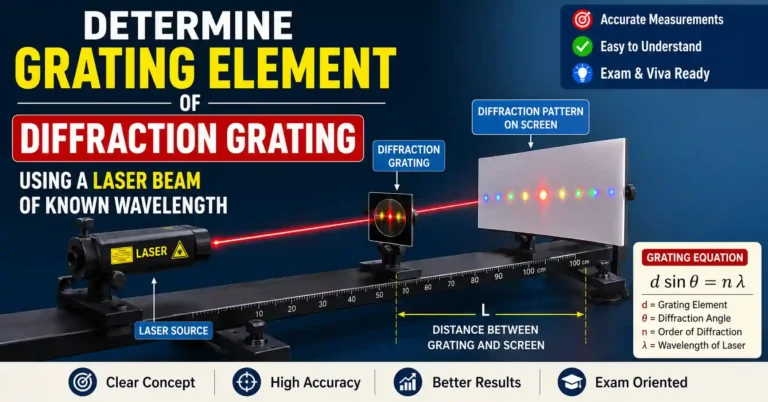
The experiment to determine grating element of diffraction grating using a laser beam of known wavelength is an important practical in Engineering Physics and Wave Optics. It helps students understand the wave nature of light and the phenomenon of diffraction simply and practically.
When a monochromatic laser beam passes through a diffraction grating containing a large number of closely spaced parallel lines, a series of bright diffraction maxima is formed on a screen. By measuring the diffraction angles corresponding to different orders of maxima and applying the grating equation, the grating element can be accurately calculated.
🎯 The Aim of This Experiment:
To determine the grating element (grating constant) of a diffraction grating using a laser beam of known wavelength.
✨Importance in Engineering Physics:
This experiment is an important part of Engineering Physics because it introduces students to diffraction phenomena, interference effects, optical measurements, and precision experimental techniques.
Thus, studying and determining the grating element of a diffraction grating not only strengthens the understanding of wave optics but also provides valuable practical experience in experimental physics.
It is equally relevant for JEE Advanced, GATE, and NEET students, where questions on grating and optics appear consistently every year.
🎯Application of Diffraction Grating:
Diffraction gratings are widely used in spectrometers, optical communication systems, laser instruments, wavelength analysis, and scientific research laboratories.
📝 Experiment Summary:
| Parameter | Description |
|---|---|
Aim |
To determine the grating element of a diffraction grating using a laser beam of known wavelength. |
Apparatus required |
Laser source, diffraction grating, optical bench, screen, and meter scale. |
Principle |
Diffraction maxima are formed when laser light passes through a diffraction grating. |
Formula |
d sin θ = nλ |
Observation |
Measure the positions of diffraction maxima on the screen. |
Result |
Calculate the grating element using the known laser wavelength and measured diffraction angle. |
Applications |
Spectroscopy, wavelength measurement, and optical instruments. |
🎯 Experiment at a Glance:
The grating element of a diffraction grating is determined using the diffraction equation d sinθ = nλ, where d is the grating element, θ is the diffraction angle, n is the diffraction order, and λ is the known wavelength of the laser beam.
You can view and download the complete lab manual from the section below.
📝Modified Lab Manual:
📚 Normal Lab Manual:
📋 Observation Table:
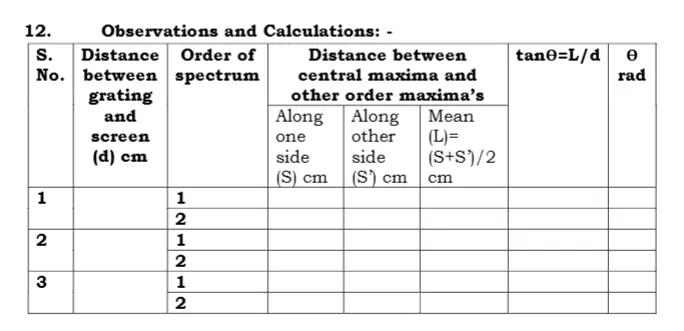
▶️Watch on YouTube:
🔍 Exam-Oriented Questions and Answers
What is a diffraction grating?
A diffraction grating is an optical element containing a large number of closely spaced parallel slits or grooves. It produces diffraction and interference of light, resulting in distinct maxima and minima that help determine wavelengths and grating spacing.
What is the grating element?
The grating element is the distance between two adjacent slits or grooves of a diffraction grating. It is usually represented by d and is measured in meters or micrometers.
Which formula is used in this experiment?
The experiment uses the diffraction grating equation:
d sinθ nλ
Where d is the grating element, n is the diffraction order, λ is the wavelength, and θ is the diffraction angle.
How do you calculate the number of lines per inch from the grating element?
The number of lines per inch (N) is the reciprocal of the grating element when measured in inches. If the grating element is d cm, then N = 2.54/d.
Most standard laboratory gratings have 15,000 lines per inch.
What is the difference between Fresnel and Fraunhofer diffraction?
In Fresnel diffraction, the light source and the screen are at finite distances from the obstacle, and the wavefronts are spherical or cylindrical.
In Fraunhofer diffraction, the source and screen are effectively at an infinite distance (using lenses or collimated beams like lasers), and the wavefronts are planar. This experiment uses Fraunhofer diffraction.
What happens to the diffraction pattern if the distance between the grating and the screen is increased?
If the distance (D) between the grating and the screen is increased, the distance (x) between the diffracted spots on the screen increases proportionally. While the spots spread further apart, making measurements easier, their intensity decreases slightly because the laser energy spreads over a larger area.
Why do we use laser light instead of ordinary white light in this experiment?
Laser light is highly monochromatic, coherent, and intense. It produces a sharp, distinct pattern of single-colored spots on the screen. Ordinary white light contains a spectrum of wavelengths, causing the grating to spread the light into a continuous blur of rainbow colors rather than distinct points.
Can you get a first-order maximum if the wavelength of light is greater than the grating element?
No. According to the grating equation, sinθ = nλ/d. Because the maximum possible value of sin θ is 1, the condition for diffraction requires that nλ ≤ d. If λ > d, no diffraction maxima can be formed.
⚡ Viva Questions and Answers:
Q1. What is diffraction?
Diffraction is the bending and spreading of light waves when they encounter an obstacle or aperture comparable to their wavelength.
Q2. What is a diffraction grating?
A diffraction grating is a large collection of equally spaced parallel slits or grooves that diffract light.
Q3. What is meant by grating element?
The distance between two adjacent grating lines is called the grating element.
Q4. What is the SI unit of grating element?
Meter (m).
Q5. Why is laser light preferred?
Because it is monochromatic, coherent, and highly directional.
Q6. What is monochromatic light?
Light having a single wavelength is called monochromatic light.
Q7. What is constructive interference?
When two light waves combine in phase and produce maximum intensity.
Q8. What is diffraction order?
The position number of a diffraction maximum from the central maximum.
Q9. What happens if wavelength increases?
The diffraction angle increases.
Q10. What happens if grating spacing decreases?
The diffraction maxima spread farther apart.
Q11. What is the central maximum?
The bright spot corresponding to zero-order diffraction.
Q12. What is the grating equation?
d sin θ = nλ
Q13. What is coherent light?
Light waves having a constant phase difference.
Q14. What are common applications of diffraction gratings?
Spectrometers, optical communication systems, wavelength measurement, and astronomical instruments.
Q15. Why are higher-order maxima less intense?
Energy is distributed among multiple diffraction orders, reducing intensity at higher orders.
Q16. What is meant by the 'zeroth order' diffraction maximum?
The zeroth-order diffraction maximum is the central bright fringe formed at θ = 0o, corresponding to diffraction order n = 0. It is produced when there is no path difference between light waves from adjacent slits.
Q17. What is the resolving power of a diffraction grating?
The resolving power of a diffraction grating is its ability to separate two closely spaced wavelengths. It is given by R = λ/Δλ = nN, where n is the diffraction order, and N is the number of illuminated grating lines.
❓ FAQs:
Q1. How do you determine the grating element of a diffraction grating?
The grating element is determined using the diffraction equation dsin θ = nλ, where the wavelength is known and the diffraction angle is measured experimentally.
Q2. Why is a laser beam used in diffraction grating experiments?
Laser light is monochromatic and coherent, producing clear diffraction patterns that improve measurement accuracy.
Q3. What is the difference between grating element and grating constant?
Both terms represent the spacing between adjacent grating lines and are often used interchangeably.
Q4. What are the applications of diffraction gratings?
Diffraction gratings are used in spectrometers, optical communication systems, laser devices, chemical analysis, and astronomical observations.
Q5. Which branch of physics studies diffraction gratings?
Diffraction gratings are studied under wave optics, which deals with interference, diffraction, and polarization of light.
Q6. Why are higher orders of diffraction less bright than the central maximum?
Higher-order diffraction maxima are less bright than the central maximum because the light intensity decreases with increasing diffraction order. The available light energy is distributed among several maxima, making higher-order fringes progressively weaker.
Q7. What are the main sources of error in the diffraction grating experiment?
The main sources of error are misalignment of the laser and grating, parallax errors, inaccurate measurement of diffraction maxima positions, uncertainty in screen distance measurement, and defects or dust on the diffraction grating.
Q8. What wavelength of laser is used in the diffraction grating experiment?
The most commonly used laser in this experiment is the He-Ne (helium-neon) laser with a wavelength of 632.8 nm (red).
📈 Related Experiments:
🔗 You May Also Like:
- Determination of the Wavelength of a Laser Using a Diffraction Grating
- Fresnel Biprism Experiment
- Determination of Numerical Aperture of Optical Fiber
- Semiconductor Laser Characteristics
- Determination of Radius of Curvature Using Newton’s Rings