

Contents
Toggle📌 Introduction
What happens when light encounters a narrow opening? Does it simply pass through, or does it reveal something deeper about its nature? The answer leads us into the remarkable phenomenon known as diffraction of light waves.
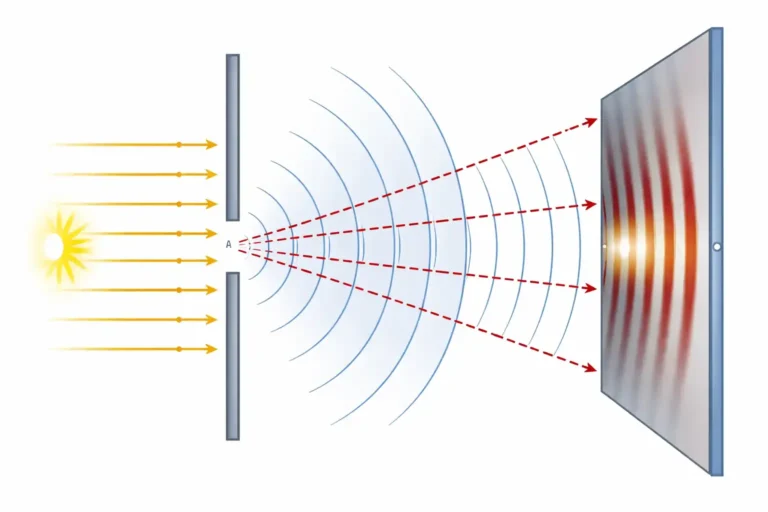
Diffraction of light is a fundamental concept in wave optics that explains how light bends around obstacles and spreads when it passes through small openings (as shown in the following figure). This phenomenon proves that light behaves as a wave.
By the end of this article,
- You will have a clear conceptual grip on what diffraction is and why it happens.
- A thorough understanding of Huygen’s principle and its role,
- A complete derivation of single-slit and double-slit diffraction patterns, including every mathematical step,
- A comparison with interference so you never confuse the two again, and
- A solid awareness of real-world applications from spectroscopy to fiber optics.
Let’s begin.
📜 Historical Background of Diffraction
The phenomenon of diffraction was first systematically studied by Francesco Maria Grimaldi in the 17th century. Later, scientists like Thomas Young and Augustin-Jean Fresnel expanded their understanding.
Their work helped establish that:
Light is not just particles—it also has wave nature.
This was a turning point in physics and led to the development of wave optics.
🌊 What is Diffraction?
The diffraction phenomenon is a common characteristic of all kinds of waves. Imagine a series of ocean waves hitting a harbor wall with a narrow opening. As the waves pass through the gap, they don’t just continue in a straight, narrow beam; they spread out in semi-circles. Light does the exact same thing.
Diffraction of light waves is the bending and spreading of light waves when they pass through a narrow slit or around an obstacle into the region of geometrical shadow.
When the size of the obstacle or slit is comparable to the wavelength of light, diffraction becomes significant. But if the gap is vastly larger than the wavelength (like sunlight through a door), the bending is negligible, and geometric optics works fine.
⚙️ Basic Principles of Diffraction
The concept behind the diffraction is Huygens’ principle. It states that every point on a wavefront acts as a source of secondary spherical “wavelets.”
Under normal conditions, these wavelets interfere to keep the light moving in a straight line. However, when an obstacle blocks part of the wavefront, the remaining wavelets spread out into the shadow zone, creating the diffraction pattern.
When these diffracted light rays fall on a screen, the final intensity at any point on the screen is determined by the superposition (adding up) of all these wavelets, accounting for their relative path differences and, hence, their phase differences.
✨ Important Conditions:
For proper observation of the diffraction pattern, the following condition should be satisfied:
- Wavelength of light ≈ size of slit
- Coherent wavefront
- Proper observation distance
➡️ This naturally leads us to different types of diffraction patterns.
🔬 Types of Diffraction of Light
In the world of optics, we categorize diffraction into two distinct classes based on the distance of the source and the screen from the diffracting aperture.
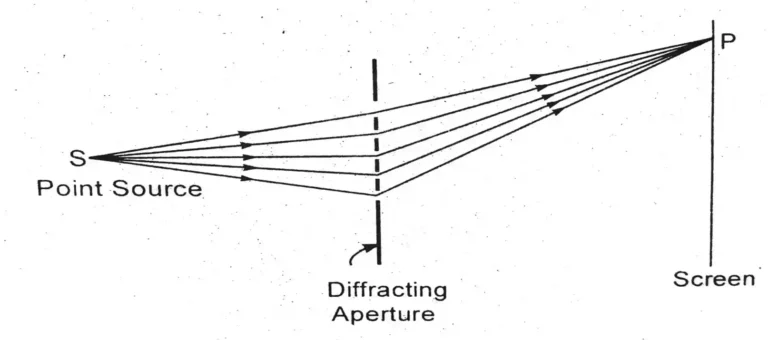
1. Fresnel Diffraction (Near-Field Diffraction)
In Fresnel diffraction, either the light source, the screen, or both are at a finite (close) distance from the diffracting aperture. The wavefronts arriving at and leaving the aperture are spherical or cylindrical rather than planar. And the math is quite complex because we can’t assume the rays are parallel.
2. Fraunhofer Diffraction (Far-Field Diffraction)
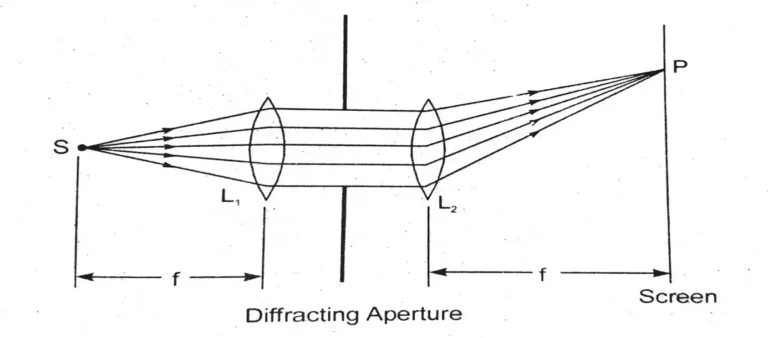
Fraunhofer diffraction applies when both the source and the observation screen are effectively at infinity—meaning the incoming and outgoing wavefronts are both treated as plane waves.
In practice, this is achieved by using lenses, placing the source and screen in the focal planes of the lenses.
Because the geometry simplifies beautifully, Fraunhofer diffraction is far more tractable mathematically. The single-slit and double-slit derivations are both Fraunhofer cases. This is also the regime used in diffraction gratings and spectrometers.
Difference b/w Fresnel and Fraunhofer Diffraction
| S. No. | Fresnel Diffraction | Fraunhofer Diffraction |
|---|---|---|
1. |
In this case, the source of light or screen or usually both are at finite distance from the diffracting aperture (obstacle). |
In this case, the source of light and screen are effectively at an infinite distance from the diffracting aperture (obstacle). |
2. |
In this case no lenses are used. |
This is achieved by placing the source and screen in the focal planes of two lenses. |
3. |
The incident wavefront is either spherical or cylindrical. |
The incident wavefront is plane |
4 |
Used in edge diffraction, close setups |
Gratings, spectrometers, laser optics |
📊 Factors Affecting the Diffraction
Not every light wave diffracts equally, but the extent of diffraction depends on the following factors:
1. Wavelength (λ): Diffraction is most pronounced when the wavelength is comparable to or larger than the aperture. Longer wavelengths diffract more than shorter wavelengths.
2. Aperture size (a or d): Narrower slits produce wider central maxima (more spreading).
3. Nature of the obstacle or aperture: The shape and edges of the aperture matter. A circular aperture produces a circular diffraction pattern (the Airy disk). A rectangular slit produces a one-dimensional fringe pattern.
4. Distance to Screen: Affects fringe visibility.
5. Medium: Refractive index influences wavelength.
🧮 Single Slit Fraunhofer Diffraction
Consider a plane wavefront of monochromatic light with wavelength λ falling normally on a narrow slit AB of width a (as shown in the following figure). According to Huygens’ principle, every point within the slit acts as a source of secondary wavelets.
Let us find the intensity at a point P on a screen placed at a distance. The secondary wavelets traveling in the direction making an angle θ with the incident path will arrive at P with different phases.
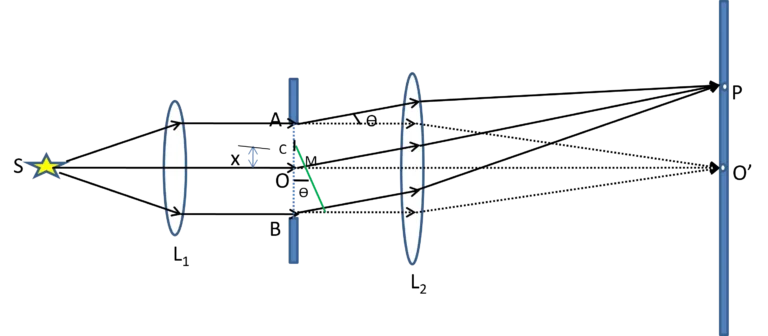
Let A be the amplitude of the disturbance caused at point P due to light waves coming from a slit of unit width at point O. Then the disturbance caused at point P by these waves is
$$y=Acos\,ωt$$
Let us assume a slit of width dx at point C at a distance x from point O, as shown in the above figure.
The amplitude of disturbance at point P due to the slit of width dx at point C will be Adx. And the path difference between wavelets coming from point O and C at point P is—
$$\Delta=OM =x\,sin\,\theta$$
Therefore, the corresponding phase difference will be
$$\phi=\frac{2\pi}{\lambda}x\,sin\,\theta$$
Let the disturbance caused at point P due to wavelets coming from the slit of width dx be dy. Then
$$dy=Adx\,cos\left( \omega t-\frac{2\pi}{\lambda}x\,sin\,\theta\right) \qquad ….. (1)$$
Now we can get the total disturbance (Y) caused at point P by all wavelets coming from the slit of width a by integrating the eq. (1), which is given by
$$Y=\int_{-a/2}^{+a/2} dy$$
Now substituting the value of dy from eq. (1),
$$Y=\int_{-a/2}^{+a/2} A\,cos\left( \omega t-\frac{2\pi}{\lambda}x\,sin\,\theta\right)\,dx$$
$$=\int_{-a/2}^{+a/2} A\left[ cos\ \omega t \cos\left( \frac{2\pi}{\lambda}x\sin\theta\right)-sin\ \omega t\,sin\left( \frac{2\pi}{\lambda}x\sin\theta \right)\right]dx$$
$$\left[ ∵\cos(A-B)=cosAcosB+sinAsinB \right]$$
$$=Acos\ \omega t\int_{-a/2}^{+a/2}\cos\left( \frac{2\pi}{\lambda}x\sin\theta\right)dx$$
$$+\, Asin\ \omega t\int_{-a/2}^{+a/2}sin\left( \frac{2\pi}{\lambda}x\sin\theta \right)dx$$
After solving the second term, we get zero. Hence, now we will solve the first term of the above equation.
$$Y=Acos\ \omega t\int_{-a/2}^{+a/2}\cos\left( \frac{2\pi}{\lambda}x\sin\theta\right)dx$$
$$=Acos\ \omega t\left[ \frac{sin\left( \frac{2\pi}{\lambda}x\sin\theta\right)}{\left( \frac{2\pi}{\lambda}\sin\theta\right)} \right]_{-a/2}^{+a/2}$$
$$=Acos\ \omega t\left[ \frac{sin\left( \frac{\pi a}{\lambda}\sin\theta\right)}{ \frac{\pi}{\lambda}\sin\theta} \right]$$
$$=Aacos\ \omega t\left[ \frac{sin\left( \frac{\pi a}{\lambda}\sin\theta\right)}{ \frac{\pi a}{\lambda}\sin\theta} \right]$$
Let $$\frac{\pi a \sin\theta}{\lambda} = p \qquad …. (2)$$ Then the above equation becomes
$$Y=Aa\frac{sin\,p}{p}cos\ \omega t \qquad … (3)$$
This is the equation of resultant disturbance at point P. From this equation, the amplitude of the resultant disturbance is
$$R_\theta=Aa\frac{sin\,p}{p}$$
Hence, the resultant amplitude at angle θ is given by
$$R_\theta=R_0\frac{sin\,p}{p}$$
Since the intensity (I) is proportional to the square of the amplitude, the resultant Intensity at point P is given by
$$I_θ\propto R_\theta^2$$
$$I_θ = k(Aa)^2\left(\frac{sin\,p}{p} \right)^2$$
When θ = 0, p = 0; therefore,
$$\lim_{p \to 0} \frac{sin\,p}{p}=1$$
∴ I0 = (A𝑎)2
$$∴ \; I_\theta = I_0\left(\frac{sin\,p}{p} \right)^2 \qquad … (4)$$
💡Condition for maxima and minima:
To find the condition for maximum and minimum, we will differentiate the equation. (4) with respect to p, because at minima and maxima
$$\frac{dI_\theta}{dp}=0$$
$$\frac{d}{dp}I_0\left(\frac{sin\,p}{p} \right)^2 = 0$$
$$\Rightarrow I_0×2\frac{sin\,p}{p}×\frac{p\,cos\,p-sin\,p}{p^2}=0$$
From the above equation, we can get,
$$\frac{sin\,p}{p} = 0 \qquad … (5)$$ or $$p\,cos\,p-sin\,p = 0$$
$$\Rightarrow tan\,p = p \qquad … (6)$$
From the above two equations (5) and (6), we can find the exact conditions for maxima and minima. Let’s see—
 Condition for minima:
 Condition for minima:
When equation (5) is satisfied, the intensity becomes zero when sin p = 0, but p ≠ 0. This occurs when:
💡Condition for maxima:
We can find the final condition for maxima using eq. (6). To find the value of p for which the above condition is satisfied, let us draw two graphs: y1 = p and y2 = tan p, as shown in the following figure.
Here, y1 = p is an equation of a linear line that goes through the origin. But y2 = tan p is a discontinuous curve that has many branches. Because when p = 0, π, 2π, 3π, …, then tan p = 0, and when p = π/2, 3π/2, 5π/2, …, then tan p = ∞.
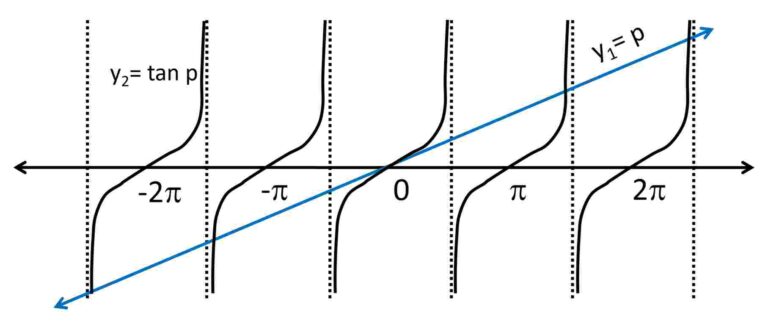
The point of intersection of both graphs satisfies the condition p = tan p. Hence, this gives the value of p where intensity is maximum, and the condition p = tan p is satisfied at p = 0 and p = π/2, 3π/2, 5π/2, … (approx.).
Here, the central maxima is obtained corresponding to p = 0, and the intensity at the central maxima is I = I₀, and corresponding to other values of p, we get other higher-order maxima that are called secondary maxima.
💡Condition for secondary maxima:
$$p=\left( 2m + 1 \right)\frac{\pi}{2}$$
$$\frac{\pi a sin\theta}{\lambda}= \left( 2m + 1 \right)\frac{\pi}{2}$$
$$\color{Red} {\Large a sin\theta =\left(2m + 1\right)\frac{\lambda}{2}}$$
This is the condition for secondary maxima. Here, for m = 1, 2, 3,… We get 1st, 2nd, 3rd… order secondary maxima.
🖼️ Single Slit Diffraction Pattern
The following figure is the resulting intensity pattern for single-slit diffraction of light.
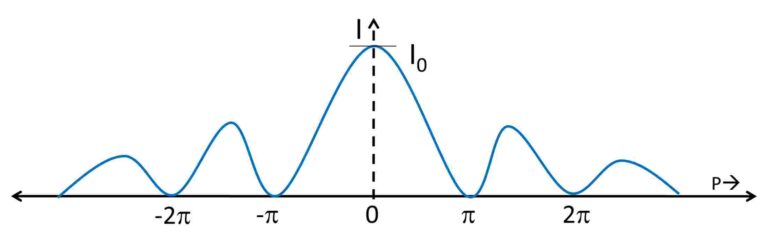
Linear width of Central maxima
If x is the distance of the first secondary maxima from the center of the principal maxima, then the width of the central maxima is W = 2x.
If the lens L2 is very near the slit or the screen is very far away from the lens, and f is the focal length of the lens, then OO’ = f is very large. Then
$$sin\,\theta = \frac{x}{f}$$
But, for the 1st minima—
$$sin\,\theta = \frac{\lambda}{a}$$
Therefore $$\frac{x}{f} = \frac{\lambda}{a}$$
$$\Rightarrow x=\frac{f\lambda}{a}$$
Hence, the linear width of the central maxima is given by
$$\color{Red}{\Large W=2x=\frac{2f\lambda}{a}} $$
Angular width of Central maxima:-
The angular distance b/w the 1st minima of both sides of the central maxima is called the angular width of the central maxima.
Since the central maxima is obtained at ɑ sin θ=0 and the 1st minima is obtained at ɑ sin θ=λ. Hence, it is clear that the angular width of the central maxima is inversely proportional to the slit width ɑ.
Therefore, the angular half-width of the central maxima is—
$$\color{Red}{\Large \theta = \sin^{-1}\left( \frac{\lambda}{a} \right) \approx \frac{\lambda}{a}}$$
⚖️ Comparison: Diffraction vs Interference
| S. No. | Feature | Diffraction | Interference |
|---|---|---|---|
1. |
Origin |
Diffraction is the result of interaction of light coming from different parts of the same wave front. |
Interference is the result of the interaction of light coming from different wave fronts originating from the same source. |
2. |
Fringe width |
Diffraction fringes are not of same width. |
Interference fringes may or may not be of the same width. |
3. |
Fringe intensity |
Intensity decreases rapidly as we move from the center. |
All bright fringes have roughly equal intensity. |
4 |
Darkness |
Minima are often not perfectly dark. |
Points of minimum intensity are usually perfectly dark. |
✅ Advantages & Limitations
✅ Advantages
- Helps measure wavelength precisely
- Useful in resolving small objects
- Diffraction is the basis of spectrometers.
❌ Limitations
- It reduces image sharpness in optical systems
- It limits the resolving power of optical devices.
- Diffraction causes the spreading losses.
🚀 Applications of Diffraction of Light Waves
X-Ray Diffraction (XRD): Scientists use the tiny spacing between atoms in a crystal as a “slit” to diffract X-rays, allowing them to map the structure of DNA and new medicines.
Spectrometers: Used in astronomy to determine what stars are made of by analyzing the “fingerprint” of diffracted light.
Laser Structural Analysis: Engineers use diffraction patterns to detect microscopic cracks in airplane wings or bridges.
Optical Computing: Using light instead of electricity requires precise control over light bending at the nanoscale.
CD/DVD Technology: Rainbow patterns are due to diffraction of light.
🧠 Conclusion
The diffraction of light waves proves that the universe doesn’t always play by the rules of straight lines. It is a reminder that light is fundamentally a wave, capable of bending and weaving through the smallest gaps to reveal its hidden patterns.
Key Takeaways:
 Key Takeaways:
- Diffraction of light waves shows the wave nature of light
- It occurs when light encounters an obstacle comparable to its wavelength.
- The intensity pattern is dominated by a bright central maximum and fading secondary fringes.
- Understanding diffraction is crucial in modern optics and engineering.
 Engineering Insight:
Diffraction sets the ultimate limit of resolution in imaging systems—making it fundamental for design and innovation.
📝 Important Questions for Exam Preparation
- Define diffraction of light waves with examples.
- Derive the condition for minima in single-slit diffraction.
- Explain Fraunhofer diffraction with a diagram.
- Compare diffraction and interference.
- What factors affect the diffraction pattern?
Distinguish between Fresnel and Fraunhofer diffraction with suitable examples.
Derive the expression for the intensity distribution in single-slit diffraction.
Why is it that we can hear sound around a corner, but we cannot see light around the same corner? (Hint: Think about wavelength).
Solved Numericals for Exam Preparation
 Solved Numericals for Exam Preparation
- Calculate the width of the central maximum if a slit of 0.1 mm is illuminated by a laser of 632.8 nm.
Solution:
Slit width (a) = 0.1 mm = 0.1 × 10⁻³ m
Wavelength (λ) = 632.8 nm = 632.8 × 10⁻⁹ m
Since the total angular width is
Substituting our values into the equation:
$$Angular\ width = \frac{2\times 632.8\times10^{-9}}{0.1\times10^{-3}} $$
$$=1.2656\times 10^{-2}\, radians$$
Or
$$=1.2656\times 10^{-2}\times\left( \frac{180}{\pi} \right)^0$$
$$Angular\ width = 0.725^0$$
❓ FAQs (People Also Ask)
Q1: What is the main condition for diffraction to occur?
The size of the opening or obstacle must be comparable to the wavelength of the light.
Q2: Why are the colors on a DVD visible?
The tiny tracks on a DVD act as a diffraction grating, splitting white light into its spectral colors.
Q3: Does diffraction happen with white light?
Yes, but since white light contains many wavelengths, each color diffracts at a different angle, creating a rainbow pattern.
Q4: How does slit width affect the pattern?
As the slit becomes narrower, the diffraction pattern spreads out wider.
Q5. What is diffraction of light waves?
It is the spreading of light when it passes through a narrow slit or around an obstacle.
Q6. Where is diffraction used in real life?
In spectroscopy, CDs, microscopes, and optical devices.
👨🎓 Watch on YouTube.
Recent Posts
Categories
🚀 Don’t Leave Empty-Handed
 The complete version of this guide + extra insights.
 Perfect for revision & complete study
⭐ Trusted educational content
 No spam. Only valuable content
Visit: https://smartstudyzone.in
 Stay ahead with expert-level content.
 10,000+ students have already benefited
About Us:
SmartStudyZone.in provides high-quality educational content, notes, and guides to help you succeed.
© 2026 YourWebsite.com | All Rights Reserved
👉 This content is for educational purposes only.