
Contents
Toggle🔬 Introduction:
Light is one of the most fascinating forms of energy in nature. Although we can see different colors with our eyes, every color of light has its own unique wavelength, which helps scientists identify and study it.
And one of the most elegant, accurate ways to decode that identity in an undergraduate physics lab is through a diffraction grating. This experiment, to determine the wavelength of sodium light using a diffraction grating, is a cornerstone of wave optics practicals across B.Sc. and B.Tech. programs.
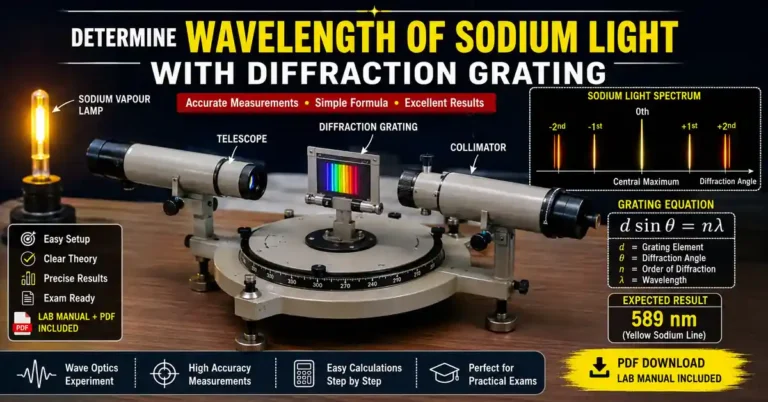
Sodium light is produced when electric current excites sodium atoms in a low-pressure sodium vapor lamp. As the excited atoms return to their normal energy state, they emit light predominantly in the yellow region of the visible spectrum. The average wavelength of sodium light is approximately 589.3 nm, consisting of two closely spaced spectral lines known as the D-lines.
A diffraction grating is an optical element containing thousands of extremely fine, parallel, equally spaced lines ruled on a glass plate. These lines create a very large number of narrow slits through which light can pass.
As the light passes through the grating, it bends and forms a pattern of bright spectral lines due to the combined effects of diffraction and interference. By measuring the angle at which these bright lines appear with a spectrometer, the wavelength of sodium light can be calculated accurately.
🚀 Aim of the Experiment:
To determine the wavelength of sodium light using diffraction grating by measuring the angles of diffraction using a spectrometer.
🌟 Why Does This Experiment Matter?
This experiment is more than just a laboratory practical—it helps you understand concepts that are widely used in modern science and engineering. The principle of diffraction is applied in spectrometers, chemical analysis, astronomy, laser technology, and optical fiber communication. Diffraction gratings are essential components of many optical instruments used for precise wavelength measurements.
If you’ve already explored our articles on the Resolving Power of a Diffraction Grating, this will strengthen those concepts. Here, the known grating spacing is used to determine the wavelength of sodium light, giving you a practical understanding of how diffraction gratings are used in real-world optical measurements.
📝 Experiment Summary:
To master the experiment for determining the wavelength of sodium light, it’s helpful to have a quick overview of the essential details. The table below summarizes the aim, principle, apparatus, formula, and other key information that will help you understand the experiment at a glance.
| Parameter | Details |
|---|---|
Aim |
Determine the wavelength of sodium light using a diffraction grating |
Principle |
Diffraction and Interference |
Light Source |
Sodium Vapour Lamp |
Apparatus Used |
Spectrometer, Plane Transmission Diffraction Grating, Sodium Lamp, Reading Lens |
Key Formula |
(a+b)sinθ=nλ |
Units of Wavelength |
Nanometres (nm) or Ångström (Å) [1 nm = 10 Å] |
Expected Result |
λ ≈ 589 nm (sodium D lines) |
Lab Type |
Optics / Wave Optics |
Relevant For |
B.Sc. Physics, B.Tech. Engineering Physics, JEE Advanced, GATE PH |
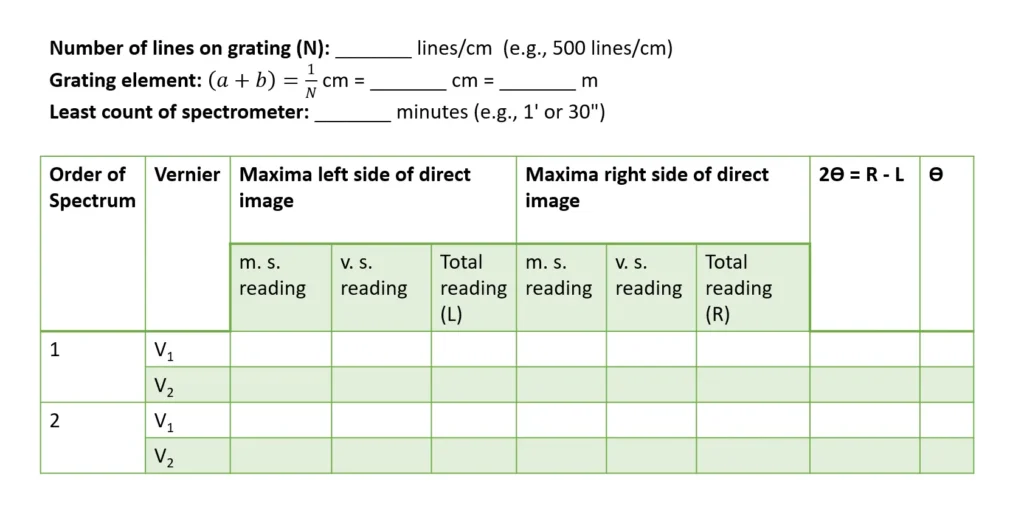
📊 Observation Table:
📄 Lab Manual PDF:
Below is the complete lab manual PDF for your direct reference during the lab session. You can view, download, or print it directly.
📄 Modified Lab Manual PDF:
🎥 Recommended Tutorial
🎯 Exam-Oriented Questions and Answers:
1. What is the aim of the diffraction grating experiment?
The aim of this experiment is to determine the wavelength of sodium light using a plane transmission diffraction grating and a spectrometer. The wavelength is calculated by measuring the diffraction angle and applying the grating equation (dsinθ=nλ).
2. What is a diffraction grating?
A diffraction grating is an optical element containing a large number of equally spaced parallel slits or grooves. When light passes through these slits, diffraction and interference occur, producing sharp spectral lines that are used to measure the wavelength of light accurately.
3. What is the grating equation?
The grating equation is dsin θ = nλ.
where d is the grating spacing, θ is the diffraction angle, n is the diffraction order, and λ is the wavelength of light.
4. Why is sodium light used in this experiment?
Sodium light is used because it produces bright yellow monochromatic light with a well-known wavelength of about 589 nm. Its high intensity and nearly single wavelength make it ideal for accurate diffraction measurements.
5. What is the grating element?
The grating element is the distance between the centers of two adjacent slits in a diffraction grating. It is represented by (d) and is usually expressed in metres. It plays a vital role in calculating the wavelength of light.
6. What is diffraction?
Diffraction is the bending or spreading of light waves when they pass through a narrow slit or around an obstacle. It is a characteristic wave phenomenon and forms the basis of wavelength measurement using a diffraction grating.
7. Why are observations taken on both sides of the central maximum?
Readings are taken on both sides of the central maximum to eliminate instrumental and alignment errors. The average of the left and right readings provides a more accurate diffraction angle.
8. What is the central or zero-order maximum?
The zero-order maximum is the bright central image formed when the diffraction angle is zero. It is the direct image of the slit and serves as the reference point for measuring higher-order diffraction angles.
9. What is the order of the diffraction pattern?
The order of diffraction represents the sequence of bright maxima produced by the grating. It is denoted by (n), where (n=0,1,2,…). Higher-order spectra appear at larger diffraction angles.
10. What is the standard wavelength of sodium light?
The commonly accepted wavelength of sodium light is approximately 589 nm. This value is widely used as a reference in optical experiments.
11. What happens if the number of lines per inch on the grating is increased?
According to the formula d sinθ = nλ, increasing the number of lines N decreases the grating element d. This results in a larger angle of diffraction sinθ, causing the spectral lines to spread further apart, thereby increasing the resolution.
12. What are the sodium D lines?
Sodium D lines (D₁ and D₂) are two closely spaced yellow spectral lines at 589.6 nm and 589.0 nm. They arise from two slightly different energy transitions of the outermost electron in the sodium atom, split due to spin-orbit coupling (a quantum mechanical effect).
🎓 Viva Questions and Answers:
Q1. What is monochromatic light?
Answer: Monochromatic light consists of a single wavelength or a very narrow range of wavelengths.
Q2. Which optical phenomenon is used in this experiment?
Answer: Diffraction and interference.
Q3. Which instrument is used in this experiment?
Answer: A spectrometer fitted with a plane transmission diffraction grating.
Q4. What is the function of the collimator?
Answer: It converts divergent light from the slit into a parallel beam.
Q5. Why is the slit kept narrow?
Answer: A narrow slit produces sharp and well-defined spectral lines.
Q6. Why should the grating be vertical?
Answer: To ensure normal incidence of light and obtain symmetrical diffraction spectra.
Q7. What happens if the slit is too wide?
Answer: The spectral lines become broad and blurred, reducing measurement accuracy.
Q8. Why is a spectrometer preferred?
Answer: It provides precise angular measurements required for wavelength calculations.
Q9. Define diffraction angle.
Answer: It is the angle between the central maximum and a particular diffraction maximum.
Q10. What is constructive interference?
Answer: It occurs when two or more waves meet in phase, producing maximum intensity.
Q11. What is destructive interference?
Answer: It occurs when waves meet out of phase, reducing or canceling the intensity.
Q12. What is the SI unit of wavelength?
Answer: Metre (m).
Q13. In which unit is wavelength commonly expressed?
Answer: Nanometre (nm).
Q14. What is the approximate wavelength of sodium light?
Answer: Approximately 589 nm.
Q15. Which spectrum is closest to the central maximum?
Answer: First-order spectrum.
Q16. What is the least count of a spectrometer?
Answer: It is the smallest angular measurement that can be read accurately by the spectrometer.
Q17. Why is parallax removed before taking readings?
Answer: To obtain accurate angular measurements.
Q18. What is meant by normal incidence?
Answer: Light falls perpendicular to the surface of the diffraction grating.
Q19. What is a plane transmission grating?
Answer: It is a transparent glass plate with thousands of equally spaced parallel lines ruled on its surface.
Q20. State one industrial application of diffraction gratings.
Answer: Diffraction gratings are widely used in spectrometers for wavelength analysis and material characterization.
Q21. What precautions should be taken to get accurate results?
Answer: Key precautions include the following: (1) The grating must be mounted perpendicular to the collimator (normal incidence). (2) The spectrometer should be properly focused with no parallax. (3) Read both verniers and take the mean. (4) Handle the grating only by its edges—do not touch the ruled surface. (5) Illuminate the slit uniformly and keep it narrow for sharp images.
❓ Frequently Asked Questions:
1. Why is sodium light preferred over white light in this experiment?
Sodium light is nearly monochromatic, producing sharp and distinct diffraction maxima. White light contains many wavelengths, which would overlap and make precise measurements difficult.
2. What is the purpose of taking readings from both sides of the spectrum?
Taking readings on both sides reduces systematic errors due to instrument misalignment and improves the accuracy of the calculated diffraction angle.
3. Can higher-order spectra be used for wavelength calculation?
Yes. Higher-order spectra generally provide larger diffraction angles, which can improve measurement accuracy if the spectral lines are clearly visible.
4. What are the sources of error in the diffraction grating experiment?
Main sources of error include (1) Improper adjustment of the spectrometer (not focussed for infinity, no elimination of parallax); (2) Grating not set at exact normal incidence; (3) Backlash error in the telescope movement — always approach the fringe from the same side; (4) The slit being too wide, causing broad maxima and imprecise angle readings; (5) Parallax between the cross-wire and the spectral image.
5. What is the difference between a diffraction grating and a prism spectrometer experiment?
A prism spectrometer uses refraction to disperse light—different wavelengths bend by different amounts as they pass through glass. A diffraction grating spectrometer uses diffraction and interference. Gratings produce multiple orders of spectra with near-linear wavelength dispersion, while prisms give a single spectrum with non-linear dispersion.
6. Can we use a laser source instead of a sodium lamp?
Yes, a laser can be used. Because a laser is highly monochromatic and intensely collimated, it produces incredibly bright, distinct spots on a screen without needing a telescope setup, though the experimental geometry changes slightly.
🔗 Related Topics You Can Read:
To strengthen your understanding and build a stronger foundation in wave optics, explore these closely connected experiments and theory articles:
- 🌟Determine the Grating Element of a Diffraction Grating Using a Laser
- 🌟 Determine the Radius of Curvature of a Plano-Convex Lens by Newton’s Rings
- 🌟 Determine the Numerical Aperture of an Optical Fiber
- 🌟 Determine the Energy Band Gap of a Semiconductor
- 🌟 Determine the Surface Tension of Water by the Capillary Rise Method
- 🌟 Fresnel Biprism Experiment
- Wave Optics Notes
- Interference of Light
- Diffraction of Light