
Ever wondered why a copper wire lights up your room instantly, while the glass covering the bulb never conducts a single spark, and yet a tiny silicon chip somewhere in between can be switched on and off billions of times a second?
The answer lies in one of the most elegant ideas in physics—the classification of solids based on electrical conductivity.
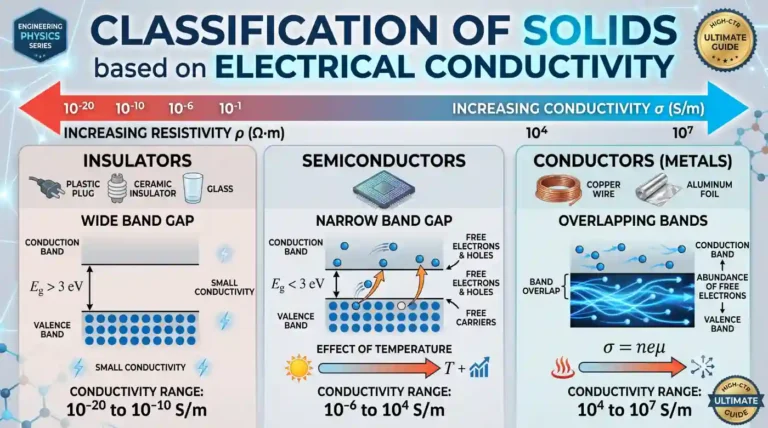
Table of Contents
Toggle💡 Introduction:
Every material around you — the fork in your kitchen drawer, the plastic case of your phone, the tiny transistor inside your laptop — behaves differently when you connect it to a battery. This behavior is what physicists capture under the heading of classification of solids based on electrical conductivity.
Solids exhibit a wide range of electrical behaviors depending on their internal atomic structure and the availability of charge carriers. Some solids allow electric current to pass through them easily, while others strongly oppose the flow of current. This difference in electrical behavior forms the basis for classifying solids according to their electrical conductivity.
Understanding this classification is essential for the study of electronic devices, semiconductor physics, and materials science, as it explains why different materials are used for wires, switches, insulators, and electronic components.
By the end of this article, you will learn:
- What electrical conductivity means
- Why solids are classified based on conductivity
- The different types of solids according to their electrical behavior
- The scientific principles behind conductors, semiconductors, and insulators
- Real-life applications of each type of material
- How this topic connects to semiconductor devices studied later in Engineering Physics
Whether you are preparing for your university examination or competitive exams or simply want to strengthen your conceptual understanding, this comprehensive guide will help you build a solid foundation in one of the most important topics of modern physics.
📜 Historical Background:
The classification of solids by conductivity has roots in the free electron theory proposed by Paul Drude in 1900, later refined by Arnold Sommerfeld using quantum statistics.
However, it was the band theory of solids, developed by Felix Bloch and Alan Wilson in the late 1920s and early 1930s, that finally explained why some solids conduct freely, some conduct only under special conditions, and some never conduct at all.
Wilson’s 1931 paper is often credited as the point where the modern conductor–semiconductor–insulator classification took its present shape.
💡 Basic Concept of Electrical Conductivity:
Before classifying solids, it is essential to understand what electrical conductivity actually means.
Electrical conductivity is the ability of a material to allow electric charges, primarily electrons, to move through it when an electric potential difference is applied.
In simple words,
Electrical conductivity is a measure of a material’s ability to conduct electric current.
The electrical conductivity of a material is represented by the Greek letter σ (sigma) and is measured in Siemens per meter (S/m).
Mathematically, electrical conductivity is given by:
$$\sigma=nq\mu$$
Where,
n = number of free charge carriers per unit volume
q = charge of an electron
μ = mobility of charge carriers
From this expression, it is clear that electrical conductivity depends mainly on the number of free charge carriers and their mobility.
Electrical conductivity and resistivity are inversely proportional to each other. i.e., $$\sigma=\frac{1}{\rho}$$
Here ρ is electrical resistivity, and its S.I. unit is Ω·m.
A material with high conductivity has low resistivity, while a material with high resistivity has low conductivity.
🌍 Why Do Different Solids Behave Differently?
At first glance, all solids may appear similar. However, their internal atomic structures are remarkably different. The arrangement of atoms and, more importantly, the behavior of electrons determine whether a material will conduct electricity efficiently.
Inside every solid, electrons occupy specific energy levels. Depending on how tightly these electrons are bound to their atoms, they may either move freely or remain confined. This difference in electron mobility is the primary reason behind the varying electrical conductivities of different solids.
For example:
- Copper contains a large number of mobile electrons, allowing electric current to flow with minimal resistance.
- Silicon has fewer free electrons under normal conditions, making it a semiconductor whose conductivity can be controlled.
- Glass holds its electrons very tightly, preventing the flow of electric current and making it an excellent insulator.
These differences are explained in detail through the energy band theory, which forms the scientific basis for the classification of solids. In the next article, we will explore how energy bands help us classify materials into conductors, semiconductors, and insulators.
🎯 Why Is Classification of Solids Necessary?
The classification of solids based on electrical conductivity is essential because no single material can satisfy every electrical requirement. Engineers choose materials according to their electrical behavior to achieve efficiency, reliability, and safety in different applications.
Some key reasons for this classification are:
- It helps engineers select suitable materials for electrical and electronic devices.
- It forms the foundation for understanding semiconductor technology and modern electronics.
- It explains why conductors are used for wiring, semiconductors for electronic circuits, and insulators for electrical protection.
- It provides the conceptual basis for advanced topics such as diodes, transistors, integrated circuits, LEDs, lasers, solar cells, and microprocessors.
- It enables the design of energy-efficient and high-performance electrical systems.
In essence, this classification bridges the gap between fundamental physics and practical engineering, making it one of the most important concepts for every engineering student.
⚡Energy Band Concept in Solids: -
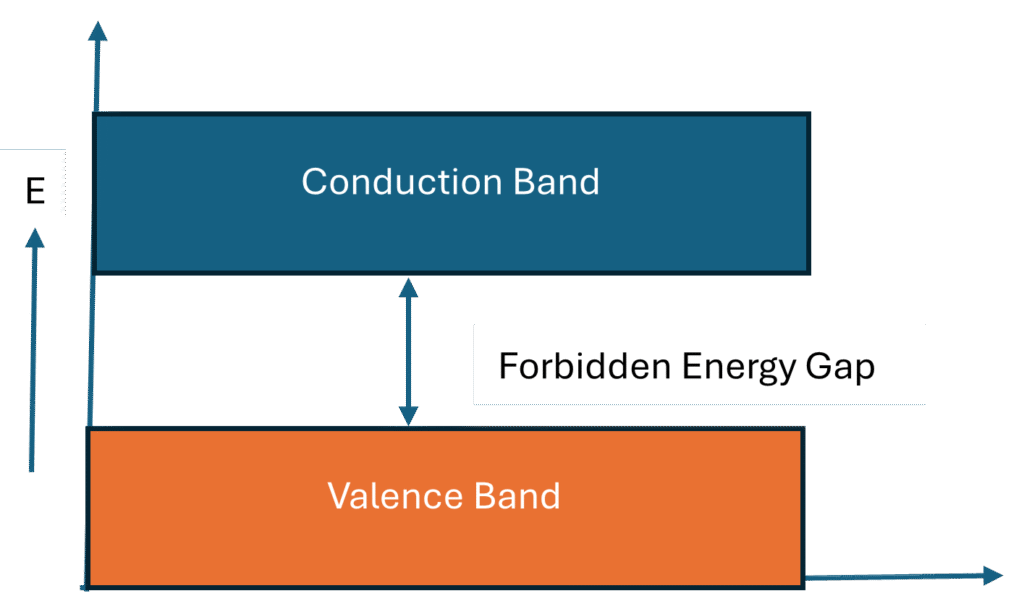
In an isolated atom, electrons occupy discrete energy levels. When a large number of atoms come together to form a solid, these discrete energy levels split into a large number of closely spaced levels, forming energy bands.
The two most important energy bands are the following:
- Valence Band (VB):
This is the energy band that is occupied by valence electrons. - Conduction Band (CB):
This is the energy band in which electrons can move freely and contribute to electrical conduction.
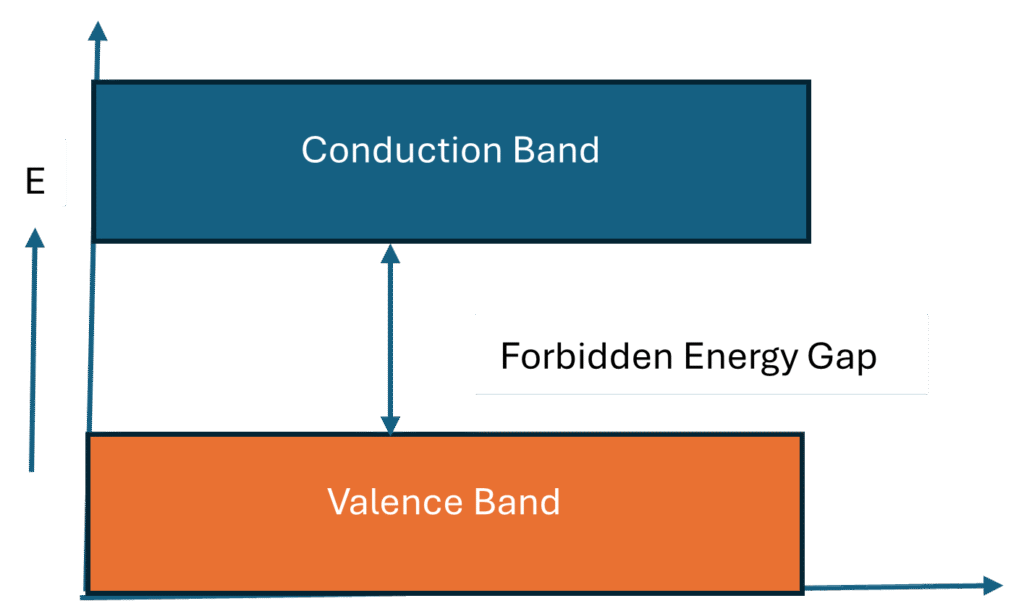
The energy gap between the valence band and the conduction band is known as the forbidden energy gap or band gap. It is denoted by Eg.
The electrical conductivity of a solid depends on the following:
- The width of the forbidden energy gap
- The availability of electrons in the conduction band
🧭 Classification of Solids Based on Electrical Conductivity:
Solids are broadly classified into three major categories based on their electrical conductivity (σ) and electrical resistivity (ρ):
- Conductors
- Semiconductors
- Insulators
🔶1. Conductors (Metals):
A conductor is a material that allows electric current to flow through it very easily because it contains a large number of free electrons.
When a voltage is applied across a conductor, these free electrons move rapidly in the direction opposite to the electric field, producing an electric current. Its
Conductivity Range (σ): 104 to 108 S m⁻¹ (or Ω⁻¹ m⁻¹)
Resistivity Range (ρ): 10-8 to 10-4 Ωm
Examples: Copper (Cu), Silver (Ag), Aluminum (Al), and Gold (Au).
💡 Why Do Conductors Conduct Electricity So Easily?
The outermost electrons of metallic atoms are loosely bound to their nuclei. These electrons can easily leave their parent atoms and move freely throughout the material.
These freely moving electrons are called
- Conduction electrons or
- Free electrons or
- Mobile charge carriers
Since millions of electrons are already available, current starts flowing almost instantly when voltage is applied.
⭐ Characteristics of Conductors:
- Large number of free electrons
- Very small resistivity
- Current flows easily
- Usually metals
- Good thermal conductors
- Shine due to metallic nature
- Easily drawn into wires (ductile)
- Can be beaten into sheets (malleable)
⚡Energy Band Structure of Conductors:
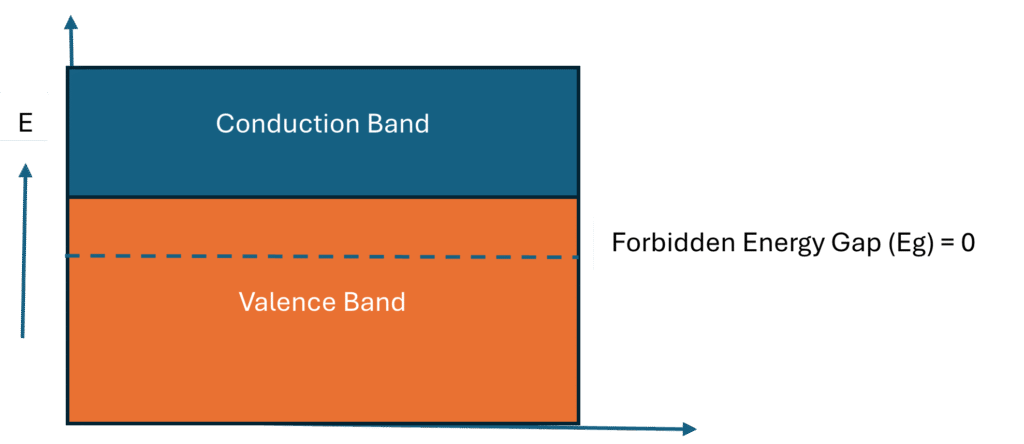
In conductors, the valence band and the conduction band overlapped. As a result, electrons require no additional energy to move into the conduction band.
Eg ≈ 0
Since a large number of free electrons are available, conductors exhibit very high electrical conductivity.
🌍 Everyday Applications of Conductors:
- House wiring
- Power transmission cables
- Electric motors
- Generators
- Charging cables
- Printed circuit boards (PCB)
- Electrical switches
Important Point:
- The electrical conductivity of conductors decreases slightly with an increase in temperature due to increased lattice vibrations.
- Although silver has the highest electrical conductivity, copper is widely used because it is less expensive, highly ductile, corrosion-resistant, and mechanically stronger.
🟠 2. Semiconductors:
Semiconductors are materials whose electrical conductivity lies between that of conductors (metals) and insulators (ceramics). Their conductivity is controllable via doping (adding impurities), temperature, light, or electric fields. Its
Conductivity Range (σ): 10-6 to 104 S m⁻¹
Resistivity Range (ρ): 10-4 to 106 Ωm
Examples: Silicon (Si), Germanium (Ge), Gallium Arsenide (GaAs).
💡 Why Are Semiconductors Special?
At room temperature, only a small number of electrons are free to conduct electricity. When energy is supplied, more electrons gain sufficient energy to participate in conduction.
Therefore, their conductivity increases significantly. This behaviour is exactly opposite to that of metallic conductors.
⭐ Characteristics of Semiconductors:
- Moderate electrical conductivity
- Moderate resistivity
- Conductivity increases with temperature
- Number of free electrons is limited
- Conductivity can be controlled
- Sensitive to light
- Sensitive to heat
- Sensitive to impurities
- Foundation of modern electronics
⚡Energy Band Structure of Semiconductors:
In semiconductors:
- The valence band is completely filled at absolute zero (0 K)
- The conduction band is empty at 0 K
- A small forbidden energy gap exists between VB and CB: 0 < Eg < 3 eV
At room temperature, thermal energy is sufficient to excite some electrons from the valence band to the conduction band, resulting in moderate conductivity.
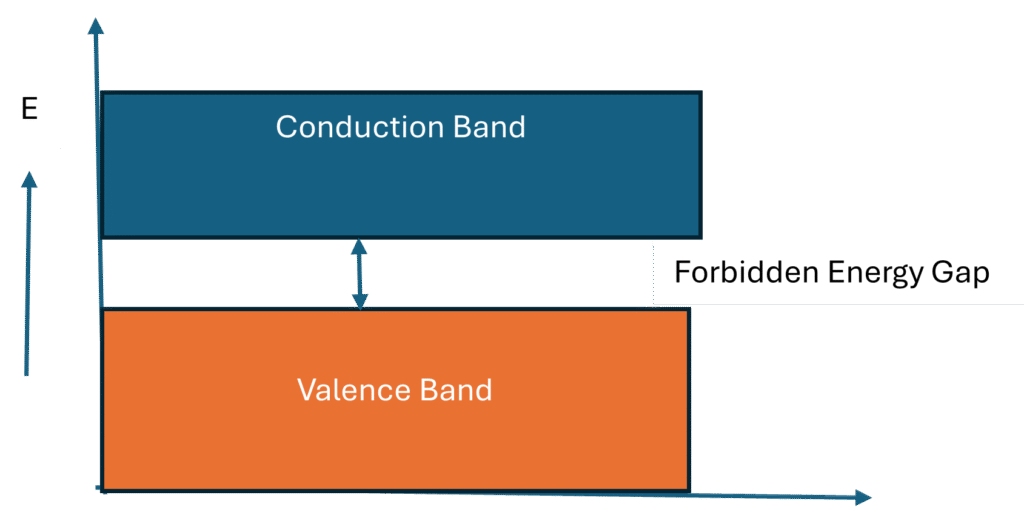
- Silicon (Si): Eg = 1.1 eV
- Germanium (Ge): Eg = 0.66 eV
🌍 Everyday Applications of Semiconductors:
Semiconductors are found almost everywhere in modern life. Examples include
- Smartphones
- Laptops
- Solar panels
- LEDs
- Laser diodes
- Television
- Remote controls
- Electric vehicles
- Medical equipment
- Artificial Intelligence hardware
They are rightly called the heart of modern electronics.
Important Point: The electrical conductivity of semiconductors increases with temperature, whereas that of conductors decreases.
🔵 3. Insulators:
An insulator is a material that does not allow electric current to pass through it under normal conditions because it contains almost no free electrons. Due to their atomic structure, they lack free electrons to carry charge, making them ideal for safety, such as covering wires, protecting against electric shock, and supporting high-voltage equipment.
Conductivity Range (σ): 10-20 to 10-10 S m⁻¹
Resistivity Range (ρ): 1010 to 1020 Ω m
- Examples: Wood, Glass, Mica, Quartz, Rubber, Diamond.
💡 Why Do Insulators Block Electricity?
In insulators, electrons are tightly bound to their atoms. These electrons require an enormous amount of energy before they can move freely.
Since this energy is not available under ordinary conditions, electric current cannot flow.
⭐ Characteristics of Insulators:
- Extremely low conductivity
- Very high resistivity
- Almost no free electrons
- Excellent electrical resistance
- Poor thermal conductivity
- Prevent electric leakage
- Used for electrical safety
⚡Energy Band Structure of Insulators:
In insulators, the forbidden energy gap between the valence band and conduction band is very large. Because of this large gap, electrons cannot be excited into the conduction band under normal conditions.
Eg > 3 eV
Hence, insulators have extremely low electrical conductivity.
🌍 Everyday Applications of Insulators:
- Cable insulation
- Electrical gloves
- Safety shoes
- High-voltage transmission towers
- Plug tops
- Switch boards
- Transformer insulation
📊 Comparison of Conductors, Semiconductors and Insulators:
| Property | Conductors | Semiconductors | Insulators |
|---|---|---|---|
Energy gap (Eg) |
≈ 0 |
0 – 3 eV |
> 3 eV |
Electrical conductivity |
Very high |
Moderate |
Very low |
Electrical Resistivity |
Very low |
Moderate |
Temperature effect |
Free Electrons |
Large Number |
Few |
Almost none |
Temperature effect |
Decreases |
Increases |
Almost unchanged |
Examples |
Cu, Ag |
Si, Ge |
Glass, Rubber |
Applications |
Wiring |
Electronic devices |
Electrical Safety |
🧮 Derivation of Electrical Conductivity:
Here, we derive the fundamental microscopic expression for electrical conductivity using the Classical Free Electron Model (Drude Model).
Consider a uniform conductor of cross-sectional area A and length L containing n free electrons per unit volume, each carrying an elementary charge e = 1.6 × 10⁻¹⁹ C.
When an external electric field E is applied across the conductor, each electron experiences an electrostatic force given by the following:
According to Newton’s second law of motion (F = ma), the acceleration a experienced by an electron of mass m is:
Due to frequent collisions with fixed lattice ions, electrons do not accelerate indefinitely. Instead, they acquire an average net directional velocity called the drift velocity (vd). If τ represents the relaxation time (the average time interval between two consecutive collisions):
The total electric charge dQ passing through a cross-section A in a time interval dt is equal to the number of electrons contained in a volume Avd dt:
By definition, electric current I is the rate of flow of charge:
Substituting the expression for drift velocity into the current equation yields:
We define current density (J) as the current flowing per unit cross-sectional area (J = I / A):
According to the microscopic form of Ohm’s Law, current density is directly proportional to the applied electric field, where the proportionality constant is the electrical conductivity (σ):
Comparing these equations gives the fundamental expression for electrical conductivity:
Since electron mobility (μ) is defined as the magnitude of drift velocity per unit electric field (μ = vd / E = e τ / m), we can simplify the equation into its most popular form:
For semiconductors carrying both electrons (n) and holes (p), the total conductivity is the sum of both charge carrier contributions:
✍️ Solved Numerical Problems:
Problem 1: Calculating Mobility from Drift Velocity
Question: A copper wire carries a current density of 2.5 × 10⁶ A/m2 under an applied electric field of 0.05 V/m. Calculate the electrical conductivity of copper and the mobility of electrons if the free electron density is 8.5 ×1028 m-3.
Solution:
Given: J = 2.5 × 10⁶ A/m2, E = 0.05 V/m, n = 8.5 × 1028 m⁻³, e = 1.6 × 10⁻¹⁹ C
Find: Electrical conductivity (σ) and electron mobility (μ).
Calculation:
Answer: Conductivity σ = 5.0 × 10⁷ S/m, Mobility μ = 3.68 ×10⁻³ m2V⁻¹s⁻¹.
Problem 2: Intrinsic Semiconductor Conductivity
Question: Calculate the intrinsic electrical conductivity of Silicon at room temperature (300 K) given intrinsic carrier concentration ni = 1.5 × 10¹⁶ m-3, electron mobility μn = 0.135 m2V⁻¹s⁻¹, and hole mobility μp = 0.048 m2V⁻¹s⁻¹.
Solution:
Given: ni = n = p = 1.5 × 10¹⁶ m⁻³, μn = 0.135 m2V⁻¹s⁻¹,
μp = 0.048 m2V⁻¹s⁻¹, e = 1.6 × 10⁻¹⁹ C
Find: Total electrical conductivity (σ).
Calculation:
Answer: Intrinsic conductivity of Silicon is 4.39 × 10⁻⁴ S/m.
Problem 3: Calculate the Resistance of a Wire
Question: A copper wire has a length of 8 m, a cross-sectional area of 2 ×10⁻⁶ m2, and a resistivity of 1.7 ×10⁻⁸Ω⋅m. Calculate its resistance.
Solution:
Given: L = 8 m, A = 2 ×10⁻⁶ m2, ρ = 1.7 ×10⁻⁸Ω⋅m
Find: Resistance (R)
Calculation: Since
$$R = \rho \frac{L}{A}$$
$$R = \frac{1.7 \times 10^{-8} \times 8}{2 \times 10^{-6}}$$
$$R = 0.068 \Omega$$
Answer: The resistance of the copper wire is R = 0.068 Ω.
🚀 Quick Answer Section:
## What is the classification of solids on the basis of electrical conductivity?
Answer:
The classification of solids based on electrical conductivity divides materials into conductors, semiconductors, and insulators according to their ability to conduct electric current. This classification depends on the number of free electrons, electrical conductivity, and energy band gap and forms the foundation of semiconductor physics and modern electronics.
## Why are solids classified based on electrical conductivity?
Answer:
Solids are classified based on electrical conductivity because different materials behave differently when electric current passes through them. This classification helps engineers select suitable materials for electrical wiring, electronic devices, semiconductor components, and insulation systems while ensuring efficiency, reliability, and safety.
## What are conductors, semiconductors, and insulators?
Answer:
Conductors allow electric current to flow easily because they have many free electrons. Semiconductors possess moderate conductivity that can be controlled by temperature and doping. Insulators strongly oppose current flow because their electrons are tightly bound to atoms and cannot move freely under normal conditions.
## What is electrical conductivity?
Answer:
Electrical conductivity is the ability of a material to allow electric current to pass through it. It is represented by the symbol σ (sigma) and measured in Siemens per metre (S/m). Materials with higher conductivity allow electrons to move more easily, resulting in lower electrical resistance.
## What is the difference between conductivity and resistivity?
Answer:
Electrical conductivity measures how easily electricity flows through a material, whereas resistivity measures how strongly a material opposes the flow of electric current. Both properties are inversely related by the equation σ = 1/ρ, where higher conductivity corresponds to lower resistivity and vice versa.
## Why is silicon called a semiconductor?
Answer:
Silicon is called a semiconductor because its electrical conductivity lies between that of conductors and insulators. It has a small energy band gap, allowing its conductivity to increase with temperature or doping. This controllable conductivity makes silicon the most widely used material in electronic devices.
## Which materials are the best conductors of electricity?
Answer:
Silver is the best electrical conductor because it has the highest conductivity among common metals. However, copper is most widely used in electrical wiring because it offers excellent conductivity, high mechanical strength, corrosion resistance, flexibility, and lower cost compared with silver.
## Why do insulators not conduct electricity?
Answer:
Insulators do not conduct electricity because their electrons are tightly bound to their atoms and require a large amount of energy to become free. The large forbidden energy gap prevents electrons from reaching the conduction band, resulting in extremely low electrical conductivity under normal conditions.
## What are the applications of classification of solids based on electrical conductivity?
Answer:
The classification of solids is widely applied in electrical engineering, electronics, renewable energy, communication systems, and computer technology. It helps engineers select conductors for power transmission, semiconductors for electronic circuits, and insulators for electrical safety, ensuring efficient and reliable device performance.
## Why Are Insulators Important?
Answer:
Insulators prevent unwanted current flow and protect users from electric shock. They are used in cable insulation, transformers, switchgear, electrical appliances, and high-voltage transmission systems to ensure safe and reliable operation.
## Why is Copper Preferred Over Silver for Electrical Wiring?
Answer:
Although silver has the highest electrical conductivity, copper is preferred because it provides excellent conductivity at a much lower cost. It also has high mechanical strength, good ductility, and corrosion resistance, and is readily available for large-scale electrical applications.
## Why does conductivity increase with temperature in semiconductors?
Answer:
As temperature increases, additional thermal energy excites more electrons from the valence band to the conduction band. This increases the number of charge carriers, thereby increasing the electrical conductivity.
## Why does conductivity decrease with temperature in metals?
Answer:
Higher temperatures increase lattice vibrations in metals. These vibrations scatter moving electrons more frequently, reducing their mobility and consequently decreasing electrical conductivity.
Important Examination Questions
Short Answer Questions
- Define electrical conductivity.
- What is a forbidden energy gap?
- Why are metals good conductors of electricity?
Long Answer Questions
- Classify solids on the basis of electrical conductivity with neat energy band diagrams.
- Explain the electrical properties of conductors, semiconductors, and insulators using energy band theory
Analytical Questions
- Why does the conductivity of semiconductors increase with temperature?
- Why is diamond an insulator, though it is made of carbon?
❓ Frequently Asked Questions (FAQs):
# Which property is used to classify solids?
Answer:
The primary property used to classify solids is electrical conductivity (σ), which measures how easily electric current flows through a material. Based on conductivity, solids are categorized into conductors, semiconductors, and insulators.
# Can the electrical conductivity of a semiconductor be increased?
Answer:
Yes. The electrical conductivity of a semiconductor can be increased by doping, increasing the temperature, or exposing it to light. These methods generate more charge carriers, allowing electric current to flow more easily through the material.
# Why is diamond an insulator while graphite is a conductor, even though both are made of carbon?
Answer:
Diamond has a strong covalent crystal structure in which all four valence electrons of each carbon atom are tightly bonded, leaving no free electrons for conduction. In graphite, one electron from each carbon atom remains delocalized and can move freely between layers, making graphite a good electrical conductor.
# Why are semiconductors considered the backbone of modern electronics?
Answer:
Semiconductors have controllable electrical conductivity, allowing them to act as switches, amplifiers, and signal processors. This property enables the fabrication of transistors, integrated circuits, microprocessors, memory chips, LEDs, laser diodes, and solar cells used in modern electronic devices.
# Why is the energy band gap important in determining electrical conductivity?
Answer:
The energy band gap determines how easily electrons can move from the valence band to the conduction band. A small or zero band gap allows electrons to move easily, resulting in high conductivity, while a large band gap prevents electron movement, producing insulating behavior.
# Why is copper preferred over silver for most electrical wiring?
Answer:
Although silver has slightly higher electrical conductivity, copper is preferred because it is significantly less expensive, readily available, mechanically stronger, corrosion-resistant, and easy to draw into long wires, making it more practical for large-scale electrical installations.
# What is the unit of electrical conductivity?
Answer:
Electrical conductivity is measured in siemens per metre (S/m), and it is the reciprocal of resistivity, which is measured in ohm-metres (Ω·m).
# What are the three types of solids based on conductivity?
Answer:
Solids are grouped into conductors, semiconductors, and insulators based on the size of the forbidden energy gap between their valence and conduction bands, which determines how easily electrons can carry current.
# How is conductivity related to resistivity?
Answer:
Conductivity is simply the reciprocal of resistivity, so a material with very low resistivity has very high conductivity, and vice versa.
# Why don't insulators have any free electrons at all?
Answer:
Insulators do have valence electrons, but they are tightly bound and separated from the conduction band by such a large energy gap that essentially none escape at ordinary temperatures.
# What is the energy bandgap (Eg) in insulators?
Answer:
Insulators have a large energy bandgap (Eg > 3 eV) separating the completely filled valence band from the empty conduction band. Room-temperature thermal energy is insufficient to bridge this gap.
🏁 Conclusion:
The classification of solids based on electrical conductivity reveals how quantum mechanics and microscopic atomic structure give rise to macroscopic electrical behavior.
A strong understanding of this topic not only helps students perform well in examinations but also builds the conceptual foundation required to study semiconductor devices and modern electronic systems.
As you continue with topics such as Energy Band Theory, Fermi Level, and Semiconductor Physics, you will find that the concepts introduced in this chapter are repeatedly applied throughout Engineering Physics.