
What if the smallest population of charge carriers in a semiconductor could have one of the biggest impacts on how electronic devices work?
So, what makes these “minor” carriers so important? Let’s uncover the physics behind minority carrier concentration and see how a simple semiconductor formula connects directly to the behavior of modern electronic devices.
Do you want to understand semiconductor carrier concentration instead of simply memorizing formulas? Start with the basic idea below and follow the derivation step by step.
Contents
Toggle1. 🔬 Introduction
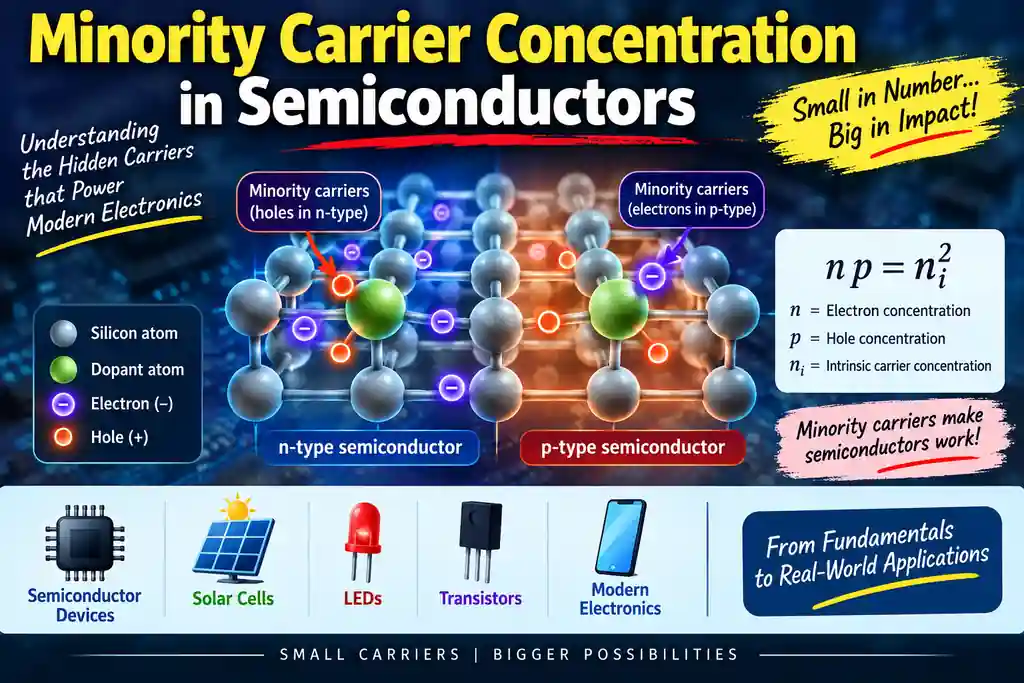
In an extrinsic semiconductor, charge carriers are classified into two types: majority carriers and minority carriers. Impurity doping increases the concentration of one type of carrier, making it dominant, while the other type remains present in a much smaller number. This smaller population is known as the minority carrier concentration.
In an n-type semiconductor, electrons are the majority carriers, while holes are present in much smaller numbers and act as minority carriers. In a p-type semiconductor, the situation is reversed—holes are the majority carriers, and electrons form the minority carrier population.
Although minority carriers are much fewer in number, they play an important role in determining the behavior of semiconductor devices. Their concentration is particularly important in devices such as p–n junction diodes, transistors, solar cells, and photodiodes. Therefore, understanding how minority carrier concentration is determined is an essential part of semiconductor physics.
By the end of this article, you will be able to:
- Identify majority and minority carriers,
- Calculate minority carrier concentration,
- Derive the important relation using the law of mass action
- Understand how doping changes minority carriers,
- Solve numerical problems confidently, and
- Connect minority carrier concentration with semiconductor devices.
2. Minority Carrier Concentration in n-Type Semiconductor
In an n-type semiconductor, the majority carriers are electrons, and the minority carriers are holes.
According to the law of mass action, the product of electron concentration n and hole concentration p in thermal equilibrium is constant and is given by
where ni is the intrinsic carrier concentration.
In an n-type semiconductor, the electron concentration is approximately equal to the donor impurity concentration:
Using the mass action law:
Substituting
Thus, the minority carrier concentration (holes) in an n-type semiconductor is inversely proportional to the donor concentration.
Important Observation:
As donor concentration increases:
- Electron concentration increases.
Hole concentration decreases.
3. Minority Carrier Concentration in p-Type Semiconductor
In a p-type semiconductor, the majority carriers are holes, and the minority carriers are electrons.
The hole concentration is approximately equal to the acceptor concentration:
Using the law of mass action:
Therefore, $$n=\frac{n_i^2}{p}$$ Substituting $$n=\frac{n_i^2}{N_A}$$ Thus, the minority carrier concentration (electrons) in a p-type semiconductor decreases as the acceptor concentration increases.
Important Observations
Minority carrier concentration is very small compared to the majority carriers.
It depends on the intrinsic carrier concentration.
Increasing impurity concentration decreases minority carrier concentration.
Minority carriers are responsible for important phenomena such as diffusion current and diode operation.
4. ⚖️ Comparison: Majority vs. Minority Carriers
| Parameter | Majority Charge Carriers | Minority Charge Carriers |
|---|---|---|
Origin / Source |
Ionization of intentionally added dopant impurities $$N_d\, or\, N_A$$ |
Pure thermal excitation across the energy bandgap $$E_g$$ |
Approximate Concentration |
$$\approx N_D$$ (in n-type) or $$\approx N_A$$ (in p-type), typically $$10^{15} – 10^{18}\text{ cm}^{-3}$$ |
$$\approx n_i^2/N_D$$ or $$\approx n_i^2/N_A$$, typically $$10^2 – 10^7\text{ cm}^{-3}$$ |
Dependence on doping |
Increases almost linearly with dopant density |
Decreases inversely with dopant density |
Dependence on temperature |
Nearly constant (saturated) over normal range |
Rises exponentially with temperature |
Dominant Conduction Mechanism |
Ohmic conduction and drift current under electric fields |
Diffusion across steep concentration gradients |
5. Effect of Doping on Minority Carrier Concentration
For n-type material, $$p_n \approx \frac{n_i^2}{N_D}$$
Therefore, $$p_n\propto \frac{1}{N_D}$$
Similarly, for p-type material, $$n_p \approx \frac{n_i^2}{N_A}$$
Therefore, $$n_p\propto \frac{1}{N_A}$$
So, when doping concentration increases, minority-carrier concentration decreases.
6. Effect of Temperature on Minority Carrier Concentration
Temperature introduces another important factor because the intrinsic carrier concentration ni strongly depends on temperature.
For an n-type semiconductor, $$p_n = \frac{n_i^2}{n_n}$$
If ni increases with temperature, then the minority-hole concentration also tends to increase.
Similarly, $$n_p = \frac{n_i^2}{p_p}$$
shows that minority-electron concentration increases as ni increases.
This explains why temperature can significantly affect semiconductor behavior.
At sufficiently high temperatures, thermally generated carriers can become comparable with dopant-generated carriers, and the semiconductor gradually moves toward intrinsic behavior.
7. Minority Carrier Diffusion in Semiconductors
Despite their small number, minority carriers play a crucial role in semiconductor devices like solar cells, transistors, and p–n junction diodes.
Minority carriers begin to migrate from the area of higher concentration to the area of lower concentration when their concentration rises in one area of the semiconductor relative to another.
Minority carrier diffusion is the term used to describe this movement of minority carriers caused by a concentration gradient.
8. Physical Origin of Minority Carrier Diffusion
In thermal equilibrium, the minority carrier concentration remains uniform throughout the semiconductor. When external disturbances such as heat, light, or electrical injection generate additional carriers, the local minority carrier concentration increases.
Due to this concentration gradient, minority carriers diffuse toward regions of lower concentration. During diffusion, many carriers recombine with majority carriers, causing the excess carrier concentration to gradually decrease until equilibrium is restored.
9. Variation of Minority Carrier Concentration with Distance
The concentration of excess minority carriers decreases exponentially with distance. This variation is expressed as $$\bigtriangleup n(x)=\bigtriangleup n(0)e^{-x/L_n}$$ where:
Δn(x) = excess electron concentration at distance x
Δn(0) = excess electron concentration at x = 0
Ln = diffusion length of electrons
The diffusion length represents the average distance a minority carrier travels before recombination occurs.
10. Minority Carrier Lifetime
Minority carriers also decay with time due to recombination. The decrease in excess carrier concentration with time is given by $$\bigtriangleup n(t)=\bigtriangleup n(0)e^{-t/\tau_n}$$
where τn = mean lifetime of electrons
The lifetime represents the average time a minority carrier exists before recombining.
11. Diffusion Length
The diffusion length is related to the diffusion coefficient and carrier lifetime by $$L_n=\sqrt{D_n\tau_n}$$
Similarly, for holes in an n-type semiconductor,
$$L_p=\sqrt{D_p\tau_p}$$
where Dn = diffusion coefficient for electrons and Dp = diffusion coefficient for holes
12. Importance of Minority Carrier Diffusion
Minority carrier diffusion is a very important process in semiconductor devices because:
It plays a major role in p–n junction formation.
It determines the operation of bipolar junction transistors (BJT).
It is responsible for carrier transport in solar cells and photodiodes.
It influences the current flow in semiconductor devices.
13. Quick Answer Section/(Interview Question-Answer)
# What is minority carrier concentration in a semiconductor?
Minority carrier concentration is the number of less abundant charge carriers present per unit volume of a semiconductor. In an n-type semiconductor, holes are minority carriers, while in a p-type semiconductor, electrons are minority carriers.
# Does increasing doping increase minority carrier concentration?
No. Under equilibrium conditions, increasing the majority-carrier concentration through doping generally decreases the minority-carrier concentration. This follows directly from np = ni2. For example, increasing ND in an n-type semiconductor reduces the equilibrium hole concentration approximately according to pn =ni2/ND.
# What role do minority carriers play in a diode?
Minority carriers diffusing across the depletion region are responsible for the reverse saturation current of a p-n junction diode, making their concentration a direct predictor of reverse leakage.
14. 🧮 Solved Numerical Problems
Problem 1: Minority Holes in n-type Silicon
Question: An n-type silicon ingot is doped uniformly with phosphorus donors at a concentration of ND = 2 × 1016 cm-3. Assuming complete ionization at T = 300 K and an intrinsic concentration of ni = 1.5 × 1010 cm-3, calculate the thermal equilibrium minority carrier concentration.
Solution:
Given:
Donor concentration, ND = 2 × 1016 cm-3
Intrinsic carrier concentration, ni = 1.5 × 1010 cm-3
Find:
Minority hole concentration, pn
Calculation: Assuming full donor ionization at room temperature:
From the Law of Mass Action:
Answer: The minority hole concentration is 1.125 × 104 cm-3.
Problem 2: Minority Electrons in p-type Germanium
Question: A germanium crystal is doped with boron acceptors at an impurity density of NA = 5.0 × 1016 cm-3. At 300 K, intrinsic germanium has an intrinsic carrier concentration of ni = 2.4 × 1013 cm-3. Determine the minority carrier concentration.
Solution:
Given:
Acceptor concentration, NA = 5.0 × 1016 cm-3
Intrinsic concentration for Ge, ni = 2.4 × 1013 cm-3
Find: Minority electron concentration, np
Calculation: Assuming full ionization of boron atoms:
Applying the Law of Mass Action:
Answer:
The minority electron concentration in the germanium sample is 1.152 × 1010 cm-3.
Problem 3: Minority Carrier Diffusion Length Calculation
Question: In a p-type silicon sample, the minority electron mobility is measured at μn = 1350 cm2/V.s at T = 300 K, and the minority carrier lifetime is τn = 2.5 μs. Calculate the electron diffusion coefficient and the corresponding minority carrier diffusion length. (Take the thermal voltage Vt = kBT/q≈ 0.0259 V).
Solution:
Given:
Electron mobility, μn = 1350 cm2/V.s
Carrier lifetime, τn = 2.5 μs = 2.5 × 10⁻⁶ s
Thermal voltage, Vt = kBT/q≈ 0.0259 V
Find:
Electron diffusion coefficient, Dn
Minority carrier diffusion length, Ln
Calculation: First, compute the diffusion coefficient using the Einstein relation:
Next, compute the minority carrier diffusion length:
Answer: The diffusion coefficient is 34.97 cm2/s and the minority carrier diffusion length is 93.5 μm.
Problem 4: Temperature Shift Impact on Minority Carriers
Question: An n-type silicon crystal has a fixed donor density of ND = 1.0 × 1015 cm-3. At 300 K, ni = 1.5 × 1010 cm-3. When the crystal is heated to 400 K, the intrinsic carrier concentration rises to ni = 4.5 × 1012 cm-3. Calculate the percentage increase in the minority hole concentration caused by this temperature rise.
Solution:
Given: Doping, ND = 1.0 × 1015 cm-3
ni (300 K) = 1.5 × 1010 cm-3
ni (400 K) = 4.5 × 1012 cm-3
Find: Percentage increase in pn
Calculation: pn at 300 K:
Now pn at 400 K:
Hence, the percentage increase:
Answer: The minority hole concentration surges by approximately 9.0 × 10⁶ % (a factor of 90,000), illustrating its extreme thermal sensitivity.
15. PYQs / Most Expected Questions
Conceptual Questions
- What are majority and minority carriers in a semiconductor?
- Define minority carrier concentration.
- Identify the minority carriers in n-type and p-type semiconductors.
- Why are holes called minority carriers in an n-type semiconductor?
- Explain the physical significance of np = ni2.
- How does doping affect minority carrier concentration?
- Explain the effect of temperature on minority carrier concentration.
- Distinguish between intrinsic and extrinsic semiconductor carrier concentrations.
Derivation Questions
- Derive the expression for minority-hole concentration in an n-type semiconductor.
- Derive the expression for minority-electron concentration in a p-type semiconductor.
- Using the law of mass action, obtain the minority carrier concentration in an n-type semiconductor.
- Using charge neutrality and the law of mass action, derive the approximate carrier concentrations in a doped semiconductor.
16. FAQs
1. What is meant by minority carrier concentration?
"Minority carrier concentration" refers to the number of charge carriers present in a smaller quantity in a semiconductor. In n-type materials, holes are minority carriers, while in p-type materials, electrons are minority carriers.
2. What are minority carriers in a semiconductor?
Minority carriers are the less abundant charge carriers:
- Electrons in a p-type semiconductor
- Holes in an n-type semiconductor
3. What is the minority carrier concentration in an n-type semiconductor?
In an n-type semiconductor, minority carriers are holes, and their concentration is given by:
p = nᵢ² / n4. What is the minority carrier concentration in a p-type semiconductor?
In a p-type semiconductor, minority carriers are electrons, and their concentration is:
n = nᵢ² / p5. Why are minority carriers important?
Even though they are fewer in number, minority carriers play a crucial role in the operation of semiconductor devices like diodes, transistors, and photovoltaic cells.
6. How does temperature affect minority carrier concentration?
As temperature increases, intrinsic carrier concentration (nᵢ) increases, which leads to an increase in minority carrier concentration.
7. How does doping affect minority carrier concentration?
Increasing doping raises majority carrier concentration, which decreases minority carrier concentration according to the mass action law.