
What hidden relationship keeps electrons and holes perfectly connected inside a semiconductor? 🤔
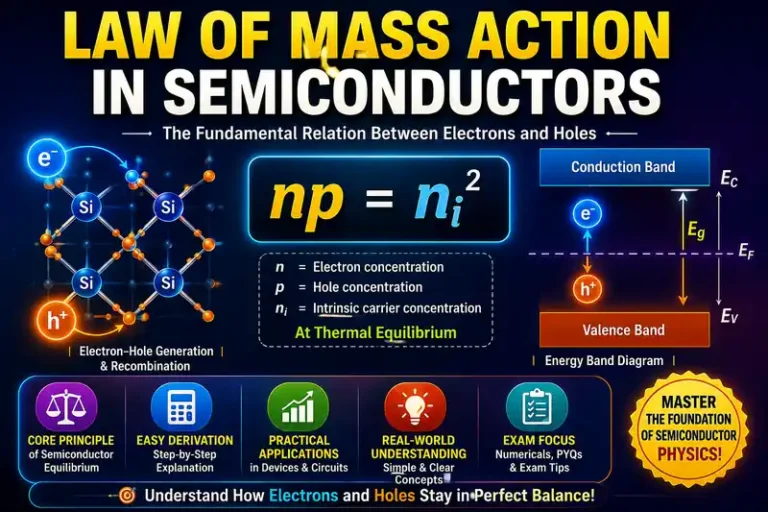
To understand this fascinating balance, let us explore the Law of Mass Action in Semiconductors and discover how the simple relation np = ni2 connects carrier concentration, doping, and semiconductor behavior.
“Keep reading — by the end, you’ll never forget np = ni² again!”
Complete derivation + real solved numericals + exam-ready FAQs, all in one place.
Contents
Toggle🚀 Introduction
In semiconductors, electrical conduction depends on the concentration of charge carriers, namely electrons and holes. When a semiconductor is in thermal equilibrium, the concentrations of electrons and holes are not independent of each other. Instead, they are related by a simple and very important law known as the Law of Mass Action.
This law plays a fundamental role in:
- Understanding intrinsic and extrinsic semiconductors
- Analysing carrier concentrations
- Explaining the effect of doping and temperature
- Studying p–n junctions and semiconductor devices
By the end of this article, you will be able to state the law precisely, derive the np = ni² relation from first principles, apply it to real numerical problems, and answer the most commonly asked exam and interview questions on this topic.
📜 Historical Background
The term “law of mass action” was originally borrowed from chemistry, where Cato Guldberg and Peter Waage proposed in the 1860s that the rate of a chemical reaction is proportional to the product of the concentrations of the reacting species.
Decades later, as quantum statistics and band theory matured through the work of Fermi, Dirac, and Wilson in the early twentieth century, solid-state physicists realized that electrons and holes in a semiconductor behave much like reacting chemical species—constantly being generated (by thermal excitation) and recombining (annihilating each other).
The chemistry-style law was adapted to describe this electron-hole equilibrium, and it has remained a cornerstone of semiconductor physics ever since.
⚡ What Is the Law of Mass Action in Semiconductors?
The Law of Mass Action in Semiconductors states that at thermal equilibrium, the product of the electron concentration in the conduction band and the hole concentration in the valence band equals the square of the intrinsic carrier concentration.
Mathematically,
$$np=n_i^2$$
where:
n = electron concentration in the conduction band
p = hole concentration in the valence band
ni = intrinsic carrier concentration
The equation shows that electrons and holes are not independent of each other. Their concentrations are connected through the intrinsic carrier concentration of the semiconductor.
This principle becomes especially useful when the concentration of one carrier is known. The concentration of the other carrier can then be calculated directly.
📌 Important:
This law is valid only under thermal equilibrium conditions.
🧠 Basic Concept Behind the Law of Mass Action
In a semiconductor, electrons and holes are continuously created and destroyed.
Generation of Electron-Hole Pairs
When a valence electron receives sufficient thermal energy, it can break its covalent bond and move from the valence band to the conduction band.
This process creates:
- One free electron in the conduction band
- One hole in the valence band
Therefore, generation always produces electrons and holes in pairs.
Recombination of Electrons and Holes
A free electron may later lose energy and fall back into a hole in the valence band.
When this happens, both the free electron and hole disappear as mobile charge carriers. This process is called recombination.
At thermal equilibrium:
$$\color{Red}{{Rate\, of\, generation}={Rate\, of\, recombination}} $$
This equilibrium between generation and recombination leads to a stable relationship between electron and hole concentrations.
The situation is similar to a water tank with both an inlet and an outlet. If water enters and leaves at the same average rate, the water level remains constant. Similarly, when carrier generation and recombination balance each other, the carrier concentrations remain stable.
This balance provides the physical foundation for the mathematical relationship derived below.
📐 Mathematical Derivation of the Law of Mass Action
To derive the law of mass action, consider a semiconductor at thermal equilibrium.
From semiconductor statistics, the electron concentration is given by:
$$n= N_C exp\left[ -\left( \frac{E_C-E_F}{kT} \right) \right]$$ Where:
NC = effective density of states in the conduction band
EC = bottom of conduction band
EF = Fermi level
k = Boltzmann constant
T = absolute temperature
Similarly, hole concentration is given by:
$$p= N_V exp\left[ -\left( \frac{E_F-E_V}{kT} \right) \right]$$
Where:
NV = effective density of states in the valence band
EV= top of valence band
Multiplying the above two equations:
$$np= N_CN_V exp\left[ -\left( \frac{E_C-E_F+E_F-E_V}{kT} \right) \right]$$
Simplifying the exponent:
$$np= N_CN_V exp\left[ -\left( \frac{E_C-E_V}{kT} \right) \right]$$
But, $$E_C-E_V=E_g$$
Where Eg is the forbidden energy gap.
Thus, $$np= N_CN_V e^{-\left( \frac{E_g}{kT} \right)}———(1)$$
For an intrinsic semiconductor: $$n=p=n_i$$
So, $$n_i^2= N_CN_V e^{-\left( \frac{E_g}{kT}\right)}——–(2)$$
Comparing the two results (1) and (2): $$np=n_i^2$$
This is the law of mass action.
The expression is not limited to an intrinsic semiconductor because Eg is unaffected by impurity concentration, while NC and NV remain constant. Therefore, the relation is equally valid for extrinsic semiconductors.
This result now leads naturally to an important question: how does doping affect this relationship?
🔄 Law of Mass Action in Extrinsic Semiconductors
N-Type Semiconductor:
If in n-type semiconductors, the electron concentration is denoted by nn and the hole concentration by pn, we can write it as
$$n_n=N_Ce^{-\left( E_C-E_{F_n}\right)/kT}$$ and
$$p_n=N_ve^{-\left( E_{F_n}-E_V \right)/kT}$$
Therefore, $$n_np_n=N_cN_ve^{-E_g/kT}$$
$$=> n_np_n=n_i^2$$
In this semiconductor, donor impurities provide a large number of free electrons.
Therefore:
$$n_n>p_n$$
Using the law of mass action, the hole concentration becomes the following:
$${p_n=\frac{n_i^2}{n_n}} $$
As the electron concentration increases, the hole concentration decreases.
P-Type Semiconductor:
Similarly, if the electron and hole concentration in a p-type semiconductor is denoted by np and pp, then
$$p_p=N_ve^{-(E_{F_p}-E_V)/kT}$$ and $$n_p=N_ce^{-(E_C-E_{F_p})/kT}$$
Therefore, $$p_pn_p=N_vN_ce^{-E_g/kT}$$
$$=> p_pn_p=n_i^2$$
In this semiconductor, acceptor impurities produce a large number of holes.
Therefore:
$$p_p>n_p$$
Using the law of mass action, the electron concentration becomes:
$${n=\frac{n_i^2}{p_p}} $$
As the hole concentration increases, the electron concentration decreases.
As a result, the above two equations demonstrate that the product of majority and minority carrier concentrations in an extrinsic semiconductor at a given temperature is a constant equal to the square of the intrinsic carrier concentration.
This behavior explains why doping can control the dominant charge carrier without destroying the fundamental equilibrium relationship.
ni (silicon, 300 K) ≈ 1.5 × 10¹⁰ cm⁻³ is held fixed. The graph uses a logarithmic scale because carrier concentrations span many orders of magnitude. Notice the electron and hole bars move in opposite directions while their product always equals ni².
🔍 Physical Significance of Law of Mass Action:
The Law of Mass Action in Semiconductors is important because it:
- Shows that electron and hole concentrations are interdependent—an increase in one leads to a corresponding decrease in the other.
- Shows that doping does not change the product at thermal equilibrium for a given temperature.
- Provides a simple way to calculate minority carrier concentration when the majority carrier concentration is known.
- Forms the foundation for many semiconductor device equations, including those used in the analysis of p–n junctions and other electronic devices.
⚡ Quick Answer Section
## What does (np=nᵢ²) mean?
The equation means that the electron and hole concentrations are related at thermal equilibrium. If one carrier concentration increases, the other decreases so that their product remains equal to the square of the intrinsic carrier concentration.
## Does the Law of Mass Action apply to both n-type and p-type semiconductors?
Yes. At thermal equilibrium, the relation (np = ni2) applies to intrinsic, n-type, and p-type semiconductors. Doping changes individual electron and hole concentrations but does not change their equilibrium product at a fixed temperature.
## Does the Law of Mass Action depend on temperature?
Yes. The relation contains (ni2), and the intrinsic carrier concentration strongly depends on temperature. Therefore, the numerical value of (np) changes when the temperature changes.
## Can the law of mass action be applied outside thermal equilibrium?
No, strictly it applies only in thermal equilibrium; under forward bias or illumination, excess carrier injection pushes np above ni².
## Why does the law of mass action fail under optical illumination?
Optical illumination injects external photon energy into the crystal, generating excess electron-hole pairs beyond thermal generation rates. This creates a non-equilibrium state characterized by split quasi-Fermi levels, causing the product np to exceed ni2.
📝 PYQs and Most Expected Questions
Short-Answer Questions:
- State the law of mass action.
- What is the significance of the law of mass action?
Long Answer / Derivation Questions:
- Derive the law of mass action in semiconductors.
- Explain the importance of law of mass action in intrinsic and extrinsic semiconductors.
⭐ Very frequently asked in university examinations
Conceptual Questions:
- Why does the product remain constant at a given temperature?
- How does temperature affect the law of mass action?
🔢 Solved Numerical Problems
Determine the majority and minority carrier concentrations.
Question 1. A sample of silicon at T = 300 K is doped with arsenic (donor atoms) at a concentration of Nd = 2 × 1016 cm-3. Given that the intrinsic carrier concentration of silicon at 300 K is ni = 1.5 × 1010 cm-3, determine the majority and minority carrier concentrations.
Solution:
Given: Nd = 2 × 1016 cm-3, ni = 1.5 × 1010 cm-3
Find: Majority electron concentration (nn), Minority hole concentration (pn)
Calculation: Assuming complete ionization at room temperature:
Applying the Law of Mass Action:
Answer: nn = 2 × 1016 cm-3 and pn = 1.125 × 104 cm-3.
Question 2. Germanium has an intrinsic carrier concentration of ni = 2.5 × 1013 cm-3 at 300 K. If it is doped with antimony to produce an electron concentration of n = 1 × 1017 cm-3, find the hole concentration.
Solution:
Given: ni = 2.5 × 1013 cm-3, n = 1 × 1017 cm-3
Find: Hole concentration (p)
Calculation: Using the equation
Answer: p = 6.25 × 109 cm-3.
❓ FAQs: Law of Mass Action in Semiconductors
1. What is the law of mass action in semiconductors?
The law of mass action states that, at thermal equilibrium, the product of the concentration of electrons and holes in a semiconductor remains constant.
2. What is the mathematical expression of the law of mass action?
n⋅p=ni²
Here, n is the electron concentration, p is the hole concentration, and nᵢ is the intrinsic carrier concentration.3. Does the law of mass action apply to both intrinsic and extrinsic semiconductors?
Yes, it applies to both types, but only under thermal equilibrium conditions.
4. How does temperature affect the law of mass action?
Temperature changes the value of nᵢ, but the relationship (n × p = nᵢ²) still holds at equilibrium.
5. Why is the law of mass action important in semiconductor physics?
It helps in analyzing carrier concentrations and is essential for understanding the behavior of devices like diodes and transistors.
6. Does the law of mass action hold under all conditions?
No, it is valid only under thermal equilibrium. It does not apply when external energy sources like electric fields or light disturb the system.