
Contents
Toggle🚀 Introduction:
The determination of the Surface Tension of Water by Capillary Rise Method is one of the most important experiments in Engineering Physics laboratories. Surface tension is a unique property of liquids that arises due to the attractive forces between their molecules. It is responsible for many everyday phenomena, such as the formation of water droplets and the rise of liquids in narrow tubes.
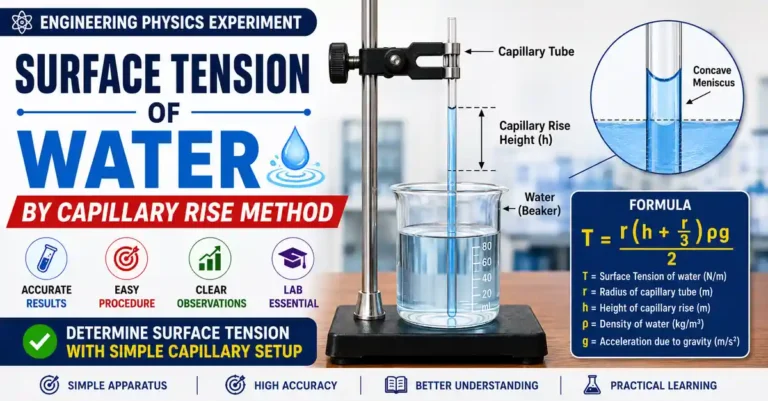
In this experiment, the surface tension of water is determined using the capillary rise method. When a clean glass capillary tube is placed in water, the liquid rises inside the tube due to capillary action.
By measuring the height of rise and the radius of the capillary tube, the surface tension of water can be calculated accurately. This experiment helps students understand the relationship between intermolecular forces, capillary action, and fluid behavior, making it an important practical application of engineering physics.
🎯 Aim of the Experiment:
“To determine the surface tension of water by capillary rise method at room temperature.”
The experiment also aims to:
- Study the phenomenon of capillary action.
- Understand the relationship between surface tension and intermolecular forces.
- Learn the use of a traveling microscope for precise measurements.
- Verify the theoretical formula for surface tension experimentally.
- Develop skills in observation, measurement, and error analysis.
📖 Molecular Origin of Surface Tension:
Every liquid consists of molecules that attract one another through intermolecular forces. Molecules located inside the liquid experience equal attractive forces from all directions.
As a result, the net force acting on them becomes zero. However, molecules at the liquid surface lack neighboring molecules above them. Therefore, they experience a net inward force.
This inward force causes the liquid surface to behave like a stretched elastic membrane. Due to this, the liquid naturally tries to minimize its surface area, and the resulting phenomenon is called surface tension.
Surface tension can be defined as the tangential force acting per unit length on an imaginary line drawn on the liquid surface.
Mathematically,
Surface Tension (T) = Force / Length
The SI unit of surface tension is Newton per meter (N/m).
✨ Factors Affecting Capillary Rise:
Several factors influence capillary rise:
- Radius of the capillary tube
- Surface tension of the liquid
- Density of the liquid
- Contact angle between the liquid and the tube material
- Acceleration due to gravity
- Temperature of the liquid
A smaller tube radius produces a greater capillary rise because the upward force becomes more significant relative to the weight of the liquid column.
🌟 Importance in Engineering Physics:
Surface tension is a fundamental property of liquids arising due to intermolecular forces. Understanding surface tension helps engineering students analyze fluid behavior in small channels, porous materials, microfluidic systems, and various industrial processes.
The capillary rise method provides a simple yet accurate way of measuring surface tension by observing the height to which water rises in a narrow capillary tube.
🎯 Applications:
• Design of microfluidic devices
• Inkjet printing technology
• Fuel transport systems
• Medical diagnostic instruments
• Soil water movement studies
• Textile and paper industries
• Paints and coating technologies
• Biological fluid analysis
Understanding surface tension is essential for engineers working in mechanical, civil, chemical, biomedical, and materials engineering fields.
📚 Modified Lab Manual PDF:
📚 Normal Lab manual PDF:
📌 Experiment Summary:
| Parameter | Description |
|---|---|
Objective |
To determine the Surface Tension of Water by the capillary rise method |
Principle |
Capillary action |
Apparatus |
Capillary tube, travelling microscope, beaker, water |
Formula |
T = r(h + r/3)ρg/2 |
Result |
Surface tension of water determined experimentally |
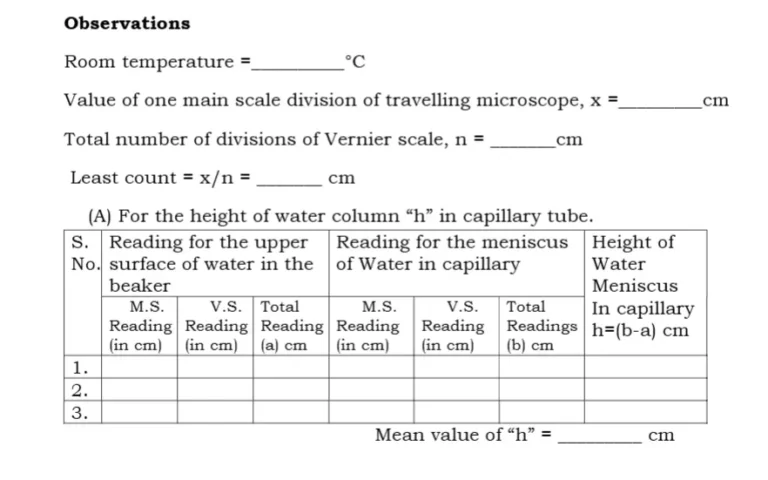
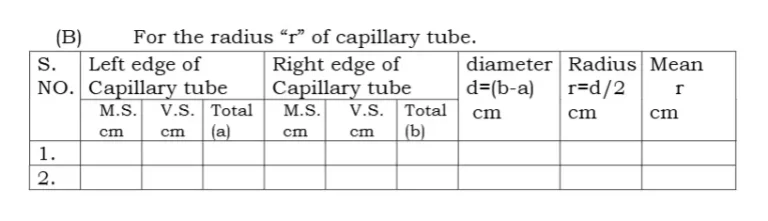
📋 Observation Table:
▶️ Watch on YouTube:
🔍 Exam-Oriented Question-Answer
What is surface tension?
Surface tension is the property of a liquid surface that makes it behave like a stretched elastic membrane. It occurs due to cohesive forces between liquid molecules and is measured as force per unit length.
What is capillary rise?
Capillary rise is the upward movement of a liquid in a narrow tube due to the combined effect of surface tension and adhesion between the liquid and tube walls.
What is the formula for surface tension by the capillary rise method?
The surface tension of a liquid is calculated using:
$$T=\frac{r(h +\frac{r}{3})\rho g}{2}$$
where ρ is density, h is capillary rise, r is tube radius, and g is acceleration due to gravity.
Why does water rise in a capillary tube?
Water rises because adhesive forces between water and glass are stronger than the cohesive forces within water molecules, producing an upward force due to surface tension.
What is the SI unit of surface tension?
The SI unit of surface tension is Newton per meter (N/m).
⚡ Viva Questions and Answers:
1. What is surface tension?
Surface tension is the tangential force acting per unit length along the free surface of a liquid.
2. What causes surface tension?
It is caused by cohesive intermolecular forces between liquid molecules.
3. Define capillary action.
Capillary action is the rise or fall of a liquid in a narrow tube due to surface tension.
4. Why is a glass capillary tube used?
A narrow tube provides a measurable capillary rise and improves accuracy.
5. Why does water form a concave meniscus?
Because adhesion between water and glass is greater than cohesion within water.
6. What is a meniscus?
The curved surface formed by a liquid in contact with a solid boundary.
7. Why is the capillary tube cleaned before use?
To remove impurities that may affect surface tension measurements.
8. What happens if the radius of the tube increases?
The capillary rise decreases.
9. What is the SI unit of surface tension?
Newton per meter (N/m).
10. What is the approximate surface tension of water at room temperature?
Approximately 0.072 N/m.
11. Why should the tube be vertical?
To ensure accurate measurement of capillary rise.
12. What is the role of density in the experiment?
Density affects the weight of the liquid column and appears directly in the formula.
13. What is cohesive force?
The force of attraction between molecules of the same substance.
14. What is adhesive force?
The force of attraction between molecules of different substances.
15. State one engineering application of capillary action.
Capillary action is used in fuel delivery systems and microfluidic devices.
❓ FAQs:
Q1. What is the aim of the capillary rise experiment?
The aim is to determine the surface tension of water by the capillary rise method.
Q2. Why does water rise in a capillary tube?
Water rises because adhesive forces between water and glass exceed cohesive forces within water molecules.
Q3. Which formula is used to calculate surface tension?
The formula used is:
$$T=\frac{r(h+r/3)\rho g}{2}$$
Q4. What factors affect capillary rise?
Capillary rise depends on tube radius, liquid density, surface tension, temperature, and contact angle.
Q5. What are the applications of surface tension?
Surface tension is important in coating technologies, printing, biomedical devices, detergents, paints, and fluid transport systems.
Q6. How does adding common salt or detergent affect the surface tension of water?
Adding highly soluble inorganic salts like sodium chloride (NaCl) increases the surface tension of water because the strong ion-dipole forces pull the water molecules closer together. Conversely, adding detergents or surfactants breaks up hydrogen bonds, significantly lowering the surface tension.
⭐ Related Experiments
Engineering Physics Laboratory Experiments:
🔹 Determination of Viscosity by Poiseuille’s Method
🔹 Determination of Wavelength of Laser Using Diffraction Grating
🔹 Fresnel’s Biprism Experiment
🔹 Determination of Numerical Aperture of Optical Fibre
🔹 Determination of Energy Band Gap of Semiconductor
🔹 Study of PN Junction Diode Characteristics