
A diode has only two terminals, yet its current can change dramatically with a very small change in voltage. This remarkable behavior is not accidental; it comes from the movement and concentration of charge carriers across the P–N junction.
The P–N junction diode equation captures this behavior mathematically, revealing the beautiful connection between semiconductor physics, carrier diffusion, and the exponential nature of diode current.
Contents
Toggle🔬 Introduction
The P–N junction diode is a fundamental building block of modern electronics. From rectifiers to signal-processing circuits, diodes play a crucial role in controlling current flow direction. It is mathematically described by the P–N junction diode equation.
This equation is the relationship between the diode current and the applied voltage and is known as the rectifier equation, the Shockley diode equation, or simply the diode equation.
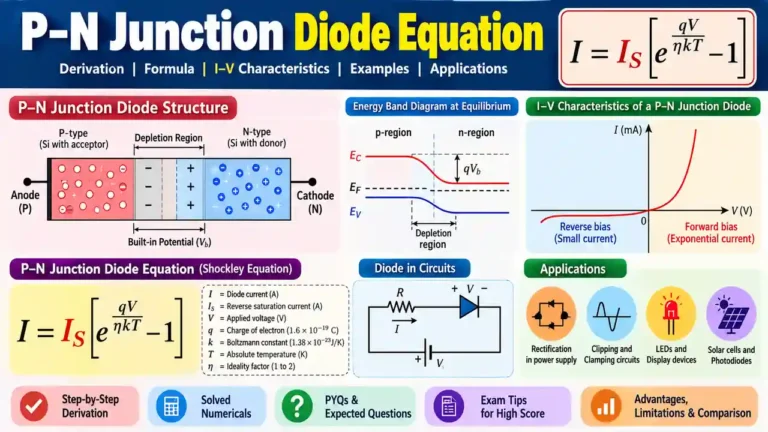
The basic equation is $$I=I_S\left(e^{\frac{qV}{\eta kT}}-1\right) $$
where the exponential term explains why a small change in forward voltage can produce a large change in diode current.
You will encounter this equation while studying:
Semiconductor physics,
P–N junctions,
Rectifiers,
Transistor junctions,
Electronic circuits, and
Semiconductor device modelling.
In this article, we will explore
- The diode equation in depth, from its physical meaning to its mathematical derivation,
- and analyze its behavior in different biasing conditions.
- Discuss its real-world applications, and
- Finally, apply it to real-world engineering problems.
By the end, you will not only understand the equation but also feel confident about its physical meaning, mathematical derivation, ideality factor, applications, and numerical problems.
📜 Historical Background
The modern semiconductor diode is closely connected with the development of semiconductor physics and the understanding of P–N junctions.
The theoretical treatment of the current–voltage behavior of a P–N junction was developed from the physics of carrier diffusion and recombination. William Shockley, working at Bell Labs in 1949, formulated the well-known relation commonly called the Shockley diode equation.
The importance of this equation lies in its ability to describe the exponential current–voltage behavior of an ideal P–N junction over its normal operating region.
It therefore became a fundamental equation in semiconductor-device physics.
🧩 Basic Concept Behind the Diode Equation
Since the current in a p–n junction arises due to the diffusion and drift of charge carriers under an energy barrier. At equilibrium, diffusion current (due to the carrier concentration gradient) and drift current (due to the internal electric field) balance each other, and hence, the net current across the junction is zero.
When a forward voltage is applied, the barrier potential decreases; therefore, more majority charge carriers cross the junction, leading to an exponential increase in current as predicted by Boltzmann statistics.
In reverse bias, the barrier increases, blocking the majority carriers and allowing only a small reverse saturation current due to minority carriers.
To explain mathematically the current flowing across the junction, the pn junction diode equation is derived.
The diode equation describes how current varies with applied voltage across a p–n junction. The following formula represents it:
$$I = I_S \left(e^{\frac{qV}{\eta kT}} – 1\right) $$
This equation tells us:
- Current increases exponentially with voltage in forward bias
- Current remains very small in reverse bias
Now, let’s derive the diode equation.
📐 Diode Equation: Derivation
According to Boltzmann’s equation, the hole concentration in the p-region (pp) and in the n-region (pn) are related as
$$p_n=p_pexp\left( -\frac{eV_B}{kT} \right)\quad……………. (1) $$
It represents the concentration of holes in the n-region when no voltage is applied. Suppose a forward voltage V is applied; then it reduces the potential barrier from VB to VB – V.
Due to this applied voltage, the majority charge carriers start diffusing in the depletion region, and after crossing the junction, holes reach the n-region and electrons reach the p-region. Therefore, minority carrier concentration increases in both regions.
Suppose Δpn is the increase in hole concentration in the n region; therefore, as per equation (1), we can write
$$p_n+\Delta p_n=p_pexp\left[ -\frac{\left( V_B-V \right)}{kT} \right] \quad…………. (2)$$
Subtracting equation (1) from equation (2), we get
$$\Delta p_n=p_pexp\left( -\frac{eV_B}{kT} \right)\left[ exp\left( \frac{eV}{kT} \right)-1 \right]\quad ………….(3)$$
Similarly, in the p region, an increase in electron concentration is given by
$$\Delta n_p=n_nexp\left( -\frac{eV_B}{kT} \right)\left[ exp\left( \frac{eV}{kT} \right)-1 \right] \quad………….(4)$$
Due to the diffusion of these charge carriers, current flows. And if A is the area of the junction, then the total current flowing across the junction is
$$I = JA = eA\left(\Delta n_p v_{d_n}+\Delta p_nv_{d_p}\right) $$
[Since J = nevd]
Putting the values of Δpn and Δnp from equations (3) and (4), we get
$$I = eA\left( n_n v_{d_n}+ p_pv_{d_p}\right)exp\left( -\frac{eV_B}{kT} \right)\left[ exp\left( \frac{eV}{kT} \right)-1 \right]$$
$$\Rightarrow I = I_S\left[ exp\left( \frac{eV}{kT} \right)-1 \right]$$
Adding an ideality factor η (≈1 for Ge, ≈2 for Si)
$$I = I_S\left[ exp\left( \frac{eV}{\eta kT} \right)-1 \right]\quad ……………(5)$$
Where $$I_S= eA\left( n_n v_{d_n}+ p_pv_{d_p}\right)exp\left( -\frac{eV_B}{kT} \right) $$
It is called reverse saturation current. And equation (5) is the required diode equation.
In forward bias: V is positive, hence exp(eV/kT) >> 1; therefore, $$I=I_Sexp\left( \frac{eV}{\eta kT} \right) $$
In reverse bias: V is negative, hence $$I=I_S$$
🧪 Effect of Temperature on the Diode Equation
The diode equation contains temperature through
$$V_T=\frac{kT}{e}$$
Therefore, temperature affects the current–voltage relationship.
For a fixed applied forward voltage,
$$I=I_S\left[e^{\frac{V}{\eta V_T}}-1\right]$$
As temperature increases, VT increases.
However, there is an additional and very important effect: the reverse saturation current IS itself changes strongly with temperature.
Therefore, a complete analysis of temperature dependence cannot be made by changing VT alone.
This is an important point in advanced semiconductor-device analysis.
🔧 Effect of Series Resistance
The basic Shockley equation assumes that the voltage appearing across the junction is the externally applied diode voltage.
In a real diode, internal resistance can become important at higher current.
A commonly used extended formula is
$$I = I_S\left[e^{\frac{V-I R_S}{\eta V_T}}-1\right]$$
where RS is the series resistance.
At low and moderate currents, the basic Shockley equation may provide a good approximation. At high currents, however, the voltage drop across RS can become significant.
This explains why the practical I–V curve may deviate from a perfect exponential curve at high forward currents.
Interactive P-N Junction Carrier Flow
Adjust bias voltage to see depletion width change and charge carriers sweep across the junction.
🌐 Applications of the P–N Junction Diode Equation
The diode equation has applications far beyond a single theoretical calculation.
1. Rectifier Circuits: Diodes convert alternating electrical signals into unidirectional or pulsating DC signals. The diode equation helps explain the relationship between applied voltage and conduction current.
2. LED Analysis: LEDs are semiconductor P–N junction devices. Their forward current also shows a strong dependence on applied voltage, although their complete behavior requires additional device physics.
3. Photodiodes: Photodiodes operate using a P–N or related junction structure. The diode equation provides the foundation for understanding their dark current and photocurrent behavior.
4. Solar Cells: A solar cell current can be represented using a modified diode equation with a photocurrent term. Thus, the P–N junction equation forms an important foundation for understanding photovoltaic devices.
5. Transistor Junctions: Bipolar junction transistors contain P–N junctions. The exponential junction relationship is therefore fundamental to understanding transistor operation and the dependence of collector current on junction voltage.
⚡ People Also Ask—Interview Question
## What is the P–N junction diode equation?
The P–N junction diode equation describes the relationship between diode current and applied voltage. Its practical form is $$I=I_S[e^{eV/(\eta kT)}-1]$$ Here, IS is the reverse saturation current, q is the elementary charge, k is Boltzmann’s constant, T is the absolute temperature, and η is the ideality factor.
## What is the Shockley diode equation?
The Shockley diode equation is the mathematical relation used to describe the current–voltage behavior of an ideal or practical P–N junction diode. Its practical form is $$I=I_S[e^{eV/(\eta kT)}-1]$$ It shows that forward diode current increases approximately exponentially with applied voltage.
## What is the diode equation at room temperature?
At approximately 300 K, the thermal voltage is $$V_T=kT/q\approx25.85\text{ mV}$$
Therefore, the practical diode equation can be written as $$I=I_S[e^{V/(\eta\times0.02585)}-1]$$ This form is convenient for solving many numerical problems in engineering physics and electronics.
## What is reverse saturation current in a diode?
Reverse saturation current, represented by IS, is the small current under reverse bias, mainly due to minority carriers, before breakdown. Its value depends strongly on semiconductor material, temperature, doping, junction area, and device construction. It is an important parameter in the Shockley diode equation.
## Why does diode current increase exponentially?
Forward bias reduces the P–N junction barrier and increases the minority-carrier concentration near the junction. The injected carrier concentration depends exponentially on the applied voltage. Since diffusion current depends on this carrier concentration, the resulting diode current also increases approximately exponentially with forward voltage.
## What is the ideality factor of a diode?
The ideality factor, represented by η or n, accounts for deviations from the ideal diffusion-based diode model. For an ideal diffusion-dominated junction, it is approximately 1. Practical devices may show values near 1 or 2 depending on the dominant transport and recombination mechanisms and the operating region.
## What is thermal voltage in a diode?
Thermal voltage is defined as VT=kT/q, where k is Boltzmann’s constant, T is absolute temperature, and q is the elementary charge. At approximately 300 K, its value is about 25.85 mV. It appears naturally in the exponential term of the diode equation.
🎓 One-Minute Revision
P–N Junction Diode Equation:
$${I=I_S\left[e^{\frac{qV}{\eta kT}}-1\right]}$$
Thermal Voltage:
$${V_T=\frac{kT}{q}}$$
At 300 K:
$${V_T\approx25.85 mV}$$
Alternative Form:
$${I=I_S\left[e^{\frac{V}{\eta V_T}}-1\right]}$$
Voltage Form:
$${V=\eta V_T\ln\left(1+\frac{I}{I_S}\right)}$$
Main Parameters:
I → diode current
IS → reverse saturation current
V → applied voltage
q → electronic charge
k → Boltzmann constant
T → absolute temperature
η → ideality factor
VT → thermal voltage
🧮 Solved Numerical Problems
Problem 1: Calculate Forward Current
Question: A silicon diode has a reverse saturation current of 0.5 nA. It is operated at 300K with a forward voltage of 0.55V. Assume η = 1. Calculate the diode current.
Solution:
Given:
$$I_S=0.5 nA=0.5\times10^{-9}A$$
$$V=0.55 V$$
$$T=300 K$$
$$\eta=1$$
At 300 K,
$$V_T\approx0.02585 V$$
Find: Diode current I.
Calculation: Using
$$I=I_S\left[e^{\frac{V}{\eta V_T}}-1\right]$$
Substituting the given values, we obtain
$$I = 0.5\times10^{-9}\left[e^{\frac{0.55}{0.02585}}-1\right]$$
$$I\approx0.868 A$$
Answer: The diode current is
$${I\approx0.868 A}$$
Problem 2: Calculate Forward Voltage
Question: A diode carries a forward current of 8 mA. Its reverse saturation current is 2 nA. The diode operates at 300 K and has an ideality factor of 1.5. Find the forward voltage.
Solution:
Given:
$$I=8\times10^{-3}A$$
$$I_S=2\times10^{-9}A$$
$$\eta=1.5$$
$$T=300 K$$
$$V_T=0.02585 V$$
Find: Applied forward voltage V
Calculation: Since
$$I=I_S\left[e^{\frac{V}{\eta V_T}}-1\right]$$
we obtain
$$V=\eta V_T\ln\left(1+\frac{I}{I_S}\right) $$
Substituting,
$$V=1.5(0.02585)\ln\left(1+\frac{8\times10^{-3}}{2\times10^{-9}}\right)$$
Therefore,
$$V\approx0.589 V$$
Answer: Applied forward voltage is
$${V\approx0.589 V}$$
Problem 3: Calculate Reverse Current
Question: A diode has a reverse saturation current of 5 nA. A reverse voltage of 10 V is applied. Assume that the diode is operating below breakdown. Find the diode current.
Solution:
Given:
$$I_S=5 nA$$
$$V=-10 V$$
Calculation: Using the diode equation
$$I=I_S\left[e^{\frac{V}{\eta V_T}}-1\right]$$
Since the applied voltage is strongly negative,
$$e^{\frac{V}{\eta V_T}}\approx0$$
Therefore,
$$I=I_S(0-1)$$
Hence,
$$I=-I_S$$
$$I=-5 nA$$
Answer:
$${I\approx-5 nA}$$
The negative sign indicates that the current flows opposite to the defined forward-current direction.
This approximation is valid only before breakdown and within the region where the Shockley model applies.
Problem 4: Determine the Reverse Saturation Current
Question: A diode carries a forward current of 3 mA at a forward voltage of 0.62 V at 300 K. Assume η = 1. Calculate the reverse saturation current.
Solution:
Given:
$$I=3\times10^{-3}A$$
$$V=0.62 V$$
$$T=300 K$$
$$\eta=1$$
$$V_T=0.02585 V$$
From the diode equation,
$$I=I_S\left[e^{\frac{V}{\eta V_T}}-1\right]$$
Therefore,
$$I_S=\frac{I}{e^{\frac{V}{\eta V_T}}-1}$$
Substituting,
$$I_S=\frac{3\times10^{-3}}{e^{0.62/0.02585}-1}$$
Therefore,
$$I_S\approx1.15\times10^{-13}A$$
Answer:
$${I_S\approx1.15\times10^{-13}A}$$
Problem 5: Calculate Diode Current at 320 K
Question: A diode has IS = 1 nA and an ideality factor η = 1.2. If the applied voltage is 0.65 V and the temperature is 320 K, calculate the current using the Shockley equation.
Solution:
Given:
$$I_S=1\times10^{-9}A$$
$$V=0.65 V$$
$$T=320 K$$
$$\eta=1.2$$
The thermal voltage is
$$V_T=\frac{kT}{e}$$
Using $$k = 1.38 \times 10^{-23} J/K$$
and $$e = 1.6 \times 10^{-19} C$$
$$V_T = \frac{\left( 1.38\times 10^{-23} \right)\left( 320 \right)}{1.6\times 10^{-19}} $$
$$V_T\approx0.02758V$$
Now,
$$I=I_S\left[e^{\frac{V}{\eta V_T}}-1\right]$$
Therefore,
$$I=10^{-9}\left[e^{\frac{0.65}{1.2(0.02758)}}-1\right]$$
Hence,
$$I\approx0.340 A$$
Answer:
$${I\approx0.340 A}$$
Conclusion
- The diode equation explains current flow in a p–n junction
- It shows the exponential dependence of current on voltage
- Temperature and material properties play a major role
- It is essential for designing all semiconductor devices
Thus, the diode equation fundamentally captures how carrier movement over a voltage-controlled energy barrier produces the characteristic exponential I–V behavior of a diode.
Final Thought:
Understanding the diode equation is like learning the grammar of electronics—once you master it, you can design and analyze almost any circuit with confidence.
📝 PYQs / Most Expected Questions
Very Short Answer Questions
What is the P–N junction diode equation?
What is meant by reverse saturation current?
Define the ideality factor of a diode.
What is thermal voltage?
Write the Shockley diode equation.
What is the approximate value of thermal voltage at 300 K?
Why does diode current increase exponentially under forward bias?
Short Answer Questions
Explain the physical meaning of the P–N junction diode equation.
Explain the role of reverse saturation current in the diode equation.
What is the significance of the ideality factor?
Explain the effect of forward bias on minority-carrier concentration.
Distinguish between ideal and practical diode equations.
Explain the reverse-bias behavior predicted by the Shockley equation.
Long Answer / Derivation Questions
Derive the P–N junction diode equation from minority-carrier diffusion.
Derive the Shockley equation for an ideal P–N junction.
Explain the physical significance of each parameter in the diode equation.
Derive the logarithmic form of the diode equation.
Explain the assumptions used in deriving the P–N junction diode equation.
Explain the effect of temperature on the diode current.
FAQs
Q1. What is the diode equation?
It is a mathematical relation that describes current flow in a diode as a function of voltage.
Q2. Why is the diode equation exponential?
Because carrier injection across the junction depends exponentially on applied voltage.
Q3. What is saturation current?
It is the small reverse current flowing through the PN junction due to minority carriers.
Q4. What is the current equation of a diode?
The diode equation is I = ISexp[(eV/kT) - 1].