
Have you ever noticed colorful circular patterns when a curved glass touches a flat surface? Those beautiful rings are not just random—they are a brilliant demonstration of wave optics known as Newton’s rings.
Newton’s rings are a fascinating example of how light behaves as a wave. These patterns are not just visually appealing; they play a crucial role in precision measurement, lens testing, and modern optical engineering.
Engineers use Newton’s rings to test the smoothness of a lens, detecting tiny imperfections invisible to the naked eye. That’s how powerful this concept is.
At the end of this article, you will understand what Newton’s rings are and how they form, derive the complete mathematical formulae for their radii, learn the experimental setup in detail, and explore where this knowledge is applied in the real world. Let’s begin.
Contents
Toggle🕰️ Historical Background of Newton's Rings
The phenomenon was first studied by Isaac Newton in the 17th century. Even though Newton supported the particle theory of light, his observations of these rings laid the foundation for understanding interference—a key concept in wave optics.
This phenomenon became one of the strongest experimental proofs that light exhibits wave-like behavior.
Newton's Rings
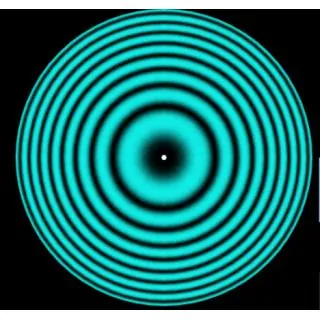
Newton’s rings are a series of concentric circular interference fringes. It is formed when a plano-convex lens is placed on a flat glass plate and illuminated with monochromatic light.
The rings are centered at the point of contact between the lens and the glass plate. These rings appear due to the interference of light waves reflected from the top and bottom surfaces of a thin air film formed between the plano-convex lens and the plate.
🧪 Formation of Newton’s Rings
When a plano-convex lens is gently placed with its curved side resting on a flat glass plate, a thin air wedge film is formed between the two surfaces. The thickness of this air film is zero at the point of contact at the center and gradually increases as we move outward.
When light falls on this arrangement, part of it is reflected from the upper surface of the air film, while another part is reflected from the lower surface. These two reflected waves travel slightly different paths and, upon recombining, interfere with each other, resulting in the formation of concentric circular interference patterns known as Newton’s rings, as shown in the following figure.
⚙️ Experimental Setup for Newton's Rings Experiment
To see this in a lab, we need a specific, yet simple, arrangement:
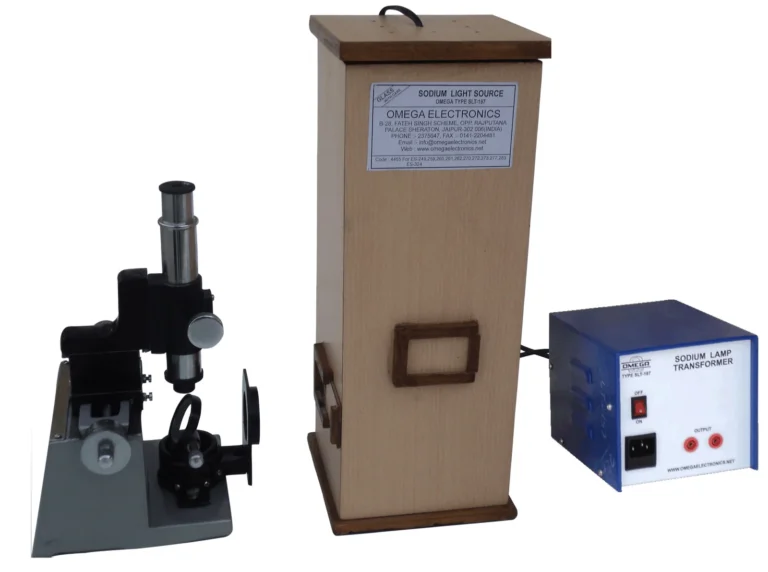
A Monochromatic Light Source: Usually a sodium vapor lamp, which provides a steady yellow light.
A Plano-Convex Lens: A lens that is flat on one side and curved (convex) on the other.
An Optical Flat: A perfectly flat glass plate.
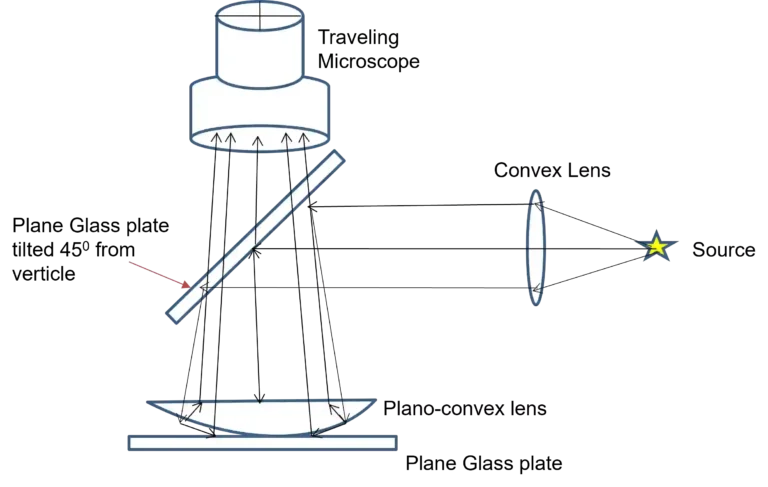
A Glass Plate at 45°: To reflect the light downward onto the lens.
Microscope for observation
The light is directed vertically, and the rings are observed through a microscope.
⚡ Working Principle
When monochromatic light strikes the curved lower surface of the lens, it splits into two beams. One beam reflects off the bottom surface of the lens (the surface in contact with the air film). The second beam transmits through the air gap and reflects off the top surface of the flat glass plate.
These two reflected beams then travel back upward along nearly the same path and meet. They are coherent (derived from the same source point) and can therefore interfere.
When these two rays recombine, they interfere. If they are “in phase,” they create a bright ring; if they are “out of phase,” they cancel each other out, creating a dark ring.
🔬 Newton’s Rings Virtual Lab
📐 Theory Behind Newton’s Rings
To understand why the rings have specific sizes, we need to calculate the Path Difference between the two interfering rays. Let R be the radius of curvature of the plano-convex lens, and t be the thickness of the air film at a distance r from the point of contact.
🧪 The Path Difference
Newton’s rings are essentially a special case of thin film interference, just like a wedge-shaped film. The governing path difference equation remains the same—the only change is in the geometry of the film, which transforms straight fringes into circular rings.
Hence, the effective path difference between the two reflected rays is:
$$\Delta = 2t + \frac{\lambda}{2}\qquad …… (1) $$
Condition for Bright Rings:
The path difference must be an even multiple of λ/2 (or nλ):
$$2t + \frac{\lambda}{2} = n\lambda$$
$$\Rightarrow 2t = \left( 2n-1 \right)\frac{\lambda}{2}\qquad ….. (2) $$
Conditions for Dark Rings:
The condition for a dark ring is that the path difference must be an odd multiple of λ/2:
$$2t + \frac{\lambda}{2} = \left( 2n+1 \right)\frac{\lambda}{2}$$
$$\Rightarrow 2t = n\lambda \qquad …… (3)$$
As in this film, t remains constant along a circle, whose center is at the point of contact; hence, the fringes are in the form of concentric circles.
Newton’s rings are circular because the thickness varies radially, and each ring represents a locus of points having identical thickness, which is why they are called fringes of constant thickness.
🔍Why Central Ring is dark in Newton’s rings experiment?
The central ring in Newton’s rings experiment appears dark because of a phase change that occurs during the reflection of light. At the point where the plano-convex lens touches the glass plate, the thickness of the air film is zero, so one might expect no path difference and hence a bright spot.
However, when light reflects from the lower surface of the air film (air to glass, a rarer to denser medium), it undergoes a phase change of π, which is equivalent to a path difference of λ/2 between the two reflected rays. This leads to destructive interference, causing the central spot to appear dark.
But sometimes it is observed to be bright due to dust particles at the point of contact.
🔍 Determination of Diameter of Newton's Rings
Consider a point P on the curved surface at a horizontal distance r from the central contact point. The vertical distance from the flat plate to the curved surface at P is the air film thickness t.
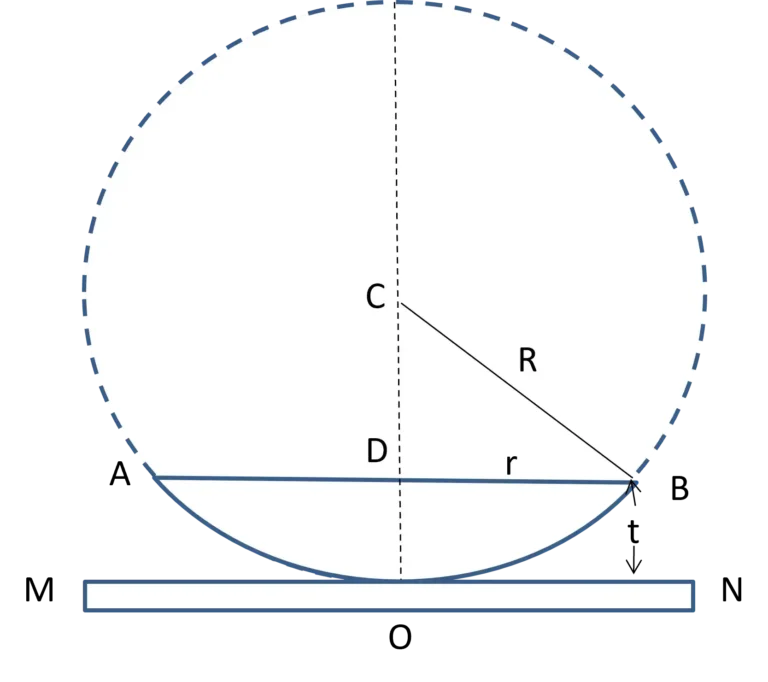
By the Pythagorean theorem applied to geometry:
$$BC^2 = CD^2 + BD^2$$
$$\Rightarrow R^2 = \left( R-t \right)^2 + r^2$$
$$\Rightarrow r^2 = 2Rt – t^2$$
Since t<<R, t² can be neglected. Therefore, $$r^2 = 2Rt$$
$$\Rightarrow 2t = \frac{r^2}{R}\qquad …….. (4)$$
🔍 Diameter of the nth bright fringe:
Substituting the value of above 2t in the condition for the bright fringe, we get
$$\frac{r^2}{R}= \left( 2n-1 \right)\frac{\lambda}{2}$$
Therefore, the radius of the nth bright ring is given by
$$r_n=\sqrt{\frac{\left( 2n-1 \right)\lambda R}{2}} $$
Hence, the diameter of the nth bright ring is
$$D_n = 2r_n=2\sqrt{\frac{\left( 2n-1 \right)\lambda R}{2}}$$
$$\Rightarrow D_N =\sqrt{2\left( 2n-1 \right)\lambda R} \qquad ….. (5) $$
$$\Rightarrow D_N \propto \sqrt{\left( 2n-1 \right)}$$
Equation (5) represents the diameter of the nth bright ring.
🔍 Diameter of the nth dark fringe:
Substituting the value of 2t from eq. (4) in the condition for the dark fringe, we get
$$\frac{r^2}{R}= n\lambda$$
Therefore, the radius of the nth dark ring is given by
$$r_n=\sqrt{n\lambda R} $$
Hence, the diameter of the nth dark ring is
$$D_n = 2\sqrt {n\lambda R} \qquad …..(6)$$
$$\Rightarrow D_N \propto \sqrt{n}$$
Equation (6) represents the diameter of the nth dark ring.
🔍Spacing between two successive Newton's rings:
For dark rings
$$D_{n+1}-D_n= k\left[\sqrt{n+1}-\sqrt{n}\right]$$
Therefore,
$$D_2-D_1=k\left [ \sqrt{2} -\sqrt{1}\right] = 0.414k$$
$$D_3-D_2=k\left[\sqrt{3}-\sqrt{2}\right]=0.317k$$
$$D_4-D_3=k\left[\sqrt{4}-\sqrt{3}\right]=0.267k$$
$$D_5-D_4=k\left[\sqrt{5}-\sqrt{4}\right]=0.236k$$
From the above equations, it is clear that the spacing between two successive fringes (rings) decreases with increasing ring order.
🔍Determination of wavelength of light by Newton’s Rings method:-
For the nth dark ring:
$$D_n^2 = 4n\lambda R$$
Similarly for (n+p)th dark rings—
$$D_{n+p}^2 = 4(n+p)\lambda R$$
Now, using the above two equations, we get
$$D_{n+p}^2-D_n^2 = 4(n+p)\lambda R – 4n\lambda R$$
$$\Rightarrow D_{n+p}^2-D_n^2 = 4p\lambda R \qquad … (7)$$
After rearranging, the wavelength is
$$\color{Red}{\Large \lambda = \frac{D_{n+p}^2-D_n^2}{4pR}} \qquad … (8) $$
🔍 Determination of refractive index of unknown liquid by Newton’s Rings method
When an air film exists between the plano-convex lens and the plane glass plate, then as per the equation. (7)—
$$\left(D_{n+p}^2-D_n^2 \right) _{air} = 4p\lambda R \qquad ….(9)$$
But if there is a liquid film between them whose refractive index is to be determined, then
$$\left(D_{n+p}^2-D_n^2 \right) _{liquid} = \frac{4p\lambda R}{\mu}\qquad …. (10)$$
Therefore, the refractive index of the liquid is given by
$$\mu = \frac{\left(D_{n+p}^2-D_n^2 \right)_{air}} {\left(D_{n+p}^2-D_n^2 \right)_{liquid}} $$
⚙️ Quick Answers
What are Newton’s rings in physics?
Newton’s rings are concentric circular interference patterns formed due to the interference of light waves reflected from the upper and lower surfaces of a thin air film between a plano-convex lens and a glass plate.
What is the formula for the radius of Newton’s rings?
The radius of the nth dark ring is given by:
where λ is the wavelength of light, and R is the radius of curvature of the lens.
What type of interference produces Newton’s rings?
Newton’s rings are produced by thin film interference, where light waves reflected from two surfaces of a thin air film interfere with each other.
What is the nature of fringes in Newton’s rings?
The fringes in Newton’s rings are circular and concentric, and they are called fringes of equal thickness because each ring corresponds to a constant thickness of the air film.
How does wavelength affect Newton’s rings?
As the wavelength of light increases, the diameter of the rings also increases, making the rings more widely spaced.
What happens if the air film is replaced by a liquid?
If the air film is replaced by a liquid of higher refractive index, the rings become smaller (contract) because the effective wavelength of light decreases inside the medium.
Why are Newton’s rings circular in shape?
Newton’s rings are circular because the thickness of the air film between the plano-convex lens and the glass plate increases uniformly in all directions from the point of contact. Since interference depends on film thickness, equal-thickness points form concentric circles, resulting in circular fringes.
Why is the central fringe dark in Newton’s rings?
The central fringe is dark because at the point of contact, the air film thickness is zero, but one of the reflected rays undergoes a phase change of π on reflection. This introduces a path difference of , causing destructive interference and producing a dark central spot.
What is the use of Newton’s rings experiment?
The Newton’s rings experiment is used to determine the wavelength of monochromatic light, measure the refractive index of liquids, and test the flatness of optical surfaces. It is widely applied in optical laboratories and engineering to detect small surface irregularities with high precision.
What happens to Newton’s rings if white light is used?
When white light is used, Newton’s rings appear colored because different wavelengths interfere differently. Only a few rings are clearly visible near the center, as overlapping of multiple wavelengths causes outer rings to become indistinct and blurred.
How is the diameter of Newton’s rings measured?
The diameter of Newton’s rings is measured using a traveling microscope. The observer focuses on one edge of a ring and notes the reading, then moves to the opposite edge and records the second reading. The difference between these readings gives the diameter of the ring.
What type of fringes are formed in Newton’s rings?
Newton’s rings produce fringes of equal thickness, where each ring corresponds to a constant thickness of the air film.
How does refractive index affect Newton’s rings?
The refractive index of the medium affects the size of Newton’s rings by changing the effective wavelength of light. As the refractive index increases, the wavelength decreases, causing the rings to contract. This results in smaller diameters compared to rings formed in air.
What is the condition for dark rings in Newton’s rings?
The condition for dark rings is that the path difference between the interfering rays is an integral multiple of the wavelength.
⚙️ Factors Affecting Newton's Rings
- The wavelength of light affects the size of the rings; as the wavelength increases, the rings become wider and more spaced.
- The radius of curvature of the lens influences the ring diameter; a larger radius of curvature produces larger rings.
- The refractive index of the medium between the lens and the plate affects the pattern; an increase in refractive index causes the rings to contract and come closer together.
- The thickness of the air film determines the position of bright and dark fringes, as different thicknesses satisfy different interference conditions.
- The use of monochromatic light produces clear and sharp rings, whereas white light results in colored rings due to multiple wavelengths.
- The surface quality of the lens and glass plate plays an important role; any imperfections or dust can distort the ring pattern.
📊Newton's Rings vs. Young's Double-Slit Experiment
| S. No. | Feature | Newton's Rings | Young's Double Slit |
|---|---|---|---|
1. |
Type of interference |
Division of amplitude (thin film) |
Division of wavefront (two slits) |
2. |
Fringe shape |
Concentric circles (circular symmetry) |
Parallel straight bands |
3. |
Fringe spacing |
Decreases outward (rings crowd together) |
Uniform (equally spaced) |
4. |
Coherent beams from |
Reflections at two surfaces of air film |
Two narrow slits in an opaque screen |
5. |
Key measurement |
Wavelength, radius of curvature, refractive index |
Wavelength, slit separation |
6. |
Phase shift involved |
Yes — half-wave loss at denser medium |
No phase shift at slits |
7. |
Practical applications |
Optical surface testing, lens quality control |
Demonstration, diffraction grating basis |
✅ Advantages and Limitations
✓ Advantages
- Non-destructive testing of optical surfaces with nanometre precision
- Simple setup — requires no elaborate equipment
- Directly measures both wavelength and lens curvature from the same data
- Can determine the refractive index of liquids by filling the gap
- Results are highly reproducible with stable monochromatic sources
✗ Limitations
- Requires a perfectly clean, dust-free contact surface—dust distorts rings
- Fringes become indistinct with white light (chromatic smearing)
- Only valid for small incidence angles (near-normal incidence assumed)
- Ring diameters are sensitive to even slight pressure on the lens
- Counting fringes accurately is difficult for high ring orders
🚀Applications of Newton's Rings
Newton’s rings are not just a classroom experiment—they are widely used in engineering and science for the determination of the following:
🔬 Wavelength Measurement
It is a primary method for determining the wavelength of monochromatic light.
🏭 Lens Surface Testing
Engineers use the symmetry of the rings to check if an optical surface is perfectly flat or centered
💧 Refractive Index of Liquids
By placing a drop of liquid between the lens and the plate, the rings “shrink.” Comparing the new diameter to the old one allows us to calculate the liquid’s refractive index (μ).
📐 Radius of Curvature
If the wavelength is known, Newton’s rings can be used to calculate the R of a lens, essential for optical manufacturing.
🎯 Conclusion
Newton’s rings beautifully demonstrate the wave nature of light through thin film interference. Here are the core takeaways:
- Newton’s rings arise from thin-film interference in the air wedge between a plano-convex lens and a flat glass plate.
- Circular rings arise from radial thickness variation
- The central spot is dark due to the phase shift
- The mathematical relation connects the radius with wavelength
- Widely used in optical engineering
👉 In modern engineering, Newton’s rings are not just a theory—they are a precision tool for measurement and quality control.
 PYQs / Most Exam Expected Questions
 PYQs / Most Exam Expected Questions
Why do the rings get closer together as the order of the ring increases?
Derive the expression for the diameter of the nth bright ring in Newton’s rings.
Explain how Newton’s rings can be used to determine the refractive index of a liquid.
- Why is the central fringe dark in Newton’s rings?
- How can Newton’s rings be used to determine wavelength?
- Explain the role of thin film in interference.
- What happens if air is replaced by water?
Solved Problems on Newton's Rings
How to find the radius of curvature?
Question: In a Newton’s rings experiment, the diameter of the 15th dark ring was found to be 0.590 cm, and that of the 5th dark ring was 0.336 cm. If the wavelength of the light used is 5890Å, calculate the radius of curvature of the plano-convex lens.
Solution:
We use the formula for the radius of curvature R:
Given:
$$D_{15} = 0.590 \text{ cm} = 0.590 \times 10^{-2} \text{ m}$$
$$D_{5} = 0.336 \text{ cm} = 0.336 \times 10^{-2} \text{ m}$$
n = 5, n+p = 15 ⇒ p = 10
$$\lambda = 5890 Å = 5890 \times 10^{-10} \text{ m}$$
Calculation:
Substitute values into the formula:
Answer: The radius of curvature of the lens is approximately 1.0 m.
How to find the refractive index of a liquid?
Question: Newton’s rings are formed by light of wavelength 6000 Å. When the air between the lens and the plate is replaced by a liquid, the diameter of the 10th dark ring shrinks from 1.50 cm to 1.25 cm. Find the refractive index of the liquid.
Solution:
The diameter of the nth dark ring in air is
$$D_{air}^2 = \frac{4n\lambda R}{1}$$
and in a liquid is $$D_{liq}^2 = \frac{4n\lambda R}{\mu}$$
By dividing the two equations:
Given:
$$D_{air} = 1.50 \text{ cm}$$
$$D_{liq} = 1.25 \text{ cm}$$
Calculation:
Answer: The refractive index of the liquid is 1.44.
How to find the diameter of a Newton ring?
Question: A plano-convex lens with a radius of curvature of 200 cm is placed on an optical flat. If monochromatic light of wavelength 546 nm is used, what will be the diameter of the 20th bright rings?
Solution:
The formula for the diameter of the nth bright ring is:
Given:
n = 20
$$\lambda = 546 \times 10^{-9} \text{ m}$$
$$R = 200 \text{ cm} = 2.0 \text{ m}$$
Calculation:
Answer: The diameter of the 20th bright ring is 9.23 mm.
The Effect of an Air Gap (Dust Particle)
Question: In a Newton’s rings setup, a small dust particle creates an additional air gap of h = 1.2 × 10⁻⁶ m at the point of contact. If λ = 600 nm and R = 1 m, what is the new condition for the center of the pattern?
Solution:
Usually, the thickness t at the center is 0. With a dust particle, the thickness at the center is t = h.
The path difference at the center is:
Calculation:
Substitute the values:
To see if it’s dark or bright, divide by λ:
Since the path difference is 4.5 λ, it satisfies the condition for destructive interference.
Answer: The center of the pattern will remain dark (it corresponds to the 4th-order dark fringe shifted to the center).
❓ FAQs (People Also Ask)
Q1: What happens if we use white light instead of monochromatic light?
You will see a few colored rings near the center, but the pattern will quickly blur into a uniform white illumination because different colors have different ring diameters.
Q2: Why is a plano-convex lens of large radius of curvature used?
Large R ensures that the air film thickness increases very slowly, which spreads the rings out enough to be easily measured with a microscope.
Q3: How does the pattern change if the air is replaced by water?
The rings will contract (get smaller) because the effective wavelength in water is shorter (λw = λ/μ).
Q4. What are Newton’s rings in simple terms?
They are circular interference patterns formed due to thin-film interference between a lens and a glass plate.
Q5. Why are Newton’s rings circular?
Because the air film thickness varies uniformly in all directions.
Q6. Why is the central spot dark?
This is due to destructive interference caused by a phase change.
Q7. Where are Newton’s rings used?
This includes lens testing, wavelength measurement, and optical calibration.
I am extremely inspired with your writing abilities as smartly
as with the layout to your blog. Is that this a paid topic or did you customize
it your self? Anyway keep up the excellent high quality writing, it is rare to see a nice
weblog like this one these days..
Thank you so much