
 For High-Quality, More Free Study Notes
Visit: http://smartstudyzone.in
Contents
Toggle⚡Introduction to Dielectrics:
In the fascinating world of electromagnetism, dielectrics and polarization play a crucial role in modern technology. From capacitors and cables to smartphones and medical devices, dielectric materials are everywhere.
Understanding concepts such as dielectric constant, bound and free charges, polar and nonpolar dielectrics, Gauss’s law in dielectrics, dielectric polarization, and susceptibility helps students build a strong foundation in physics and electrical engineering.
A dielectric material is an insulating substance that doesn’t allow electric current to flow freely. However, when placed inside an electric field, it becomes polarized. This property makes dielectric materials extremely useful in energy storage devices and communication systems.
Interestingly, dielectrics improve the efficiency of capacitors by increasing their capacitance. Because of this, they are widely used in electronic circuits. In this article, we’ll explore every important aspect of dielectrics in a simple yet detailed manner.
By the time you finish reading, you will clearly understand:
- What dielectrics are and why they matter
- The difference between bound charges and free charges
- How polar and nonpolar molecules behave in an electric field
- The concept of dielectric polarization and the polarization vector P
- The dielectric constant (relative permittivity) and dielectric susceptibility
- How Gauss’s law is modified inside a dielectric medium
- Full mathematical derivations, solved problems, and exam-ready formulae
Let’s dive in—starting with a little history.
📜 Historical Background of Dielectrics:
The study of dielectrics began during the development of electrostatics in the 18th and 19th centuries.
Michael Faraday introduced the concept of dielectric materials while studying capacitors and electric fields. He discovered that insulating materials affect the electric field between charged plates.
Later, James Clerk Maxwell mathematically explained dielectric behavior through electromagnetic theory. Their work became the foundation of modern electronics and communication engineering.
🔍 What Are Dielectrics? — The Basic Concept:
A dielectric is an insulating material that can store electrical energy when exposed to an electric field. Unlike conductors, dielectrics do not have free-moving electrons. Instead, their molecules rearrange slightly under the influence of an electric field.
When an external electric field is applied, positive and negative charges inside the dielectric slightly shift from their original positions. This process is called dielectric polarization.
Common dielectric materials include:
- Glass
- Mica
- Rubber
- Plastic
- Ceramic
- Paper
- Air
These materials are used because they resist electrical conduction while supporting electrostatic fields.
Characteristics of Dielectric Materials:
Some important properties of dielectric materials are:
- High electrical resistance
- Ability to become polarized
- Low power loss
- High dielectric strength
- Good insulating capability
Dielectrics are often inserted between the plates of capacitors to increase energy storage capacity.
🧲 Polar and Nonpolar Dielectrics:
Not all dielectric molecules behave the same way. The key question is: does a molecule have a permanent electric dipole moment, or does it only develop one when pushed by a field? This divides dielectrics into two fundamental categories.
- Polar dielectrics
- Nonpolar dielectrics
1. Polar Dielectrics:
In polar dielectrics, the centers of positive and negative charges within individual molecules do not coincide even in the absence of an external field. Each molecule has a permanent electric dipole moment.
Examples:
- Water
- HCl
- NH₃
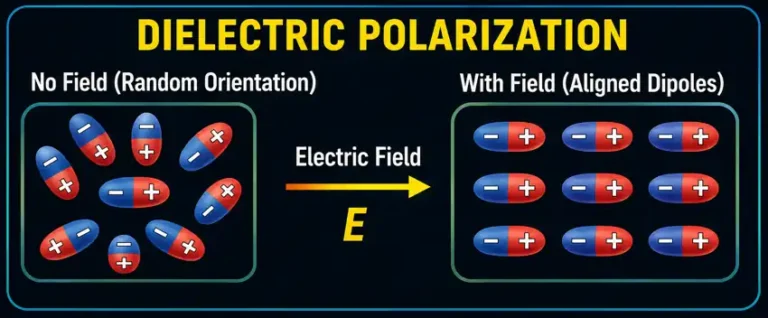
Normally, these dipoles point in random directions due to thermal agitation, so the net dipole moment of the material is zero. But when an external field is applied, the dipoles tend to align with the field (fighting thermal randomness), producing a net dipole moment.
Features of Polar Dielectrics:
- Permanent dipole moment
- Strong polarization effect
- Temperature-dependent behavior
2. Nonpolar Dielectrics:
In a nonpolar dielectric, the centres of positive charge (nuclei) and negative charge (electrons) coincide perfectly when no external field is present. The net dipole moment of each molecule is therefore zero.
Examples:
- Oxygen (O₂),
- Nitrogen (N₂),
- Carbon dioxide (CO₂) and
- Noble gases.
When an external electric field is applied, the electron cloud shifts slightly relative to the nucleus, and the molecule becomes a dipole. This effect is called electronic polarization. The moment disappears as soon as the field is removed.
Features of Nonpolar Dielectrics:
- No permanent dipole moment
- Polarization occurs only in an electric field
- Weak polarization compared to polar dielectrics
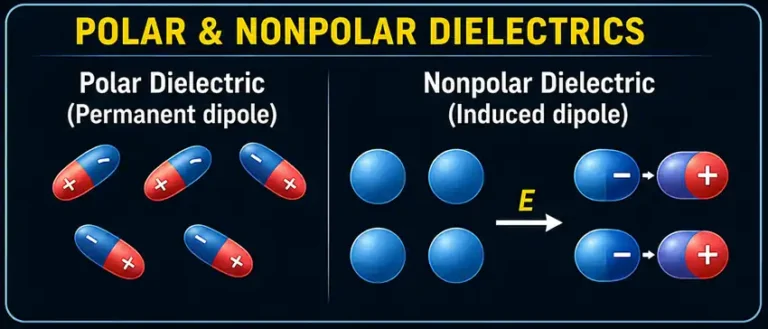
⚖️ Comparison Between Polar and Nonpolar Dielectrics:
| S. No. | Feature | Polar Dielectrics | Nonpolar Dielectrics |
|---|---|---|---|
1. |
Permanent Dipole |
Present |
Absent |
2. |
Without field arrangement |
Randomly oriented dipoles |
Symmetric charge distribution |
3. |
With field distribution |
Partial alignment of dipoles |
Induced dipole (stretching) |
4. |
Polarization Type |
Orientation polarization |
Electronic polarization |
5. |
Temperature Effect |
Strong (alignment resists thermal) |
Weak |
6. |
Examples |
H₂O, HCl, NH₃, acetone |
O₂, N₂, CO₂, diamond |
🔋 Bound Charges and Free Charges
To understand dielectrics properly, you need to first distinguish between the two types of charges that appear in the presence of an electric field.
- Free Charges
- Bound Charges
1. Free Charges:
Free charges are charges that can move freely through a material under the influence of an electric field. In a conductor, these charges redistribute until the internal field vanishes. Dielectrics, by definition, have no free charges (or only a negligible number).
Examples:
- Electrons in metals
- Charges supplied by a battery
These charges produce external electric fields.
2. Bound Charges:
Bound charges (also known as induced charges or polarization charges) are charges that are tied to their parent atoms or molecules and cannot move freely through the material.
When a dielectric is placed in an electric field:
- Positive and negative charges shift slightly within each atom or molecule
- Dipoles form inside the material
- Surface charges appear,
These are called bound charges even though no charge has actually left the material.
The surface-bound charge density is given by:
$$\sigma_b = P\cdot \hat{n}$$
where P is the polarization vector and is the outward unit normal at the surface.
The volume-bound charge density is:
$$\rho_b = -\nabla \cdot P$$

📏Dielectric Constant:
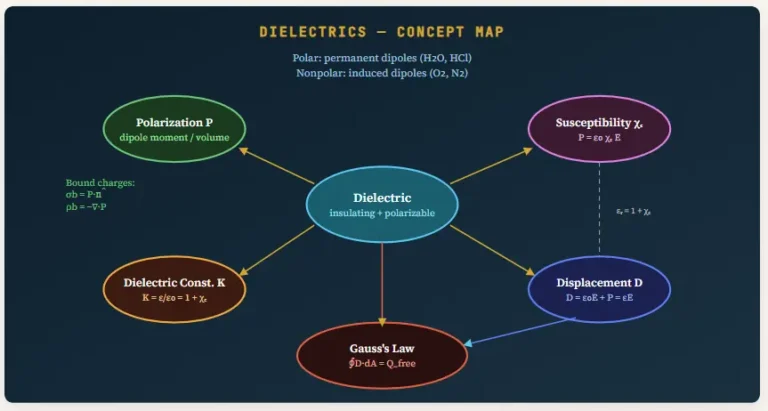
The dielectric constant is the most important dimensionless property of dielectric materials. It is the ratio of the permittivity of the dielectric material (ε) to the permittivity of free space (εo). It is denoted by K or εr.
The dielectric constant is also called relative permittivity. It measures how effectively a material can store electrical energy compared to a vacuum.
$$ K = \frac{\varepsilon}{\varepsilon_o}$$
Where:
- K = Dielectric constant
- ε = Permittivity of the material
- εo = Permittivity of free space
A higher dielectric constant means better energy storage capability. The dielectric constant is always greater than or equal to 1 (equal to 1 for vacuum).
Physical Meaning of Dielectric Constant:
A higher dielectric constant means the material can store more electrical energy.
For example:
| S. No. | Material | Dielectric Constant (K) | Susceptibility (χe) |
|---|---|---|---|
1. |
Vaccum |
1 |
0.00 |
2. |
Air (dry) |
1.0006 |
0.0006 |
3. |
Glass |
5-10 |
4-9 |
4. |
Water |
~ 80 |
~ 79 |
5. |
Mica |
6 |
5 |
6. |
Paper |
3.5 |
2.5 |
Water has a very high dielectric constant because its molecules are highly polar.
Factors Affecting Dielectric Constant:
These are the factors that influence dielectric constant:
- Temperature
- Frequency of applied field
- Nature of material
- Moisture content
As frequency increases, the dielectric constant may decrease because molecules cannot align quickly enough.
⚙️ Dielectric Polarization:
Dielectric polarization is the process by which net dipole moments are produced inside a dielectric due to an external electric field. We quantify this effect using the Polarization Vector (P), defined as the net electric dipole moment per unit volume of the dielectric material:
Polarization reduces the net electric field inside the material.
If a small volume ΔV of the dielectric contains n dipoles, each with moment μi, the polarization vector is:
$$P = \frac{\sum_{i}^{n}\mu_i}{\Delta V}$$
Where: P = Polarization vector
Its SI unit is coulombs per square metre (C/m²), which is the same as the unit of surface charge density.
Since, $$\sum_{i}^{n}\mu_i = (A\sigma_b)\cdot d= \sigma_b V$$
Hence, $$P=\sigma_b$$
It is clear that the polarization is equal to the induced surface charge density.
Polarization reduces the external electric field Eo. The induced charges create an opposing field Ei, so the resultant electric field inside the dielectric becomes smaller:
📊 Dielectric Susceptibility:
Dielectric susceptibility measures how easily a dielectric material becomes polarized when an external electric field is applied. A high susceptibility means the material’s dipoles align very readily, producing a large polarization for a given field.
The polarization is directly proportional to the strength of the net internal electric field (E). The constant of proportionality incorporates the permittivity of free space (εo) and a dimensionless material property known as the electric susceptibility (χe)
$$P = \varepsilon_o \chi_e E$$
A large susceptibility means the material polarizes easily.
It is dimensionless and always positive for ordinary dielectrics (it can be negative in exotic metamaterials).
📐 Gauss’s Law in Dielectrics
In free space, Gauss’s law states that the total electric flux through a closed surface is equal to the enclosed charge divided by the permittivity of free space.
Let us consider a charged parallel-plate capacitor without a dielectric material, as shown in the following fig. (1). Here, charges on the capacitor plates are free charges, which are enclosed charges in the Gaussian surface. Then, as per Gauss’ law
$$\oint E_o\cdot dA = \frac{q_f}{\varepsilon_o}$$
where, E = Electric field, dA = Area vector, qf = Total enclosed charge, and εo = Permittivity of free space
$$\Rightarrow E_o= \frac{q_f}{\varepsilon_o A}\qquad …(1)$$
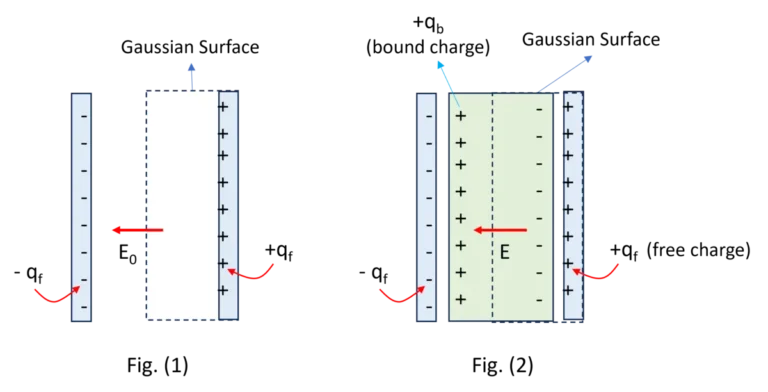
Now, when a dielectric material is placed in an electric field, the dielectric becomes polarized. This polarization produces bound charges (qb) on the surface of the dielectric in addition to the free charges (qf) already present in the capacitor plates.
Therefore, Gauss’s law must be modified to account for these polarization effects. Hence $$\oint E\cdot dA = \frac{q_f-q_b}{\varepsilon_o}\qquad … (2)$$
$$\Rightarrow E= \frac{q_f}{\varepsilon_o A}-\frac{q_b}{\varepsilon_o A} \qquad …(3)$$
This equation shows that bound charges reduce the electric field. The electric field with and without the presence of a dielectric material is related as
$$E_o = \varepsilon_r E$$
Now equation (3) becomes
$$ \frac{E_o}{\varepsilon_r}= \frac{q_f}{\varepsilon_o A}-\frac{q_b}{\varepsilon_o A}$$
Using equation (1), the above equation becomes
$$ \frac{q_f}{\varepsilon_o\varepsilon_r A}= \frac{q_f}{\varepsilon_o A}-\frac{q_b}{\varepsilon_o A}$$
$$\Rightarrow \frac{q_f}{\varepsilon_r} = q_f – q_b$$
Using this relation in equation (2)
$$\oint E\cdot dA = \frac{q_f}{\varepsilon_o \varepsilon_r}$$
$$\Rightarrow {\varepsilon_o \varepsilon_r}\oint E\cdot dA = {q_f}$$
$$\Rightarrow {\varepsilon}\oint E\cdot dA = {q_f}$$
(Because ε = εrεo)
Since the displacement vector D = εE, the above equation becomes
$$\oint D\cdot dA = {q_f}\qquad … (4)$$
This is Gauss’s Law in Dielectrics.
🧮 Relation between Vector D, E and P:
From Gauss’ law, the resultant electric field inside the dielectric is given by
$$E= \frac{q_f}{\varepsilon_o A}-\frac{q_b}{\varepsilon_o A}\qquad … (5) $$
Since the induced surface charge density (bound charge density) is equal to the magnitude of polarization. i.e.
$$P = \sigma_b = \frac{q_b}{A}$$
Therefore, from eq. (5)
$$E= \frac{q_f}{\varepsilon_o A}-\frac{P}{\varepsilon_o}$$
And $$D = \frac{q_f}{A}$$
Therefore, $$E= \frac{D}{\varepsilon_o}-\frac{P}{\varepsilon_o}$$
$$\Rightarrow \varepsilon_o E = D-P$$
$$\Rightarrow\color{Red}{\Large D=\varepsilon_o E +P}$$
Relation between Vector P and E:
Since,
$$D=\varepsilon_o E+P$$
$$⇒εE=\varepsilon_o E+P$$
$$⇒\varepsilon_o\varepsilon_rE=\varepsilon_o E+P$$
$$⇒\color{Red}{\Large P =\varepsilon_o(\varepsilon_r-1)E}$$
Relation Between Susceptibility and Dielectric Constant:
Since,
$$D=\varepsilon_o E+P$$
Putting the value of D and P, the above equation becomes
$$\varepsilon_o \varepsilon_rE=\varepsilon_o E+\varepsilon_o \chi_e E$$
$$\Rightarrow \varepsilon_o \varepsilon_r=\varepsilon_o (1+\chi_e) $$
$$\Rightarrow \color{Red} {\Large\varepsilon_r=1+\chi_e} $$
✅ Advantages of Dielectric Materials
| Advantages | Explanation |
|---|---|
High insulation |
Prevents electric leakage |
Energy storage |
Used in capacitors |
Compact devices |
Improves capacitor efficiency |
Reduced power loss |
Important in transmission systems |
Electrical safety |
Used in insulation materials |
❌ Limitations of Dielectrics
| Limitations | Explanation |
|---|---|
Dielectric breakdown |
Excess voltage damages material |
Heating effects |
High-frequency operation produces heat |
Aging |
Properties degrade with time |
Moisture sensitivity |
Water reduces insulation quality |
Electrical safety |
Used in insulation materials |
🚀 Applications of Dielectrics
1. Uses in capacitors: This is the most direct application, as Faraday first discovered. Inserting a dielectric of constant K between the capacitor plates multiplies capacitance by K:
2. Insulating layer in power cables: High-voltage power cables use cross-linked polyethylene (XLPE) as a dielectric insulator.
3. Uses in Communication Systems: Dielectrics are used in optical fibers and microwave devices.
4. Uses in Printed Circuit Boards: Ceramic dielectrics are widely used in electronic circuits.
5. Uses in Energy Storage Devices: Modern electronic devices rely on dielectric materials for compact energy storage.

🧠 Quick Answer Section:
1. What is a dielectric material?
A dielectric material is an insulating substance that becomes polarized when placed in an electric field. It does not conduct electricity freely but stores electrical energy efficiently.
2. What is dielectric constant?
Dielectric constant is the ratio of the permittivity of a material to the permittivity of free space. It indicates the energy storage capability of the material.
3. What is dielectric polarization?
Dielectric polarization is the alignment or displacement of charges inside a dielectric material under the influence of an external electric field. Electric polarization (P) is the electric dipole moment per unit volume of a dielectric. It has SI units of C/m² (coulombs per square metre).
4. What are bound charges?
Bound charges are charges attached to atoms or molecules inside a dielectric. They cannot move freely but shift slightly during polarization. In a dielectric, only bound charges appear—they create surface and volume charge densities without any macroscopic current.
5. What are free charges?
Free charges are mobile charges that can move easily inside conductors, such as electrons in metals.
6. What is dielectric susceptibility?
Dielectric susceptibility measures how easily a dielectric material becomes polarized in an electric field. It is dimensionless. The relationship to dielectric constant is: K = εr = 1 + χₑ. For vacuum, χₑ = 0 and K = 1.
7. What is Gauss’s law in dielectrics?
Gauss’s law in dielectrics states that the electric flux of the displacement vector through a closed surface equals the free charge enclosed.
8. What are polar dielectrics?
Polar dielectrics (e.g., H₂O, HCl) have molecules with a permanent electric dipole moment even without an external field, such as water and ammonia. These dipoles are randomly oriented but align with the field when applied.
9. What are nonpolar dielectrics?
Nonpolar dielectrics (e.g., O₂, N₂) have no permanent dipole; they only develop induced dipoles through electronic polarization when a field is applied.
10. What is dielectric breakdown?
Dielectric breakdown occurs when the applied electric field exceeds a critical value called the dielectric strength of the material. At this point, bound electrons are ripped free, the material becomes conducting, and a sudden discharge occurs (often permanently damaging the material).
11. What is the difference between bound and free charges?
Free charges reside on external conductors and are free to migrate across distances. Bound charges are structurally confined to the individual atoms or molecules of a dielectric material. They shift slightly under an external electric field to create surface polarization but cannot leave the medium.
12. Why does a dielectric decrease the electric field?
When a dielectric is placed in an external electric field, its molecules polarize and induce internal bound surface charges. These induced charges create an internal electric field that opposes the external field, reducing the net electric field inside the material.
13. What is the electric displacement vector D?
The electric displacement vector (D) is an auxiliary field defined as D=εoE+P. It simplifies electrostatics calculations within matter because its flux depends strictly on external free charges, completely independent of internal bound charges.
14. How does temperature affect polar dielectrics?
Rising temperatures increase random thermal agitation within polar dielectrics. This chaotic motion actively disrupts the orderly alignment of permanent molecular dipoles with the external electric field, causing the material’s total polarization and net dielectric constant to decrease.
🏁 Conclusion
Dielectrics are fundamental to understanding modern electromagnetism and electronics. Concepts such as dielectric constant, bound and free charges, polar and nonpolar dielectrics, Gauss’s law in dielectrics, polarization, and susceptibility explain how insulating materials behave in electric fields.
These materials are indispensable in capacitors, communication systems, and electrical insulation technologies. Moreover, mastering these concepts helps students solve advanced problems in physics and engineering.
As technology continues to evolve, the importance of dielectric materials will only grow stronger. Therefore, developing a solid understanding of dielectric behavior is essential for anyone studying electrical science or applied physics.
📝 PYQs / Most Expected Questions:
Conceptual Questions:
- Define a dielectric. Why do dielectrics increase the capacitance of a capacitor?
- Distinguish between polar and nonpolar dielectrics with two examples each.
- Explain the terms bound charge and free charge in the context of a dielectric material.
- What is the physical significance of the polarization vector P? State its SI unit.
- Explain why the electric field inside a dielectric is less than the applied external field.
- What is dielectric susceptibility? How is it related to the dielectric constant?
- Differentiate between E, D, and P vectors. Under what conditions is D = εE?
- Why does the dielectric constant of polar dielectrics decrease with increasing temperature?
Derivation Questions:
- Starting from the concept of bound charges, derive Gauss’s law in dielectrics: ∮D·dA = Qfree. Define D in the process.
- Show that the relative permittivity of a linear dielectric is related to its susceptibility by εr = 1 + χₑ.
- Derive expressions for the bound surface charge density σb and volume charge density ρb in terms of the polarization vector P.
- Derive the expression for the electric field inside a dielectric slab of dielectric constant K placed between the plates of a parallel-plate capacitor.
🔢 Solved Numerical Problems:
1. How to calculate free and bound surface charge density?
Q.1 A parallel-plate capacitor with plate area A = 0.05 m2 and separation distance d = 2 × 10⁻³ m is connected to a 100 V battery. A dielectric slab of dielectric constant K = 4.0 fills the space between the plates.
Find the free charge density on the plates and the induced bound charge density on the dielectric surfaces.
Solution:
Given: Area, A = 0.05 m2
Separation, d = 2 × 10⁻³ m
Voltage, V = 100 V
Dielectric Constant, K = 4.0
Permittivity of free space, εo = 8.85 × 10⁻¹² C2/(N . m2)
Find:
Free surface charge density (σf)
Bound surface charge density (σb)
Calculation:
First, let us determine the net electric field (E) acting between the plates filled with the dielectric material:
Since the free charge density is $$\sigma_f = D = \varepsilon E =K\varepsilon_o E$$
Now, let us calculate the bound surface charge density using the polarization relation $$\sigma_b = P = \varepsilon_o(K-1) E$$
Answer: The free surface charge density is 1.77 × 10⁻⁶ C/m2 and the bound induced charge density is 1.33 × 10⁻⁶ C/m2
2. How to calculate electric susceptibility and polarization?
Q.2. A dielectric material has a relative permittivity (K) of 6.0. Calculate its electric susceptibility (χe) and determine the magnitude of polarization (P) if the net internal electric field inside the material is 2 × 10⁵ V/m.
Solution:
Given:
Dielectric Constant, K = 6.0
Internal Electric Field, E = 2 × 10⁵ V/m
εo = 8.85 × 10⁻¹² F/m
Find:
- Electric Susceptibility (χe)
- Polarization magnitude (P)
Calculation:
Using the linear relationship of susceptibility to relative permittivity:
Next, let us calculate the total macroscopic polarization vector magnitude:
Answer: The electric susceptibility is 5.0 (dimensionless), and the polarization magnitude is 8.85 × 10⁻⁶ C/m2.
3. How to calculate C, Q, P, and bound charge density?
Q.3. A parallel-plate capacitor with plate area 0.04 m² and separation 2 mm is filled with a dielectric of constant K = 6. A voltage of 120 V is applied. Find: (a) the capacitance, (b) the charge stored, (c) the polarization P, and (d) the surface bound charge density σb.
The capacitance with a dielectric is $$ C = \frac{K \varepsilon_0 A}{d}$$
Field inside the dielectric: $$E = \frac{V}{d}$$
Susceptibility: $$\chi_e = K – 1 = 5$$
For a slab with a field perpendicular to the surface, $$\sigma_b = P\cdot \hat n = P \;(normal \; component)$$
4. How to calculate electric susceptibility and displacement vector?
Q.4. The electric field E inside a dielectric medium is 2.4 × 10⁴ V/m, and the polarization is 1.8 × 10⁻⁷ C/m². Find (a) electric susceptibility χₑ, (b) relative permittivity, and (c) D vector.
5. How to calculate electric displacement vector?
Q.5. Find the electric displacement for the dielectric permittivity of 3 × 10-11 and the electric field of 5 × 10⁴ N/C.
Solution:
Given: ε = 3 × 10-11
E = 5 × 10⁴ N/C
Find: Electric displacement (D)
Calculation: Since the electric displacement vector D=εE
Answer: Electric displacement = 1.5×10⁻⁶ C/m²
6. How to calculate dielectric constant?
Q.6. A dielectric material has a permittivity of 4.42 × 10⁻¹¹ F/m . Find its dielectric constant.
Solution:
Given: ε = 4.42 × 10⁻¹¹ F/m
εo = 4.42 × 10⁻¹² F/m
Find: Dielectric constant (K)
Calculation: Since
$$K = \frac{\varepsilon}{\varepsilon_o}$$
$$K = \frac{4.42\times 10^{-12}}{8.85\times 10^{-12}}=5$$
Answer: Dielectric constant = 5
❓ FAQs (People Also Ask)
1. Why are dielectrics used in capacitors?
Dielectrics increase capacitance by reducing the electric field between capacitor plates. This allows more charge storage without increasing voltage.
2. Can dielectric materials conduct electricity?
Dielectrics are poor conductors of electricity because their charges are tightly bound to atoms and molecules.
3. What happens during dielectric breakdown?
When electric field strength exceeds a critical limit, the dielectric loses insulation property and starts conducting electricity.
3. Which material has the highest dielectric constant?
Water has a very high dielectric constant among common materials, approximately equal to 80 at room temperature.
4. What is the SI unit of dielectric constant?
Dielectric constant is a ratio, so it has no SI unit.
5. Why is polarization important?
Polarization explains how dielectric materials store electrical energy and modify electric fields in electronic devices.
6. What is the difference between permittivity and dielectric constant?
Permittivity is the absolute ability of a material to permit electric field lines, whereas dielectric constant is the relative comparison with vacuum.
Message:
Thank you for reading this comprehensive guide on dielectrics. Keep exploring physics concepts regularly to strengthen your understanding and problem-solving skills in electromagnetism and modern electronics.