
 For High-Quality, More Free Study Notes
Visit: https://smartstudyzone.in
Contents
Toggle1. 📘 Introduction to Losses in Optical Fibre:
Optical fibre communication has changed the modern world dramatically. From high-speed internet to medical imaging and military communication, optical fibres are everywhere. However, one major issue affects their efficiency—losses in optical fibre.
These losses reduce the strength of the light signal while it travels through the fibre. As a result, communication quality decreases over long distances. Therefore, understanding the causes and solutions of losses in optical fibre is extremely important for students, engineers, and researchers.
In simple words, optical fibre losses refer to the reduction in optical power as light propagates through the fibre medium. Although optical fibres are highly efficient, no system is completely perfect. Some signal energy is always lost due to different physical and material reasons.
Today, fibre optic systems are designed to minimize these losses as much as possible. Scientists and engineers continuously work on developing low-loss optical fibres for faster and more reliable communication systems.
By the end of this article, you will know clearly:
- What optical fibre losses are
- Why attenuation occurs
- Different types of losses in optical fibre
- Mathematical expressions used to calculate attenuation
- Advantages and limitations of different fibre characteristics
- Practical applications
- Solved numerical problems
- Important examination questions
Let us begin at the very root of the problem.
2. ⚙️Losses in Optical Fibre:
To understand losses in optical fibre, we must look at how light behaves inside the ultra-pure silica glass core. Light propagates through the fibre via Total Internal Reflection (TIR). However, as the photons bounce along this highway, they interact with the material structure of the glass and experience geometric imperfections.
Losses in optical fibre are the reduction in optical signal power as light propagates through the fibre. These losses decrease the intensity of transmitted light and limit the maximum communication distance.
The reduction of signal power is generally measured in decibels (dB) and is commonly called attenuation.
2.1. 📝 Basic Concept of Optical Attenuation:
Attenuation is the gradual decrease in the power of an optical signal as it travels through an optical fibre. It is also called “signal loss” or “fiber loss.” The longer the fibre, the greater the attenuation.
This loss occurs due to:
- Absorption and scattering of light within the fibre,
- Bending of the fibre, and
- Imperfections at connectors, splices, and couplers.
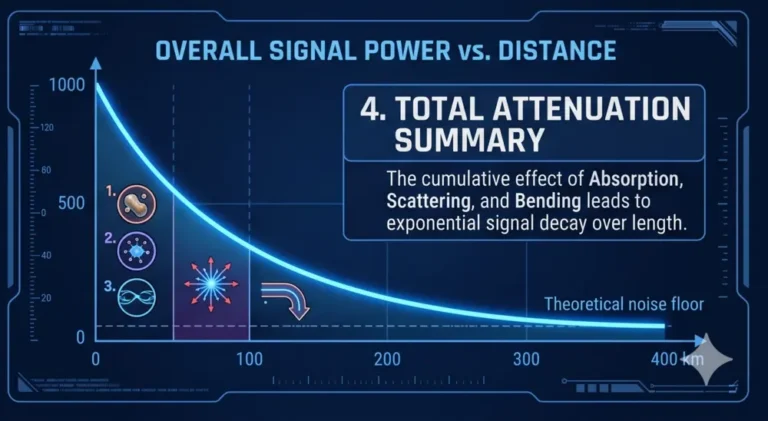
2.1.1. 📝Expression for Attenuation and Its Derivation:
To understand how the power of a light signal decreases while travelling through an optical fibre, let us derive the attenuation formula.
Consider a light wave with an initial optical power Pin entering the fibre and propagating along the positive x-direction. As the light travels through the fibre, a small portion of its power is continuously lost due to absorption, scattering, bending, and other attenuation mechanisms.
Now, consider an extremely small fibre segment of length dx. Within this tiny section, the decrease in optical power, -dP, is proportional to both the total power, Pin, entering the optical fibre and the small distance traveled. Mathematically, we express this relationship as:
Here, αe is a constant of proportionality, which represents the intrinsic attenuation coefficient of the material in units of m-1 or km-1.
Now, we can rearrange this differential expression:
To find the total power remaining after the light travels a full distance L, we integrate both sides of the equation. We set our integration limits from the input face of the fiber, where the distance x = 0 and power is Pin, to the exit point where distance x = L and power drops to Pout:
Executing the integration gives us:
Using standard logarithmic properties, we can simplify:
$$\Rightarrow \frac{P_{out}}{P_{in}} = e^{-\alpha_e L}$$
$$\Rightarrow P_{out}= P_{in}e^{\alpha_e L}$$
In practical telecommunications engineering, working, a base-10 decibel (dB) scale is used to express losses. Hence, the standard formula for the attenuation coefficient α in dB/km is:
Here, $$\alpha \approx 4.343 \alpha_e$$
3. 🔬 Types of Losses in Optical Fibre:
There are several types of losses in optical fibre. These signal attenuations are broadly classified into:
- Absorption Loss
- Scattering Loss
- Bending Loss
- Waveguide Loss
- Joint and Connector Loss
1. Absorption Loss:
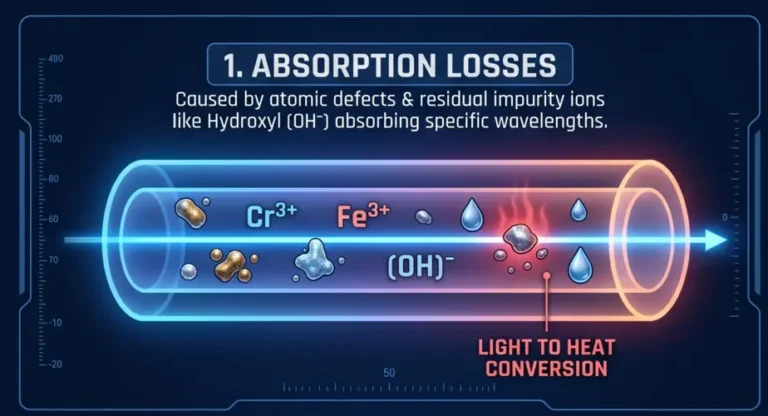
Absorption loss occurs when a part of the light energy travelling through the optical fibre is absorbed by the fibre material and converted into heat. As a result, the optical signal gradually loses its power while propagating through the fibre.
Absorption loss in optical fibres can be classified into the following types:
1. Intrinsic Absorption:
Intrinsic absorption is caused by the natural properties of pure silica glass. Silica absorbs light strongly in the ultraviolet region due to electronic transitions and in the infrared region due to vibrations of silicon-oxygen bonds.
Between these two regions lies a highly transparent wavelength range, known as the optical transmission window, where optical communication systems operate with minimum loss.
2. Extrinsic Absorption:
Extrinsic absorption occurs due to impurities present in the fibre material. Small amounts of metallic impurities, such as iron, copper, and chromium, can absorb light and increase attenuation.
Another major source of absorption is hydroxyl (OH⁻) ions, which originate from moisture trapped during the manufacturing process. These ions cause significant absorption at specific wavelengths.
3. Defect Absorption:
Defect absorption arises when imperfections or structural defects are present in the silica glass. These defects may be created during manufacturing due to excessive heat, mechanical stress, or exposure to high-energy radiation. Such imperfections absorb some of the propagating light energy, leading to additional signal loss.
Therefore, absorption loss reduces the intensity of the optical signal by converting a portion of the transmitted light energy into heat within the fibre material.
2. Scattering Loss:
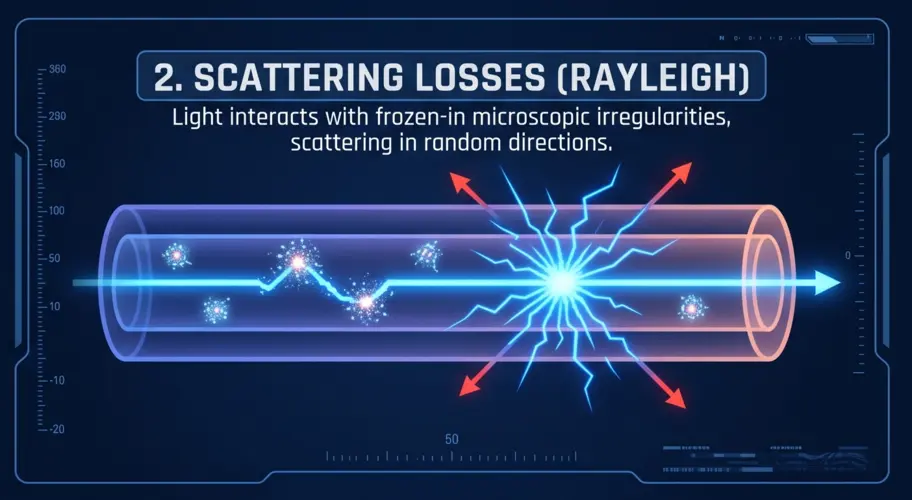
Scattering loss occurs when light deviates from its original propagation direction due to microscopic variations in material density, compositional fluctuations, and manufacturing defects. When a photon is scattered in the wrong direction, it escapes from the fibre core into the cladding and does not reach the receiver, causing a loss of signal power
Scattering loss is of two types:
- Rayleigh Scattering Loss
- Mie Scattering Loss
- Rayleigh Scattering Loss: This is the most significant scattering loss in modern fibres. It arises because microscopic density fluctuations naturally occur within glass. As light interacts with these fluctuations, part of the optical power is scattered.
Characteristics:
- Dominant at shorter wavelengths
- Inversely proportional to wavelength raised to the fourth power
where A is the Rayleigh scattering coefficient, a material constant that depends on the composition and thermal history of the glass. Therefore, longer wavelengths experience lower Rayleigh scattering.
2. Mie Scattering Loss:
Mie scattering occurs due to relatively large structural imperfections present inside the optical fibre. These imperfections scatter light in different directions, causing a portion of the optical signal to be lost.
Common causes of Mie scattering include:
- Irregularities at the core-cladding boundary
- Variations in the fibre diameter
- Air bubbles or tiny particles trapped during manufacturing
- Small changes in the refractive index profile
Unlike Rayleigh scattering, Mie scattering does not depend strongly on the wavelength of light. Therefore, its effect remains nearly the same over a wide range of wavelengths.
Since Mie scattering mainly arises from manufacturing defects, it can be significantly reduced by using high-quality fabrication techniques and maintaining a smooth, uniform core-cladding interface during the fibre drawing process.
As a result, modern optical fibres exhibit very low Mie scattering losses compared to earlier fibres.
3. Bending Loss:
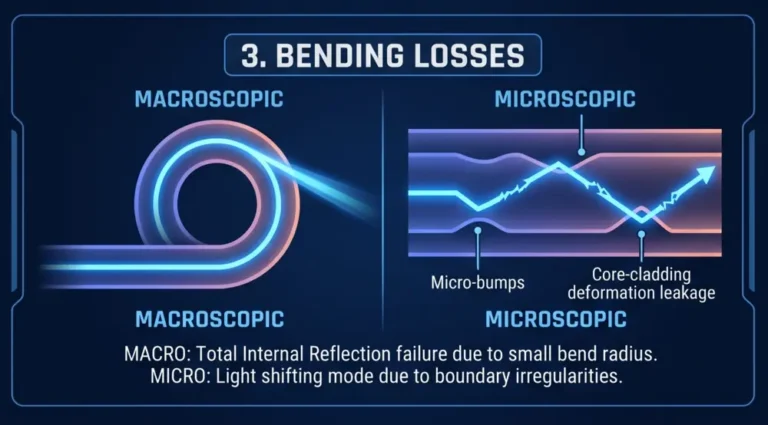
When an optical fibre is bent, the path of light inside the core is disturbed. As a result, some light rays strike the core-cladding interface at angles smaller than the critical angle and escape into the cladding instead of remaining confined within the core. This loss of optical power is known as bending loss.
Bending losses are generally classified into two types: macrobending loss and microbending loss.
- Macroscopic Bending Loss: This happens when an entire fiber cable is bent sharply during installation or handling. If the bend becomes excessive, some guided light escapes from the core into the cladding.
- Microscopic Bending Loss: Microbending loss is caused by very small bends or deformations in the optical fibre caused by mechanical pressure, manufacturing defects, or temperature changes. These small distortions alter the path of light rays, causing some optical power to leak out of the core and resulting in signal loss.
4. Waveguide Loss:
Waveguide loss occurs due to small imperfections in the structure of an optical fibre. Variations in the core diameter, irregularities in the refractive index profile, or defects at the core-cladding boundary can disturb the propagation of light.
As a result, a small portion of the guided optical energy leaks out of the fibre, causing signal loss. Although waveguide loss is generally very small in modern fibres, it can become significant in long-distance optical communication systems.
5. Joint and Connector Loss:
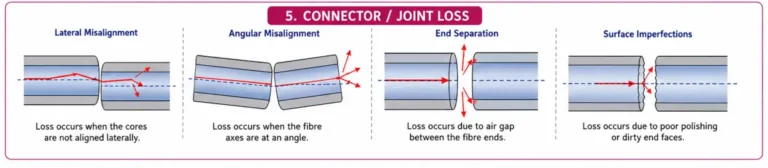
Joint and connector loss occurs when light travels across fibre connections, splices, or connectors. Small imperfections such as misalignment or air gaps can cause a portion of the optical signal to be lost.
Although the loss at a single connection is usually small, the combined effect of many connections can become significant in long-distance communication systems.
3.  Comparison of Optical Fibre Losses:
 Comparison of Optical Fibre Losses:
| S. No. | Loss Type | Main Cause | Significance |
|---|---|---|---|
1. |
Absorption |
Impurities and material absorption |
Moderate |
2. |
Rayleigh Scattering |
Density fluctuations |
High |
3. |
Mie Scattering |
Structural defects |
Moderate |
4. |
Macrobending |
Large bends |
High |
5. |
Microscopic bendings |
Microscopic bends |
Moderate |
6. |
Waveguide Loss |
Structural irregularities |
Low |
7. |
Connector Loss |
Misalignment |
Moderate |
4. 🎉 Distortion:
So far, we have seen how various losses reduce the power of an optical signal. However, signal quality can also deteriorate even when sufficient power reaches the receiver.
As light pulses travel through an optical fibre, they may spread out in time due to dispersion. This spreading causes the pulses to lose their original shape, making it difficult for the receiver to distinguish one pulse from another.
Optical fibre distortion is the change in the shape of an optical pulse as it propagates through the fibre. It mainly occurs because of pulse spreading (dispersion), which can cause neighbouring pulses to overlap and interfere with each other. As a result, the received signal becomes less clear and more difficult to interpret correctly.
This phenomenon is commonly referred to as pulse broadening.
4.1. 🌟 Dispersion:
While attenuation answers the question, “How much light is lost?” dispersion answers a completely different question: “How distorted does the signal become?”
Even if you had a perfect optical fiber with zero attenuation, dispersion would still limit how much data you could send over long distances.
Dispersion is the broadening or spreading of light pulses as they travel along an optical fiber.
4.1.1. 📝Types of Dispersion:
Dispersion occurs due to different physical mechanisms within the fiber. It is generally classified into three major types:
- Intermodal Dispersion
- Intromodal dispersion
1. Intermodal Dispersion:
It occurs in multimode fibres. Inside the optical fibre, different modes travel different path lengths. As a result, some rays reach the receiver earlier while others arrive later. Hence, there are propagation delay differences between different modes. This broadens the pulse.
2. Intramodal Dispersion:
It is the pulse spreading that occurs within a single-mode optical fibre. It is further classified into:
a. Material Dispersion: It occurs because different wavelengths of light travel at different speeds through the optical fibre material. As a result, the various wavelength components of a light pulse reach the receiver at different times, causing the pulse to spread out. This spreading of the pulse is known as material dispersion.
Material dispersion is also called chromatic dispersion or spectral dispersion because it arises from the variation of the refractive index of the fibre material with wavelength.
To quantify chromatic dispersion, engineers use the dispersion parameter D, measured in picoseconds per nanometer-kilometer (ps/(nm · km)). The total pulse broadening Δτ is calculated using the equation:
Where:
Δτ = Total pulse spreading time (in picoseconds)
D = Dispersion coefficient of the fiber
Δλ = Spectral width of the light source (in nanometers)
L = Length of the fiber link (in kilometers)
This formula directly demonstrates that using a highly stable laser with a narrow spectral width (Δλ → 0) drastically reduces chromatic pulse distortion!
b. Waveguide Dispersion: It occurs because different portions of light travel through the core and cladding of the optical fibre at slightly different speeds. As a result, the components of an optical pulse reach the receiver at different times, causing the pulse to spread out. This pulse spreading can reduce the maximum data transmission speed of the communication system.
5. 📚 Importance of Studying Fibre Losses:
Understanding losses in optical fibre helps in:
- Designing better communication systems
- Improving internet speed
- Increasing transmission distance
- Enhancing data security
- Reducing maintenance costs
Without proper knowledge of fibre losses, efficient communication networks cannot be developed.
6. ⚖️ Attenuation vs Distortion:
Although attenuation and distortion both degrade communication quality, they affect the signal differently.
| S. No. | Parameter | Attenuation | Distortion |
|---|---|---|---|
1. |
Effect |
Reduces power |
Changes pulse shape |
2. |
Cause |
Absorption, scattering, bending |
Dispersion |
3. |
Result |
Weak signal |
Pulse broadening |
4. |
Unit |
dB/km |
ns/km |
5. |
Main Impact |
Limits transmission distance |
Limits data rate |
7. 💡Quick Answer Section:
1. What are losses in optical fibre?
Losses in optical fibre refer to the reduction of optical signal power during transmission through the fibre. These losses occur because of absorption, scattering, bending, and connector imperfections. They are measured as attenuation in decibels and directly affect communication distance and signal quality.
2. What is attenuation in optical fibre?
Attenuation is the gradual decrease in optical power as light travels through a fibre. It is usually expressed in dB/km and indicates how much signal strength is lost over a specific distance.
3. What causes absorption loss in optical fibre?
Absorption loss occurs when fibre material or impurities absorb optical energy and convert it into heat. Common impurities include hydroxyl ions and metallic contaminants introduced during manufacturing.
4. What is Rayleigh scattering?
Rayleigh scattering is the scattering of light caused by microscopic density variations within silica glass. It is the dominant loss mechanism in modern optical fibres and decreases with increasing wavelength.
5. What is bending loss in optical fibre?
Bending loss occurs when fibre bends cause light rays to escape from the core. Excessive bending reduces total internal reflection and results in signal attenuation.
6. What is the difference between macrobending and microbending?
Macrobending results from visible large fibre bends, whereas microbending arises from microscopic deformations caused by mechanical stress or manufacturing imperfections.
7. Why are optical fibre losses important?
Optical fibre losses determine communication range, bandwidth performance, signal quality, and the number of repeaters or amplifiers required in a network.
8. How is attenuation measured?
Attenuation is measured in decibels per kilometer (dB/km) using the ratio of input optical power to output optical power.
9. Which wavelength has minimum fibre loss?
Modern silica fibres exhibit minimum attenuation near 1550 nm, making it the preferred wavelength for long-distance communication.
10. How can optical fibre losses be reduced?
Losses can be minimized by using high-purity silica, proper installation practices, optimized wavelength selection, and precision connector alignment.
11. What are the main types of losses in optical fibre?
The main types are absorption loss (intrinsic and extrinsic), scattering loss (Rayleigh and Mie), bending loss (macro and micro), dispersion, and coupling loss. Each arises from a different physical mechanism and varies differently with wavelength and fibre geometry.
12. What is the attenuation formula for optical fibre?
Attenuation is given by α (dB/km) = (10/L) × log₁₀(Pᵢₙ/Pₒᵤₜ), where Pᵢₙ and Pₒᵤₜ are the input and output optical powers, and L is the fibre length in km. Power decays exponentially as Pₒᵤₜ = Pᵢₙ × exp(−αₙL), where αₙ is the linear coefficient.
13. What is the unit of attenuation in optical fibre?
Attenuation is measured in decibels per kilometre (dB/km). The dB scale is logarithmic: a 10 dB loss means signal power has dropped to one-tenth; 20 dB means one-hundredth. Modern single-mode fibres achieve about 0.2 dB/km at 1550 nm.
14. What is Dispersion?
Dispersion is the broadening or spreading of light pulses as they travel along an optical fiber.
When digital data is transmitted, it is converted into rapid pulses of light representing 1 and 0. As these pulses travel down the core, they widen. If they travel too far, adjacent pulses begin to overlap and blur together.
8. 🧠 Conclusion
Losses in optical fibre are a crucial topic in fibre optic communication systems. Although optical fibres provide incredibly fast and efficient communication, some signal loss is unavoidable.
The major losses include absorption, scattering, bending, and dispersion. Each type affects communication performance differently. Fortunately, advanced manufacturing methods and improved technologies help minimize these losses significantly.
Understanding losses in optical fibre is essential for students, engineers, researchers, and communication professionals. As technology advances toward 6G networks, quantum communication, and high-speed internet systems, low-loss optical fibres will become even more important.
The continued development of advanced fibre materials and innovative communication systems promises a future with faster, safer, and more reliable global connectivity.
9. 📝 PYQs and Most Expected Questions:
Conceptual Questions:
- Define attenuation in optical fibre.
- Explain absorption loss with examples.
- Differentiate between Rayleigh and Mie scattering.
- What are macrobending and microbending losses?
- Why is 1550 nm preferred in optical communication?
- Explain waveguide loss.
- Discuss connector losses.
- Why are impurities harmful in optical fibres?
- Define dispersion in optical fibre.
- What is optical fibre distortion?
- What is pulse broadening?
- Differentiate between dispersion and distortion.
- What is intermodal dispersion?
- What is material dispersion?
- Why is material dispersion also called chromatic dispersion?
- What is waveguide dispersion?
- How does dispersion affect communication systems?
- Which type of fibre is free from intermodal dispersion?
- Explain the concept of dispersion in optical fibre and discuss its types.
- Describe intermodal dispersion with a suitable diagram.
- Explain material (chromatic) dispersion and its causes.
- Discuss waveguide dispersion in optical fibres.
- Explain optical fibre distortion and its effects on signal transmission.
- Compare material dispersion and waveguide dispersion.
- Differentiate between attenuation and distortion in optical fibre communication.
- Explain pulse broadening and its impact on data transmission rate.
Derivation Questions:
- Derive the attenuation coefficient expression.
- Derive the relationship between optical power and distance.
- Explain attenuation measurement in dB.
10. 🎯 Solved Numerical Problems:
1. Calculate total attenuation coefficients:
Q. 1. An optical fiber has an initial input power of 5.0 mW. After traveling down a continuous 12 km length of fiber cable, the output power is measured at 1.2 mW. Find the total attenuation coefficient of the fiber line in dB/km.
Solution:
Given:
Input Power (Pin) = 5.0 mW
Output Power (Pout) = 1.2 mW
Fiber Length (L) = 12 km
Find:
Attenuation Coefficient (α) in dB/km
Calculation: Since,
Answer: The attenuation coefficient of the fiber line is 0.516 dB/km.
2. Find output optical power:
Q. 2. A high-performance single-mode fiber link spans a distance of 455 km and exhibits a rated attenuation factor of 0.22 dB/km. If the optical transmitter injects an input signal with a power level of 15 mW, calculate the absolute optical power available at the receiver end.
Solution:
Given:
Fiber Length (L) = 45 km
Attenuation Factor (α) = 0.22 dB/km
Input Power (Pin) = 15 mW
Find:
Output Power (P0ut) in mW
Calculation: Since,
Answer: The absolute optical power available at the receiver end is 1.535 mW.
3. Calculate attenuation coefficient:
Q. 3. A specific glass material has an intrinsic physical attenuation constant αe = 4.6 × 10⁻² km-1. Convert this physical constant into our standard commercial engineering attenuation coefficient α in units of dB/km.
Solution:
Given:
Physical Attenuation Constant αe = 4.6 × 10⁻² km-1
Find:
Engineering Attenuation Coefficient (α) in dB/km
Calculation: Since,
Answer: The standard commercial engineering attenuation coefficient is approximately 0.20 dB/km.
4. Calculate Total Pulse Broadening and Maximum Supported Bit Rate:
Q. 4. An optical fiber link spans a total distance of 80 km. The light source used is a semiconductor laser operating at a wavelength of 1550 nm with a spectral width (Δλ) of 1.5 nm. The chromatic dispersion coefficient (D) of the fiber at this operating wavelength is rated at 17 ps/(nm·km).
Calculate:
The total pulse broadening (Δτ) experienced by the signal at the end of the link.
The maximum bit rate (Bmax) that this fiber link can support without severe inter-symbol interference, assuming the pulse broadening should not exceed 25% of the bit duration (T).
Solution:
Part 1: Calculating Total Pulse Broadening
Given:
Fiber Length (L) = 80 km
Spectral Width of Source (Δλ) = 1.5 nm
Dispersion Coefficient (D) = 17 ps/(nm.km)
Find:
Total pulse broadening (Δτ) in picoseconds (ps)
Formula & Calculation:
The core equation for pulse broadening due to chromatic dispersion is:
Let’s substitute our given values into the formula:
Multiplying the terms step-by-step:
Answer for Part 1:
The total pulse broadening at the end of the link is 2020 ps or 2.04 ns.
Part 2: Calculating Maximum Supported Bit Rate
Given Condition:
The pulse broadening must not exceed 25% of the total bit period (T).
Mathematically, this threshold is written as:
Find:
Maximum supported bit rate (Bmax) in Gigabits per second (Gbps)
Formula & Calculation:
First, we isolate the minimum required bit period (T) using our target threshold constraint:
Since bit rate (B) is the mathematical inverse of the bit duration time period (B = 1/T), the maximum speed threshold becomes:
To present this in clean engineering units, we convert bits/second to Megabits per second (Mbps):
Answer for Part 2:
The maximum data bit rate this fiber link can safely support without experiencing corrupting interference is 122.55 Mbps.
11. 💡 FAQs (People Also Ask):
1. Why are optical fibres better than copper cables?
Optical fibres offer higher bandwidth, lower losses, and faster communication speeds than copper cables.
2. Which wavelength has minimum fibre loss?
The 1550 nm wavelength region has the minimum attenuation in optical fibres.
3. Which loss is unavoidable in optical fibre?
Rayleigh scattering is fundamentally unavoidable because it originates from natural microscopic density fluctuations within the glass material.
4. Why is silica used in optical fibres?
Silica offers excellent transparency, low attenuation, chemical stability, mechanical strength, and efficient transmission of optical signals.
5. What is connector loss?
Connector loss is the optical power reduction occurring at fibre joints because of misalignment, air gaps, or imperfect polishing.
12. Watch on YouTube
Recent Posts
Find Category Wise all Notes:
Message:
Thank you for reading this comprehensive guide on losses in optical fibre. Keep learning and exploring the fascinating world of fibre optic communication for a brighter technological future!