
The I-V characteristics of the diode is crucial, as it works as a rectifier, which enables current flow in one direction (forward bias) while preventing it in the opposite direction (reverse bias). This behavior of the junction diode is illustrated by the I-V characteristics curve, which is described by the Shockley diode equation: $$I=I_S\left(e^{\frac{qv}{\eta kT}}-1\right) $$
where Is represents the reverse saturation current. A practical application of this is in smartphone chargers, which convert alternating current (AC) to direct current (DC) for safe charging of devices.
The p-n junction diode plays a vital role in converting AC to DC due to its unique I-V characteristics that describe current flow under varying voltage conditions, effectively indicating whether the diode allows current flow or blocks it depending on the voltage applied.
By the end of this article, you will clearly understand:
- How current varies with voltage in a diode
- Why does a diode behave differently in forward and reverse bias
- The mathematical equation governing this behavior
- Real-world applications of these characteristics
Contents
ToggleI-V Characteristics of a p–n Junction Diode
The I-V characteristics of a p–n junction diode is a curve drawn between current flowing through the junction and externally applied voltage, which describes how current (I) varies with applied voltage (V).
These characteristics have two parts, one for forward bias and the other for reverse bias connection.
Forward Bias Characteristics
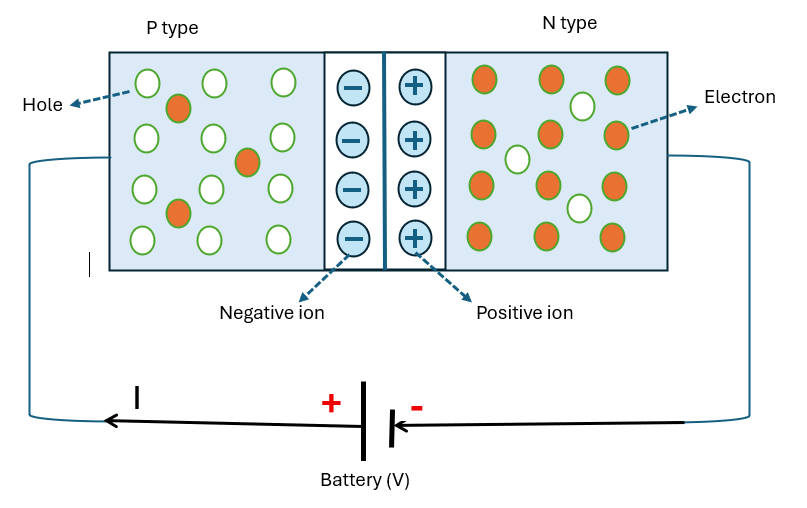
When the p-side is connected to the positive terminal and the n-side to the negative terminal of the battery, then the diode is in the forward bias condition. In this case:
- Barrier potential decreases
- Charge carriers cross the junction easily
- Current increases rapidly
Imagine it like opening a floodgate—once the barrier is reduced, the current flows freely.
Let’s understand the behavior of the junction diode at externally applied forward voltages.
Behaviour at Small Forward Voltage
When a small forward voltage is applied:
- The potential barrier reduces slightly.
- Only a small current flows.
- Current increases slowly at first.
This region is sometimes called the cut-in or knee region.
Cut-in (Threshold) Voltage
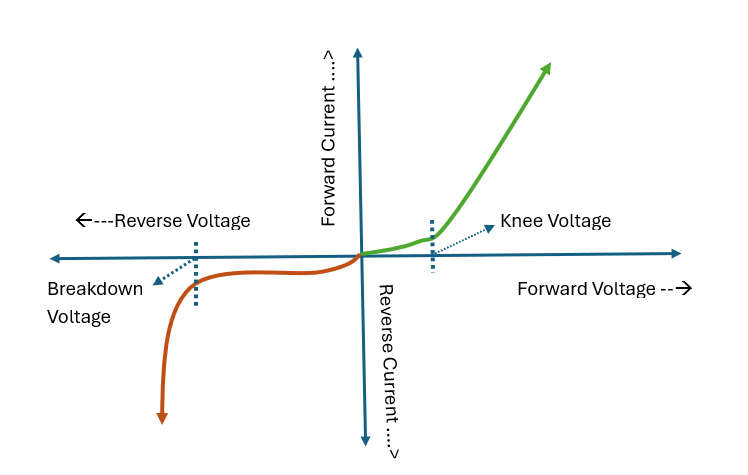
The diode begins conducting significantly after a certain voltage called the cut-in voltage. It is nearly 0.7 V for a silicon diode and nearly 0.3 V for a germanium diode.
Beyond this voltage:
- The barrier becomes very small.
- The majority of carriers cross the junction easily.
- Current rises rapidly.
Exponential Increase of Current
From the Shockley equation:
$$I\propto e^{\frac{qV}{kT}} $$
This explains why the forward current increases exponentially rather than linearly.
Reverse Bias Characteristics
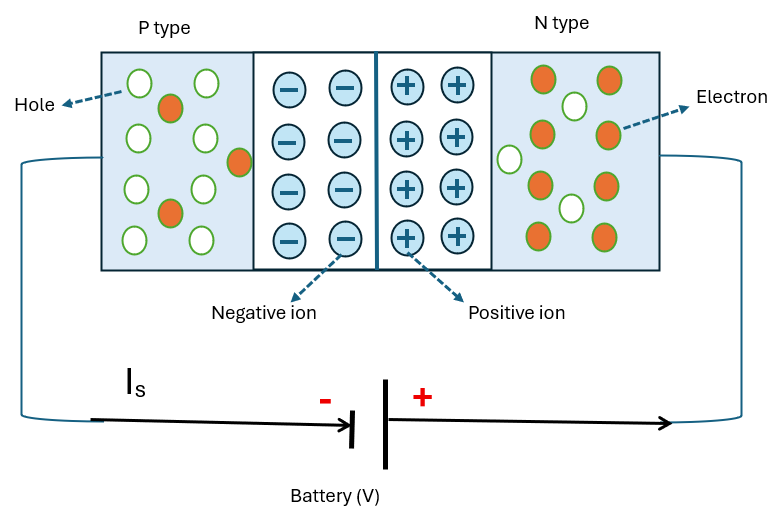
When the p-side is connected to the negative terminal and the n-side to the positive terminal of the battery, then the diode is in the reverse bias condition.
Let’s examine the behavior of the junction diode under externally applied reverse-bias voltages.
Behaviour Under Reverse Bias
When reverse voltage is applied, the following changes appear:
- Potential barrier increases.
- Depletion region widens.
- Majority charge carriers move away from the junction.
- Only minority carriers contribute
- Current flow is extremely small
👉 This works like a closed valve, only with tiny leakage.
Reverse Saturation Current
When reverse bias voltage is applied, the current increases slightly, and then it becomes nearly constant. Until the breakdown region is reached, this current, which has a very small magnitude, is almost unaffected by the reverse voltage that is applied. It is called the reverse saturation current.
However, it is temperature-dependent, rising sharply as the temperature rises because of large charge carrier generation.
Breakdown Region
When a high reverse voltage is applied, the diode’s behavior drastically changes; the current, which was previously very low, suddenly increases. This abrupt increase in current is due to the breakdown process within the junction. The reverse applied voltage at which the current increases abruptly is called the breakdown voltage.
This breakdown can occur in one of two ways:
- Zener breakdown, which occurs in a heavily doped pn junction diode.
- An avalanche breakdown, which occurs in a lightly doped junction.
I-V Characteristic Curve
The following figure shows the I-V characteristics of a pn junction diode.
Factors that Affect I-V Characteristics
- Temperature
- The reverse saturation current increases strongly with temperature in reverse bias.
- But in forward bias, the cut-in voltage decreases slightly with temperature.
- Semiconductor Material
- I-V characteristics are also affected by the material used to form the junction diode, as silicon has a higher threshold voltage than germanium.
- Doping Level
- The doping concentration affects breakdown voltage and leakage current.
Comparison Between Forward and Reverse Bias Characteristics
| Property | In Forward Bias | In Reverse Bias |
|---|---|---|
|
Barrier potential |
Decreases |
Increases |
|
Depletion width |
Narrows |
Widens |
|
Current magnitude |
Large |
Very small |
|
Carrier type |
Majority |
Minority |
|
Curve nature |
Exponential rise |
Nearly constant |
Real-World Engineering Applications
The I–V characteristics of a p–n junction diode are used to design a special-purpose diode for various applications in different electric circuits, such as
- Rectifiers → for AC to DC conversion
- Clipping circuits → for waveform shaping
- Voltage regulators → using Zener breakdown
- Signal detection → in radio receivers
- Switching circuits → in digital electronics
Conclusion
The I–V characteristics of a p–n junction diode reveal the true behavior of this most important electronic device.
The main takeaways are the following:
- In forward bias, current increases exponentially
- While in reverse bias, the current is extremely small and constant
- Diode behavior can be described by the Shockley equation
- Temperature affects its performance significantly.
👉 In modern engineering, understanding this curve is like understanding the heartbeat of electronics.
Important Questions
- Explain the I–V characteristics of a p–n junction diode with a neat diagram.
- What is reverse saturation current?
- Derive the Shockley diode equation.
FAQs
-
1. What are I–V characteristics of a diode?
It is a curve that describes how current varies with applied voltage.
-
2. Why is diode current exponential?
Diode current is exponential because of carrier diffusion and barrier reduction.
-
3. What is cut-in voltage?
Cut-in voltage (also called threshold voltage) is the minimum forward voltage required for significant conduction.
-
4. Why is reverse current small?
Reverse current in a diode is very small because it is mainly due to minority charge carriers.
-
5. What happens during breakdown?
During breakdown, a sudden increase in reverse current occurs when the applied voltage exceeds a critical value called the breakdown voltage.