
📚 Understand the physics behind diode current—not just the polarity. Read the complete guide, work through the numericals, and test yourself with the exam questions at the end.
Contents
Toggle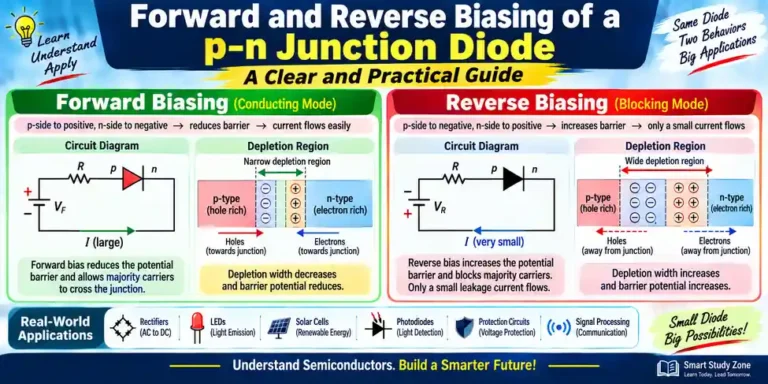
Introduction
Consider a basic cell phone charger. It safely charges your phone by converting alternating current (AC) to direct current (DC). The p–n junction diode is a tiny but potent hidden part of this commonplace gadget.
This diode’s capacity to let current in one direction while blocking it in another is what makes it so unique. This behavior is governed by forward and reverse biasing of pn junction diode.
Applying an external voltage to a diode is called biasing. The diode either readily conducts electricity or nearly entirely stops it, depending on how this voltage is applied.
In a p–n junction, the p-region contains holes as majority carriers, while the n-region contains electrons as majority carriers. When these regions are joined, diffusion and recombination produce a depletion region and an internal electric field. Applying an external voltage either reduces or increases the barrier majority carriers must overcome.
That simple change is the physical basis of forward and reverse biasing.
This principle is used in rectifiers, protection circuits, signal detection, switching circuits, LEDs, photodiodes, solar cells, and many other semiconductor devices. NPTEL’s semiconductor-device curriculum also treats forward and reverse biased p–n junctions, current equations, and junction electrostatics as fundamental device concepts.
By the end of this article, you will understand:
- what forward bias means,
- what reverse bias means,
- how to connect a p–n diode correctly,
- What happens to the depletion region
- how the potential barrier changes,
- how electrons and holes move,
- why forward current increases rapidly,
- why reverse current remains very small,
- how the diode equation describes its behaviour, and
- How to solve typical numerical problems.
⚡ What Is Biasing of pn Junction Diode?
Biasing means applying an external voltage across a p–n junction to control its electrical behaviour.
There are two basic modes:
- Forward bias
- Reverse bias
The polarity of the external voltage determines which mode occurs.
A useful way to remember the basic idea is: Forward bias reduces the barrier and promotes majority-carrier conduction, whereas reverse bias increases the barrier and suppresses majority-carrier conduction.
This is why the diode behaves somewhat like an electrical one-way valve.
However, this analogy has a limitation. A real reverse-biased diode does not carry exactly zero current. A small reverse leakage or saturation current exists, and a sufficiently large reverse voltage can cause breakdown.
🔬 What Is the Depletion Region?
The depletion region is the thin region around a p–n junction where most mobile electrons and holes have been depleted. It mainly contains fixed, charged impurity ions.
These charges create an internal electric field, which produces the built-in potential (barrier potential) that opposes further diffusion of charge carriers.
When an external voltage is applied, it changes this barrier and the width of the depletion region. Forward bias narrows it, while reverse bias widens it.
For a more detailed explanation, see [Potential Barrier (Built-in Potential) and Its Derivation].
Forward and Reverse Biasing of a p–n Junction Diode
To understand forward and reverse biasing of pn junction diode, we must first recall the structure of the diode.
Structure of p–n Junction:
A p–n junction consists of:
- p-region: Rich in holes (positive charge carriers)
- n-region: Rich in electrons (negative charge carriers)
At the junction, diffusion of carriers creates a depletion region, which contains no mobile carriers but has fixed ions. This region acts as a potential barrier.
Built-in Potential:
The potential barrier formed at equilibrium is called the built-in potential. This potential prevents further diffusion of carriers.
Concept of Biasing:
Biasing means applying an external voltage across the diode.
Depending on polarity:
- Forward Bias → Reduces barrier
- Reverse Bias → Increases barrier
This simple idea explains the entire operation of a diode.
Forward Biasing of a p–n Junction Diode
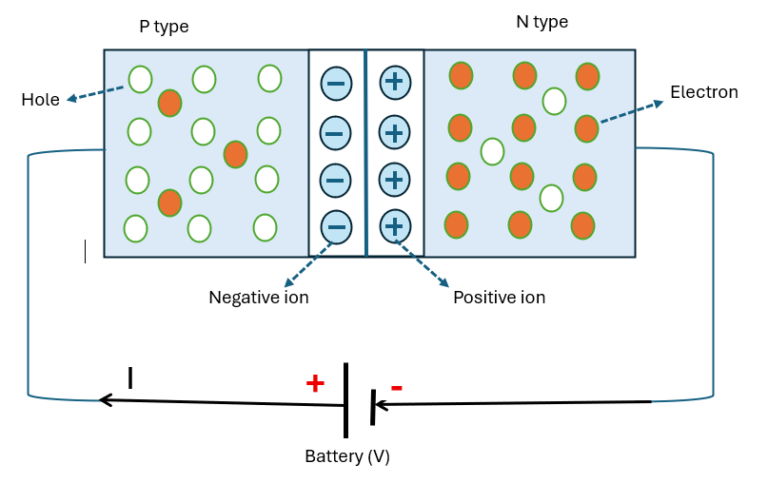
When the p–n junction diode is forward biased, the p-side is connected to the positive terminal and the n-side to the negative terminal of the external voltage source.
This type of connection applies an external electric field that opposes the built-in potential barrier present at the junction. The behavior of the diode changes gradually as the applied voltage is increased.
Working:
At the beginning, when a small forward voltage is applied, it slightly opposes the internal electric field of the junction. However, the potential barrier is still strong enough to prevent significant movement of charge carriers. As a result, only a very small current flows.
As the external voltage is increased, the potential barrier continues to decrease, and the depletion region becomes thinner. This allows more majority carriers (electrons and holes) to approach the junction.
When the applied voltage reaches a certain critical value called the knee voltage (about 0.7 V for silicon and 0.3 V for germanium), the barrier is effectively overcome. At this point, the diode begins to conduct appreciable current.
Beyond the knee voltage, even a small increase in voltage results in a large increase in current. The majority of carriers cross the junction in large numbers, recombine, and produce a strong current. The diode now behaves like a low-resistance path.
Forward Bias Energy Band Diagram
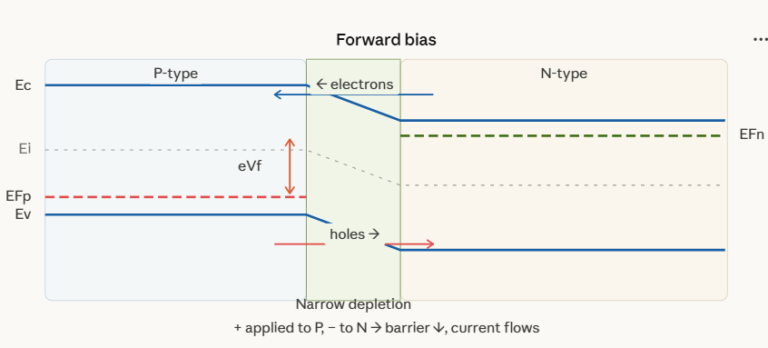
In forward bias, the applied voltage opposes the internal electric field, causing the energy barrier between the conduction and valence bands to decrease.
As a result, the band bending is reduced, and the depletion region becomes narrower. This allows electrons from the n-side and holes from the p-side to easily cross the junction, leading to a significant flow of current.
Reverse Biasing of a p–n Junction Diode
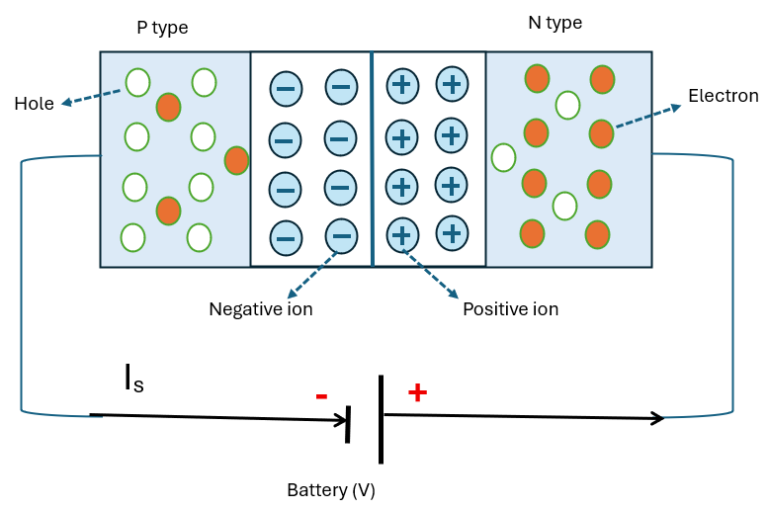
In reverse bias, the p-side is connected to the negative terminal and the n-side to the positive terminal of the battery. This connection strengthens the internal electric field.
Working:
When a small reverse voltage is applied, the depletion region widens and the potential barrier increases. The majority of carriers are pulled away from the junction, preventing current flow.
When reverse voltage increases despite the barrier, a very small current flows due to minority carriers (thermally generated electrons and holes). This current is called reverse saturation current and remains almost constant with increasing voltage.
As the reverse voltage increases further, the depletion region becomes wider, but the current still remains very small and nearly constant.
When the reverse voltage reaches a very high value known as the breakdown voltage, At this stage, the diode suddenly starts conducting a large current—not because the barrier is reduced (as in forward bias), but because new charge carriers are generated inside the junction itself. This occurs due to mechanisms such as avalanche multiplication or Zener breakdown.
Beyond the breakdown voltage, the current increases abruptly with very little increase in voltage. If not controlled, this can damage the diode.
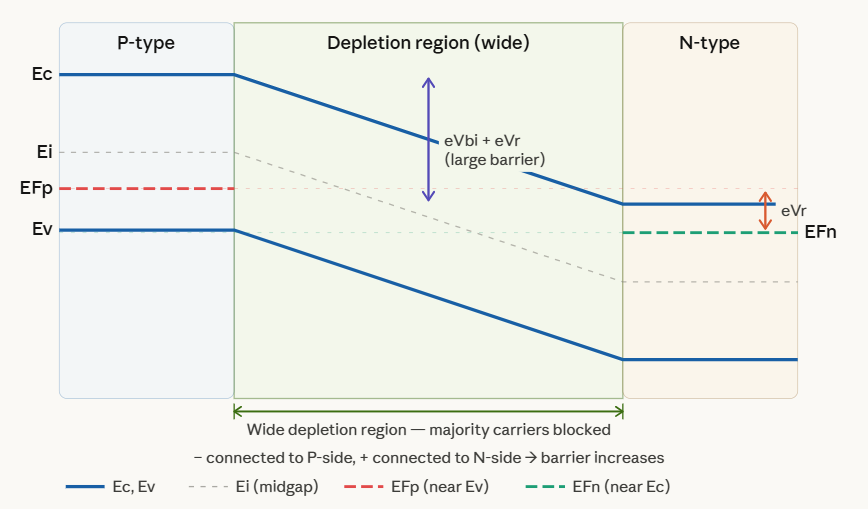
Reverse Bias Energy Band Diagram
In the reverse bias, the applied voltage strengthens the internal electric field, which increases the energy barrier and causes greater band bending. The depletion region widens, making it more difficult for charge carriers to cross the junction.
As a result, only a very small current due to minority carriers flows until breakdown occurs at high voltage.
Avalanche Breakdown (Impact Ionization)
This occurs mainly in lightly doped junctions with a wide depletion region.
The strong electric field accelerates minority carriers (electrons or holes) to very high speeds.
These high-energy carriers collide with atoms in the crystal lattice.
Each collision can knock out additional electrons, creating electron–hole pairs.
These newly generated carriers are also accelerated and cause further collisions.
This creates a chain reaction, known as avalanche multiplication. As a result, the current increases suddenly and rapidly, even with a small further increase in voltage.
Zener Breakdown (Quantum Tunneling)
This occurs in heavily doped junctions with a very thin depletion region.
The electric field becomes extremely intense across the narrow depletion region.
Due to quantum mechanical effects, electrons can directly jump (tunnel) from the valence band of the p-side to the conduction band of the n-side.
This happens without needing extra energy from collisions.
This process is called Zener tunneling, and it leads to a sharp increase in current.
Interactive Diode Biasing Simulator
I-V Characteristics:
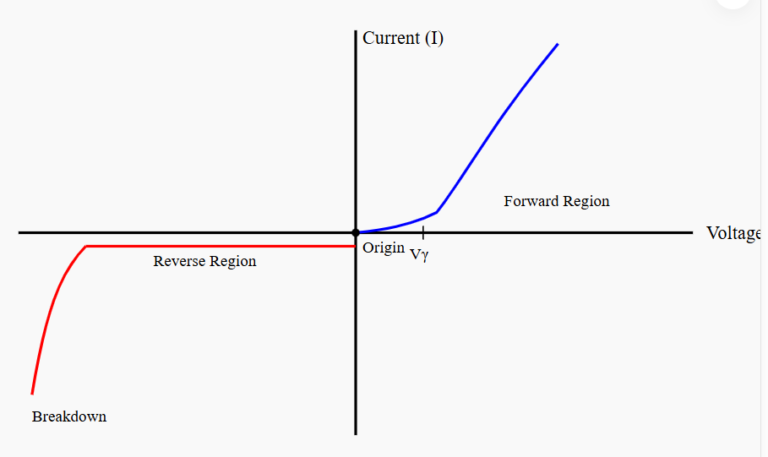
The I–V characteristics of a p–n junction diode describe how current varies with applied voltage. In forward bias, the current remains very small until the knee voltage is reached, after which it rises rapidly in an exponential manner. In reverse bias, only a small constant current flows until the breakdown voltage, where the current increases sharply.
Conclusion
The forward and reverse biasing of a p–n junction diode form the backbone of modern electronics.
Key takeaways:
- Forward bias reduces the barrier and allows current flow
- Reverse bias increases the barrier and blocks current
- Diode current follows exponential behavior
- The depletion region plays a crucial role
- Biasing determines device operation
Understanding this concept is essential for designing and analyzing electronic circuits.
Important Questions
- Explain forward and reverse biasing with a diagram.
- Compare forward and reverse bias.
- What is reverse saturation current?
- Explain breakdown mechanisms.
FAQs
1. What is forward biasing of a diode?
When the p–n junction diode is forward biased, the p-side is connected to the positive terminal and the n-side to the negative terminal of the external voltage source.
2. What is reverse biasing?
In reverse bias, the p-side is connected to the negative terminal and the n-side to the positive terminal of the battery.
3. Why does diode conduct in one direction?
Because of potential barrier behavior.
4. What is cut-in voltage?
Minimum voltage required for conduction in forward bias.
5. What happens in breakdown?
Large current flows due to high reverse voltage.
The explanation of forward and reverse biasing is clear and easy to follow, especially the discussion of the depletion region and breakdown mechanisms. The practical examples and key points also make the topic easier for students to understand.
Thank you