
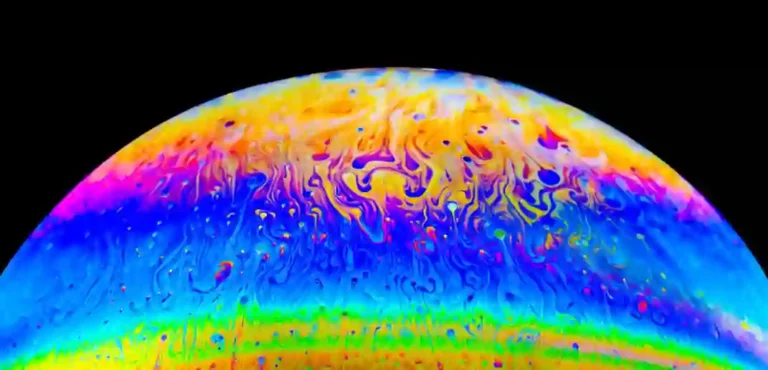
As shown in the following figure, have you ever noticed those shimmering rainbow colors on a soap bubble or the pale iridescent glow on a puddle of oil in a parking lot? That is not paint, pigment, or dye—it is pure physics. The colors you see are produced by the wave nature of light itself, and the principle behind it is called thin-film interference. Among all thin film setups, the wedge shaped film is one of the most elegant and instructive examples in all of undergraduate optics.
A wedge shaped film is a thin film of air or liquid formed between two surfaces that are inclined at a very small angle. When light falls on it, interference occurs, producing straight, parallel fringes.
What makes the wedge shaped film so important in science and engineering is that it turns an invisible property—the wavelength of light—into a visible, measurable pattern of bright and dark fringes. This phenomenon is not just visually appealing—it plays a crucial role in:
- Testing surface flatness in engineering
- Measuring extremely small thicknesses
- Designing optical instruments
By the end of this article, you will understand:
- How a wedge film is physically formed and why the thickness matters
- The complete theory of interference in a thin film
- The step-by-step mathematical derivation of the path difference and fringe width
- What the fringe pattern looks like and how to interpret it
- Real engineering and scientific applications of wedge film interference
Whether you are preparing for a university physics exam, working through a derivation for the first time, or simply trying to understand why the world shimmers in color, this article has everything you need. Let us start at the beginning.
Contents
Toggle📜 Historical Background of Wedge-Shaped Film
The study of thin-film interference evolved from early work by Isaac Newton, who first studied interference patterns (Newton’s Rings).
Later, scientists extended these ideas to wedge-shaped films to explain the following:
- Surface imperfections
- Optical precision
These characteristics made wedge films extremely important in optical engineering and metrology.
🔷 Formation of Wedge Film
How Do Two Glass Plates Create a Wedge?
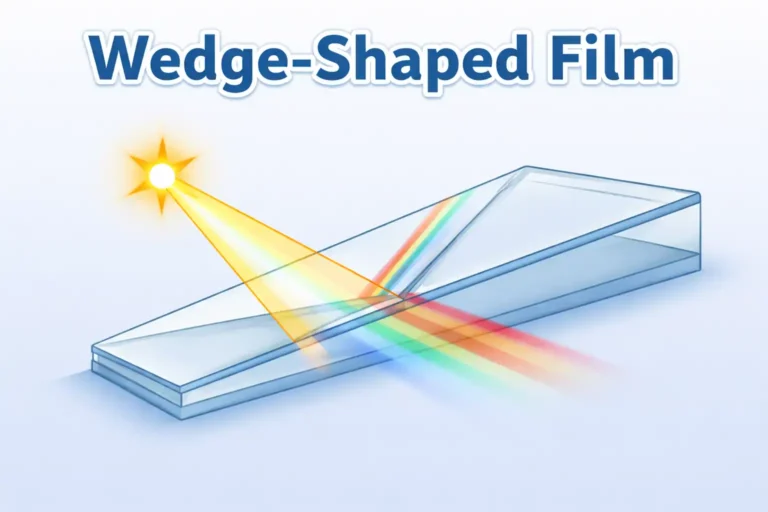
A wedge-shaped film is formed when:
- Two glass plates are placed one over the other
- One end is in contact
- The other end is slightly separated using a thin spacer
What you have created is a thin-air wedge film of gradually increasing thickness trapped between the two glass surfaces. At the contact end, the film has zero thickness. At the end of the spacer, it has a thickness equal to the diameter of the spacer.
The Angle of the Wedge (θ) and Why It Matters
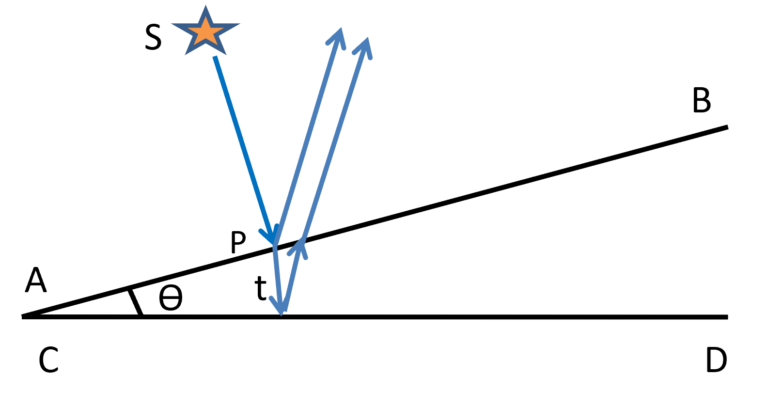
The angle formed between the two surfaces is denoted by θ, and it is called the angle of the wedge. In most practical applications, this angle is extremely small (often less than a fraction of a degree).
The Apex: The point or line where the two plates touch (t = 0).
The Wedge Angle (θ): The angle of inclination between the two surfaces.
The Thickness (t): Since the plates are inclined, the thickness of the film increases linearly as we move away from the apex.
At any distance x from the contact edge (the apex), the thickness t of the film can be related to the angle by:
Since θ is very small, we can use the approximation tan θ ≈ θ (in radians), giving us:
🌊 Theoretical Foundation of interference by Wedge Shaped Film
To understand why we see fringes, we must look at how light interacts with the boundaries of the wedge. When a beam of monochromatic light (light of a single wavelength) falls on the top plate, it undergoes a “split-personality” act.
Part of the light is reflected from the top surface of the film (the bottom of the upper glass plate), and part of it penetrates the film, reflects off the bottom surface, and then exits.
🌈 Interference in Thin Wedge Films
Because the two reflected rays originate from the same source, they are coherent. However, they travel different distances. The ray reflecting off the bottom surface has to travel “down and back” through the film.
This extra distance creates a path difference. Depending on whether this path difference aligns the “peaks” of the waves or matches a “peak” with a “trough,” we see either a bright stripe or a dark stripe.
Wedge Film Simulation
Wavelength (nm)
Wedge Angle (θ)
📐 Mathematics behind the Wedge Shaped Film
Let us derive the condition for these interference patterns. Consider a thin film of refractive index μ and a wedge angle θ. Suppose a ray of light is incident on the film.
📏 Determining the Geometric Path Difference
When a light ray is incident at an angle i and refracted at an angle r, the optical path difference (Δ) between the two reflected rays is generally given by the cosine law for thin films:
For near-normal incidence (where light hits almost straight down), we assume cos r ≈ 1. Hence, Δ = 2μt.
In our wedge, the first reflection occurs at the glass-to-film boundary (no phase change). The second reflection occurs at the film-to-glass boundary (bottom plate). Hence, as per Stoke’s treatment, it undergoes a phase change of π, which is equivalent to an additional path difference of λ/2.
Therefore, the total effective path difference between the two reflected rays is:
$$\Delta_{eff} = 2\mu t + \frac{\lambda}{2}\qquad ……..(2) $$
🎯 Conditions for Interference
✔️ For Bright Fringes (Constructive Interference)
For the fringes to be “Bright” (Constructive Interference), the path difference must be an integer multiple of the wavelength:
Rearranging the equation, we get:
(Where n = 1, 2, 3…)
✔️ For Dark Fringes (Destructive Interference)
For the fringes to be “Dark” (Destructive Interference), the path difference must be an odd multiple of half-wavelengths:
$$\Rightarrow 2\mu t = n\lambda \qquad ………… (4)$$
(Where n = 0, 1, 2…)
📏 Deriving the Fringe Width
The fringe width (β) is defined as the distance between two successive dark (or bright) fringes. Let two consecutive dark fringes correspond to orders n and n+1, located at distances xn and xn+1 from the contact edge, respectively.
For the nth dark fringe, using Eq. (4) and Eq. (1):
$$ 2\mu t_n = n\lambda$$
$$\Rightarrow 2\mu x_n\theta=n\lambda $$
$$\Rightarrow x_n = \frac{n\lambda}{2\mu \theta} \qquad ……….(5)$$
Similarly, for the (n+1)th order dark fringe:
$$x_{n+1}=\frac{\left( n+1 \right)\lambda}{2\mu\theta}\qquad …….. (6)$$
The fringe width is the separation between them:
$$\beta= x_{n+1}-x_n$$
$$\Rightarrow \beta = \frac{\left( n+1 \right)\lambda}{2\mu\theta}-\frac{n\lambda}{2\mu\theta}$$
$$\color{Red}{\large\Rightarrow \beta=\frac{\lambda}{2\mu\theta}\qquad …. (7) }$$
This is the famous fringe width formula for a wedge shaped film. It tells us three important things:
- First, the fringe width is directly proportional to the wavelength of light used.
- Second, the fringe width is inversely proportional to the wedge angle.
- Third, the fringes are equally spaced regardless of which fringe you measure—because β does not depend on n.
🔍 Determination of Wedge Angle (θ)
In a wedge-shaped film:
- Thickness increases linearly along the length
- Interference fringes are equally spaced
We use this property to find the wedge angle (θ).
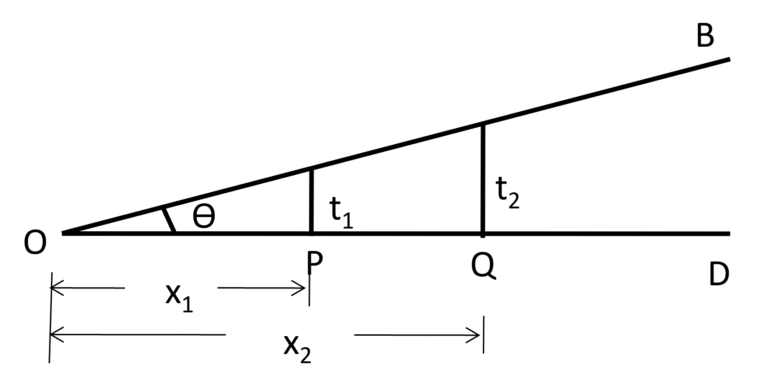
If the nth dark fringe is obtained at point P, then:
$$2\mu t_1=n\lambda$$
But t1 = x1θ, hence
$$2\mu x_1\theta=n\lambda \qquad ….. (8)$$
Similarly, we can write for the dark fringe at point Q:
$$2\mu x_2\theta=(n+N)\lambda\qquad ….(9)$$
Where N is the number of dark fringes lying between the positions P and Q. Now, subtracting equation (8) from (9), we get
$$2\mu\left( x_2-x_1 \right)\theta=N\lambda$$
$$\color{Red}{\Large\Rightarrow \theta=\frac{N\lambda}{2\mu\left( x_2-x_1 \right)}\qquad ….(10)} $$
This is the formula for the wedge angle.
🔍 Determination of the thickness of the Spacer
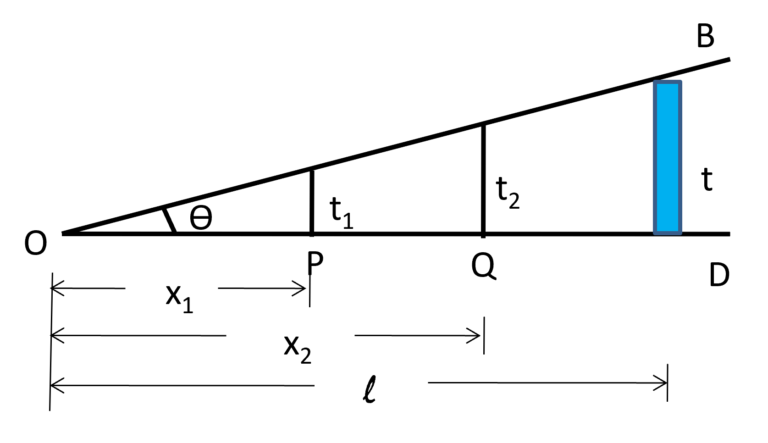
From the above figure:
$$t=l\theta$$
$$\Rightarrow \theta =\frac{t}{l}$$
Putting the value of θ from equation (10), we get
$$\color{Red}{\Large t=\frac{lN\lambda}{2\mu\left( x_2-x_1 \right)}} $$
This gives the thickness of the spacer.
🔍 Number of Dark Fringes in a Wedge
The fringe width and wedge angle for the wedge film are given by
$$ \beta=\frac{\lambda}{2\mu\theta}$$
$$\theta=\frac{t}{l}$$
Therefore, using the above equations
$$\beta=\frac{\lambda l}{2\mu t}\qquad …..(12)$$
Let the number of dark fringes observed in a wedge of length l be N; then— $$l=N\beta \qquad …… (13)$$
Hence, using equations (12) and (13), we get the number of dark fringes in a wedge
$$\color{Red}{\Large N=\frac{2\mu t}{\lambda}} $$
⚖️ Comparison: Wedge film vs Newton's rings vs the parallel thin film
| S. No. | Feature | Wedge Shaped Film | Newton's Rings | Parallel Thin Film |
|---|---|---|---|---|
1. |
Film geometry |
Linearly varying thickness (wedge) |
Radially varying (circular) |
Uniform thickness |
2. |
Fringe shape |
Straight, parallel lines |
Concentric circles (rings) |
Uniform color / no fringes visible |
3. |
Fringe spacing |
Equal (β = λ/2μθ) |
Decreasing with order (rings get closer) |
Not applicable |
4. |
Path difference |
2μt + λ/2 |
2μt + λ/2 |
2μt cos r + λ/2 |
5. |
Primary use |
Wavelength & thickness measurement |
Refractive index, curvature measurement |
Color of thin films (soap, oil) |
6. |
Light used |
Monochromatic preferred |
Monochromatic preferred |
White or monochromatic |
✅ Advantages and Limitations
Advantages
High Sensitivity: Can detect variations in thickness as small as a fraction of the wavelength of light.
Simple Setup: Requires only two glass plates and a monochromatic source.
Direct Measurement: Allows for the calculation of the diameter of thin wires or the thinness of a coating without physical contact.
Limitations
Small Angles Only: If θ becomes too large, the fringes become so close together that the human eye (or even a microscope) cannot resolve them.
Surface Quality: Requires extremely flat glass plates (optical flats); otherwise, the fringes will be wavy and distorted.
🚀 Applications of Wedge Shaped Film
The wedge shaped film is far more than a classroom demonstration. As mentioned in the introduction, the same principle that makes soap bubbles shimmer has been harnessed by engineers and scientists to solve real measurement problems across multiple industries. Here are five specific applications:
🔬 Optical Surface Flatness Testing
In precision lens manufacturing, a reference flat is placed against a test surface. Straight, parallel fringes confirm flatness; curved or irregular fringes reveal surface errors down to fractions of a wavelength (nanometers).
💡 Wavelength Determination
With a known spacer thickness, the wavelength of an unknown light source can be calculated from the measured fringe width. This is a standard undergraduate optics laboratory experiment worldwide
📏 Measurement of Small Thicknesses
The thickness of very thin objects—a sheet of biological film, a calibration shim, or a polymer coating—can be measured by counting fringes using a known wavelength light source.
🏭 Industrial Crack Detection
In non-destructive testing, wedge-based interferometry can detect surface cracks and subsurface defects in metals and semiconductors by monitoring distortions in the interference fringe pattern caused by local stress or deformation.
🌈 Anti-Reflection Coating Design
The physics of the wedge film directly informs the design of anti-reflection coatings on cameras, eyeglasses, and solar cells. By engineering film thickness to produce destructive interference for reflected light, reflection losses can be minimized.
Quick Answer Section
What is a wedge shaped film in physics?
A wedge shaped film is a thin film formed between two surfaces inclined at a small angle, where the thickness varies linearly. It produces straight interference fringes when illuminated with light.
Why are fringes straight in wedge shaped film?
Fringes are straight because the thickness of the film changes linearly along one direction. This results in parallel lines of constant thickness, leading to straight interference fringes.
What is the formula for fringe width in wedge shaped film?
The fringe width is given by:
where λ is wavelength and θ is wedge angle.
Why is the central fringe dark in wedge film?
The central fringe is dark because at the point of contact, the thickness is zero, and due to the phase change of λ/2 on reflection, destructive interference occurs.
What are the conditions for dark fringes in wedge film?
Dark fringes occur when:
This corresponds to destructive interference.
How does wedge angle affect fringe width?
Fringe width is inversely proportional to wedge angle:
- Small θ→ wide fringes
- Large θ → narrow fringes
🧾 Conclusion
The wedge shaped film is a masterclass in how simple geometry can reveal the complex nature of light. By creating a gradient of thickness, we transform invisible wave interactions into a visible, measurable “ruler” of light.
Key Takeaway: The fringes are straight, parallel, and equally spaced.
The Math: Fringe width β = λ/2μθ.
The Practicality: It is the go-to method for checking surface precision in engineering.
Whether you are designing high-end telescope mirrors or simply trying to understand the wonders of optics, the wedge film remains one of the most elegant tools in the physicist’s toolkit.
📚 Important Questions for Exam Preparation
- Derive the expression for fringe width in wedge shaped film.
- Why are fringes straight in wedge film?
- Explain the formation of wedge films with a diagram.
- What is the condition for dark fringes?
- Compare wedge film and Newton’s rings.
- Explain how a wedge shaped film can be used to determine the thickness of a very thin spacer or wire.
📚 Solved Numerical Problems
How to Calculate the Wedge Angle?
Question 1: An air wedge is formed by placing a thin wire between the edges of two flat glass plates of length 10 cm. When illuminated normally with light of wavelength 600 nm, the fringe width is found to be 0.05 mm. Find the diameter of the wire.
Solution:
Given Values:
Wavelength λ = 600 nm = 6×10⁻⁷ m
Length of plates L = 10 cm = 0.1 m
Fringe width β = 0.05 \mm = 5×10⁻⁵ m
Relate Geometry to Optics:
From geometry, θ = d/L (where d is the wire diameter).
From optics, θ = λ/2β
Equating the two:
Calculate d:
Final Answer: The diameter of the wire is 0.6 mm.
Find the Thickness at a Specific Fringe
Question 1: In an air wedge experiment using light of wavelength 500 nm, find the thickness of the air film at the position of the 10th dark fringe and the 10th bright fringe (observed in reflected light).
Solution:
Given Values:
λ = 500 nm = 5×10⁻⁷ m
n = 10
For the 10th Dark Fringe:
The condition for a dark fringe is $$2\mu t = n\lambda$$
For air (μ = 1):
For the 10th Bright Fringe:
The condition for a bright fringe is $$2\mu t = (2n – 1)\frac{\lambda}{2}$$
Final Answer: The thickness at the 10th dark fringe is 2.5 μm, and at the 10th bright fringe, it is 2.375 μm.
❓ FAQs (People Also Ask)
Q1: What happens to the fringes if we use white light instead of monochromatic light?
Instead of clear, dark, and bright bands, you will see a few colored fringes near the apex, which eventually overlap and wash out into uniform white light as the thickness increases.
Q2: If the wedge angle increases, what happens to the fringe width?
Since β = λ/2μθ, increasing the angle θ makes the fringe width β smaller. The fringes get crowded together.
Q3: Why are these called "Fringes of Equal Thickness"?
Because each fringe represents a locus of points where the film has the exact same thickness t. Since the thickness is constant along a line parallel to the apex, the fringes are straight lines.
Q4: Can we see these fringes in transmitted light?
Yes, but they are the "complement" of the reflected pattern. The apex will be bright in transmitted light because there is no phase reversal in transmission.
Q5. What is wedge shaped film interference?
It is interference produced when light reflects from a thin film formed between two inclined surfaces.