
Have you ever wondered how light—something that feels so smooth and continuous—can produce beautiful alternating bright and dark patterns? This fascinating behavior is explained by interference, one of the most important phenomena in wave optics.
The Fresnel biprism experiment is one of the most elegant demonstrations of this concept. Unlike the famous Young’s double-slit experiment, it uses a single light source to create two virtual coherent sources—a brilliant trick that simplifies experimental setup while preserving accuracy.
Think of it like placing a mirror in front of a candle to create two identical flames. Even though there is only one real candle, you see two sources. Fresnel’s biprism does something similar—but with light waves.
By the end of this article, you will clearly understand:
- How Fresnel’s biprism works
- How interference fringes are formed
- How to derive the fringe width formula
- How to measure wavelength and thickness
- Its real-world applications in science and engineering
Contents
Toggle1. 📜 Historical Background of Fresnel Biprism:
The experiment is named after Augustin-Jean Fresnel, a pioneer in wave optics. During the early 19th century, there was intense debate between the particle and wave nature of light.
Fresnel’s work strongly supported the wave theory of light, especially through experiments like this one, where interference patterns could only be explained using wave behavior.
This experiment became a cornerstone in proving that light behaves as a wave.
2. 📘 What is Fresnel’s Biprism?
A Fresnel’s Biprism is an optical instrument used to obtain two coherent sources of light from a single monochromatic source. Structurally, it consists of two thin prisms joined at their bases. However, it is usually ground from a single glass plate to ensure perfect alignment.
2.1. 🏗️ Construction of Fresnel’s Biprism:
The biprism is constructed from high-quality optical glass ground and polished to tight tolerances. The biprism’s cross-section is an isosceles triangle, with a large obtuse angle at the top (the apex angle of the full prism, typically around 179°) and two equal small angles at the base (approximately 0.5° each). The two base angles are the ones at which the two prisms bend light.



2.2. 🏗️ Experimental setup for Fresnel’s Biprism Experiment:
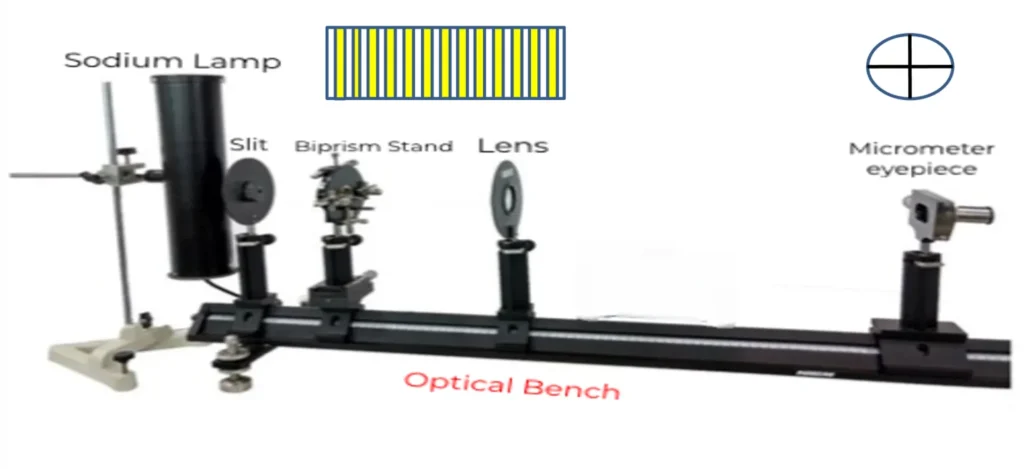
In the lab, the biprism is mounted on an optical bench alongside the following:
- A monochromatic light source (usually a sodium lamp or a laser), placed at one end
- A narrow slit (width ~0.1–0.5 mm), positioned close to the source, acts as a linear source
- The biprism, placed about 10–20 cm from the slit
- A micrometer eyepiece or screen is placed at the other end of the optical bench to observe fringes
- A convex lens is used to measure the separation between virtual sources
All components are carefully aligned along the same optical axis, ensuring a symmetric refraction geometry and clearly visible fringes.
3. ⚙️ Working Principle of Fresnel's Biprism:
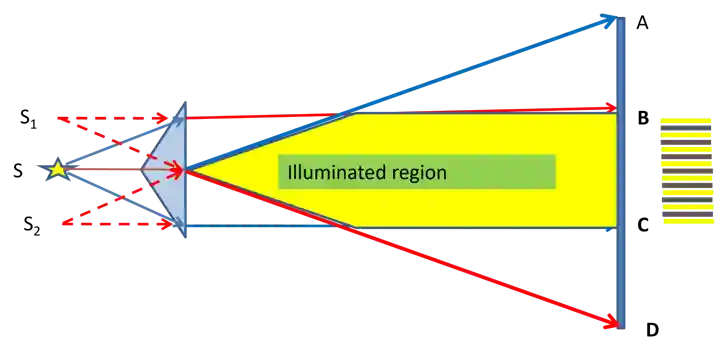
When monochromatic light from the source passes through the narrow slit, it diverges as a cylindrical wavefront. This wavefront strikes the biprism. The upper half of the biprism acts as a prism with its apex pointing upward—it refracts the incoming rays downward toward the central axis. The lower half does the reverse — it refracts rays upward.
The two refracted beams now travel toward the screen along slightly different directions, but they appear to originate from two point sources, S₁ and S₂, located behind the biprism. These are the virtual coherent sources—they come from the same original source (the slit), so they maintain a constant phase relationship.
As their wavefronts spread and overlap in the region between the biprism and the screen, they produce a steady pattern of alternating bright and dark fringes: constructive and destructive interference.
3.1. The Physics of Fringe Width:
When you look through a micrometer eyepiece at the interference zone, you see a series of alternate bright and dark bands called fringes. The distance between two consecutive bright (or dark) fringes is known as the Fringe Width (β). It is given by
$$\beta=\frac{\lambda D}{d} $$
Where:
- β = fringe width
- λ = wavelength
- D = distance between slit & screen
- d = separation between virtual sources
The stability of these fringes depends entirely on the precision of the optical bench alignment. This brings us to the mathematical heart of the experiment.
4. 🧮 Full Mathematical Framework:
Let d be the distance between the two virtual sources S1 and S2, and D be the distance between the slit and the eyepiece (the screen).
According to the theory of interference, the fringe width (β) is given by:
To determine λ, we rearrange the above equation:
Physical Significance: This equation tells us that if we can measure the width of the bands (β), the distance from the light to the screen (D), and the tiny gap between the invisible virtual sources (d), we can calculate the wavelength of light.
- Measurement of fringe width β:
Using a micrometer eyepiece, focus on the interference fringes on the screen. Move the eyepiece across a known number N of fringes (say, 10 or 20) and record the total distance X. The fringe width is:
Or using the following, we can find the fringe width: $$\beta = x_{n+1} – x_n$$
Where xn+1 = position of (n+1)th bright fringe and xn = position of nth bright fringe
2. Measurement of D (source to screen distance):
The distance D from the slit to the eyepiece is read directly from the optical bench scale:
$$D=b\sim a$$
Where,
b = the eyepiece’s position on the optical bench; a = the slit position on the optical bench
3. Measurement of d (separation between virtual sources):
A convex lens is inserted between the biprism and the eyepiece. For two positions of the lens, the eyepiece shows two real images of the virtual sources S₁ and S₂. Let:
- d1 = separation between images in the first lens position
- d2 = separation between images in the second lens position
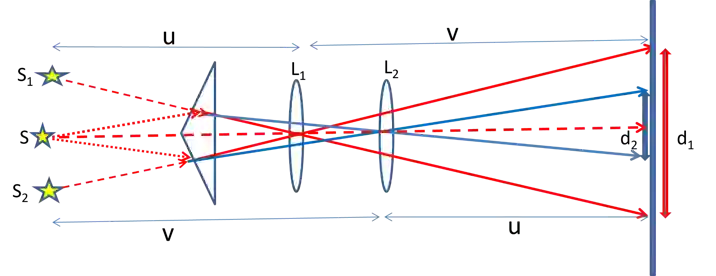
According to the linear magnification produced by the lens:
$$\frac{size\ of\ the\ image}{size\ of\ \ the\ object}=\frac{distance\ between\ image\ and\ lens}{distance\ between\ object\ and\ lens}$$
For the L1 position of the lens:
$$\frac{d_1}{d}=\frac{v}{u}\qquad ………….(3)$$
For the L2 position of the lens:
$$\frac{d_2}{d}=\frac{u}{v}\qquad ………….(4)$$
Now multiplying equation (3) and (4), we get
$$\frac{d_1}{d}\times \frac{d_2}{d}=\frac{v}{u}\times \frac{u}{v}$$
$$\Rightarrow d = \sqrt{d_1d_2}\qquad ………(5)$$
Substituting the values of β, D, and d into the equation. (2), which gives the wavelength directly.
4.2.✨ Determination of Thickness of Thin Film:
When a thin transparent film is placed in the path of one of the two beams, as shown in the following figure, it introduces an additional optical path difference because light travels more slowly inside the denser medium. Let t be the thickness and μ be the refractive index of the sheet.
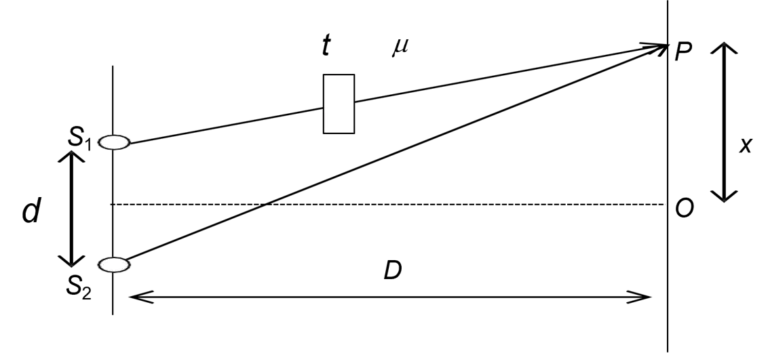
The time taken by the light wave to reach P from S1 is $$T=\frac{S_1P-t}{c}+\frac{t}{v}$$
$$\Rightarrow T=\frac{S_1P-t}{c}+\frac{\mu t}{c} \qquad{\left(Since\; \mu=\frac{c}{v} \right)} $$
$$\Rightarrow cT=S_1P+(\mu-1)t$$
The above equation is the effective path length in air from S1 to P.
Therefore, the effective path difference between S2P and S1P will then be given by
$$\Delta =S_2P-[S_1P+(\mu-1)t]$$
Let the point P be the center of the nth bright fringe; then the path difference should be equal to nλ. Hence $$S_2P-S_1P-(\mu-1)t=n\lambda\qquad ……….(6)$$
But when a thin sheet is not introduced, then $$S_2P-S_1P=\frac{y_nd}{D}$$
Hence eq. (6) becomes
$$\frac{y_nd}{D}-(\mu-1)t=n\lambda$$
$$\Rightarrow y_n=\left[(\mu-1)t+n\lambda\right]\frac{D}{d}\qquad …………(7)$$
Here, yn represents the distance of the nth bright fringe from the central fringe when a thin sheet is present.
But in the absence of a thin sheet, the distance of the nth bright fringe from the central fringe is given by
$$y_n^{‘}=\frac{n\lambda D}{d}$$
Therefore, the displacement of the nth bright fringe is given by
$$y= \left[ n\lambda+(\mu-1)t \right]\frac{D}{d}-\frac{n\lambda D}{d}$$
$$\Rightarrow y= \frac{D}{d}\left( \mu-1 \right)t\qquad ……….(8)$$
Since the above displacement equation has no order term, it indicates that all fringes are shifted by a distance y.
Using equation (7), we can determine the fringe width as follows:
$$\beta=y_{n+1}-y_n$$
$$\Rightarrow \beta=\left[(\mu-1)t+(n+1)\lambda\right]\frac{D}{d}
-\left[(\mu-1)t+n\lambda\right]\frac{D}{d}$$
$$\Rightarrow \beta=\frac{\lambda D}{d}$$
This indicates that the presence of a thin sheet does not change the fringe width.
If the displacement of the fringe pattern (y) is equal to the width of n fringes, then y = nβ. Now, using this value of y, equation (8) becomes
$$n\beta= \frac{D}{d}\left( \mu-1 \right)t$$
$$\Rightarrow n \frac{\lambda D}{d}= \frac{D}{d}\left( \mu-1 \right)t$$
$$\Rightarrow t = \frac{n\lambda}{\mu-1}\qquad ………..(9)$$
This is the thickness of the thin sheet. It is also given by using equation (8) as follows:
$$t= \frac{yd}{D\left( \mu-1 \right)}\qquad ………(10)$$
5. 🔁 Comparison: Fresnel's Biprism vs Young's Double-Slit Experiment (YDSE):
| S. No. | Feature | Fresnel's Biprism | Young's Double-Slit (YDSE) |
|---|---|---|---|
1. |
Method of creating coherent sources |
Refraction through biprism |
Diffraction through two slits |
2. |
Fringe brightness |
Brighter (more light utilised) |
Dimmer (most light blocked by screen) |
3. |
Source separation dd
d |
Fixed by prism geometry |
Fixed by slit spacing |
4. |
Ease of setup |
Slightly harder (precise alignment) |
Relatively simpler |
5. |
Fringe width formula |
β=λD/d |
β=λD/d (identical) |
6. |
Virtual or real sources |
Virtual (behind the biprism) |
Real (the slits themselves) |
7. |
Wavelength measurement |
Very accurate |
Accurate but less light |
8. |
Practical use |
Advanced optics labs |
Basic experiments |
6. 🔬 Applications of Fresnel’s Biprism:
The biprism is far more than a classroom curiosity. Its ability to produce stable, bright interference fringes from a single light source makes it a precision instrument in various optical and scientific applications.
1. Measurement of wavelength of light:
As derived above, the biprism provides one of the most direct and accurate methods for measuring the wavelength of monochromatic light sources—from sodium lamps to lasers. In research settings, this method achieves nanometer-level accuracy.
2. Measurement of thin-film thickness:
As shown in Eq. (9), the biprism enables sub-wavelength thickness measurements of thin transparent films.
3. Determination of refractive index of materials:
By placing a transparent material (liquid or glass slab) in one of the two beam paths and measuring the resulting fringe shift, the refractive index of the material can be calculated using Eq. (10).
4. Testing the coherence of light sources:
By observing the contrast (visibility) of fringes produced by the biprism with different light sources, scientists can quantitatively measure the coherence length of those sources
5. Demonstration and education in wave optics:
The Fresnel biprism is a standard laboratory instrument in undergraduate and postgraduate physics programs worldwide.
6. Testing Optical Flatness:
Engineers use the interference patterns to check if a lens or glass surface is perfectly flat.
7. 📌 Important Formulas in Fresnel Biprism:
| S. No. | Quantity | Formula | Meaning |
|---|---|---|---|
1. |
Fringe Width |
β = (λD)/d |
Distance between two consecutive fringes |
2. |
Wavelength |
λ = (βd)/D |
Used to calculate wavelength |
3. |
Thickness of Film |
t = (Δx·d)/((μ−1)D) |
Thin film thickness |
8. 🔍 Quick Answer Section:
1. What is Fresnel biprism interference?
Fresnel biprism interference is a wave optics phenomenon where a single light source produces two virtual coherent sources using a biprism. These sources overlap and create alternating bright and dark fringes on a screen, demonstrating the interference of light in a simple and effective experimental setup.
2. How does Fresnel biprism create coherent sources?
A Fresnel biprism refracts light from a single slit into two separate directions, forming two virtual images of the slit. Since both originate from the same source, they maintain a constant phase difference, making them coherent sources capable of producing stable interference patterns.
3. What is the fringe width formula in Fresnel biprism?
The fringe width formula in Fresnel biprism interference is given by β = (λD)/d. Here, λ is the wavelength of light, D is the distance between the biprism and screen, and d is the separation between virtual sources. This formula helps calculate the spacing between consecutive fringes.
4. How is wavelength measured using Fresnel biprism?
The wavelength of light is determined by measuring fringe width, source separation, and screen distance. Using the relation β = (λD)/d, the wavelength can be calculated precisely. This method is widely used in wave optics experiments for accurate wavelength determination.
5. How is Fresnel biprism different from Young’s double slit experiment?
Fresnel biprism uses a single slit to create two virtual coherent sources, while Young’s experiment uses two physical slits. Biprism setup is simpler and ensures better coherence, whereas YDSE requires precise alignment of two slits to achieve interference.
6. What is the illuminated region in Fresnel biprism?
The illuminated region is the area where refracted rays from the biprism overlap. Only in this region does interference occur, producing visible fringes. Outside this region, light does not overlap, so no interference pattern is observed.
9. 🧾 Conclusion:
The Fresnel biprism experiment is a masterpiece of optical design—simple in appearance, profound in implication. Here are the key takeaways:
It creates coherent sources through the division of the wavefront.
The experiment is used to measure wavelength (λ) and film thickness (t).
The virtual sources are found using the displacement method with a lens.
👉 In engineering and optics, this experiment forms the basis of many precision measurement techniques.
10. 📚 PYQs & Most Expected Exam Questions:
- Derive the expression for fringe width in a biprism experiment. How does it differ from YDSE?
If a thin glass plate is introduced in the path of one beam, why does the fringe pattern shift? Derive the formula for the shift.
Describe the “Displacement Method” used to determine the distance between the two virtual sources.
- Explain why the Fresnel biprism produces brighter fringes than Young’s double-slit experiment.
- What happens to the fringe width if the biprism is moved closer to the slit? Use the formula to justify your answer.
- Compare the Fresnel biprism and the YDSE.
- How is wavelength measured?
- Derive a formula for the thickness of a thin film.
11. 🧮 Solved Problems on Fresnel’s Biprism
1. How to calculate fringe width?
Question: In a Fresnel biprism experiment, the wavelength of light used is 600 nm. The distance between the virtual sources is 0.5 mm, and the distance between the biprism and the screen is 1 m. Calculate the fringe width.
✏️ Solution:
Given:
Since the fringe width:
Substituting values:
✅ Final Answer:
2. Determination of Wavelength:
Question:
In a Fresnel biprism experiment, the fringe width is 0.8 mm, the distance between the screen and the slit is 1.2 m, and the separation between virtual sources is 0.6 mm. Find the wavelength of light used.
✏️ Solution:
Given:
β=0.8 mm=0.8×10⁻³ m
D = 1.2 m
d = 0.6 mm = 0.6 × 10⁻³ m
Using the formula:
Substitute: $$\lambda=\frac{0.8\times 10^{-3}\times 0.6\times 10^{-3}}{1.2}$$
$$\lambda=0.4 \times 10^{-6}$$
✅ Final Answer: λ = 400 nm
3. Thin film thickness determination:
Question:
A thin glass plate of refractive index μ = 1.5 is inserted in one path of a Fresnel biprism setup, causing a fringe shift of 2 mm. If the distance between virtual sources is 0.4 mm and the distance to the screen is 1 m, find the thickness of the plate.
✏️ Solution:
Given: Δx = 2 mm = 2 × 10⁻³ m
d = 0.4 × 10⁻³ m
D = 1 m
μ = 1.5
Formula: $$t =\frac{\Delta x.d}{(\mu – 1)D}$$
Substitute: $$t = \frac{2 \times 10^{-3}\times 0.4\times 10^{-3} }{(1.5- 1)\times 1}$$
$$t = 1.6 \times 10^{-6} m$$
✅ Final Answer: t = 1.6 μm
12. ❓FAQs (People Also Ask)
Q1: What happens if I use white light in a Biprism experiment?
You will see a central white fringe surrounded by a few colored fringes. Eventually, the different colors overlap so much that the screen just looks uniformly illuminated.
Q2: Why is the biprism called a "wavefront division" device?
Because the single wave coming from the slit is physically split into two halves by the two different faces of the prism.
Q3: Is the fringe width the same for all colors?
No. Since β = λD/d, red light (longer λ) produces wider fringes than blue light (shorter λ).
Q4. What is Fresnel biprism experiment?
It is an interference experiment that uses a single slit to produce two virtual coherent sources.
Q5: What is the role of the slit in this experiment?
The slit acts as a point source that ensures the light hitting the biprism is spatially coherent.
Q6: Can we use a laser instead of a sodium lamp?
Yes, a laser is highly monochromatic and coherent, making the fringes incredibly sharp and easy to measure without a complex setup.
Q7. Why monochromatic light is used?
To get a clear and stable interference pattern.