
Why does doping a piece of silicon with a few boron atoms cause the variation of Fermi level inside the crystal? And why does heating the same semiconductor pull that invisible energy level back toward its intrinsic position? Understanding the variation of Fermi level makes semiconductor physics much easier to follow. Once you can track how the Fermi level shifts with doping and temperature, many concepts in semiconductor devices stop feeling like isolated formulas and begin to make logical sense.
Contents
Toggle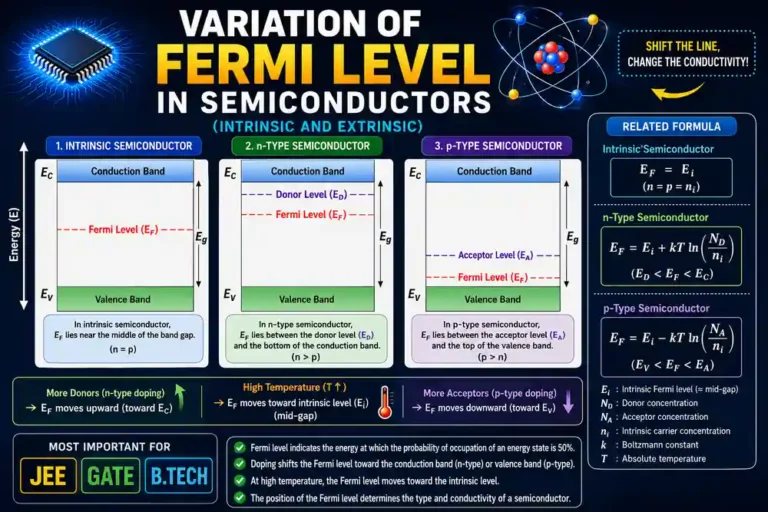
1. 🔍 Introduction
The Fermi level is one of the most important concepts in semiconductor physics because its position helps determine the carrier concentration and, therefore, the electrical conductivity of a semiconductor. The variation of Fermi level plays a central role in understanding how a semiconductor behaves under different physical conditions.
Unlike a fixed energy level, the Fermi level in a semiconductor changes mainly with temperature and doping. In an intrinsic semiconductor, the Fermi level lies approximately near the middle of the energy band gap. However, when the semiconductor is doped with donor or acceptor impurities, the variation in the Fermi level becomes more noticeable. In an n-type semiconductor, it shifts toward the conduction band, whereas in a p-type semiconductor, it moves toward the valence band.
Understanding the variation of Fermi level with doping and temperature is essential for explaining the following:
- The behaviour of n-type and p-type semiconductors
- Different temperature regions of semiconductor operation
- Changes in carrier concentration and electrical conductivity
- The working and performance of semiconductor devices
Once you understand how and why the Fermi level moves, many semiconductor concepts become easier to connect logically rather than simply memorize.
2. 🔬 Basic Concept of the Variation of Fermi Level
The Fermi level, denoted by (EF), is an important reference energy that determines the probability of occupation of electronic energy states.
In quantum physics, the Fermi-Dirac distribution function f(E) gives the probability that an available electron state at energy E is occupied by an electron at thermodynamic temperature T:
Where:
EF is the Fermi energy or Fermi level.
kB is the Boltzmann constant (1.38 × 10⁻²³ J/K or 8.617 × 10⁻⁵ eV/K).
T is the absolute temperature in Kelvin (K).
At absolute zero (T = 0 K):
For E < EF, f(E) = 1 (all states are filled).
For E > EF, f(E) = 0 (all states are empty).
At temperatures above absolute zero (T > 0 K), at E = EF:
Thus, the Fermi level is defined as the energy state at which the probability of electron occupancy is exactly 50% (0.5) at any non-zero temperature.
The important point is that the Fermi level is not necessarily fixed at one location inside the band gap. Its position depends mainly on:
- Temperature
- Impurity concentration
- Type of impurity
- Carrier concentration
Thus, the variation of the Fermi level provides a direct picture of how the electronic properties of a semiconductor are changing.
3. 📌 What Causes the Fermi Level to Move?
Imagine a seesaw with equal weight on both sides. It remains balanced near the center. This situation is similar to an intrinsic semiconductor, where electrons and holes are present in equal concentrations.
Now suppose additional electrons are introduced into the system. The electronic balance changes. In the same way, when donor impurities are added, the Fermi level shifts upward.
On the other hand, if holes become dominant because of acceptor impurities, the Fermi level shifts downward.
Therefore:
- More electrons → Fermi level moves toward the conduction band.
- More holes → Fermi level moves toward the valence band.
- Strong intrinsic behavior → Fermi level moves toward the intrinsic position.
This principle forms the basis of the behavior of intrinsic and extrinsic semiconductors.
4. 🌡️ Variation of Fermi Level in an Intrinsic Semiconductor
4.1🌡️ Effect of Temperature on the Intrinsic Fermi Level
In intrinsic semiconductors, the number of electrons in the conduction band is equal to the number of holes in the valence band. Due to this balance, the Fermi level lies approximately at the center of the energy band gap at absolute zero temperature.
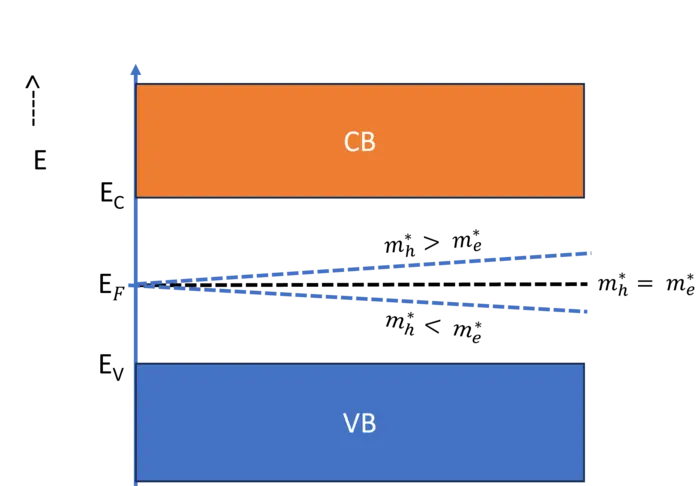
However, the position of the Fermi level is not completely fixed. With an increase in temperature, slight shifts may occur due to changes in carrier concentration and effective mass of electrons and holes. The variation of the Fermi level is shown in Figure 1.
The position of the intrinsic Fermi level is given by:
$$E_F=\frac{E_V+E_C}{2}+\frac{3kT}{4}log_e\left({\frac{m_h^*}{m_e^*}}\right)$$
where:
- me* = effective mass of electrons
- mh* = effective mass of holes
- k = Boltzmann constant
- T = absolute temperature
Interpretation of the Formula
- If T = 0k or mh* = me*, the second term becomes zero
→ Fermi level stays exactly at mid-gap. - If T > 0K and the hole’s effective mass is larger:
→ Fermi level shifts slightly toward the conduction band. - If T > 0 K and the electron effective mass is larger:
→ Fermi level shifts slightly toward the valence band
- If T = 0k or mh* = me*, the second term becomes zero
5.⚡ Variation of Fermi Level in Extrinsic Semiconductor
An extrinsic semiconductor is formed by adding a controlled amount of impurity atoms to a pure semiconductor. The variation of Fermi level in such a semiconductor depends mainly on doping concentration and temperature.
Increasing donor concentration shifts the Fermi level upward toward the conduction band in an n-type semiconductor, while increasing acceptor concentration moves it downward toward the valence band in a p-type semiconductor. Temperature also changes the carrier concentration, causing the Fermi level to gradually move toward the intrinsic level at sufficiently high temperatures.
The following sections explain these variations in detail for both n-type and p-type semiconductors.
5.1🌡️ Variation of Fermi Level with Temperature
In an extrinsic semiconductor, the position of the Fermi level changes with temperature because the dominant type of charge carriers changes as temperature increases.
5.1.1. In n-type semiconductors
In the n-type semiconductor, EF is given by
$$E_F = \frac{E_D+E_C}{2}+\frac{kT}{2}log_e\left( \frac{N_D}{N_C} \right)$$
It is clear that at T 0K, $$E_F = \frac{E_D+E_C}{2}$$
Hence, at T = 0K, the Fermi level lies between the donor level and the bottom of the conduction band.
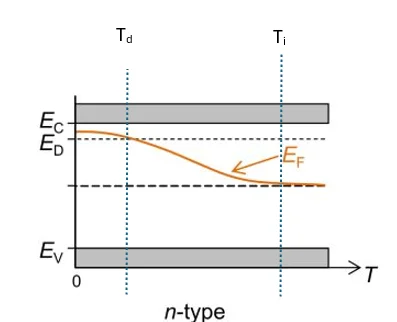
At very low temperatures, known as the depletion temperature region, most donor atoms are not ionized. Very few free electrons are present in the conduction band. In this region, the Fermi level lies close to the donor energy level, because electrons are still bound to donor atoms.
As the temperature increases to the extrinsic region, donor levels gradually get depleted, and almost all donor atoms become completely ionized. The electron concentration becomes approximately equal to the donor concentration (n≈ND). In this region, the Fermi level moves downward. At the depletion temperature (Td), the Fermi level coincides with the donor level.
When the temperature increases further and reaches the intrinsic region, thermal generation of electron–hole pairs becomes dominant over impurity carriers, and the Fermi level shifts downward approximately linearly.
At intrinsic temperature (Ti), the intrinsic carrier concentration becomes significant. The semiconductor loses extrinsic character and behaves like an intrinsic semiconductor.
As a result, the Fermi level moves away from the conduction band and shifts toward the middle of the forbidden energy gap, coinciding with the intrinsic Fermi level.
The variation of the Fermi level in n-type semiconductors with temperature is illustrated in the following figure:
5.1.2. In p-type semiconductor
The behavior of a p-type semiconductor is similar, but the direction of movement of the Fermi level is opposite.
In the p-type semiconductor, EF is given by
$$E_F = \frac{E_V+E_A}{2}+\frac{kT}{2}log_e\left( \frac{N_V}{N_A} \right)$$
It is clear that at T 0K, $$E_F = \frac{E_V+E_A}{2}$$
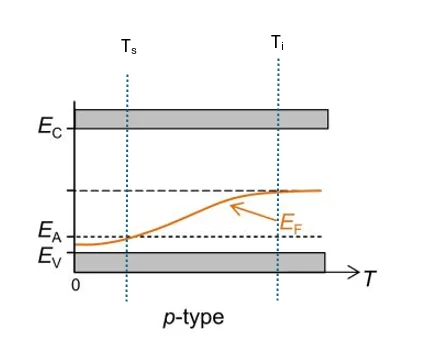
Hence, at absolute zero temperature (T = 0K), acceptor atoms are not ionized, and no holes are present in the valence band. The Fermi level lies between the acceptor level and the valence band.
As the temperature increases slightly (freeze-out region), some acceptor atoms ionize and create a small number of holes in the valence band. Since ionization is incomplete, the Fermi level remains close to the acceptor level.
As temperature increases (extrinsic region), the acceptor level gradually fills, and the Fermi level moves upward. At saturation temperature (Ts), almost all acceptor atoms are fully ionized, and the hole concentration becomes approximately equal to the acceptor concentration (p≈NA); the Fermi level coincides with the acceptor level.
For T > Ts, the Fermi level shifts upward approximately linearly. At intrinsic temperature (Ti), the semiconductor behaves intrinsically, and the Fermi level approaches the intrinsic value.
The variation of the Fermi level in p-type semiconductors with temperature is illustrated in the following figure:
5.2. 🧪 Variation of Fermi Level with Doping Concentration
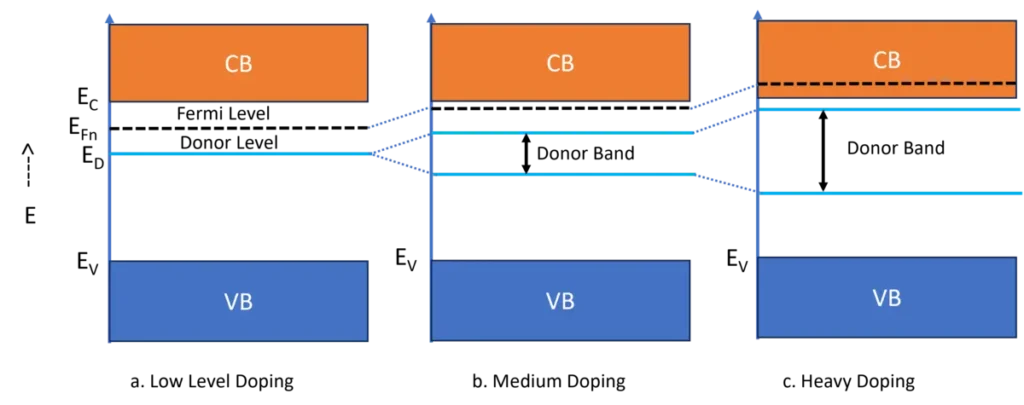
When impurity atoms are added (doping), the carrier concentration changes significantly, and consequently, the position of the Fermi level also shifts.
Thus, the position of the Fermi level is not fixed — it depends strongly on:
Type of impurity (donor or acceptor)
Magnitude of impurity concentration
Temperature
In this section, we discuss how the Fermi level varies with impurity concentration in both n-type and p-type semiconductors.
5.2.1. In n-type semiconductors
Consider an n-type semiconductor doped with a donor concentration ND. In the extrinsic region (moderate temperature and non-degenerate doping), the electron concentration is approximately:
$$n\approx N_D$$
Substituting it in the electron concentration equation:
$$N_D= N_C exp\left[ -\left( \frac{E_C-E_F}{kT} \right) \right]$$
Taking natural logarithm:
$$E_C-E_F =kTlog_e\left( \frac{N_C}{N_D} \right)$$
Thus:
$$E_F =E_C-kTlog_e\left( \frac{N_C}{N_D} \right)$$
As donor concentration ND increases, ln(NC/ND) decreases
Hence, EC – EF decreases; therefore, the Fermi level moves closer to the conduction band
Hence, in an n-type semiconductor, the addition of donor impurities creates discrete donor levels below the conduction band. As impurity concentration increases, donor levels broaden and may form an impurity band. With heavy doping, this band may overlap with the conduction band, and the Fermi level shifts closer to or into the conduction band.
5.2.2. In a p-type semiconductor
For a p-type semiconductor with acceptor concentration NA:
$$p\approx N_A$$
Using the hole concentration equation:
$$N_A= N_V exp\left[ -\left( \frac{E_F-E_V}{kT} \right) \right]$$
Taking natural logarithm:
$$E_F -E_V=kTlog_e\left( \frac{N_V}{N_A} \right)$$
As acceptor concentration NA increases, ln(NV/NA) decreases
- Hence, EF – EV decreases
- Therefore, the Fermi level moves closer to the valence band
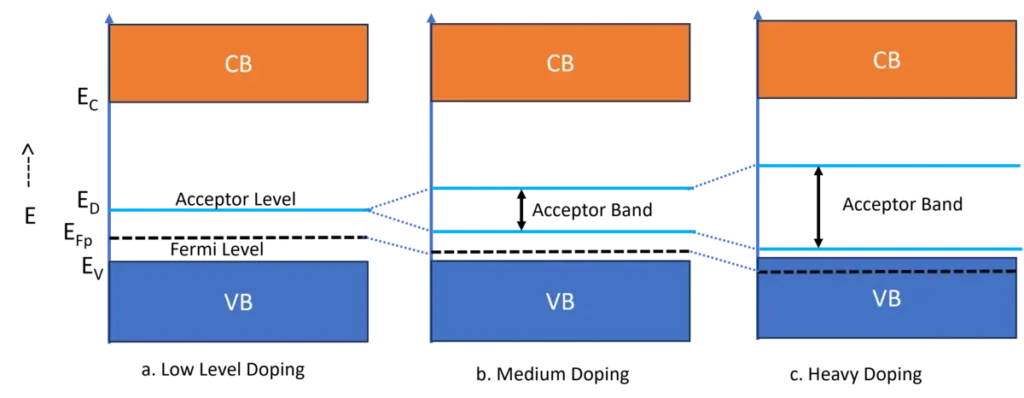
In a p-type semiconductor, acceptor levels broaden with increasing impurity concentration and may overlap with the valence band. The Fermi level shifts closer to the valence band and may enter it at very high doping levels.
The variation of the Fermi level in p-type semiconductors with impurity concentration is illustrated in the following figure:
6. Combined Effect of Temperature and Impurity Concentration
In the previous sections, we discussed the effect of temperature and impurity concentration on the Fermi level separately. In a real extrinsic semiconductor, however, both factors act simultaneously. The actual position of the Fermi level is therefore determined by the combined influence of doping concentration and temperature.
At low and moderate temperatures, the carriers introduced by donor or acceptor impurities strongly influence the semiconductor. Therefore, the impurity concentration mainly determines how far the Fermi level shifts from the intrinsic level. A higher donor concentration shifts the Fermi level closer to the conduction band, while a higher acceptor concentration shifts it closer to the valence band.
As the temperature increases, the semiconductor begins to generate a larger number of intrinsic electron–hole pairs. These thermally generated carriers gradually reduce the relative influence of the dopant atoms. As a result, even though the impurity concentration remains unchanged, the Fermi level starts moving back toward the intrinsic Fermi level.
Thus, the combined behaviour can be understood simply: doping determines the initial direction and extent of the Fermi-level shift, whereas temperature determines how strongly that doping effect is maintained as the semiconductor is heated.
Therefore:
At low temperature → impurity levels and their ionization strongly influence the Fermi level.
At moderate temperature → the dopant concentration largely controls the Fermi-level position.
At high temperature → intrinsic carrier generation becomes dominant, and the Fermi level moves toward the intrinsic level.
This combined effect explains an important practical point: a heavily doped semiconductor can maintain its extrinsic behaviour over a wider temperature range, whereas a lightly doped semiconductor becomes intrinsic more easily as the temperature rises. Thus, both temperature and impurity concentration must be considered together when predicting the behaviour of a semiconductor device.
| Factor | Effect on Fermi Level |
|---|---|
Increase in donor concentration |
Moves upward (toward CB) |
Increase in acceptor concentration |
Moves downward (toward VB) |
Increase in temperature (high T) |
Moves toward mid-gap |
Low temperature |
Moves toward impurity level |
7. 📊 Simulation: Fermi Level Position vs Doping Concentration & Temperature
📊 Interactive: Fermi Level Position vs Doping & Temperature
Silicon band diagram (Eg = 1.12 eV). Adjust doping type/concentration and temperature to see EF move.
8. 📊 Comparison: Intrinsic vs n-Type vs p-Type Fermi Level
| Parameter / Feature | Intrinsic Semiconductor | N-Type Semiconductor | P-Type Semiconductor |
|---|---|---|---|
Position at T = 0 K |
Exactly midway between Ec and Ev |
Exactly midway between Ec and Ed |
Exactly midway between Ea and Ev |
Room Temperature Position |
Close to middle: ≈ {Ec + Ev}/2 |
Just below Ec (near donor level) |
Just above Ev (near acceptor level) |
High Temperature Behavior |
Remains near the band center |
Drops downward toward E{Fi} |
Climbs upward toward E{Fi} |
Formula for EF |
(Ec + Ev)/2 + 3/4 (k T ln(mh*/me*)) |
Ec – k T ln(Nc/Nd) |
Ev + k T ln(Nv/Na) |
Effect of Doping Increase |
Not applicable |
Moves closer to Ec |
Moves closer to Ev |
9. 🔬 Physical Significance of Variation of Fermi Level
The variation of the Fermi level is physically important because it directly reflects changes in the carrier concentration and electrical behaviour of a semiconductor. By observing how the Fermi level shifts with temperature and doping, we can understand why a semiconductor becomes more or less conductive under different conditions.
This variation also helps engineers select an appropriate doping concentration to obtain the desired electrical properties for a particular device. The position of the Fermi level further indicates whether a semiconductor is behaving predominantly as intrinsic, n-type, or p-type material, helping define its operating region.
Most importantly, the variation of the Fermi level is fundamental to the analysis and design of semiconductor devices. It plays a crucial role in understanding p–n junction diodes, transistors, and other electronic devices, where the movement and relative position of the Fermi level determine carrier flow and overall device behaviour.
10.⚡ Quick Answer Section:
## Why does the Fermi level move toward the conduction band in n-type semiconductors?
Donor impurities provide additional electrons to the semiconductor. As the electron concentration becomes greater than the hole concentration, the equilibrium Fermi level shifts upward toward the conduction band to reflect the increased probability of electron occupation.
## Why is the Fermi level close to the valence band in a p-type semiconductor?
Acceptor impurities create a large concentration of holes. This makes holes the majority carriers and shifts the equilibrium Fermi level downward. Therefore, the Fermi level in a p-type semiconductor lies closer to the valence band.
## How does temperature affect the Fermi level of an extrinsic semiconductor?
At low temperature, incomplete impurity ionization strongly affects the Fermi level. In the moderate-temperature extrinsic region, the Fermi level is mainly controlled by dopant concentration. At high temperatures, intrinsic carrier generation dominates, and the Fermi level approaches the intrinsic position.
## What happens to the Fermi level when donor concentration increases?
As donor concentration increases, the electron concentration increases. The relation (EF – EFi = kT\ln(ND/ni)) shows that the Fermi level moves upward. Therefore, heavier n-type doping shifts the Fermi level closer to the conduction band.
## What happens to the Fermi level when acceptor concentration increases?
Increasing the acceptor concentration increases the hole concentration. As a result, the Fermi level shifts downward according to (EF – EFi = -kT ln(NA/ni)). Therefore, heavier p-type doping moves the Fermi level closer to the valence band.
## Can the Fermi level enter the conduction or valence band?
Yes. Under very heavy doping, a semiconductor can become degenerate. In such a case, the Fermi level may enter the conduction band for heavily doped n-type material or the valence band for heavily doped p-type material.
## Why does the Fermi level move toward mid-gap at high temperature?
Because thermally generated electron-hole pairs eventually outnumber the fixed dopant atoms, the crystal starts behaving intrinsically, and its Fermi level converges back to the intrinsic level.
11.🎓 PYQs / Most Expected Examination Questions
Short Answer Questions
- Define the Fermi level.
- Where does the Fermi level lie in an intrinsic semiconductor?
- Why does the Fermi level shift after doping?
- Where is the Fermi level located in an n-type semiconductor?
- Where is the Fermi level located in a p-type semiconductor?
- How does temperature affect the Fermi level?
Long Answer / Derivation Questions
- Derive the expression for the position of the Fermi level in an intrinsic semiconductor.
- Explain the variation of the Fermi level with temperature in an n-type semiconductor.
- Explain the variation of the Fermi level with temperature in a p-type semiconductor.
- Discuss the effect of impurity concentration on the Fermi level.
- Compare the position of the Fermi level in intrinsic, n-type and p-type semiconductors.
- Explain the freeze-out, extrinsic and intrinsic regions of a doped semiconductor.
- Derive expressions for the Fermi-level position in n-type and p-type semiconductors.
- Explain the variation of the Fermi level with temperature in extrinsic semiconductors.
 Very frequently asked in university examinations
Conceptual Questions
- Why does the Fermi level move toward the mid-gap at high temperature?
- Why is the Fermi level nearly constant in the extrinsic region?
Reference: A Textbook of Engineering Physics (S. Chand Publications) and AI
12. 🧮 Solved Numerical Problems
Problem 1: Intrinsic Fermi Level Offset
Question: Calculate the shift of the intrinsic Fermi level from the mid-gap of silicon at T = 300 K, given that the effective mass of holes is mh* = 0.56 mo and the effective mass of electrons is {me* = 1.08 mo. (kB = 8.617 × 10⁻⁵ eV/K).
Solution:
Given: T = 300 K, mh* = 0.56 mo, me* = 1.08 mo, kB = 8.617 × 10⁻⁵ eV/K.
Find: Δ E = EFi – Emid.
Calculation: Using Eq.:
Answer: The intrinsic Fermi level lies 12.7 meV below the middle of the bandgap.
Problem 2: Fermi Level Position in N-Type Silicon
Question: An n-type Silicon wafer is doped with Nd = 2 × 1016 cm-3 Phosphorus atoms at T = 300 K. Given that the effective density of states in the conduction band is Nd = 2 × 1016 cm-3, determine the location of the Fermi level relative to the conduction band edge EC.
Solution:
Given: Nd = 2 × 1016 cm-3, Nd = 2 × 1016 cm-3, kB T = 0.0259 eV at 300 K.
Find: (EC – EFn).
Calculation: Using Eq.
Answer: The Fermi level EFn lies 0.188 eV below the conduction band edge EC.
Problem 3: Shift in Fermi Level with Temperature in P-Type Material
Question: A p-type semiconductor has an acceptor concentration Na = 5 × 1015 cm-3 with NV = 1.04 × 1019 cm-3 at 300 K. Find the position of EFp relative to EV at 300 K.
Solution:
Given: Na = 5 × 1015 cm-3, NV = 1.04 × 1019 cm-3, kB T = 0.0259 eV.
Find: (EFp – EV).
Calculation: Using Eq.
Answer: The Fermi level EFp lies 0.198 eV above the valence band edge EV.
Problem 4: Identifying Semiconductor Type from Fermi-Level Shift
Question: At 300 K, a semiconductor has EF – EFi=+0.18 eV. Identify the type of semiconductor.
Solution: The positive sign means
$$E_F>E_{Fi}$$
Therefore, the Fermi level lies above the intrinsic level.
An upward shift indicates an increased electron concentration.
Answer: The semiconductor is n-type.
13. FAQs
1. What is the Fermi level in a semiconductor?
The Fermi level is the energy level at which the probability of finding an electron is 50% at absolute zero temperature.
2. Where is the Fermi level located in an intrinsic semiconductor?
In an intrinsic semiconductor, the Fermi level lies approximately at the center of the energy band gap.
3. Where is the Fermi level in an n-type semiconductor?
In an n-type semiconductor, the Fermi level shifts closer to the conduction band.
4. What happens to the Fermi level with heavy doping in n-type materials?
With heavy doping, the Fermi level moves even closer to the conduction band and may enter it in extreme cases.
5. Where is the Fermi level in a p-type semiconductor?
In a p-type semiconductor, the Fermi level shifts closer to the valence band.
6. How does doping affect the Fermi level?
Doping shifts the Fermi level toward the conduction band (n-type) or valence band (p-type).