
Whenever you pick up your TV remote and point it at the screen, something almost magical happens in a fraction of a millisecond—a tiny semiconductor device on your television captures invisible infrared light, converts it into a precise electrical signal, and faithfully executes your command.
That device is a photodiode, and it is quietly present in billions of gadgets around you: smartphones, medical sensors, fiber-optic networks, digital cameras, and even spacecraft.
At its heart, a light detector answers one of the most elegant questions in all of physics: how does light become electricity? The answer lies in the quantum nature of light and the extraordinary properties of semiconductor p-n junctions.
Once you understand the photodiode, you have a window into quantum mechanics, solid-state physics, and cutting-edge photonics all at once.
In this comprehensive guide, you will learn
- How is a photosensor constructed?
- How does it convert photons into current?
- The mathematics governing its behavior,
- The major types available to engineers and
- Why it matters in fields ranging from autonomous vehicles to cancer diagnostics.
Whether you are preparing for an examination or designing a real system, this article has you covered.
Contents
Toggle🕰️ Historical Background of Photodiode
When Albert Einstein, in his landmark 1905 paper, explained the photoelectric effect by introducing the concept of the photon, a discrete packet of light energy.
This breakthrough laid the foundation for modern optoelectronic devices. Photodiodes emerged later with semiconductor technology advancements, becoming essential in optical communication and sensing systems.
Practical semiconductor photodiodes emerged in the 1940s and 1950s alongside the development of transistor technology at Bell Laboratories. By the 1960s, the PIN photodiode had been developed for high-speed applications, and the 1970s brought the avalanche photodiode (APD) for ultra-sensitive detection.
Today, photodetectors operate across the electromagnetic spectrum from ultraviolet to far infrared, and their descendants — image sensors — have replaced photographic film in virtually every camera on Earth.
📖 What Is a Photodiode?
A photodiode is a light-sensitive two-terminal semiconductor device that operates mainly in reverse bias and is designed to convert light (photons) into electrical current.
A photodiode is also called a photodetector, photosensor, or light detector.
Unlike a regular p-n junction diode, whose primary job is to conduct current in one direction, a photodiode is deliberately optimized to interact with light. This widens the depletion region and makes the device extremely sensitive to incoming photons.
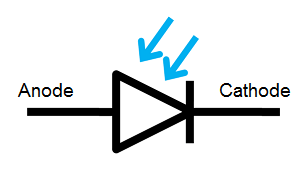
Symbol of a Photodetector—
🏗️ Construction and Structure of a Photodiode
The physical construction of a photodetector is carefully engineered to maximize the light absorption, efficiency, and response speed.
A typical photodetector consists of:
- p-type semiconductor
- n-type semiconductor
- Wide depletion region (for better light absorption)
- Transparent window for light entry
- Metal contacts
Let us walk through the key structural elements.
📌 Semiconductor Material (Defines Sensitivity Range)
The semiconductor material determines which wavelengths of light the photodiode can detect. Silicon is commonly used for visible and near-infrared light, while materials such as germanium and InGaAs extend detection into the infrared. For ultraviolet sensing, GaN and SiC are preferred.
👉 The key condition is simple:
Only photons with energy greater than the band gap can generate current.
📌 Antireflection Coating (Improves Efficiency)
A significant portion of light can reflect off the surface of a photodetector, reducing its performance. To solve this, a thin antireflection coating is applied using materials like silicon nitride or titanium dioxide.
This coating minimizes reflection and allows as much light as possible to enter the device, improving sensitivity and efficiency.
📌 Optical Window & Packaging (Protection + Precision)
Photodetectors are enclosed in protective packages with transparent windows made of glass or sapphire. These windows allow light to pass through while protecting the internal structure from dust and moisture.
In high-precision systems, a microlens is added to focus light directly onto the active region, improving accuracy.
📌 Metal Contacts (Electrical Connection)
Metal contacts are used to connect the photosensor to external circuits. These are typically made of aluminum or gold.
On the light-facing side, the contact is designed as a thin grid or ring so it does not block incoming light, ensuring both good conductivity and high optical efficiency.
⚙️ Types of Photodetectors Based on Structure
The designs of different photodetectors are developed to improve performance parameters like speed, sensitivity, and efficiency. Let’s explore each type.
🔹 p-n Photodiode (Basic & Cost-Effective)
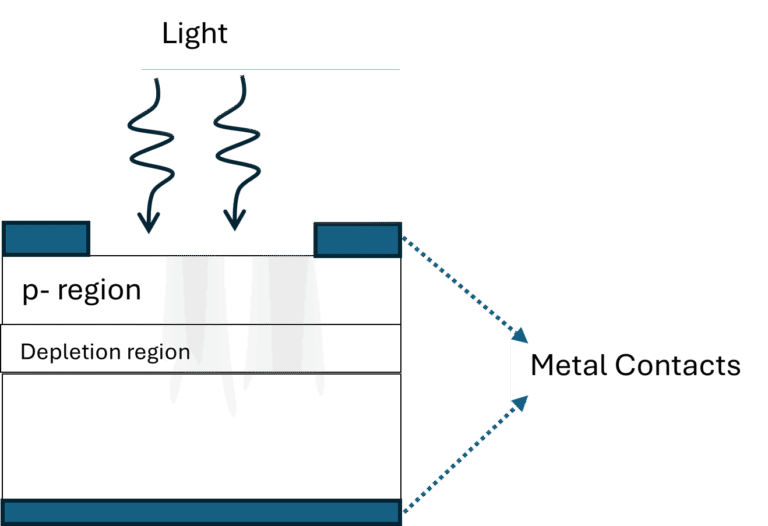
The p-n photodiode is the simplest form and serves as the foundation for understanding all other types. It consists of a thin p-type layer placed over an n-type semiconductor. The structure is shown in the following figure.
The depletion region formed at the junction is relatively narrow, which limits the amount of light that can be effectively absorbed. If light is absorbed outside this region, charge carriers must diffuse to the junction, which slows down the response.
Because of its simple design and low cost, this type is widely used in basic applications such as remote controls, light sensors, and alarm systems.
🔹 PIN Photodiode (High Speed & High Efficiency)
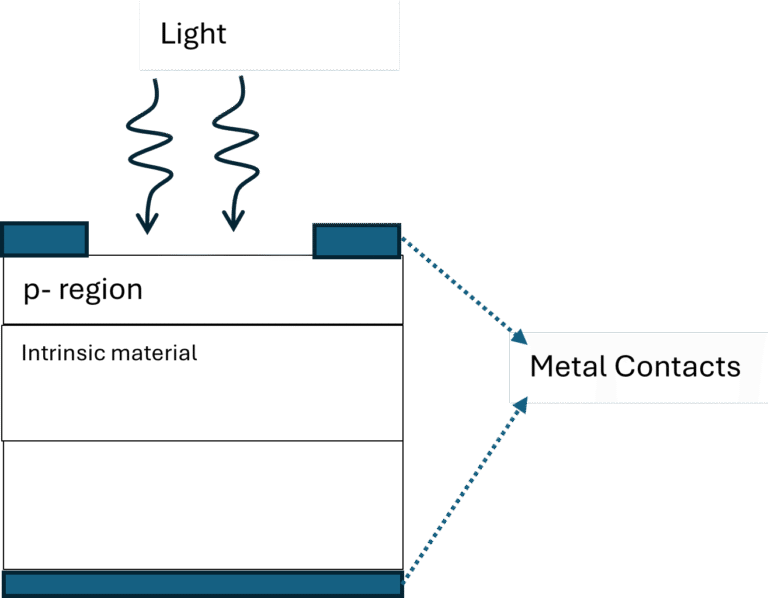
The PIN photodiode introduces an intrinsic (undoped) layer between the p and n regions, which significantly enhances performance. The structure is shown in the following figure.
This intrinsic layer acts as a wide depletion region, allowing more photons to be absorbed directly where charge separation is efficient. As a result, both sensitivity and speed improve dramatically.
Additionally, the wider depletion region reduces capacitance, enabling operation at very high frequencies, making the PIN light detector ideal for optical communication systems.
🔹 Avalanche Photodiode (Ultra-Sensitive Detection)
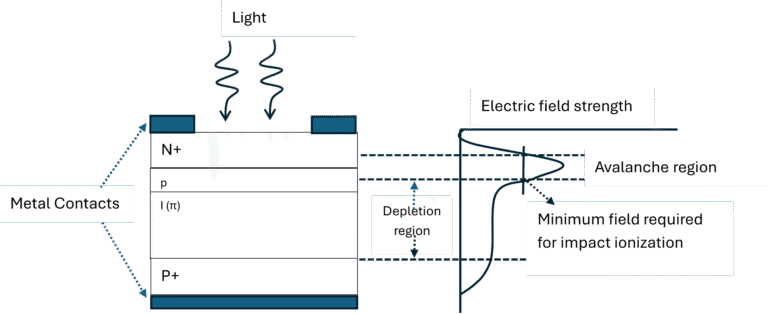
The avalanche photodiode (APD) is designed for applications requiring extremely high sensitivity. It includes a special high electric field region where charge multiplication occurs. The structure is shown in the following figure.
When electrons enter this region, they gain enough energy to generate additional electron-hole pairs through collisions. This creates an avalanche effect, amplifying the signal internally.
Although APDs are highly sensitive, they require higher operating voltages and careful design to control noise and ensure stable performance.
🔹 Schottky Photodiode (Ultra-Fast Response)
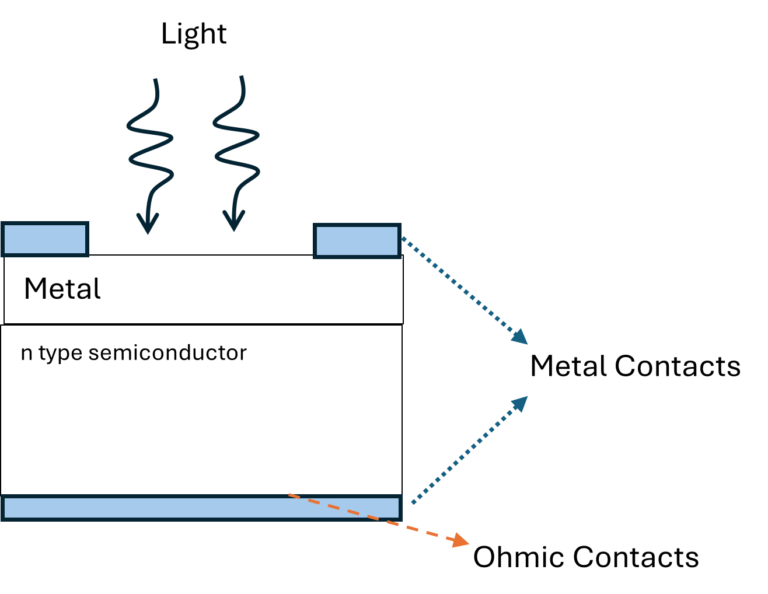
The Schottky photodiode replaces the traditional p-n junction with a metal–semiconductor interface, resulting in extremely fast response times. The structure is shown in the following figure.
Since it operates using majority carriers only, there is no delay due to charge storage. This allows the device to respond almost instantly to changes in light intensity.
Because of this unique property, Schottky light detectors are used in high-speed optical systems, ultrafast measurements, and advanced communication technologies.
⚙️ Working Principle of Photodiode
The depletion layer expands when a reverse bias is implemented because mobile carriers are carried away to their respective majority sides. The diode’s reverse leakage current is caused by the movement of minority charge carriers.
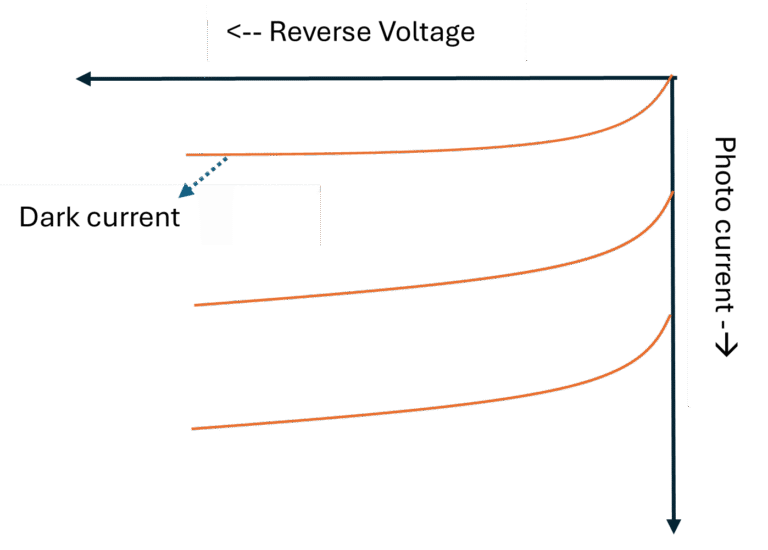
Therefore, there is a tiny leakage current even in the absence of light radiation. This is called “dark current.” The magnitude of dark current is contingent upon the reverse bias voltage, series resistance, and ambient temperature.
The operation of a light detector can be summarized in the following three distinct phases, when the diode is illuminated with light:
🔹 Photon Absorption
When light enters the semiconductor, photons transfer their energy to electrons. If the photon energy is sufficient (hυ ≥ Eg), electrons jump from the valence band to the conduction band, leaving behind holes. This process generates electron-hole pairs, which are essential for current production.
However, absorption does not occur uniformly throughout the material. As light travels deeper, its intensity gradually decreases. The distance at which the intensity drops to about 37% of its original value is known as the absorption depth (δ), given by
🔹 Carrier Separation
The depletion region contains a strong electric field that immediately acts on the generated charges. Electrons are driven toward the n-side, while holes move toward the p-side.
This separation occurs very quickly, preventing carrier recombination. Efficient separation ensures that the maximum generated charges contribute to the current.
🔹 Current Flow
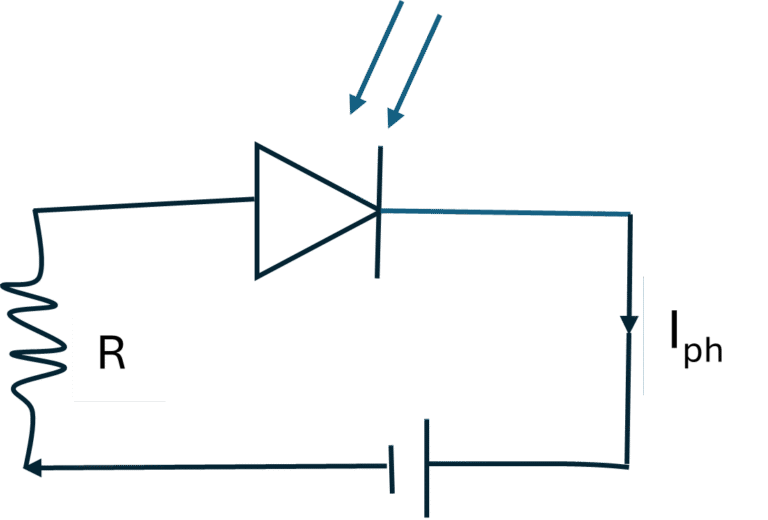
As charge carriers are separated, electrons accumulate on the n-side and holes on the p-side, creating a potential difference across the device. When the photodiode is connected to an external circuit—typically under reverse bias—this separation leads to a flow of electrons through the external path.
Electrons move from the n-side through the external circuit toward the p-side, which corresponds to a conventional current flowing from p to n. This current is known as the photocurrent (Iph
An important point to note is that this photocurrent flows in the opposite direction to the normal forward diode current. As a result, in the I–V characteristics of a photodetector, the photocurrent appears in the reverse bias region, specifically in the third quadrant.
📊 Quick Comparison of Photosensor Types
| Type of Photodiode | Key feature | Speed | Sensitivity | Application |
|---|---|---|---|---|
|
p-n Photodiode |
Simple structure |
Medium |
Moderate |
Sensors |
|
PIN Photodiode |
Wide depletion region |
High |
High |
Fiber Optics |
|
Avalanche Photodiode |
Internal gain |
High |
Very High |
Low-light detection |
|
Schottky Photodiode |
No charge storage |
Ultra High |
Moderate |
High-speed systems |
 I–V Characteristics of Photodetector
The illumination I-V characteristics of the photodetector are shown in the following figure.
 Mathematical Analysis of Photodetector
The total current through a photosensor is the superposition of the normal diode dark current and the photocurrent. When illuminated, it is given by $$I=I_{dark}-I_{ph}$$
Where, $$I_{dark}=I_s \left[ exp\left( \frac{eV}{\eta kT} \right)-1 \right]$$
A photodetector’s quantum efficiency, responsivity, dark current, and bandwidth are its main attributes. The number of electron-hole pairs produced for each incident photon of energy hv is known as the “quantum efficiency,” and it is determined by
$$\eta=\frac{number \ of \ electron-hole \ pairs\ generated}{number\ of\ incident\ photons}$$
$$\eta=\frac{I_{ph}/q}{P_{in}/h\upsilon}$$
$$\eta=\frac{I_{ph}h\upsilon}{P_{in}q}$$
The performance of a photodiode is characterized by the responsivity R, which quantifies the photocurrent generated per unit optical power. It is given by
$$R=\frac{I_{ph}}{P_{in}}$$
Here, Iph is the output photocurrent in amperes, and Pin is the incident optical power in watts.
🌍 Real-World Engineering Applications
Optical Fiber Communications: PIN photodiodes act as the receivers at the end of fiber optic cables, converting light pulses back into high-speed electrical data.
Medical Pulse Oximetry: By measuring how much red and infrared light passes through a finger, photodiodes help calculate blood oxygen levels.
Safety Light Curtains: In manufacturing, photodiodes detect when a person’s hand breaks a light beam, instantly stopping dangerous machinery.
Consumer Electronics: Every time you use a TV remote, an infrared photosensor in the TV “reads” the blinking patterns to change the channel.
Smoke Detectors: Optical smoke detectors use a photodiode to sense light scattered by smoke particles entering a chamber.
- Light Sensors: Automatic street lights and camera exposure systems use photodiodes.
- Barcode Scanners: Detect reflected light to read codes.
⚠️ Common Misconceptions & Clarifications
| Misconceptions | Clarifications |
|---|---|
|
More voltage → more photocurrent |
Photocurrent depends on light intensity, not voltage |
|
It behaves like a solar cell |
Solar cells generate power, photodiodes detect light |
🎯 Important Questions (Exam-Oriented)
- Define a photodetector and explain its working principle.
- Derive the current equation of a photosensor.
- Draw and explain the I–V characteristics of a photodetector.
- Compare PN, PIN, and avalanche photodiodes.
- Explain the role of the depletion region in photosensor operation.
✅ Conclusion
- A photodiode is a light-sensitive semiconductor device
- It converts light into electrical current efficiently
- Operates mainly in reverse bias
- Current is directly proportional to light intensity
- Widely used in communication, sensing, and medical systems
👉 Final Thought:
In modern engineering, photodetectors act as the “eyes” of electronic systems—quietly translating light into meaningful electrical information.
❓ FAQs (People Also Ask)
-
1. What is a photodiode used for?
A photodetector is used to detect light and convert it into electrical signals in sensors and communication systems.
-
2. Why is photodiode reverse biased?
Reverse bias increases the depletion region, improving sensitivity and response time.
-
3. What is dark current in photodiode?
It is the small current flowing in the absence of light.
-
4. What is the difference between photodiode and LED?
A photosensor detects light, while an LED emits light.
-
5. What is responsivity of photodiode?
Responsivity is the ratio of photocurrent to incident light power.