
Visit:  https://smartstudyzone.in
For High-Quality, More Free Study Notes
Contents
Toggle1. 🔬 Introduction to CO₂ Laser
The CO₂ laser is a gas laser that uses carbon dioxide as its active medium. It is one of the most powerful and efficient lasers used today. CO₂ lasers are widely used in industries, medical surgeries, scientific research, and defense applications because they can produce a very strong and focused laser beam.
These lasers are commonly used for cutting metals, engraving materials, welding machine parts, and fabric cutting with high precision. Unlike visible lasers, the CO₂ laser produces invisible infrared radiation, but its beam is powerful enough to melt and cut hard materials accurately.
By the end of this article, you will completely understand:
- How a CO₂ laser is constructed,
- What happens inside the gas discharge tube at the molecular level,
- Why nitrogen and helium are added to the gas mixture,
- What the energy level diagram looks like and what each transition means physically,
- Their key characteristics and where they are used in the real world.
- You will also find solved numerical examples, PYQs, exam tips, and a live interactive simulation.
Let’s get into it.
2. 📜 Historical Background of CO₂ Lasers
The CO₂ laser was developed in 1964 by the Indian-American physicist Kumar Patel at Bell Laboratories. Its discovery was a turning point in photonics. Before the CO₂ laser, gas lasers like the He-Ne laser were famous but lacked the power for heavy industrial use.
Patel’s innovation shifted the focus from electronic transitions in atoms to vibrational-rotational transitions in molecules. This shift unlocked a much higher power output, making it the first laser capable of continuous-wave (CW) operation at kilowatt levels.
3. ⚙️ Basic Concept of Laser
Before diving into the CO₂ laser specifically, let’s quickly refresh the foundational principles that make any laser work. The word “LASER” stands for “Light Amplification by Stimulated Emission of Radiation.”
A laser works mainly through the following three important processes:
- Absorption: An atom or molecule in the ground state absorbs a photon and jumps to a higher energy state.
- Spontaneous emission: The excited species randomly drops back down, releasing a photon in a random direction—this is ordinary fluorescence or glow.
- Stimulated emission: An incoming photon encounters an already-excited atom and triggers it to emit a second photon that is perfectly in phase, same wavelength, same direction, and same polarisation as the incident photon. This is the key to laser action.
For the laser action, the system must achieve the following:
- Population inversion
- Stimulated emission
- Optical feedback
The CO2 laser is a gas laser where the active medium is a mixture of gases instead of solid materials.
3.1. ⚡Definition of CO₂ Laser
A CO2 laser is a gas laser in which carbon dioxide molecules act as the active medium and produce intense infrared radiation mainly at a wavelength of 10.6 μm.
It is known for:
- High efficiency
- High output power
- Continuous wave operation
- Excellent beam quality
4. 🧱 Construction of the CO₂ Laser
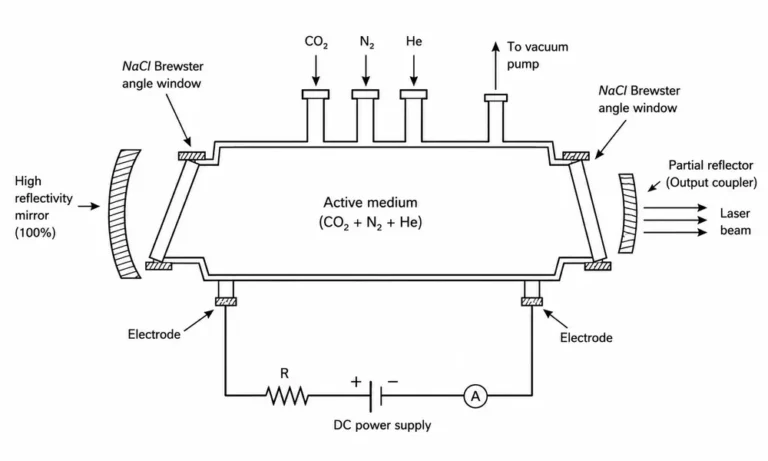
The construction of a CO₂ laser is a masterpiece of thermal management and optical precision. To produce a high-power, stable beam, the following components are essential:
The Discharge Tube: A long quartz or heat-resistant glass tube (a few centimeters to 1 or 2 meters long) contains the gas mixture.
Active Medium: The active medium is a gas mixture of:
- Carbon dioxide (CO₂)
- Nitrogen (N₂)
- Helium (He)
Each gas plays a specific role in generating laser light. The typical ratio is roughly 1:2:3 or 1:2:8.
The Brewster Windows:
The ends of the discharge tube are not sealed with flat glass. Instead, they are fitted with Brewster windows—plates made of infrared-transmissive materials like Zinc Selenide (ZnSe) or Sodium Chloride (NaCl).
These windows are set at a specific angle (the Brewster angle, roughly 67.4° for ZnSe).
Why they matter: They eliminate reflection losses for p-polarized light, ensuring the resulting laser beam is linearly polarized. This is vital for industrial cutting, as polarized light interacts more consistently with metallic surfaces.
Energy Source (Pumping): A high-voltage DC power supply or RF (Radio Frequency) source is used to excite the gas molecules.
Optical Resonator: It is a pair of mirrors placed at the ends of the tube. One is fully reflecting (usually gold-coated or silicon), and the other is partially reflecting (made of germanium or zinc selenide) to let the laser beam escape.
Cooling System: Since CO₂ lasers generate significant heat, the tube is usually water-jacketed to keep the gas cool and maintain efficiency.
5. Modes of Vibration in CO₂ Molecules
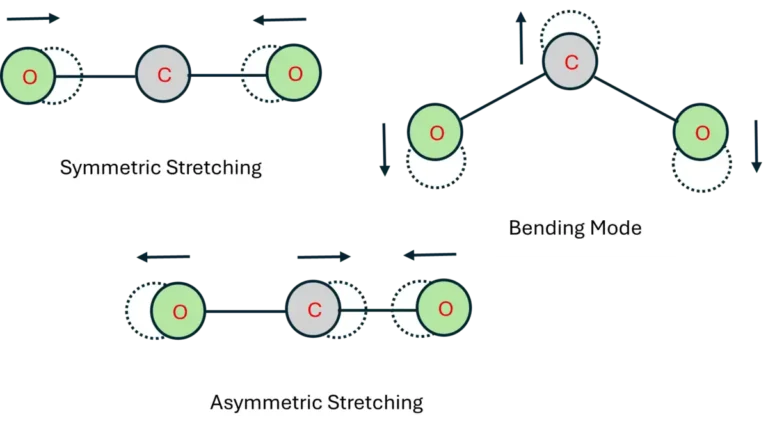
The working of the CO₂ laser depends on the vibrational energy levels of CO₂ molecules. It exhibits three important vibrational modes:
Symmetric Stretching: Both oxygen atoms move symmetrically outward and inward along the molecular axis while the carbon remains stationary.
Bending Mode: The molecule bends, with the carbon moving perpendicular to the molecular axis while the oxygens deflect in the opposite direction, and it is the lowest-energy vibrational mode.
Asymmetric Stretching: One oxygen moves toward the carbon while the other moves away, and the carbon atom moves in the opposite direction. This mode is mainly responsible for laser action.
6. Energy Level Diagram of CO₂ Laser:
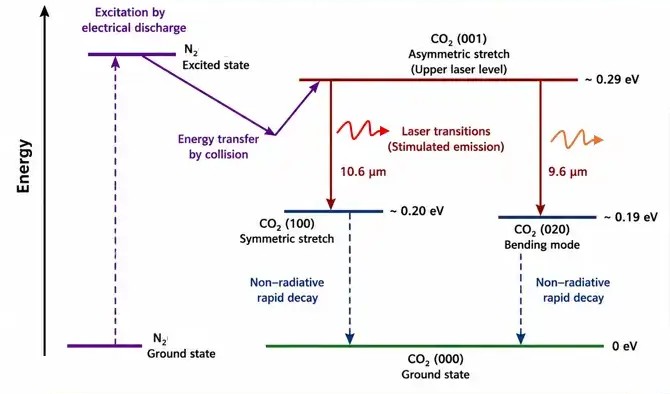
The diagram below shows the energy levels and key transitions in the CO₂ laser system. Its working depends on the vibrational energy levels of CO₂ molecules.
7. ⚙️ Working Principle of CO₂ Laser
Here is the step-by-step mechanism of the CO₂ laser’s operation. Each step flows naturally into the next, forming an elegant chain from electrical input to coherent infrared output.
7.1. Electrical Excitation:
When a high-voltage electrical discharge is applied across the gas mixture, free electrons are accelerated through the gas. These electrons preferentially collide with N₂ molecules, exciting them to a long-lived “metastable” state, because nitrogen molecules have a particularly large cross-section for this type of electron-impact vibrational excitation.
7.2. Energy Transfer:
Excited N₂ molecules collide with ground-state CO₂ molecules. Their energy is transferred efficiently because the energy levels are nearly identical. This excites CO₂ molecules to a higher vibrational state (001) (asymmetric stretch level).
7.3. Population Inversion:
In this way, more CO₂ molecules accumulate in the upper energy state (0,0,1) than in the lower state. Because it is a metastable state for CO₂ molecules.
Thus, population inversion is achieved between the (001) upper level and the (100) or (020) lower levels.
7.4. Stimulated Emission:
When a photon of appropriate energy passes through the medium, it triggers an excited CO₂ molecule of the (001) level to drop to a lower energy state (100) or (020). This produces a second, identical photon. The two photons go on to trigger two other excited CO₂ molecules and so on. In this way, stimulated emission started.
When the excited photon drops to level (100), it produces a light of 10.6 μm, and when it drops to level (020), it emits a photon of 9.6 μm.
7.5. The Role of the Brewster Window:
As the laser light starts moving back and forth inside the discharge tube, it passes through the Brewster windows placed at both ends of the tube.
The Brewster window is kept at a special angle called the Brewster angle. At this angle, only light vibrating in one particular direction (plane-polarized light) can pass through easily without reflection loss.
7.6. Optical Amplification:
These polarized lights bounce back and forth between the two mirrors of the optical resonator. With each pass through the active medium, more stimulated emission events occur, and the light intensity amplifies exponentially.
7.7. Laser Output:
When the round-trip gain exceeds the round-trip losses, laser oscillation is sustained. A fraction of the circulating intensity leaks through the partially transparent output coupler (mirror) as the usable laser beam.
7.8. The Role of Helium:
After stimulated emission, CO₂ molecules in the lower level must quickly return to the ground state so that the population inversion is maintained. This happens primarily through collisions with He atoms, which accept their vibrational energy.
The helium then hits the water-cooled walls of the discharge tube, dissipating the heat and allowing the CO₂ molecule to return to the ground state.
The cycle then repeats: ground-state CO₂ molecules get pumped back to the upper level via N₂ collisions, and the laser continues to oscillate.
8. CO₂ Laser Parameters:
In the study of molecular lasers, the performance of the laser is defined by specific physical parameters.
8.1. Wavelength and Photon Energy:
The energy difference between the upper laser level CO₂ (001) and the primary lower laser level (100) determines the wavelength of the emitted photon.
If Eupper is the energy of the asymmetric stretch state (001) and Elower is the energy of the symmetric stretch state (100), the energy of the emitted is:
$$E = E_{upper}-E_{lower}$$
The relationship between photon energy, frequency, and wavelength is given by Planck’s equation: $$E = h\nu = \frac{hc}{\lambda}$$
8.2. Small-Signal Gain Coefficient:
The gain parameter determines how much the light is amplified as it passes through the gas mixture. It depends on the population difference between the excited and lower states.
The small-signal gain coefficient G(ν) for a laser transition at frequency ν is:
$$G(\nu) = \left( N_2-N_1 \right)\times \sigma(\nu)$$
Here,
N₂ = population density of the upper laser level,
N₁ = population density of the lower laser level, and
σ(ν) = stimulated emission cross-section at frequency ν.
Laser action requires G(ν) > 0, meaning population inversion (N₂ > N₁) must be established.
8.3. Laser Output Power and Efficiency:
The output power of a CO₂ laser is roughly proportional to the gain medium volume and the electrical input power. The overall (wall plug) efficiency η is defined as: $$\eta=\frac{P_{out}}{P_{in}}$$
This efficiency can be further decomposed as a product of three sub-efficiencies:
- The quantum efficiency ηq (ratio of photon energy to pump energy quantum),
- the excitation efficiency ηe (fraction of electrical energy that successfully excites N₂), and
- the extraction efficiency ηx (fraction of stored energy that is extracted as laser light)
$$\eta= \eta_q\times\eta_e\times\eta_x$$
The quantum efficiency alone is high and is given by $$\eta_q=\frac{Energy\;of\;laser\;transition}{Energy\;of\;pumping\;level}$$
8.4. Condition for Population Inversion (Rate Equation Approach):
In steady-state operation, the rate of change of population in the upper level N₂ must be zero:
$$\frac{dN_2}{dt}=R_{pump}-A_{21}\cdot N_2-B_{21}\cdot \rho\cdot N_2 + B_{12}\cdot \rho\cdot N_1 = 0$$
where,
Rpump = pumping rate (proportional to N₂* of excited nitrogen and the collision rate),
A₂₁ = Einstein A coefficient for spontaneous emission from the upper level,
B₂₁ = Einstein B coefficients for stimulated emission
B₁₂ = Einstein B coefficients for absorption, and
ρ = radiation energy density
Population inversion (N₂ > N₁) is maintained as long as R_pump is large enough relative to the decay rates.
8.5. The Brewster Angle:
As we discussed in the construction, the orientation of the windows is a vital geometric parameter. To ensure zero reflection loss for polarized light, the window must be set at the Brewster angle (θB), calculated using the refractive index (n) of the window material (e.g., zinc selenide): $$tan(\theta_B) = n$$
9.⚖️ Comparison with Other Lasers
| S. No. | Feature | CO₂ Laser | Nd:YAG Laser | He-Ne Laser | Diode Laser |
|---|---|---|---|---|---|
1. |
Wavelength |
10.6 μm (IR) |
1064 nm (near-IR) |
632.8 nm (visible) |
630–1550 nm |
2. |
Type |
Gas (molecular) |
Solid-state |
Gas (atomic) |
Semiconductor |
3. |
Efficiency |
10–20% |
1–3% |
<0.1% |
30–70% |
4. |
Power Output |
~100 kW |
~10 kW (lamp-pumped) |
<50 mW |
~1 kW (bars) |
5. |
Metal cutting |
Excellent |
Good |
Not suitable |
Limited |
10.✅ Advantages and Limitations of CO₂ Laser:
10.1.✅ Advantages of CO₂ Laser:
- Very high efficiency
- High output power
- Continuous operation possible
- Excellent beam quality
- Suitable for industrial machining
- Long operational life
10.2.✅ Limitations of CO₂ Laser:
- Large size
- Infrared beam is invisible
- Requires cooling systems
- Expensive setup
- Mirrors must be precisely aligned
11.🚀 Applications of CO₂ Laser:
- Industrial Cutting and Welding: CO₂ lasers can cut thick metals accurately with minimal material wastage.
- Medical Surgery: Used in delicate surgeries because it causes less bleeding and high precision.
Textile Industry: Used for fabric cutting and engraving designs.
Scientific Research: Used in spectroscopy and molecular studies.
Military Applications: Used in range finding and target designation systems.
12. Quick Answer Section
What is CO2 laser?
A CO2 laser is a gas laser that uses carbon dioxide molecules as the active medium to produce powerful infrared radiation at 10.6 μm wavelength. It is widely used in industries for cutting, welding, and engraving due to its high efficiency and output power.
Why is nitrogen used in a CO2 laser?
Nitrogen molecules absorb electrical energy efficiently and transfer it to carbon dioxide molecules through collisions. This process helps achieve population inversion and improves laser efficiency significantly.
What is the wavelength of CO2 laser?
The CO₂ laser emits primarily at 10.6 micrometers (μm) in the mid-infrared region. A secondary line at 9.6 μm is also available. These wavelengths are invisible to the human eye and highly effective for cutting, surgery, and materials processing.
What is the efficiency of CO₂ laser?
CO₂ lasers achieve wall-plug efficiencies of 10–20%, which is the highest among major laser types. This exceptional efficiency arises from the near-perfect energy resonance between the nitrogen (N₂) vibrational level and the CO₂ asymmetric stretch upper laser level, enabling highly efficient energy transfer from the electrical discharge to the laser output.
Who invented the CO₂ laser and when?
The CO₂ laser was invented by C. Kumar N. Patel at Bell Telephone Laboratories in 1964. Patel discovered that a mixture of CO₂, N₂, and He, excited by an electrical discharge, could produce powerful laser action in the mid-infrared region.
Why is helium used in a CO₂ laser?
Helium serves two key purposes in a CO₂ laser. First, it rapidly de-excites the lower laser levels of CO₂ through collisions, preventing population buildup there and maintaining a strong population inversion. Second, helium’s high thermal conductivity conducts waste heat from the discharge region to the tube walls, stabilising the discharge and preventing thermal runaway.
What are the modes of vibration of CO₂ molecule??
The CO₂ molecule has three fundamental vibrational modes: (1) symmetric stretching, where both oxygens move symmetrically along the axis; (2) bending, a doubly degenerate mode where the molecule flexes perpendicular to its axis; and (3) asymmetric stretching, where one oxygen moves toward the carbon while the other moves away.
What is the use of Brewster window in co2 laser?
The Brewster window in a CO₂ laser is mainly used to produce a plane-polarized laser beam and to reduce loss of light inside the laser cavity.
When light passes through the Brewster window at a special angle called the Brewster angle, light vibrating in one particular direction passes through without reflection. This minimizes energy loss inside the laser system.
13. 🧠 Conclusion
The CO2 laser is one of the most powerful and efficient gas lasers ever developed. Its unique gas mixture, excellent energy transfer mechanism, and high output power make it extremely valuable in modern industries, medicine, and scientific research.
From cutting thick metal sheets to performing precise surgeries, the CO2 laser demonstrates how physics can transform real-world technology. Understanding its construction, working principle, and applications not only helps students score well in exams but also provides insight into one of the most practical achievements of laser physics.
14. 📝PYQs / Most Expected Questions
- Explain the construction and working of CO2 laser.
- Draw and explain the energy level diagram of CO2 laser.
- What is the role of nitrogen in CO2 laser?
- Compare CO2 laser with Nd:YAG laser.
- Explain population inversion in CO2 laser.
- Write advantages and applications of CO2 laser.
- Why is helium added to the gas mixture?
- Derive the expression for photon energy emitted in a laser.
- What are the three modes of vibration of the CO₂ molecule? Which mode acts as the upper laser level?
- Explain the role of each gas (CO₂, N₂, He) in the operation of the CO₂ laser.
15. Solved Numericals
15.1. How to calculate the wavelength of laser light?
Question: A CO₂ laser transition involves an energy gap of 0.117 eV. Calculate the wavelength of the emitted radiation.
Solution:
Given: E = 0.117 eV = 0.117 × 1.6 × 10-19 J
Find: λ
Using $$\lambda = \frac{hc}{E}$$
$$ \lambda = \frac{6.626 \times 10^{-34} \times 3 \times 10^8}{0.117 \times 1.6 \times 10^{-19}} $$
Result: The wavelength is 10.6 micrometers.
15.2. How to calculate the efficiency of CO2 laser?
Question: If a CO₂ laser consumes 5000W of electrical power to produce a 750W laser beam, what is its wall-plug efficiency?
Solution:
Given: Pin = 5000 W, Pout = 750 W
Find: Efficiency (%)
Result: The efficiency is 15%.
15.3. How to calculate the frequency of radiation emitted by CO2 laser?
Question: Calculate the frequency of radiation emitted by a CO₂ laser having a wavelength of 10.6 μm.
Solution:
Given: λ = 10.6 × 10⁻⁶ m
c = 3 × 10⁸ m/s
Find: Frequency ν
Using: $$\nu=\frac{c}{\lambda}$$
Substituting values: $$\nu=\frac{3 × 10^8}{10.6 × 10^{-6}} $$
$$\nu=2.83\times 10^{-13}\;Hz$$
Result: $$\nu=2.83\times 10^{-13}\;Hz$$
16. Exam Tips for Students to Score High
- Always draw a neat labeled diagram.
- Mention the role of each gas separately.
- Write wavelength values correctly.
- Explain population inversion and working clearly.
- Use headings and bullet points in answers.
- Practice numerical problems regularly.
- Learn the energy transfer mechanism properly.
17. ❓ FAQs (People Also Ask)
Is the CO₂ laser beam visible?
No, it is in the far-infrared region. Operators use a secondary low-power red He-Ne laser as a "pilot beam" to see where the CO₂ laser is pointing.
What gases are used in CO2 laser?
CO2, nitrogen, and helium gases are used in CO2 laser.
Why is CO2 laser highly efficient?
It has efficient energy transfer between nitrogen and carbon dioxide molecules, leading to efficiency as high as 30%.
Which gas acts as active medium in CO2 laser?
Carbon dioxide gas acts as the active lasing medium in CO2 laser.
Why are mirrors used in CO2 laser?
Mirrors provide optical feedback and amplify stimulated emission inside the resonator cavity.