
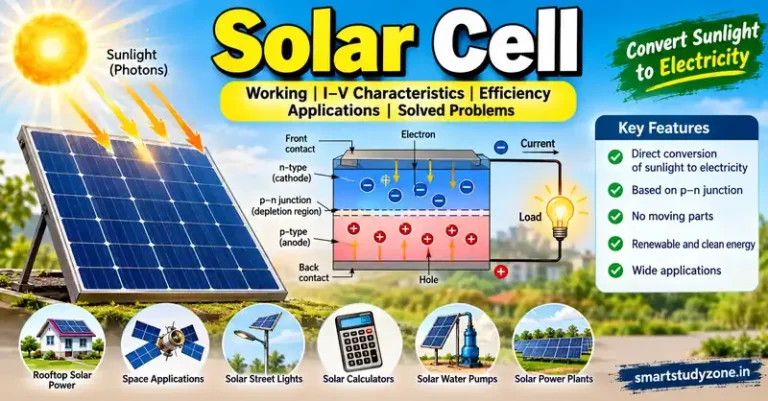
A solar cell is an electronic device that converts sunlight directly into electrical energy through the photovoltaic effect. Unlike a conventional generator, it does not require rotating machinery. It uses the energy carried by sunlight photons to produce an electric current.
Solar cells have become an important part of modern renewable-energy technology. They are used in rooftop power systems, satellites, streetlights, solar-powered pumps, and large solar farms. Their operation depends on fundamental concepts of semiconductor physics, particularly the formation of a p–n junction, the generation of electron–hole pairs, and the movement of charge carriers.
In this article, we will examine the construction and working principle of a solar cell, understand the photovoltaic effect, derive its important equations, study its I–V characteristics, and calculate its efficiency using solved numerical problems.
Contents
Toggle🕰️ Historical Background of Solar Cell
The foundation of solar cell technology lies in the photovoltaic effect, first observed by Edmond Becquerel in 1839. However, practical solar cells were developed much later.
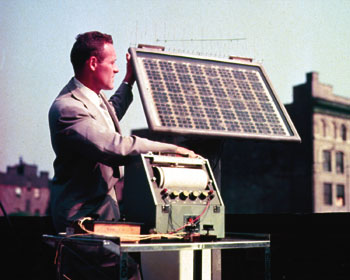
In 1954, scientists at Bell Labs created the first efficient silicon solar cell. This marked the beginning of modern solar energy technology.
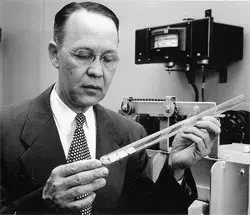
Today, PV cells power satellites, homes, and even entire cities, making them a cornerstone of sustainable engineering.
☀️ What is a solar cell?
A solar cell (also called a photovoltaic cell or PV cell) is a specialized semiconductor diode that directly converts electromagnetic radiation from the sun into electrical energy through the photovoltaic effect.
Most conventional solar cells are made from silicon and contain a p–n junction. When sunlight falls on the device, photons with sufficient energy generate electron–hole pairs. The internal electric field in the junction separates these charge carriers, creating a potential difference and enabling current to flow through an external circuit.
A single cell typically produces a relatively small voltage. Therefore, manufacturers connect multiple cells in series or parallel to construct solar modules and arrays that meet practical power requirements.
⚡Basic principle of a solar cell
The working of a solar cell is based on the photovoltaic effect.
When light of suitable energy falls on a semiconductor, it can transfer energy to electrons. Some electrons move from the valence band to the conduction band, leaving holes behind. The junction’s internal electric field helps separate these charge carriers, reducing their immediate recombination and enabling an external current.
The overall energy conversion is
A useful analogy is a water pump that creates a pressure difference to drive water through a pipe. In a solar cell, the junction’s electric field separates charges, while the voltage developed across the terminals drives current through an external load.
🔧 Construction and Structure of a Solar Cell
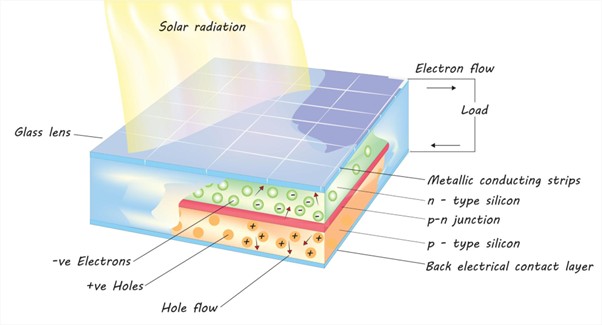
At the heart of a photovoltaic cell lies a p–n junction, formed by joining two types of semiconductor materials—p-type and n-type silicon.
The p-type layer, which is usually very thin and placed at the top, is designed to allow sunlight to pass through easily. This layer contains a high concentration of holes (positive charge carriers).
Just beneath it lies the n-type substrate, which is relatively thicker and provides structural support as well as a rich supply of electrons (negative charge carriers).
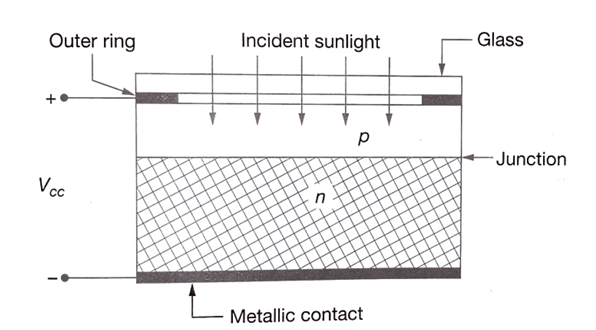
The interface between these two regions forms a depletion layer that creates an internal electric field, which is essential for separating charge carriers.
Metal contacts are added to both sides of the cell to collect and transport the generated current to an external circuit.
To minimize the loss of incident light due to reflection, an anti-reflection coating is applied on the surface, and the entire structure is covered with a transparent protective layer to shield it from environmental damage.
Among all materials, silicon (Si) is most commonly used because of its suitable electronic properties, durability, and availability.
⚡ Working of Solar Cell
The heart of a photovoltaic cell’s operation lies in three simultaneous processes: Absorption, Separation, and Collection.
1. Photon Absorption
Sunlight enters the PV cell through an anti-reflection coating, usually made of silicon nitride, which helps reduce light loss.
When a photon with enough energy (equal to or greater than the band gap) strikes the semiconductor, it excites an electron from the valence band to the conduction band.
This process leaves behind a hole, and together they form an electron–hole pair.
2. Carrier Separation
When this electron–hole pair is generated near the depletion region, the built-in electric field of the p–n junction immediately acts on it.
The electron is pushed toward the n-type side, while the hole moves toward the p-type side.
This separation of charges is what converts light energy into electrical potential.
3. Collection and External Current
The separated charges are then collected by metal contacts before they can recombine.
Electrons flow through the external circuit, supplying power to a device, and eventually return to the p-side to recombine with holes.
This movement of charges results in a continuous electric current.
🖼️ I-V Characteristics of Solar Cell
The current–voltage (I–V) characteristic describes how the output current of a solar cell changes with its terminal voltage under specified illumination and temperature.
The I-V characteristics of the photovoltaic cell are shown in the following figure.
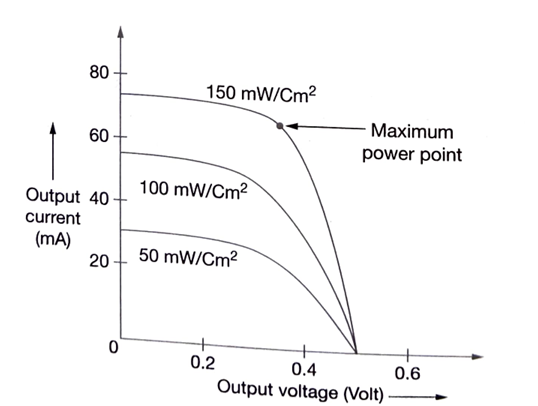
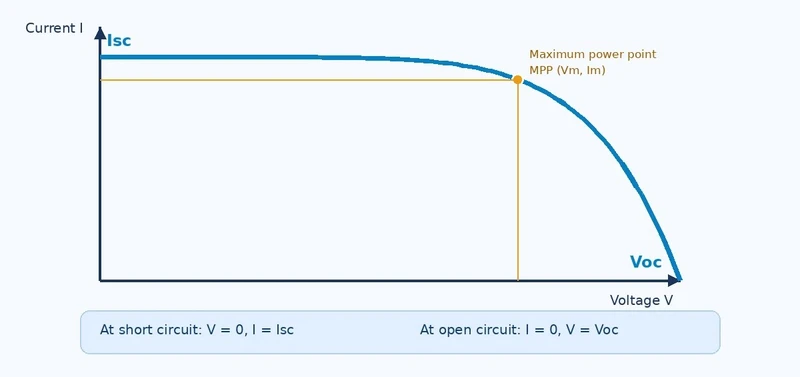
The graph contains three important operating points.
Short-circuit current (\(I_{\text{SC}}\)): The current at zero terminal voltage.
Open-circuit voltage (\(V_{\text{OC}}\)): The voltage when terminal current is zero.
Maximum power point (MPP): The operating point at which the product \(VI\) reaches its maximum value.
At short circuit, current is maximum, but output power is zero because voltage is zero. At open circuit, voltage is maximum, but output power is zero because current is zero. Between these two limits, the cell can supply useful electrical power.
The maximum power point lies near the bend, or knee, of the I–V curve. Practical photovoltaic systems use maximum power point tracking (MPPT) to adjust the operating point as sunlight and temperature change.
Effect of sunlight intensity:
When irradiance increases, more photons are available for absorption. Consequently, the photocurrent and short-circuit current generally increase approximately in proportion to irradiance under normal operating conditions.
Open-circuit voltage also increases, but approximately logarithmically with photocurrent in the ideal model. The increase in current is usually more pronounced than the increase in voltage.
Effect of temperature:
For a typical silicon solar cell, an increase in temperature generally causes the open-circuit voltage to decrease. Short-circuit current may rise slightly, but this usually does not compensate for the voltage loss.
As a result, the maximum power output and conversion efficiency often decrease at higher cell temperatures. This is one reason why adequate ventilation and correct module installation matter.
📐 Mathematical Analysis of Solar Cell
When light illuminates the photovoltaic cell, it generates a photocurrent IL that flows in the opposite direction to the forward diode current.
By superposition (valid for the ideal model), the current in a solar cell is given by: $$I = I_L – I_D\quad………… (1)$$
Where:
- IL: Light-generated current
- ID: Diode current
From the diode equation: $$I_D = I_S\left[exp\left(\frac{eV}{\eta kT}\right)-1\right]\quad……….(2)$$
Substituting Eq. (2) into Eq. (1), we obtain the ideal photovoltaic cell I-V equation: $$I =I_L- I_S\left[ exp\left( \frac{eV}{\eta kT} \right)-1 \right]\quad…….(3)$$
Open Circuit Voltage:
When no external current flows (I = 0, the open-circuit condition), all the photocurrent is “absorbed” by the internal diode. Setting I = 0 in Eq. (3):
$$0 =I_L- I_S\left[ exp\left( \frac{eV_{OC}}{\eta kT} \right)-1 \right]$$
Rearranging to isolate the exponential term:
$$exp\left( \frac{eV_{OC}}{\eta kT} \right)=\frac{I_L}{I_S}+1$$
Taking the natural logarithm of both sides and rearranging:
$$V_{OC}=\frac{\eta kT}{e}log_e\left(\frac{I_L}{I_S}+1 \right) $$
Hence, Voc increases logarithmically with the ratio IL / IS. A larger photocurrent (more light) OR a smaller dark saturation current (better material quality) both increase Voc.
For silicon cells, Voc typically ranges from 0.55–0.72 V under standard test conditions (1000 W/m² illumination, 25°C).
This result has a beautiful physical meaning: Voc is the forward voltage that the illuminated junction must build up to exactly cancel the photocurrent with its own forward diode current.
Short-Circuit Current:
When the external terminals are short-circuited (V = 0), the exponential term in Eq.(3) equals zero, and the entire photocurrent appears as terminal current: $$I=I_{SC}=I_L$$
For an ideal cell, ISC equals the photogenerated current IL exactly.
In real cells, ISC is slightly less due to series resistance and surface recombination losses, but the approximation ISC ≈ IL is widely used.
Output Power and Fill Factor
The output power P at any operating point is:
$$P=VI=V.\left\{I_L-I_S\left[ exp\left( \frac{eV}{\eta kT} \right)-1 \right] \right\}\quad ……….(4)$$
To find the maximum power point (Vmp, Imp), we differentiate Eq.(4) with respect to V and set dP/dV = 0. This yields a transcendental equation that must generally be solved numerically. The maximum power is:
$$p_{max}= V_{mp} \times I_{mp}\quad …………(5)$$
Fill Factor:
The Fill Factor (FF) is an important parameter that tells us how efficiently a solar cell converts the available voltage and current into usable power. In simple terms, it measures how “square” the I–V curve of a PV cell is.
Fill Factor is defined as the ratio of the maximum power output to the product of open-circuit voltage and short-circuit current:
$$FF= \frac{P_{max}}{I_{SC}\times V_{OC}}=\frac{V_{mp}\times I_{mp}}{I_{SC}\times V_{OC}}$$
FF is dimensionless, ranging from 0 to 1. For high-quality silicon cells, FF ≈ 0.75–0.85.
Losses due to series resistance (Rs) and shunt resistance (Rsh) degrade the fill factor. A low FF is often the first indicator of a cell defect in quality control.
Power Conversion Efficiency:
The power conversion efficiency (η) of a solar cell is the ratio of maximum output power to the incident solar power Pin:
$$\eta= \frac{P_{max}}{P_{in}}=\frac{I_{SC}\times V_{OC}\times FF}{P_{in}}$$
If the irradiance is \(G\) and the active cell area is \(A\), the incident power is
🔋 Types of solar cells
Solar cells can be classified according to their semiconductor material and device structure.

These cells are made from single-crystal silicon. They generally offer high efficiency and good power output per unit area. Their manufacturing process is relatively energy-intensive, and their cost depends on production scale and market conditions.

These cells contain silicon made up of multiple crystal grains. Historically, they offered a lower-cost alternative to monocrystalline cells, although monocrystalline technology now dominates many markets.

Thin-film devices use a thin layer of photovoltaic material. Examples include cadmium telluride (CdTe), copper indium gallium selenide (CIGS), and amorphous silicon. Some designs are lightweight or flexible.

Gallium arsenide (GaAs) has useful optical and electronic properties. It is used in high-performance photovoltaic applications, particularly space systems, where efficiency and performance under demanding conditions can justify higher material costs.

Perovskite-based absorbers have attracted considerable research interest because they can absorb light strongly and can be processed using several low-temperature methods. Long-term stability, large-scale manufacturing, and environmental considerations remain important development challenges.
Factors Affecting Solar Cell Performance
- Light Intensity: An increase in sunlight intensity directly increases the current produced by the solar cell.
- Temperature: As temperature rises, the efficiency of the solar cell decreases due to increased internal losses.
- Energy Band Gap: The band gap of the material determines which wavelengths of light can be absorbed and converted into electricity.
- Surface Reflection: Reflection losses reduce performance, but they can be minimized using an anti-reflection coating.
Advantages of Solar Cell
- Solar cells use a renewable source of energy, making them sustainable.
- They are environmentally friendly and do not produce pollution during operation.
- Since there are no moving parts, maintenance requirements are minimal.
- Solar cells have a long operational life, often lasting for decades.
Limitations of Solar Cell
- The initial installation cost of solar cells is relatively high.
- Their efficiency depends on the availability of sunlight.
- A large surface area is required to generate significant power output
Applications of Solar Cell

Rooftop solar modules supply electricity to homes, schools, offices and industrial buildings. Grid-connected systems can reduce the amount of electricity purchased from the grid.

Solar arrays generate electricity for onboard instruments, communication equipment, and spacecraft systems. Space applications often require high reliability and careful thermal design.

Photovoltaic systems can drive pumps for irrigation and water supply, especially in rural areas where grid electricity may be unreliable or unavailable.

Solar modules charge batteries during daylight. The stored energy can power lights at night, making the arrangement useful in roads, parks and remote locations.

Small photovoltaic cells power or supplement the power supply of calculators, outdoor sensors, and selected portable equipment.
These applications demonstrate why the solar cell is an important practical example of semiconductor physics. A microscopic process involving photons and charge carriers can be scaled into systems that supply electricity to buildings, farms, and spacecraft.
Comparison: Solar Cell vs LED
| Features | Solar Cell | LED |
|---|---|---|
Energy Conversion |
Light → Electrical |
Electrical → Light |
Biasing |
No external bias needed |
Forward bias required |
Principle |
Photovoltaic effect |
Electroluminescence |
📝 Quick answers: People Also Ask
# What is the basic principle of a solar cell?
A solar cell works on the photovoltaic effect, in which a semiconductor converts incident light into electrical energy. Absorbed photons generate electron–hole pairs, and the internal electric field of the junction helps separate these charges. When an external circuit is connected, the separated charges produce a usable electric current.
# Which semiconductor is commonly used in solar cells?
Silicon is the most widely used semiconductor in conventional solar photovoltaic modules. Its useful electronic properties, abundance, and mature manufacturing processes make it suitable for large-scale electricity generation. Other materials, including cadmium telluride, copper indium gallium selenide, gallium arsenide, and perovskite absorbers, are also used or researched.
# Why is a p–n junction used in a solar cell?
A p–n junction establishes a built-in electric field in its depletion region. This field helps separate photo-generated electrons and holes before they recombine. The resulting charge separation supports the development of a terminal voltage and allows the cell to deliver electrical current through an external circuit.
# Can a solar cell work without direct sunlight?
Yes. A solar cell can generate electricity from diffuse daylight, including on cloudy days, because some sunlight still reaches the cell. Its output usually falls when irradiance decreases. Indoor artificial light can also produce a response, but useful power depends on the light spectrum, intensity and cell design.
# What is the difference between a solar cell and a solar panel?
A solar cell is a single photovoltaic device that converts light into electricity. A solar panel or module contains multiple interconnected cells enclosed in a protective structure. Connecting modules into larger arrays increases the voltage, current, and power available for residential, commercial, and industrial systems.
# Why does solar cell efficiency decrease at high temperatures?
For a typical silicon solar cell, higher temperature increases the semiconductor’s intrinsic carrier concentration and generally increases its diode saturation current. This tends to reduce the open-circuit voltage. Although short-circuit current may increase slightly, the voltage reduction often dominates, lowering maximum power and conversion efficiency.
# What is the fill factor of a solar cell?
The fill factor is the ratio of maximum electrical power to the product of open-circuit voltage and short-circuit current. It indicates how effectively the cell’s I–V curve delivers power. A higher fill factor generally reflects a better-shaped curve and lower resistive losses, although it also depends on cell design and operating conditions.
🧮 Solved numerical problems on solar cells
Numerical 1: Calculate solar cell efficiency
Question: A solar cell has a maximum output voltage of 0.48 V and a maximum output current of 3.2 A. Its active area is 0.015 m2. If the incident irradiance is 800 W/m2, calculate its conversion efficiency.
Solution:
Given:
Find: Efficiency, \(\eta\).
Maximum electrical power:
Incident optical power:
Therefore,
Answer: The solar cell has a conversion efficiency of \(12.8\%\).
Numerical 2: Determine fill factor
Question: A solar cell has an open-circuit voltage of \(0.64\,\text{V}\), a short-circuit current of \(4.5\,\text{A}\), and a maximum output power of \(2.16\,\text{W}\). Calculate the fill factor.
Solution:
Given:
Find: Fill factor, \(FF\).
Using
Substituting the values,
Expressing it as a percentage,
Answer: The fill factor is \(0.75\), or \(75\%\).
Numerical 3: Calculate maximum power
Question: The maximum power point of a solar cell occurs at a voltage of \(0.42\,\text{V}\) and a current of \(2.8\,\text{A}\). Calculate the maximum output power.
Solution:
Given:
Find: \(P_{\max}\).
Using the electrical power relation,
Answer: The maximum output power is \(1.176\,\text{W}\).
Numerical 4: Calculate short-circuit current
Question: A solar cell produces a photocurrent of \(0.85\,\text{A}\). Assuming the ideal single-diode model, determine its short-circuit current.
Solution:
Given:
Find: \(I_{\text{SC}}\).
For the ideal solar cell,
Therefore,
Answer: The short-circuit current is \(0.85\,\text{A}\).
Numerical 5: Calculate the area required for a solar cell
Question: A photovoltaic cell must deliver \(6\,\text{W}\) of maximum electrical power at an efficiency of \(15\%\). If the incident solar irradiance is \(1000\,\text{W/m}^2\), calculate the required active cell area.
Solution:
Given:
Find: Active area, \(A\).
The efficiency equation is
Rearranging for area,
Substituting the values,
Therefore,
Answer: The required active area is \(0.04\,\text{m}^2\), or \(400\,\text{cm}^2\).
🎓 PYQs and most expected examination questions
Short-answer questions (2 marks)
Define a solar cell.
What is the photovoltaic effect?
What is the role of the p–n junction in a solar cell?
Define short-circuit current and open-circuit voltage.
What is the fill factor of a solar cell?
State two advantages and two limitations of solar cells.
Descriptive questions (5 marks)
Explain the construction and working principle of a silicon solar cell with a neat diagram.
Explain the photovoltaic effect and the generation of electron–hole pairs.
Draw and explain the I–V characteristics of a solar cell.
Compare monocrystalline, polycrystalline, and thin-film solar cells.
Explain the advantages, limitations, and practical applications of solar cells.
Long-answer and derivation questions (8–10 marks)
Explain the construction and working of a solar cell with a labeled diagram.
Derive the expression for the open-circuit voltage of an ideal solar cell.
Derive the solar cell efficiency equation and explain the significance of the fill factor.
Explain the effects of irradiance and temperature on solar cell characteristics.
Discuss different types of solar cells and compare their properties.
🧾 Conclusion
A PV cell is an important semiconductor device that converts sunlight directly into electrical energy through the photovoltaic effect. Its operation involves photon absorption, electron–hole pair generation, charge separation, and current flow through an external circuit.
The p–n junction, I–V characteristics, open-circuit voltage, short-circuit current, fill factor, and conversion efficiency are the central concepts students should understand. The mathematical relationships introduced in this article also provide the foundation for solving common examination numericals.
Solar cells demonstrate how a fundamental principle of semiconductor physics can support practical technologies ranging from small electronic devices to large power-generation systems. Understanding their construction, working, and limitations helps students connect classroom theory with the engineering challenges of renewable energy.
Explore more engineering physics notes, derivations, diagrams, and solved numerical problems on Smart Study Zone.
❓ FAQs (People Also Ask
Q1. What is the difference between the photovoltaic effect and the photoelectric effect?
The photoelectric effect commonly refers to the emission of electrons from a material when light supplies sufficient energy. The photovoltaic effect produces a voltage or electrical current within a device due to light absorption and charge separation. Solar cells use the photovoltaic effect to generate electrical power.
Q2. What is photovoltaic effect?
It is the generation of voltage and current when light falls on a material.
Q3. What is the efficiency of a solar cell?
Typically ranges from 15% to 25% for silicon cells.
Q4.Does a solar cell store electrical energy?
No. A solar cell converts light into electricity but does not inherently store that energy. A battery or another storage system is needed to store surplus electricity for later use. A solar installation can also feed electricity into a grid when its system design and local regulations permit it.
Q5. Why is silicon used in solar cells?
Because of its suitable band gap and abundance.
Q6.Why are solar cells connected in series and parallel?
Series connections increase the total voltage, while parallel connections increase the available current. Combining both arrangements allows a photovoltaic array to meet a particular power and electrical-system requirement. The design must also account for shading, current mismatch, inverter limits and electrical safety.