
How can a semiconductor contain electrons, holes, and charged impurity ions, yet remain electrically neutral? ⚡ The answer lies in the charge neutrality condition, a fundamental principle that connects carrier concentration, doping, and the electrical behavior of semiconductors.
Try the interactive simulator below and see the balance equation update live →
Book-style derivation + live simulation + GATE/JEE-ready numericals in one place.
Contents
Toggle🔍 Introduction
When foreign impurity atoms such as phosphorus or boron are introduced into a pure semiconductor, a natural question arises: Does adding billions of charged impurities make the semiconductor electrically positive or negative? The answer is no. An isolated, uniformly doped semiconductor at thermal equilibrium still has zero net charge, and this balance is explained by the charge neutrality condition in semiconductors.
This principle relates electrons, holes, and ionized impurity atoms, making it essential for understanding intrinsic, n-type, and p-type semiconductors. It also provides a key relationship for calculating carrier concentrations and analyzing the operation of diodes, transistors, solar cells, and other semiconductor devices.
By the end of this article, you will understand:
- what charge neutrality means physically,
- why a semiconductor must satisfy electrical neutrality,
- derivation of the charge neutrality equation,
- charge neutrality in intrinsic semiconductors,
- charge neutrality in n-type and p-type semiconductors,
- the role of donor and acceptor impurities,
- practical applications,
- solved numerical problems, and
- important exam questions.
Before going further, it is useful to remember that this topic is closely connected with carrier concentration in semiconductors, the law of mass action, and the Fermi level. Together, these concepts form the foundation for understanding semiconductor equilibrium.
⚡ What Exactly Is the Charge Neutrality Condition?
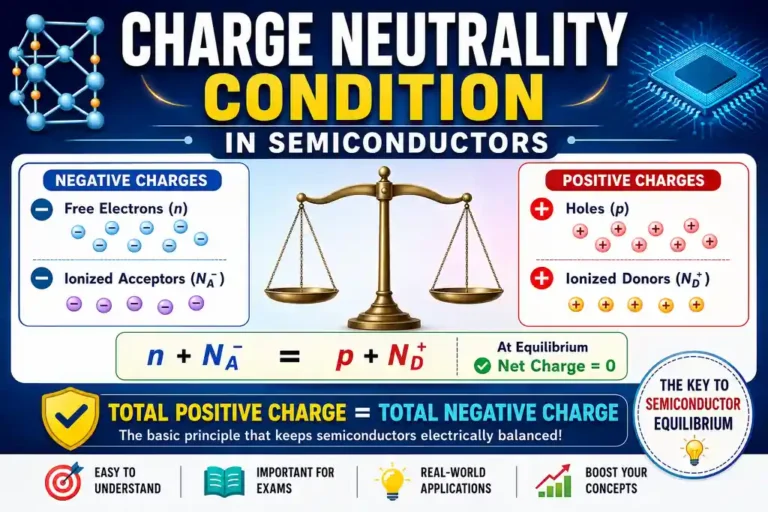
The charge neutrality condition in semiconductors states that, at thermal equilibrium, the total concentration of positive charges must be equal to the total concentration of negative charges.
Mathematically,
$$\text{Total positive charge}=\text{Total negative charge}$$
In a semiconductor, the important charged particles are:
Positive charges
- Holes: (p)
- Positively charged ionized donor atoms: (ND+)
Negative charges
- Free electrons: (n)
- Negatively charged ionized acceptor atoms: (NA–)
Therefore, the general charge neutrality equation is
$$n+N_A^-=p+N_D^+\tag{1}$$
This is the most general form of the charge neutrality condition for a semiconductor in thermal equilibrium.
The equation can also be written as
$$p+N_D^+-n-N_A^-=0\tag{2}$$
Equation (2) means that the net charge concentration inside the semiconductor is zero.
This condition must be satisfied at all temperatures and for all types of semiconductors under equilibrium.
🧠 Basic Concept of Charge Neutrality
To understand charge neutrality properly, we must first identify the four main types of charges that may exist inside a doped semiconductor.
1. Free electrons: Free electrons move through the conduction band and carry negative charge.
Their concentration is represented by n. Each electron carries a charge of -q.
where $$q=1.6\times 10^{-19}\text{ C}$$
2. Holes: A hole represents the absence of an electron in the valence band. It behaves like a positively charged mobile carrier.
The hole concentration is represented by p. Each hole carries a charge of +q.
3. Ionized donor atoms: When a donor atom releases its extra electron to the conduction band, the donor atom becomes positively charged.
The concentration of ionized donors is represented by ND+. These donor ions remain fixed inside the crystal lattice because they cannot move freely like electrons.
4. Ionized acceptor atoms: When an acceptor atom accepts an electron from the valence band, it becomes negatively charged.
The concentration of ionized acceptors is represented by NA–. These ions also remain fixed at their lattice positions.
⚖️ Why Is Charge Neutrality Necessary?
Suppose the total positive charge inside a semiconductor suddenly became much larger than the total negative charge.
The semiconductor would no longer be electrically balanced. This imbalance would produce an electric field.
That electric field would immediately affect the motion of charged particles:
- Electrons would be attracted toward positive regions,
- Holes would respond to negative regions,
- Charges would redistribute until the imbalance is reduced.
Therefore, a uniformly doped semiconductor at thermal equilibrium naturally satisfies charge neutrality.
This principle is extremely important in solving semiconductor problems because carrier concentrations cannot be chosen independently. If the number of electrons changes, the concentrations of holes or ionized impurities must adjust accordingly to maintain electrical balance.
🧪 Charge Neutrality Balance Simulator
📐 Mathematical Derivation of the Charge Neutrality Condition
Consider a semiconductor containing:
- (n) free electrons per unit volume,
- (p) holes per unit volume,
- (ND+) ionized donor atoms per unit volume,
- (NA–) ionized acceptor atoms per unit volume.
Each type of particle contributes to the total charge density.
The charge density due to holes is
$$\rho_h=+qp\tag{3}$$
The charge density due to ionized donors is
$$\rho_D=+qN_D^+\tag{4}$$
Therefore, the total positive charge density is
$$\rho_+=q(p+N_D^+)\tag{5}$$
Similarly, electrons contribute negative charge density:
$$\rho_e=-qn\tag{6}$$
Ionized acceptors contribute
$$\rho_A=-qN_A^-\tag{7}$$
Therefore, the total negative charge density is
$$\rho_-=-q(n+N_A^-)\tag{8}$$
The total charge density is the sum of all these contributions:
$$\rho=q(p+N_D^+)-(n+N_A^-)\tag{9}$$
At thermal equilibrium, a uniform semiconductor is electrically neutral. Therefore,
$$\rho=0\tag{10}$$
Substituting Eq. (9) into Eq. (10),
$$q(p+N_D^+)-q(n+N_A^-)=0\tag{11}$$
Divide both sides by (q):
$$p+N_D^+-n-N_A^-=0\tag{12}$$
Rearranging the terms,
$$n+N_A^-=p+N_D^+\tag{13}$$
Equation (13) is the general charge neutrality equation in semiconductors.
It tells us that the total negative charge concentration must equal the total positive charge concentration.
The next important question is how this equation changes for different types of semiconductors.
🔬 Charge Neutrality in an Intrinsic Semiconductor
An intrinsic semiconductor is a pure semiconductor without intentional donor or acceptor impurities.
Therefore, $$N_D^+=0 $$
and $$ N_A^-=0 $$
Substituting these values into the general charge neutrality equation,
$$n+0=p+0$$
Therefore, $$n=p\tag{14}$$
In an intrinsic semiconductor, the electron concentration is equal to the hole concentration.
Both concentrations are equal to the intrinsic carrier concentration:
$$ n=p=n_i \tag{15}$$
This makes physical sense because thermal energy creates electrons and holes in pairs. Every time an electron is excited from the valence band to the conduction band, one electron and one hole are created.
Therefore, the number of negative free charges equals the number of positive mobile charges.
This relationship also connects directly with the law of mass action:
$$np=n_i^2\tag{16}$$
For an intrinsic semiconductor,
$$n=p$$
Hence, $$n^2=n_i^2$$
Therefore, $$n=n_i$$
and $$p=n_i$$
Thus, charge neutrality and the law of mass action together describe the carrier balance in an intrinsic semiconductor.
📐 Charge Neutrality in Extrinsic Semiconductor
In extrinsic semiconductors, impurity atoms introduce additional charges. Therefore, charge neutrality must include both free carriers and ionized impurity atoms.
🔵 Charge Neutrality in an N-Type Semiconductor
An n-type semiconductor is formed by doping a pure semiconductor with donor impurities.
Common donor atoms have five valence electrons. When a donor atom releases its extra electron to the conduction band, it becomes a positively charged donor ion.
For an n-type semiconductor with negligible acceptor impurities,
$$N_A^-\approx0\tag{17}$$
The general charge neutrality equation becomes
$$n=p+N_D^+\tag{18}$$
Equation (18) shows an important fact: the number of free electrons is balanced by the combined positive charge of holes and ionized donor atoms.
If the donors are completely ionized,
$$N_D^+\approx N_D\tag{19}$$
Therefore,
$$n=p+N_D\tag{20}$$
In an ordinary extrinsic n-type semiconductor, electrons are majority carriers. Therefore,
$$n\gg p$$
When the donor concentration is much larger than the intrinsic carrier concentration,
$$n\approx N_D\tag{21}$$
This approximation means that nearly every ionized donor contributes approximately one free electron.
The minority hole concentration can then be obtained using the law of mass action:
$$np=n_i^2\tag{22}$$
Therefore,
$$p=\frac{n_i^2}{n}\tag{23}$$
Using
$$n\approx N_D$$
we obtain
$$p\approx\frac{n_i^2}{N_D}\tag{24}$$
Thus, the charge neutrality condition helps us determine the majority carrier concentration, while the law of mass action helps us calculate the minority carrier concentration.
🔴 Charge Neutrality in a P-Type Semiconductor
A p-type semiconductor is formed by doping a pure semiconductor with acceptor impurities.
When an acceptor atom captures an electron from the valence band, it becomes a negatively charged acceptor ion and leaves behind a hole.
For a p-type semiconductor with negligible donor impurities,
$$N_D^+\approx0\tag{25}$$
The general charge neutrality equation becomes
$$n+N_A^-=p\tag{26}$$
If the acceptors are completely ionized,
$$N_A^-\approx N_A\tag{27}$$
Therefore,
$$n+N_A=p\tag{28}$$
or
$$p=n+N_A\tag{29}$$
Since holes are majority carriers,
$$p\gg n$$
For a strongly extrinsic p-type semiconductor,
$$p\approx N_A\tag{30}$$
Using the law of mass action,
$$np=n_i^2$$
the minority electron concentration becomes
$$n=\frac{n_i^2}{p}\tag{31}$$
Using
$$p\approx N_A$$
we obtain
$$n\approx\frac{n_i^2}{N_A}\tag{32}$$
Thus, the acceptor concentration primarily determines the majority-hole concentration.
🧪 Charge Neutrality in Compensated Semiconductors
A compensated semiconductor contains both donor and acceptor impurities.
This may happen intentionally during device fabrication or naturally due to unwanted impurity atoms.
The charge neutrality condition for a fully ionized compensated semiconductor is
$$n+N_A=p+N_D\tag{33}$$
The behavior depends on the relative impurity concentrations.
Case 1: (ND>NA)
The semiconductor behaves as n-type.
The approximate majority carrier concentration is
$$n\approx N_D-N_A\tag{34}$$
The minority hole concentration is
$$p\approx
\frac{n_i^2}{N_D-N_A}\tag{35}$$
Case 2: (NA>ND)
The semiconductor behaves as p-type.
The approximate majority carrier concentration is
$$p\approx N_A-N_D\tag{36}$$
The minority electron concentration is
$$n\approx\frac{n_i^2}{N_A-N_D}\tag{37}$$
Case 3: (NA=ND)
The donor and acceptor effects compensate each other.
If the impurities are fully ionized and no other effects dominate, the net doping becomes zero:
$$N_D-N_A=0$$
The semiconductor then approaches intrinsic behavior:
$$n=p=n_i$$
This is called complete compensation.
📊 Comparison of Charge Neutrality in Different Semiconductors
| Type of Semiconductor | Charge Neutrality Condition | Majority Carrier | Approximate Carrier Concentration |
|---|---|---|---|
Intrinsic |
(n=p) |
None |
(n=p=nᵢ) |
N-Type |
(n=p+N_D) |
Electrons |
n ≈ N_D |
P-Type |
(p=n+N_A) |
Holes |
(p ≈ N_A) |
Compensated N-Type |
(n+N_A=p+N_D) |
Electrons |
(n ≈ N_D – N_A) |
Compensated P-Type |
(n+N_A=p+N_D) |
Holes |
(p ≈ N_A – N_D) |
📱 Applications of the Charge Neutrality Condition
The importance of charge neutrality extends far beyond classroom calculations.
1. Semiconductor Device Design: Engineers use charge neutrality to calculate carrier concentrations in semiconductor regions. These concentrations influence the electrical behavior of diodes, transistors, and integrated circuits.
2. Doping Optimization: The concentration of donor and acceptor impurities determines whether a semiconductor behaves as n-type or p-type.
The charge neutrality condition helps engineers calculate the resulting majority and minority carrier concentrations.
3. Analysis of PN Junctions: Before a p-n junction is formed, each semiconductor region has its own equilibrium carrier concentration.
Charge neutrality provides the starting point for calculating these concentrations. These values are later used to understand diffusion, depletion regions, and junction potential.
4. Transistor Design: The operation of a transistor depends strongly on carrier concentrations in different semiconductor regions.
Charge neutrality is used when analyzing equilibrium conditions in the emitter, base, and collector regions of a transistor.
5. Semiconductor Sensors: Temperature, light, and chemical conditions can change carrier concentrations.
Understanding charge balance helps engineers analyze how semiconductor sensors respond to environmental changes.
🚀 Quick Answer Section: Common Search Questions
## Why is a semiconductor electrically neutral?
A semiconductor remains electrically neutral because every positive charge is balanced by an equal negative charge. Free electrons are balanced by holes or ionized donor ions, while negatively charged acceptor ions are balanced by positive holes. This prevents a large net charge from building up in the semiconductor at equilibrium.
## What is the charge neutrality equation?
The general charge neutrality equation is
$$n+N_A^-=p+N_D^+$$
Here, n is the electron concentration, p is the hole concentration, (NA–) is the ionized acceptor concentration, and (ND+) is the ionized donor concentration.
## What is the charge neutrality condition for an intrinsic semiconductor?
In an intrinsic semiconductor, there are no donor or acceptor impurities. Therefore,
$$N_D=N_A=0$$
The charge neutrality equation becomes
$$n=p$$
Since electron-hole pairs are generated together, both concentrations are equal to the intrinsic carrier concentration:
$$n=p=n_i$$
## Can a heavily doped semiconductor still be electrically neutral?
Yes. Heavy doping increases the number of charged particles, but opposite charges are also produced. For example, when a donor releases an electron, the electron carries a negative charge while the donor atom becomes a fixed positive ion. Their charges balance, keeping the semiconductor electrically neutral overall.
## How does temperature affect charge neutrality?
Temperature affects electron and hole concentrations and the degree of impurity ionization. However, the semiconductor still satisfies the general charge-neutrality condition. At low temperatures, incomplete ionization must be considered, whereas at high temperatures, intrinsic carrier generation may become significant.
## What is a compensated semiconductor?
A compensated semiconductor contains both donor and acceptor impurities. If donor concentration exceeds acceptor concentration, it behaves as n-type. If acceptor concentration exceeds donor concentration, it behaves as p-type. The effective majority carrier concentration depends mainly on the difference between the donor and acceptor concentrations.
## How is charge neutrality related to the law of mass action?
Charge neutrality provides one equation relating carrier and impurity concentrations, while the law of mass action gives
$$np=n_i^2$$
Using both equations together allows us to calculate the equilibrium electron and hole concentrations in intrinsic, n-type, p-type, and compensated semiconductors.
🎯 PYQs and Most Expected Exam Questions
Conceptual Questions
- Define the charge neutrality condition in semiconductors.
- Why does a doped semiconductor remain electrically neutral?
- Explain charge neutrality in an intrinsic semiconductor.
- Explain why ionized donor atoms carry a positive charge.
- Explain why ionized acceptor atoms carry a negative charge.
- How can a compensated semiconductor behave as n-type?
- Under what condition does a compensated semiconductor behave as p-type?
- Explain the difference between charge neutrality and the law of mass action.
Long Answer / Derivation Questions
- Derive the general charge neutrality equation for a semiconductor.
- Derive the electron concentration in a fully ionized n-type semiconductor using charge neutrality and the law of mass action.
- Derive the hole concentration in a p-type semiconductor.
- Derive the exact carrier concentration formula for a compensated semiconductor.
- Derive the relationship (n-p=ND-NA) for a fully ionized semiconductor.
- Derive the minority carrier concentration in n-type and p-type semiconductors.
🧮 Solved Numerical Problems
Problem 1: Intrinsic Semiconductor
Question: An intrinsic semiconductor has an intrinsic carrier concentration of ni = 1.2 × 1010 cm-3. Find the electron and hole concentrations.
Solution:
Given: ni = 1.2 × 1010 cm-3
Find: Electron concentration (n) and hole concentration (p).
For an intrinsic semiconductor,
$$
n=p=n_i$$
Therefore,
$$n=1.2\times10^{10}\text{ cm}^{-3}$$
and
$$p=1.2\times10^{10}\text{ cm}^{-3}$$
Answer: $$n=p=1.2\times 10^{10}\text{ cm}^{-3}$$
Problem 2: N-Type Semiconductor Question
Question: A silicon semiconductor is doped with donor atoms having concentration ND = 7 × 1015 cm-3. Assume complete ionization and negligible acceptor concentration. If ni = 1.5 × 1010 cm-3, find the electron and hole concentrations.
Solution
Given: ND = 7 × 1015 cm-3, ni = 1.5 × 1010 cm-3
Find: (n) and (p).
For an n-type semiconductor,
$$n\approx N_D$$
Therefore,
$$n\approx7\times10^{15}\text{ cm}^{-3}$$
Using the law of mass action,
$$np=n_i^2$$
Therefore,
$$p=\frac{n_i^2}{n}$$
Substituting the values,
$$p=\frac{(1.5\times10^{10})^2}{7\times10^{15}}$$
$$p=\frac{2.25\times10^{20}}{7\times10^{15}}$$
$$p\approx3.21\times10^4\text{ cm}^{-3}$$
Answer:
$${n\approx7\times10^{15}\text{ cm}^{-3}}$$
$${p\approx3.21\times10^4\text{ cm}^{-3}}$$
❓ FAQs About Charge Neutrality in Semiconductors
1. What is the charge neutrality condition in a semiconductor?
The charge neutrality condition states that the total positive charge must equal the total negative charge in a semiconductor.
Mathematically:where:
- p = hole concentration
- n = electron concentration
= ionized donor concentration
= ionized acceptor concentration
2. Why is charge neutrality important in semiconductors?
Charge neutrality ensures that the semiconductor remains electrically stable and does not build up excess charge, which would otherwise create internal electric fields and disrupt device operation.
3. How does doping affect the charge neutrality condition?
Doping introduces donor (n-type) or acceptor (p-type) atoms:
- In an n-type semiconductor, electrons increase, and donors contribute positive ions.
- In p-type, holes increase, and acceptors contribute negative ions.
The neutrality condition adjusts accordingly to maintain balance.
4. What is the charge neutrality equation for n-type semiconductors?
For an n-type semiconductor:
if donor concentration is much greater than intrinsic carriers.
More precisely:5. What is the charge neutrality equation for p-type semiconductors?
For a p-type semiconductor:
And the full relation is:
6. Does charge neutrality hold under all conditions?
Charge neutrality holds under equilibrium conditions.
However, in non-equilibrium situations (like under illumination or applied voltage), a temporary charge imbalance can occur locally.7. How is charge neutrality used in semiconductor calculations?
It is used to:
- Determine carrier concentrations (n and p)
- Solve the Fermi level position
- Analyze doped semiconductors
- Design electronic devices like diodes and transistors
8. What happens if charge neutrality is violated?
If charge neutrality is disturbed, an electric field is generated, which quickly redistributes charges to restore equilibrium.
9. What role does temperature play in charge neutrality?
Temperature affects carrier concentrations (n and p), but the charge neutrality condition still holds, as the balance between positive and negative charges is maintained.