
In solid-state physics, semiconductors occupy a special position between conductors and insulators. Among semiconductors, the simplest and most fundamental type is the intrinsic semiconductor.
Contents
ToggleAn intrinsic semiconductor is a pure semiconductor material, free from any intentional impurities. Understanding intrinsic semiconductors is essential because they form the starting point for all semiconductor devices. Before studying doped (extrinsic) semiconductors, it is important to clearly understand how a pure semiconductor behaves.
Definition of Intrinsic Semiconductor
An intrinsic semiconductor is defined as:
A perfectly pure semiconductor in which electrical conduction occurs only due to thermally generated charge carriers.
In an intrinsic semiconductor:
- There are no impurity atoms
- Conduction is due to electrons and holes generated by thermal energy
- The number of electrons is equal to the number of holes
Examples of Intrinsic Semiconductors
The most commonly used intrinsic semiconductors are:
- Silicon (Si)
- Germanium (Ge)
These materials have four valence electrons and form covalent bonds with neighbouring atoms.
Energy Band Structure of an Intrinsic Semiconductor
In an intrinsic semiconductor:
- The valence band is completely filled at absolute zero (0 K)
- The conduction band is completely empty at 0 K
- A small forbidden energy gap exists between the valence band and conduction band
Typical band gap values:
- Silicon: Eg ≈ 1.1 eV
- Germanium: Eg ≈ 0.66 eV
Because the band gap is small, some electrons can move from the valence band to the conduction band when thermal energy is supplied.
Generation of Charge Carriers
Electron–Hole Pair Formation
At room temperature:
- Thermal energy breaks some covalent bonds
- An electron gains sufficient energy to jump from the valence band to the conduction band
- This process leaves behind a vacancy in the valence band called a hole
Thus, electrons and holes are generated in pairs, known as electron–hole pairs.
Charge Carriers in Intrinsic Semiconductor
- Electrons in the conduction band act as negative charge carriers
- Holes in the valence band act as positive charge carriers
- Both contribute equally to electrical conduction
Since every electron excited to the conduction band creates one hole:
$$n = p = n_i$$
where
n = number of electrons
p = number of holes
ni = intrinsic carrier concentration
Electrical Conduction in Intrinsic Semiconductor
When an external electric field is applied:
- Conduction band electrons move toward the positive terminal
- Holes move toward the negative terminal
- Both movements contribute to the electric current
Because the number of charge carriers is limited, intrinsic semiconductors have low conductivity at room temperature compared to metals.
Intrinsic Carrier Concentration
The intrinsic carrier concentration depends on:
- Temperature
- Band gap of the material
With an increase in temperature:
- More covalent bonds break
- More electron–hole pairs are generated
- Conductivity increases
This explains why intrinsic semiconductors show a negative temperature coefficient of resistance.
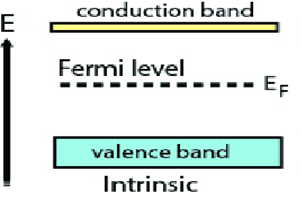
Position of Fermi Level in Intrinsic Semiconductor
In an intrinsic semiconductor:
- The Fermi level lies approximately at the middle of the forbidden energy gap
This indicates:
- Equal probability of finding electrons and holes
- Equal electron and hole concentrations
The mid-gap position of the Fermi level is a key characteristic of intrinsic semiconductors.
Characteristics of Intrinsic Semiconductor
- Pure material with no impurities
- An equal number of electrons and holes
- Low conductivity at room temperature
- Conductivity increases rapidly with temperature
- Fermi level lies at the centre of the band gap
Importance of Intrinsic Semiconductors
Intrinsic semiconductors:
- Form the theoretical foundation of semiconductor physics
- Help in understanding carrier generation and recombination
- Provide the base for explaining extrinsic semiconductors
- Are essential for understanding temperature effects in semiconductors
Important Examination Questions
Short Answer Questions
- Define intrinsic semiconductor.
- What is an electron–hole pair?
- Where does the Fermi level lie in an intrinsic semiconductor?
Long Answer Questions
- Explain the energy band structure and conduction mechanism of an intrinsic semiconductor with neat diagrams.
- Describe the electrical properties of an intrinsic semiconductor.
Conceptual Questions
- Why does the conductivity of an intrinsic semiconductor increase with temperature?
- Why are electrons and holes equal in number in an intrinsic semiconductor?
FAQs
-
1. What is an intrinsic semiconductor?
An intrinsic semiconductor is a pure form of semiconductor material without any added impurities. Its electrical conductivity is solely due to the charge carriers (electrons and holes) generated within the material itself.
-
2. What are common examples of intrinsic semiconductors?
The most common intrinsic semiconductors are silicon and germanium. These materials are widely used because of their suitable electrical properties.
-
3. How does conduction occur in an intrinsic semiconductor?
Conduction occurs when thermal energy excites electrons from the valence band to the conduction band, leaving behind holes. Both electrons and holes contribute equally to current flow.
-
4. What is meant by electron-hole pair?
An electron-hole pair is created when an electron gains enough energy to jump to the conduction band, leaving a vacancy (hole) in the valence band.
-
5. Why is an intrinsic semiconductor electrically neutral?
It remains electrically neutral because the number of electrons is always equal to the number of holes generated.
-
6. How does temperature affect intrinsic semiconductors?
As the temperature increases, more electrons gain energy and move to the conduction band, increasing conductivity.