
Have you ever noticed the colorful patterns on a soap bubble or the shimmering colors on a CD? These beautiful patterns are not random—they arise due to interference of light. And at the heart of these patterns lies a simple but powerful concept: Fringe Width.


Fringe width is the measurable spacing between consecutive bright or dark bands that appear whenever light waves interfere with each other.
Why does this matter? By understanding these tiny gaps, we can measure the thickness of a human hair, determine the wavelength of distant starlight, or even build ultra-high-speed fiber-optic communication networks.
By the end of this article, you will understand:
- What fringe width really means
- How it is derived mathematically
- What factors affect it
- Where it is used in real engineering applications
Contents
Toggle🕰️ Historical Background
The concept of fringe width became prominent after the famous work of Thomas Young in 1801.
His experiment showed that light behaves like a wave, not just particles. When light waves overlap, they produce interference fringes, and the spacing between them—fringe width—becomes a measurable and meaningful quantity.
This discovery laid the foundation for:
- Wave optics
- Quantum mechanics
- Modern optical engineering
SmartStudyZone 🔬
Interactive Young’s Double Slit Simulation
50 nm
80 μm
300 cm
Fringe Width (β): --
📖 What is Fringe Width?
Fringe width (symbol: β, pronounced “beta”) is defined as the perpendicular distance between the centers of two consecutive bright fringes or two consecutive dark fringes in an interference pattern.
$$\beta= y_{n+1}-y_n$$
where and are the screen positions of the th and th fringes of the same type (both bright, or both dark), measured from the central maximum.
💡 The Physical Origin of Fringes
Fringes exist because of wave interference. When two coherent waves (waves with a stable phase relationship) overlap, they superpose. Where crests meet crests, they reinforce, producing a bright fringe (constructive interference). Where crest meets trough, they cancel, producing a dark fringe (destructive interference).
The spatial pattern of these reinforcements and cancellations on a screen is entirely governed by the path difference between the two waves at each point.
🌈 Types of Fringe Width
It helps to distinguish three related scenarios that all involve Fringe spacing, because each has a slightly different context and formula:
1. Young’s Double Slit (YDSE) Fringe Width — The standard classroom case. Two coherent point sources (slits), a flat screen, and the formula β = λD/d are used. This scenario is the most commonly tested one and the one this article derives in full.
2. Thin Film Fringe Width — When light reflects from the top and bottom surfaces of a thin film (a soap bubble, an oil slick, a lens coating), the path difference creates color fringes. The fringe width here depends on the film geometry, angle of incidence, and wavelength.
3. Diffraction Fringe Spacing — In single-slit diffraction, a central maximum is flanked by secondary maxima. The “fringe width” here refers to the width of the central maximum, given by
The remainder of this article focuses on the YDSE fringe width—the foundational case—before comparing all three in the table below.
🧮 Full Mathematical Derivation of Fringe Width
Experimental Setup
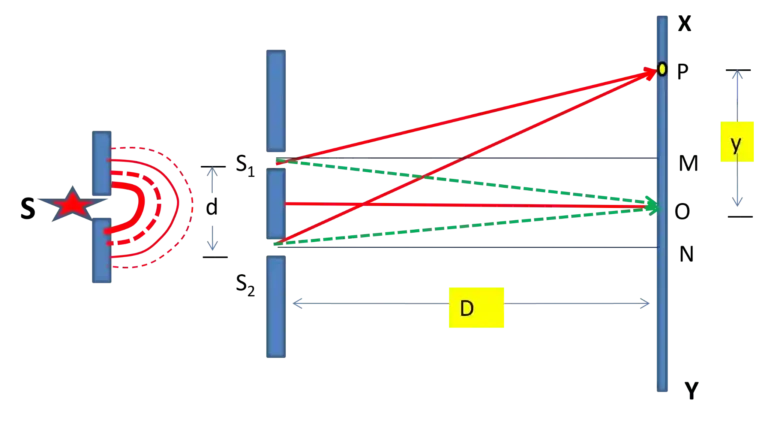
Let us consider a monochromatic light source of wavelength λ illuminating two narrow slits, S1 and S2, which are separated by a small distance d. A screen XY is placed at a distance D from the plane of the slits.
Let O be the equidistant point on the screen from S1 and S2, and let P be an arbitrary point on the screen at a height y above O.
The entire derivation rests on finding the path difference Δ = S2P – S1P at the point P.
Calculating the Path Difference
Using the Pythagorean theorem in ΔS₂NP of the setup:
$$(S_2P)^2 = (S_2N)^2 + (NP)^2$$
$$\Rightarrow(S_2P)^2 = D^2 + \left(y + \frac{d}{2}\right)^2$$
$$\Rightarrow S_2P = D^2 \left[1 +\frac{1}{D^2} \left(y + \frac{d}{2}\right)^2 \right]^{1/2} $$
Expanding by the binomial theorem, we get
$$\Rightarrow S_2P = D^2 \left[1 +\frac{1}{2D^2} \left(y + \frac{d}{2}\right)^2 + ……. \right] $$
Since here, D >> x + d/2
Therefore, the higher power term of D can be neglected. Hence
$$\Rightarrow S_2P = D^2 \left[1 +\frac{1}{2D^2} \left(y + \frac{d}{2}\right)^2 \right] \qquad……..(1)$$
Similarly, we can find
$$S_1P = D^2 \left[1 +\frac{1}{2D^2} \left(y – \frac{d}{2}\right)^2 \right] \qquad……..(2)$$
To determine the path difference between these two waves, we subtract Eq. (2) from Eq. (1):
For constructive interference (a bright fringe), the path difference must be an integer multiple of the wavelength. Hence:
Where n = 0, 1, 2, …
$$\Rightarrow y_n = \frac{n\lambda D}{d}$$
Here, yn denotes the distance of the nth bright fringe from the center. The position of the (n + 1)th bright fringe is
$$ y_{n+1} = \frac{(n+1)\lambda D}{d} $$
By definition, the fringe width β is the distance between two consecutive bright fringes, such as the nth and the (n+1)th fringe. hence
🌟 Physical Meaning
This result shows:
- Fringes are equally spaced
- Fringe spacing is independent of fringe order
- β ∝ λ—A longer wavelength results in wider fringe spacing.
- β ∝ D — moving the screen farther away magnifies the pattern.
- β ∝ 1/d—Squeezing the slits together widens the fringes; separating them narrows the fringes.
This is why interference patterns look so beautifully organized.
Interactive Fringe Width Lab
📊 Comparison: Bright vs. Dark Fringes
| Property | Bright Fringe (Max) | Dark Fringe (Min) |
|---|---|---|
|
Path Difference |
nλ |
(2n + 1)λ/2 |
|
Phase Difference |
2nπ |
(2n + 1)π |
|
Intensity |
Maximum (Reinforcement) |
Minimum (Cancellation) |
|
Fringe Width |
β = λD/d |
β = λD/d |
⚙️ Real-World Engineering Applications
Fringe spacing (width) is not just a theoretical concept—it is widely used in engineering.
1. Interferometry
Used to measure very small distances with high precision (e.g., surface testing)
2. Optical Fiber Technology
Helps in signal modulation and transmission efficiency
3. Thin Film Measurement
Used to calculate the thickness of coatings like lenses and solar panels
4. Holography
Stores 3D images using interference patterns
5. Astronomy
Used to measure distances between stars using interference techniques
🧾 Conclusion
The study of fringe spacing (width) is a gateway to understanding the wave-particle duality of our universe. From Thomas Young’s simple slits to the complex interferometers used in gravitational wave detection (LIGO), the principle remains the same.
Key Takeaways:
Fringe width (β) is the distance between consecutively similar fringes.
The fundamental formula is β = λD/d.
To increase the fringe spacing, you can use light with a longer wavelength (like red instead of violet) or move the screen further away.
The pattern is a direct result of the path difference between two coherent light sources.
👉 In engineering, fringe width plays a key role in optics, communication, and precision measurement systems
📝Important Questions for Exam Preparation
- Define fringe width and explain its significance
- Derive the expression for fringe width
- What factors affect fringe width?
- Why is fringe width uniform?
- How does wavelength affect fringe width?
What happens to the fringe width if the entire Young’s double-slit apparatus is immersed in water? (Hint: Consider the change in the refractive index and its effect on wavelength).
Show mathematically that the width of a dark fringe is identical to the width of a bright fringe.
Why is it impossible to see an interference pattern if the two slits are replaced by two independent light bulbs?
❓ FAQs (People Also Ask)
-
1. What is fringe width?
Fringe width is the distance between the centers of two consecutive bright (or dark) fringes in an interference pattern.
-
What is formula for fringe width?
In Young's double-slit experiment, it is given by , where is the wavelength of light, is the slit-to-screen distance, and d is the slit separation.
-
3. Does intensity affect fringe width?
No, intensity does not affect fringe width.
-
4. Why are fringes equally spaced?
Because the position depends linearly on fringe order.
-
5. What factors affect fringe width?
Three factors directly affect fringe width: the wavelength of light, the distance from the slits to the screen, and the slit separation. The medium also affects it indirectly—in a medium of refractive index μ, the effective wavelength becomes λ/μ, so fringe width becomes
-
6. What happens to fringe width when the experiment is done in water?
Water has a refractive index of approximately 1.33. Inside water, the wavelength of light reduces to . Since β ∝ λ, the fringe width in water becomes —approximately 1/1.33 ≈ 75% of the fringe width in air. The fringes become narrower and more closely spaced.