
Solids exhibit a wide range of electrical behaviours depending on their internal atomic structure and the availability of charge carriers. Some solids allow electric current to pass through them easily, while others strongly oppose the flow of current. This difference in electrical behaviour forms the basis for classifying solids according to their electrical conductivity.
Table of Contents
ToggleUnderstanding this classification is essential for the study of electronic devices, semiconductor physics, and material science, as it explains why different materials are used for wires, switches, insulators, and electronic components.
Electrical Conductivity: -
Electrical conductivity is a measure of a material’s ability to conduct electric current. Mathematically, electrical conductivity is given by:
σ= nqμ
where
n = number of free charge carriers per unit volume
q = charge of an electron
μ = mobility of charge carriers
From this expression, it is clear that electrical conductivity depends mainly on the number of free charge carriers and their mobility.
Energy Band Concept in Solids: -
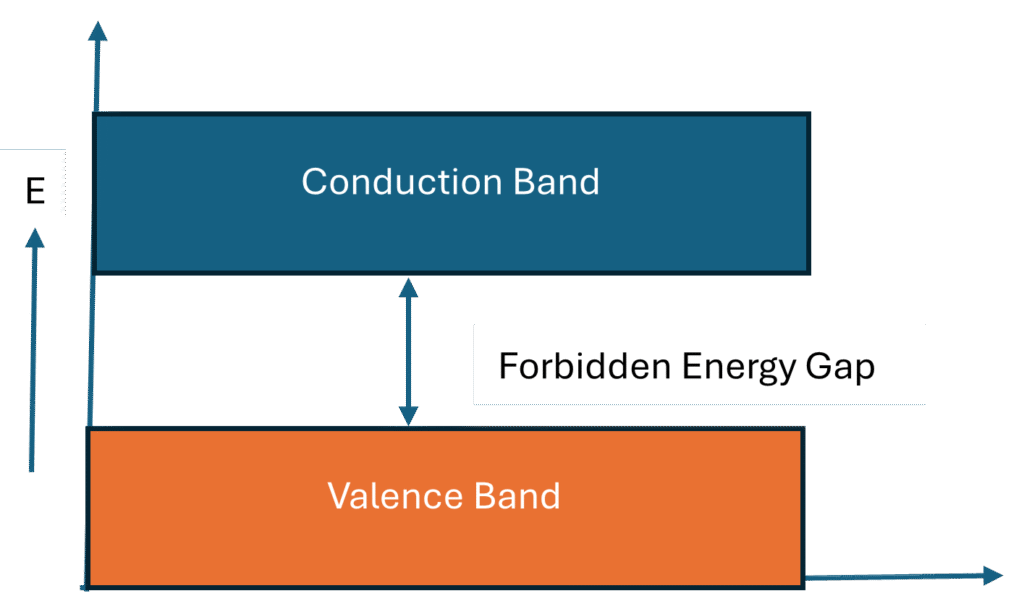
In an isolated atom, electrons occupy discrete energy levels. When a large number of atoms come together to form a solid, these discrete energy levels split into a large number of closely spaced levels forming energy bands.
The two most important energy bands are:
- Valence Band (VB):
This is the energy band which is occupied by valence electrons. - Conduction Band (CB):
This is the energy band in which electrons can move freely and contribute to electrical conduction.
The energy gap between the valence band and the conduction band is known as the forbidden energy gap or band gap. It is denoted by Eg.
The electrical conductivity of a solid depends on:
- The width of the forbidden energy gap
- The availability of electrons in the conduction band
Classification of Solids: -
On the basis of electrical conductivity and energy band structure, solids are classified into:
- Conductors
- Semiconductors
- Insulators
Conductors: -
Conductors are materials or substances that allow electricity or heat to flow through them easily. It is characterized by low electrical resistance and the presence of free, loosely bound valence electrons.
Energy Band Structure
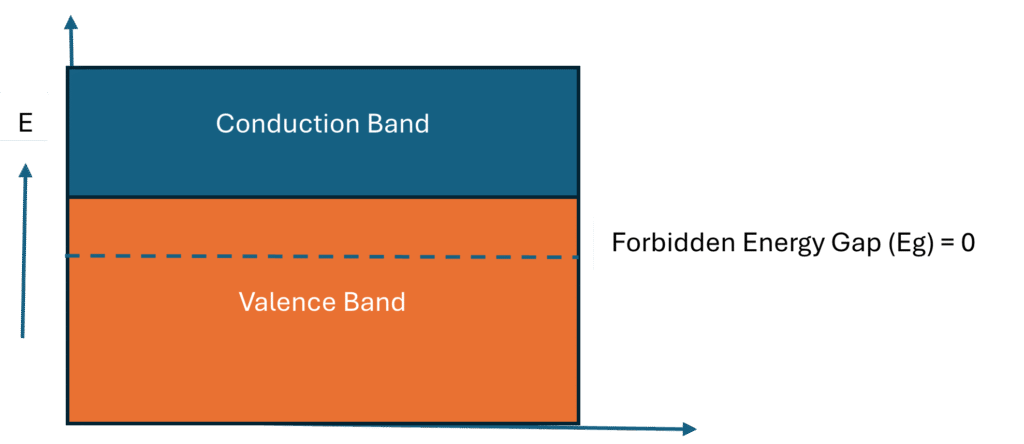
In conductors, the valence band and the conduction band overlapped. As a result, electrons require no additional energy to move into the conduction band.
Eg ≈ 0
Since a large number of free electrons are available, conductors exhibit very high electrical conductivity.
Examples
Copper, Silver, Aluminium, Gold etc.
Important Point
The electrical conductivity of conductors decreases slightly with increase in temperature due to increased lattice vibrations.
Semiconductors: -
Semiconductors are materials which electrical conductivity lies between that of conductors (metals) and insulators (ceramics). Their conductivity is controllable via doping (adding impurities), temperature, light, or electric fields.
Energy Band Structure
In semiconductors:
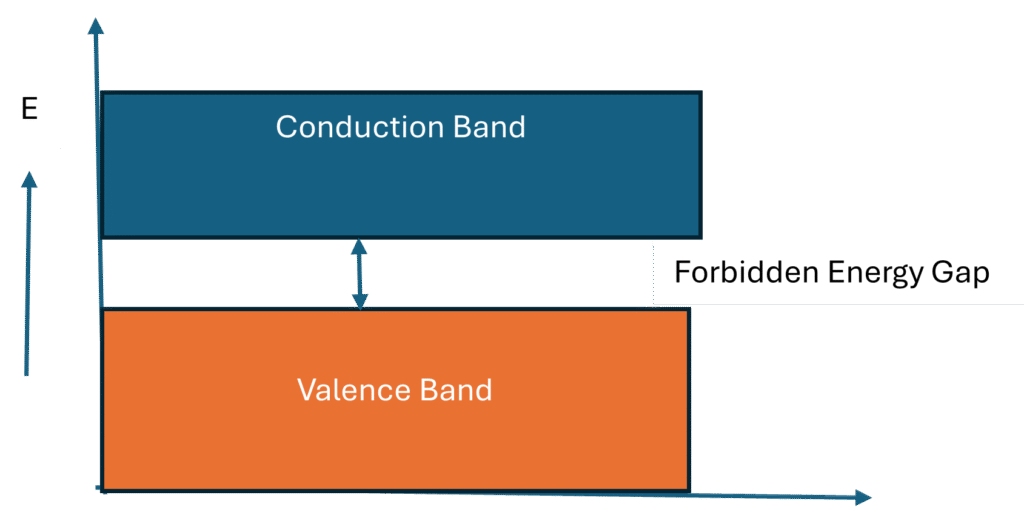
- Valence band is completely filled at absolute zero (0 K)
- Conduction band is empty at 0 K
- A small forbidden energy gap exists between VB and CB 0 < Eg < 3 eV
At room temperature, thermal energy is sufficient to excite some electrons from the valence band to the conduction band, resulting in moderate conductivity.
Examples
- Silicon (Si): Eg = 1.1 eV
- Germanium (Ge): Eg = 0.66 eV
Important Point
The electrical conductivity of semiconductors increases with temperature, which is opposite to the behaviour of conductors.
Insulators: -
Insulators are materials with very high electrical resistance that prevent or significantly slow the flow of electric current. Due to their atomic structure, they lack free electrons to carry charge, making them ideal for safety, such as covering wires, protecting against electric shock, and supporting high-voltage equipment.
Energy Band Structure
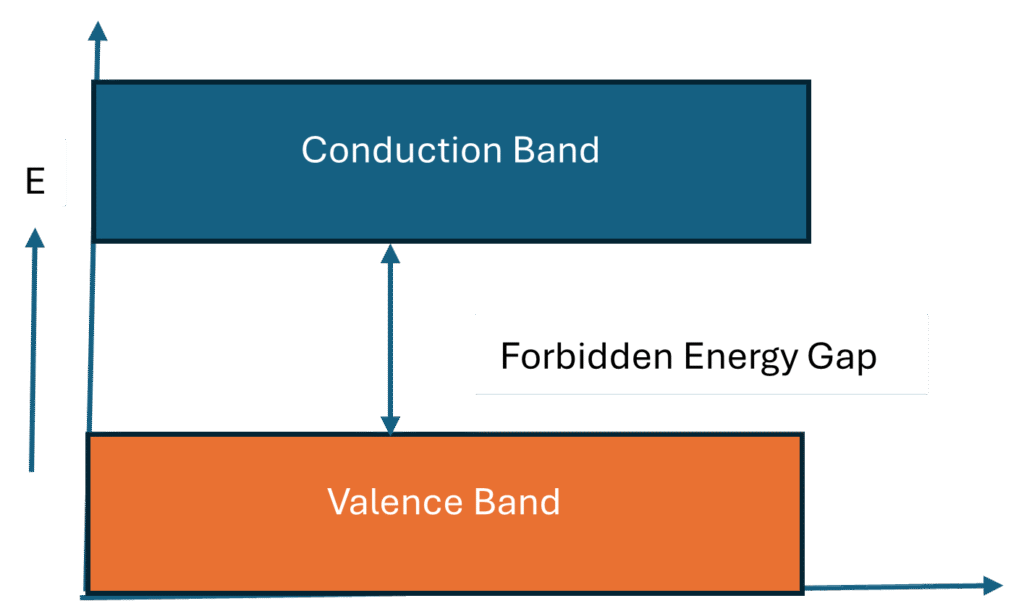
In insulators, the forbidden energy gap between the valence band and conduction band is very large. Because of this large gap, electrons cannot be excited into the conduction band under normal conditions.
Eg > 3 eV
Hence, insulators have extremely low electrical conductivity.
Examples
-
Glass, Rubber, Mica, Diamond, Porcelain, etc.
Comparative Study of Solids
| Property | Conductors | Semiconductors | Insulators |
|---|---|---|---|
|
Energy gap (Eg) |
≈ 0 |
0 – 3 eV |
> 3 eV |
|
Electrical conductivity |
Very high |
Moderate |
Very low |
|
Temperature effect |
Decreases |
Increases |
Almost unchanged |
|
Examples |
Cu, Ag |
Si, Ge |
Glass, Rubber |
Important Examination Questions
Short Answer Questions
- Define electrical conductivity.
- What is a forbidden energy gap?
- Why are metals good conductors of electricity?
Long Answer Questions
- Classify solids on the basis of electrical conductivity with neat energy band diagrams.
- Explain the electrical properties of conductors, semiconductors, and insulators using energy band theory
Analytical Questions
- Why does the conductivity of semiconductors increase with temperature?
- Why is diamond an insulator, though it is made of carbon?