
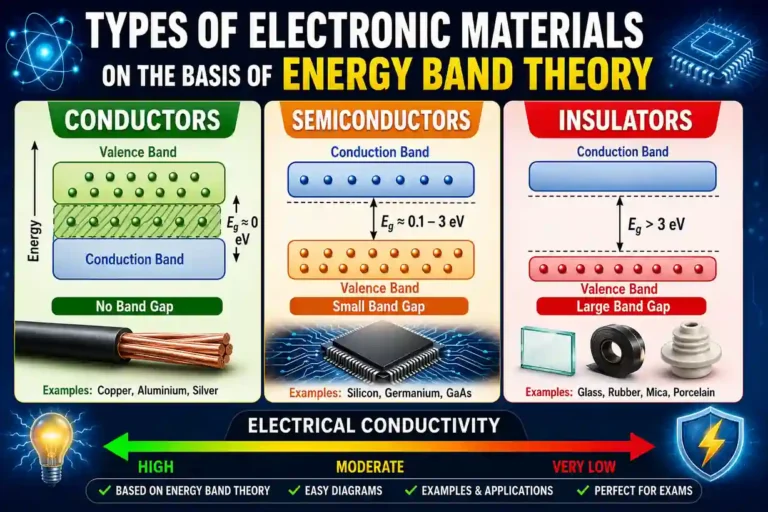
Every electronic device, from smartphones and computers to solar panels and LED lights, depends on the electrical properties of different materials. The Types of Electronic Materials based on Energy Band Theory explain why some materials conduct electricity easily, while others partially conduct or completely resist it.
This fundamental concept of Engineering Physics forms the backbone of modern electronics and semiconductor technology. Understanding energy band theory helps students connect atomic structure with the electrical behaviour of solids.
Contents
Toggle🚀 Introduction:
Electronic materials are the foundation of modern electrical and electronic technology. From simple connecting wires to advanced microprocessors, the selection of a material depends primarily on its electrical conductivity. Energy Band Theory provides the most effective explanation for this electrical behaviour.
According to this theory, the conductivity of a material depends on:
- The arrangement of electrons in the energy bands
- The availability of free electrons
- The size of the forbidden energy gap (Eg) between the valence and conduction bands
A simple analogy is a multi-storey building. If the floors are connected by stairs, people can move easily between them. However, if a large gap separates the floors, movement becomes difficult. Similarly, electrons can move freely only when the energy bands are favourably arranged.
This concept explains why different materials exhibit different electrical properties. Based on Energy Band Theory, electronic materials are classified into three main categories:
- Conductors
- Semiconductors
- Insulators
This classification forms the basis of modern electronics and helps engineers select suitable materials for devices such as smartphones, computers, LEDs, solar cells, integrated circuits, and electric vehicles.
By the end of this article, you will clearly understand:
- How energy bands are formed
- How Energy Band Theory classifies electronic materials?
- Why conductors, semiconductors, and insulators have different conductivities
- Why this concept is considered the backbone of modern electronics
Once you understand this topic, many advanced Engineering Physics concepts become much easier to learn.
📜 Historical Background:
The foundations of energy band theory trace back to the 1920s and 30s, when physicists like Felix Bloch, Rudolf Peierls, and Alan Wilson combined quantum mechanics with the periodic arrangement of atoms in crystals.
Bloch’s theorem (1928) showed that electrons in a periodic potential form allowed and forbidden energy zones—a radical departure from treating electrons as free particles.
Wilson later used this framework (1931) to explain, for the first time, why some solids conduct, and others don’t—effectively founding the field of semiconductor physics that gave us the transistor two decades later.
🧠 What Exactly Is an Energy Band?
Before classifying electronic materials, it is essential to understand the concept of an energy band.
In an isolated atom, electrons occupy fixed, discrete energy levels separated by definite energy gaps. When a large number of atoms (about 1023 atoms/cm³) come together to form a crystal, the outer electrons of neighbouring atoms interact due to the overlap of their electron clouds.
As a result, each discrete energy level splits into a large number of closely spaced levels. These closely spaced levels merge to form continuous energy bands.
Thus, an energy band is a continuous range of closely spaced allowed electron energy levels formed due to the interaction of a very large number of atoms in a crystal.
The two most important energy bands are the following:
- Valence Band (VB): The highest-energy band, normally filled with electrons at absolute zero temperature. These electrons participate in chemical bonding.
- Conduction Band (CB): The energy band above the valence band where electrons are free to move and conduct electricity.
Between these two bands lies the Forbidden Energy Gap (Band Gap, Eg), a region where no electron energy states exist. The size of this band gap determines whether a material behaves as a conductor, semiconductor, or insulator.
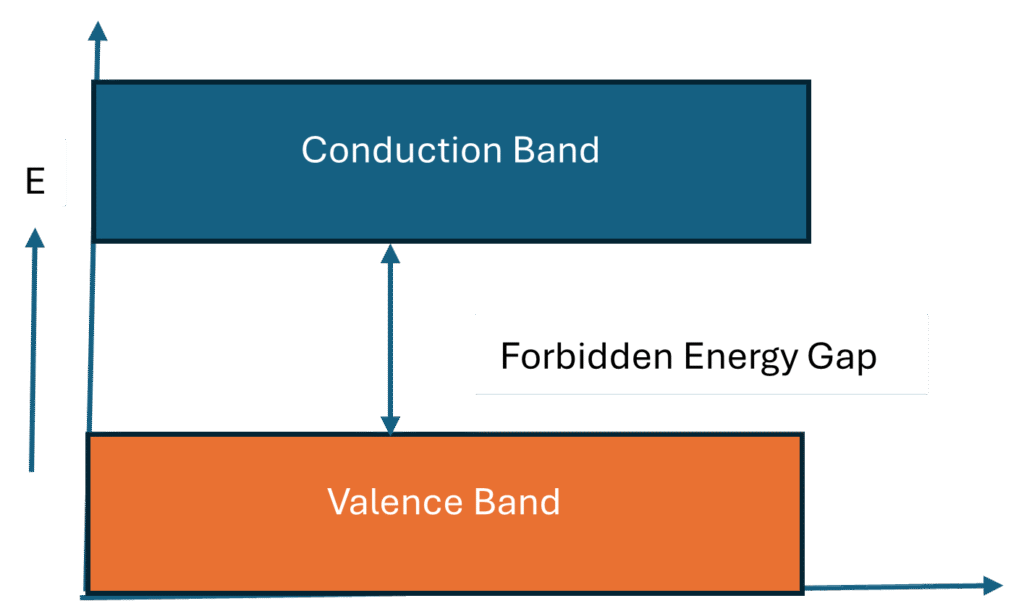
The width of the forbidden energy gap plays a decisive role in determining the electrical nature of a material.
🔷 Types of Electronic Materials Based on Energy Band Theory:
According to the Energy Band Theory, electronic materials are classified into three major categories based on the relationship between the valence band, conduction band, and the forbidden energy gap (Eg).
- Conductors
- Semiconductors
- Insulators
Each category exhibits unique electrical behavior because of the arrangement of its energy bands.
⚡ 1. Conductors:
Conductors are materials that allow electric current to flow easily through them. Electrical current flows through them easily even under an infinitesimal applied voltage.
Electron Density: Very high free electron concentration (∼ 1023 m-3).
Temperature Effect: As temperature increases, lattice vibrations (phonons) increase, causing more electron scattering. Consequently, electrical resistance increases (positive temperature coefficient of resistance).
Examples: Copper (Cu), Aluminum (Al), Gold (Au), Silver (Ag).
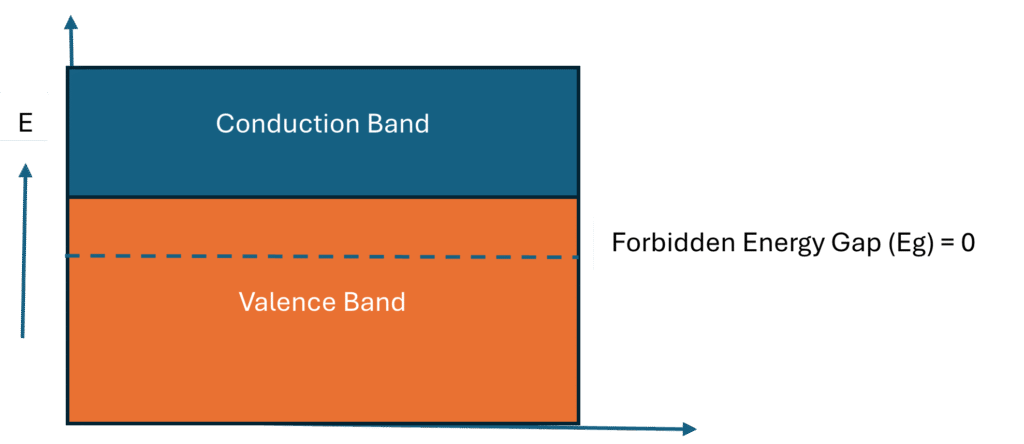
Energy Band Structure of Conductors:
In conductors:
- The valence band and conduction band overlap.
- The conduction band is partially filled
As a result:
- No forbidden energy gap exists
- Electrons can move freely even at very low temperatures
Eg = 0 eV
Because a large number of free electrons are already present, conductors exhibit very high electrical conductivity.
Electrical Behavior of Conductors:
- High conductivity at room temperature.
- Conductivity slightly decreases with increase in temperature due to increased lattice vibrations.
- Current flow is due to free electrons.
💎 2. Semiconductors:
Semiconductors are materials whose electrical conductivity lies between that of conductors and insulators.
Temperature Behavior: At absolute zero (0 K), semiconductors behave as perfect insulators. As temperature rises, thermal agitation excites electrons across Eg into the conduction band, leaving behind vacant states called holes in the valence band.
Temperature Coefficient: Electrical conductivity increases with temperature (negative temperature coefficient of resistance).
Examples: Silicon (Eg = 1.1 eV at 300 K), Germanium (Eg = 0.67 eV), Gallium Arsenide (GaAs, Eg = 1.42 eV).
Semiconductors form the basis of:
- Diodes
- Transistors
- Integrated circuits
- Solar cells
Energy Band Structure of Semiconductors:
In semiconductors:
- The valence band is completely filled at absolute zero
- The conduction band is completely empty at absolute zero
- A small forbidden energy gap exists between VB and CB
0 < Eg < 3 eV
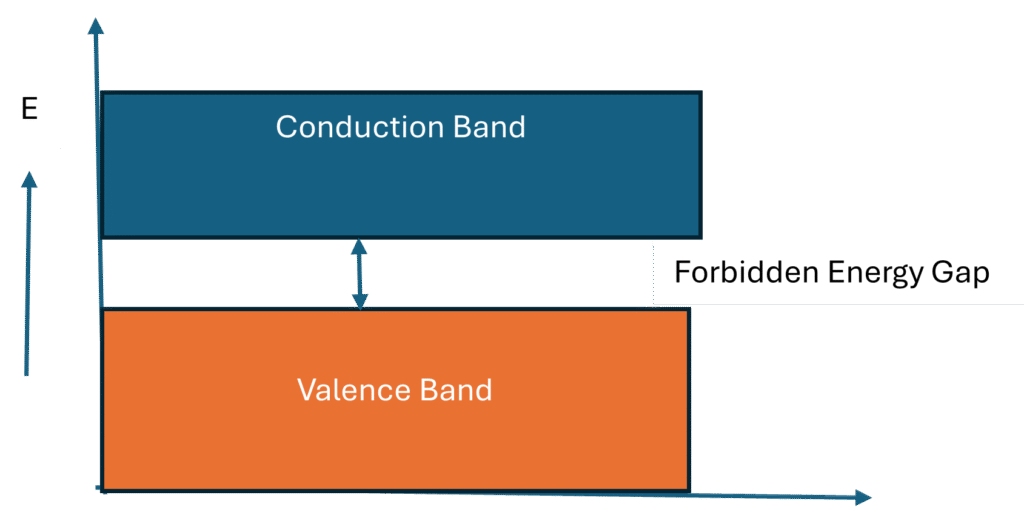
At room temperature, thermal energy excites some electrons from the valence band to the conduction band, making conduction possible.
Electrical Behaviour of Semiconductors:
- Moderate electrical conductivity
- Conductivity increases with an increase in temperature
- Both electrons and holes contribute to conduction
🛡️ 3. Insulators:
An insulator is a material that strongly resists the flow of electric current. According to the Energy Band Theory, insulators have a very large forbidden energy gap, preventing electrons in the valence band from reaching the conduction band under normal conditions.
Thermal Excitation: Room-temperature thermal energy (kBT ≈ 0.026 eV) is far too small to bridge this massive gap.
Temperature Effect: At extremely high temperatures or ultra-high voltages, insulators undergo dielectric breakdown.
Examples: Diamond (Eg ≈ 5.5 eV), Quartz (SiO₂, Eg ≈ 9 eV), Rubber, and Glass etc.
💡 Energy Band Structure of Insulators:
In insulators:
- The valence band is completely filled
- The conduction band is completely empty
- A large forbidden energy gap exists
Eg > 3 eV
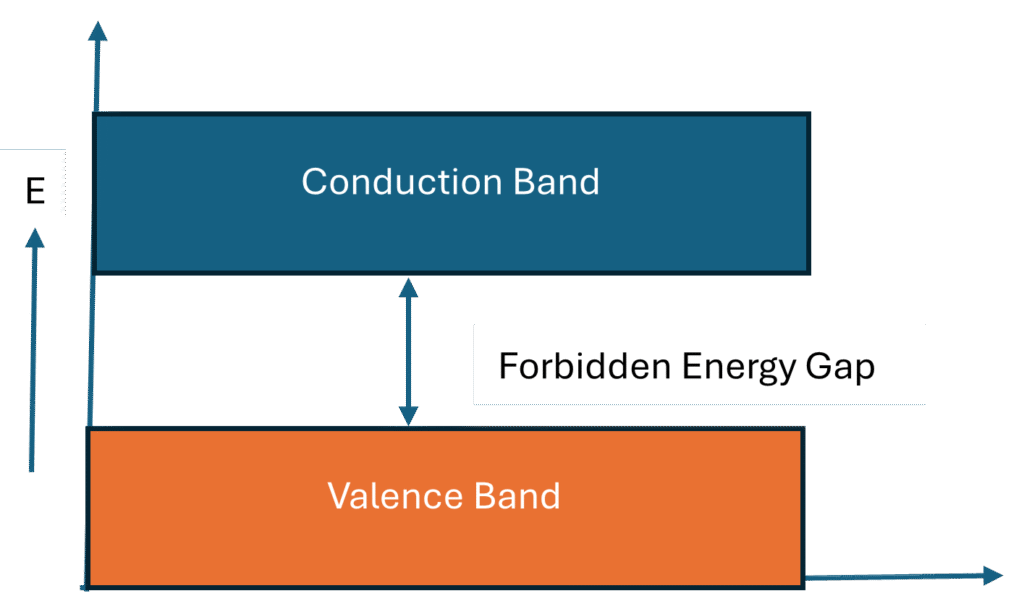
Due to this large energy gap, electrons cannot reach the conduction band under normal conditions.
Electrical Behavior of Insulators:
- Very low electrical conductivity
- Conductivity almost independent of temperature
- Used mainly for electrical insulation
⚡ Energy Band Theory Simulator
Tap a material type to see how its conduction band, valence band, and forbidden gap differ — and watch electrons attempt to cross the gap.
📊 Comparison of Conductors, Semiconductors, and Insulators:
| S. No. | Conductotrs | Semiconductors | Insulators |
|---|---|---|---|
1 |
Easily conduct the electrical current |
Conduct the electrical current greater than insulator but less than the conductor. |
Does not conduct any current |
2 |
Has only one valence electron in its outermost orbit. |
Has four valence electron in its outermost orbit. |
Has eight valence electrons in its outermost orbit. |
3 |
Conductor formed using metallic bonding. |
Semiconductors are formed due to covalent bonding. |
Insulators are formed due to ionic bonding. |
4 |
Valence and conduction bands are overlapped. |
Valence and conduction bands are separated by forbidden energy gap of 1.1 eV. |
Valence and conduction bands are separated by forbidden energy gap of 6 to 10 eV. |
5 |
Resistance is very small. |
Resistance is high. |
Resistance is very high. |
6 |
It has a positive temperature coefficient. |
It has a negative temperature coefficient. |
It has a negative temperature coefficient. |
7 |
Ex: copper, aluminium, etc. |
Ex: silicon, germanium, etc |
Ex: Mica, Paper, etc. |
Importance of Energy Band Classification
- Explains electrical conduction in solids
- Helps in selection of materials for electronic devices
- Forms the foundation of semiconductor technology
- Essential for understanding modern electronics
🎯 Conclusion:
The Types of Electronic Materials on the Basis of Energy Band Theory provide a simple yet powerful framework for understanding the electrical behaviour of solids. By examining the relationship among the valence band, conduction band, and forbidden energy gap, we can classify materials as conductors, semiconductors, or insulators.
Conductors allow electrons to move freely due to overlapping energy bands, semiconductors possess a small band gap that enables controlled conduction, and insulators have a large band gap that restricts electron movement. This classification forms the scientific foundation of modern electronics and electrical engineering.
Whether designing high-speed computers, energy-efficient LED lighting, renewable energy systems, or safe electrical installations, engineers rely on Energy Band Theory to select the most suitable materials. A thorough understanding of this topic also prepares students for advanced concepts such as intrinsic and extrinsic semiconductors, carrier transport, Fermi level, PN junctions, and semiconductor devices.
⚡ Quick Answer Section:
# What is energy band theory?
Answer: Energy band theory explains how the energy levels of individual atoms merge into continuous bands when atoms combine into a solid, determining whether the material conducts, semi-conducts, or insulates based on the gap between its valence and conduction bands.
# What are electronic materials according to Energy Band Theory?
Answer: Electronic materials are solids classified according to the arrangement of their valence band, conduction band, and forbidden energy gap. Based on these energy bands, materials are divided into conductors, semiconductors, and insulators, each exhibiting different electrical conductivities.
# How many types of electronic materials are there?
Answer: According to Energy Band Theory, there are three major types of electronic materials:
- Conductors
- Semiconductors
- Insulators
Their classification depends mainly on the size of the forbidden energy gap.
# Why do conductors conduct electricity?
Answer: Conductors have overlapping valence and conduction bands or a partially filled conduction band. As a result, electrons move freely without requiring additional energy, enabling efficient electrical conduction.
# Why are semiconductors called controlled conductors?
Answer: Semiconductors possess a small forbidden energy gap. Their conductivity can be controlled by temperature, light, electric fields, or impurity doping, making them ideal for electronic devices.
# Why do insulators resist electric current?
Answer: Insulators have a very large forbidden energy gap that prevents electrons from reaching the conduction band under normal conditions. Consequently, almost no free electrons are available to carry electric current.
# What is the importance of Energy Band Theory?
Answer: Energy Band Theory explains the electrical properties of solids and provides the scientific basis for designing conductors, semiconductors, insulators, and modern electronic devices such as transistors, LEDs, and solar cells.
# Which electronic material is used in solar cells?
Answer: Semiconductor materials, particularly silicon, are widely used in solar cells because their band gap allows sunlight to generate electron–hole pairs that produce electrical energy.
Important Examination Questions
Short Answer Questions
- What is an electronic material?
- Define the forbidden energy gap.
- Why are metals good conductors of electricity?
Long Answer Questions
- Explain the classification of electronic materials using energy band theory with neat diagrams.
- Describe the energy band structures of conductors, semiconductors, and insulators.
Conceptual Questions
- Why does the conductivity of semiconductors increase with temperature?
- Why does an insulator not conduct electricity even at room temperature?
FAQs
1. What are conductors according to energy band theory?
Conductors are materials in which the valence band and conduction band overlap, allowing electrons to move freely and conduct electricity easily.
2. Why do conductors have high conductivity?
Because there is no energy gap between bands, electrons can move without needing extra energy.
3. What are examples of conductors?
Common examples include Copper, Aluminum, and Silver.
4. What are semiconductors in energy band theory?
Semiconductors are materials with a small energy gap between the valence band and conduction band.
5. Why is conductivity moderate in semiconductors?
Because electrons require a small amount of energy to jump across the band gap.
6. Why do insulators not conduct electricity?
Because electrons cannot easily jump across the large band gap, even at higher temperatures.
7. What are examples of insulators?
Examples include glass, rubber, and materials like carbon.