
Why can copper carry current effortlessly while glass cannot, even though both are built from atoms with the same basic rules? The answer isn’t in a single atom — it’s in what happens when trillions of them are packed together. This is the formation of energy bands in solids, explained step by step.
⇒ Read the full guide to ace your engineering physics exams today!
⇒ Includes full explanations, solved numerical problems, interactive HTML visualization, and previous year exam questions.
Contents
Toggle📖 Introduction:
The formation of energy bands in solids is one of the most important concepts in solid-state physics because it explains why different materials conduct electricity differently. For example, metals like copper and aluminium allow electric current to flow easily, while materials such as glass and rubber do not. On the other hand, silicon and germanium have intermediate electrical conductivity, making them essential for modern electronic devices.
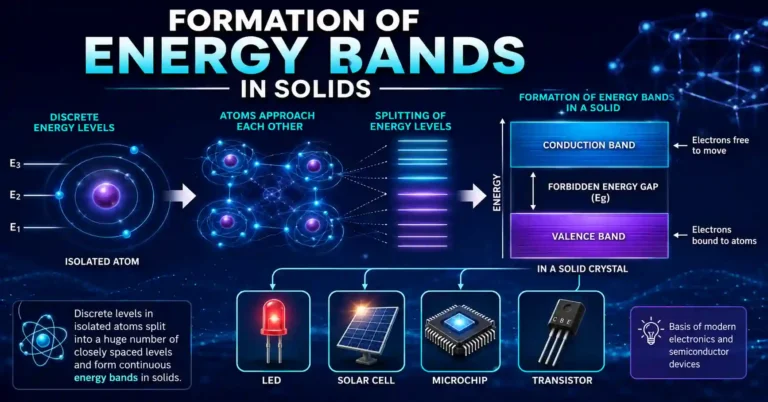
In an isolated atom, electrons can occupy only specific discrete energy levels. However, when a large number of atoms come together to form a solid, the atoms are packed very closely. Their outer electrons interact with one another, causing these discrete energy levels to split into a large number of closely spaced levels. These closely spaced levels combine to form energy bands.
Understanding the formation of energy bands in solids is essential because it forms the basis of Energy Band Theory, which explains the electrical behaviour of conductors, semiconductors, and insulators. It also helps us understand the working of electronic devices such as diodes, transistors, LEDs, and solar cells.
By the end of this article, you will clearly understand:
✅ Why isolated atomic energy levels change inside a solid
✅ How formation of energy bands in solids takes place
✅ The concept of valence band, conduction band, and forbidden energy gap
✅ Why different materials have different electrical conductivities
✅ How energy band theory explains the operation of modern electronic devices
Whether you are preparing for Engineering Physics examinations, competitive tests, or simply wish to understand the science behind electronic materials, this chapter will provide a strong conceptual foundation in simple and easy-to-understand language.
📜 Historical Background:
The story of band theory began in the early 20th century following the birth of quantum mechanics:
1928 — Felix Bloch: Extended quantum theory to crystalline solids by introducing Bloch’s Theorem, showing how wave functions propagate through periodic potential fields.
1931 — Ralph Kronig & William Penney: Formulated the Kronig-Penney Model, an idealized 1D periodic potential square-well system that mathematically proved the existence of allowed energy bands and forbidden gaps.
1931 — Alan Herries Wilson: Applied band theory to explain the fundamental distinction between metals, semiconductors, and insulators, paving the way for modern solid-state electronics.
Today, the concept of energy bands is one of the fundamental pillars of solid-state physics and electronic engineering. Every modern electronic technology—from computer processors to fibre-optic communication systems—relies on this theory.
🔬 What Actually Happens When Atoms Come Together?
To grasp the formation of energy bands in solids, let us begin with the simplest scenario: a single isolated atom.
⚛️ Energy Levels in an Isolated Atom:
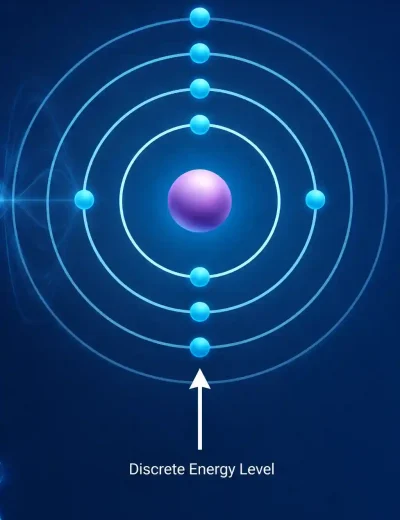
In an isolated atom (such as a free sodium or silicon atom), electrons occupy fixed and well-defined energy levels around the nucleus. According to quantum mechanics, these energy levels are quantized, meaning an electron can exist only in certain allowed energy states such as 1s, 2s, 2p, 3s, and so on. Electrons cannot have energies between these allowed levels, so the energy spectrum of an isolated atom consists of discrete energy levels.
According to the Pauli Exclusion Principle, no two electrons in the same atom can have the same set of four quantum numbers. Since isolated atoms are widely separated from one another, their electrons do not interact with the electrons of neighboring atoms.
As a result, the energy levels remain sharp, distinct, and unchanged. These discrete energy levels exist independently until atoms come close together to form a solid, where interactions between neighboring atoms lead to the formation of energy bands.
Thus, isolated atoms possess sharp and discrete energy levels, as shown in Figure 1.
⚛️ Two Atoms Approach Each Other:
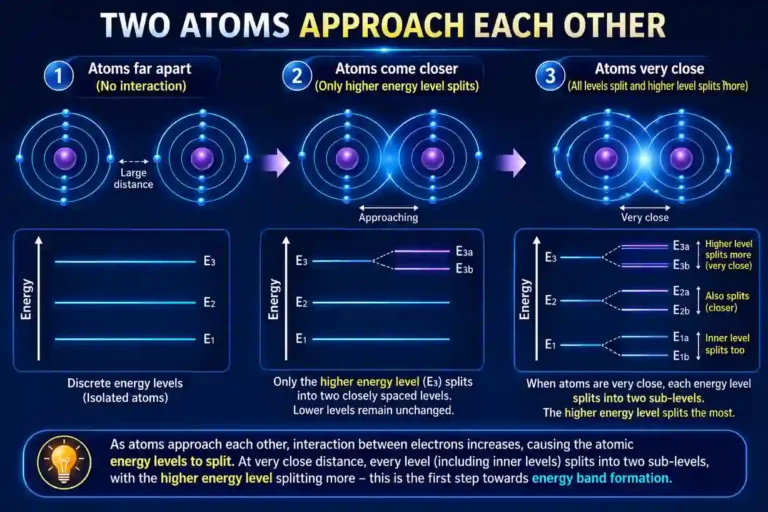
Now imagine bringing two identical atoms, such as two silicon atoms, closer to each other. When the atoms are far apart, they behave independently, and each atom has its own set of discrete energy levels. However, as the distance between them decreases, the situation begins to change.
The outermost electron clouds of the two atoms start to overlap, allowing the electrons of one atom to interact with the nucleus and electrons of the neighboring atom. As these interactions become stronger, the electrostatic forces between the atoms also increase. At this stage, the atoms can no longer be treated as completely independent.
According to the Pauli Exclusion Principle, no two electrons can occupy the same quantum state. Therefore, the electrons must rearrange themselves into different energy states. As a result, each original energy level splits into two slightly different but closely spaced energy levels—one at a slightly higher energy and the other at a slightly lower energy. It is shown in Figure 2.
Although this splitting is very small for only two interacting atoms, it represents the first stage in the formation of energy bands. As more and more atoms come together to form a solid, this splitting continues, eventually leading to the formation of continuous energy bands.
🧱 Formation of Energy Bands in Solids: When Several Atoms Form a Crystal:
We have already seen that when two identical atoms come close together, each atomic energy level splits into two closely spaced energy levels. Now, let us see what happens when a very large number of atoms combine to form a solid.
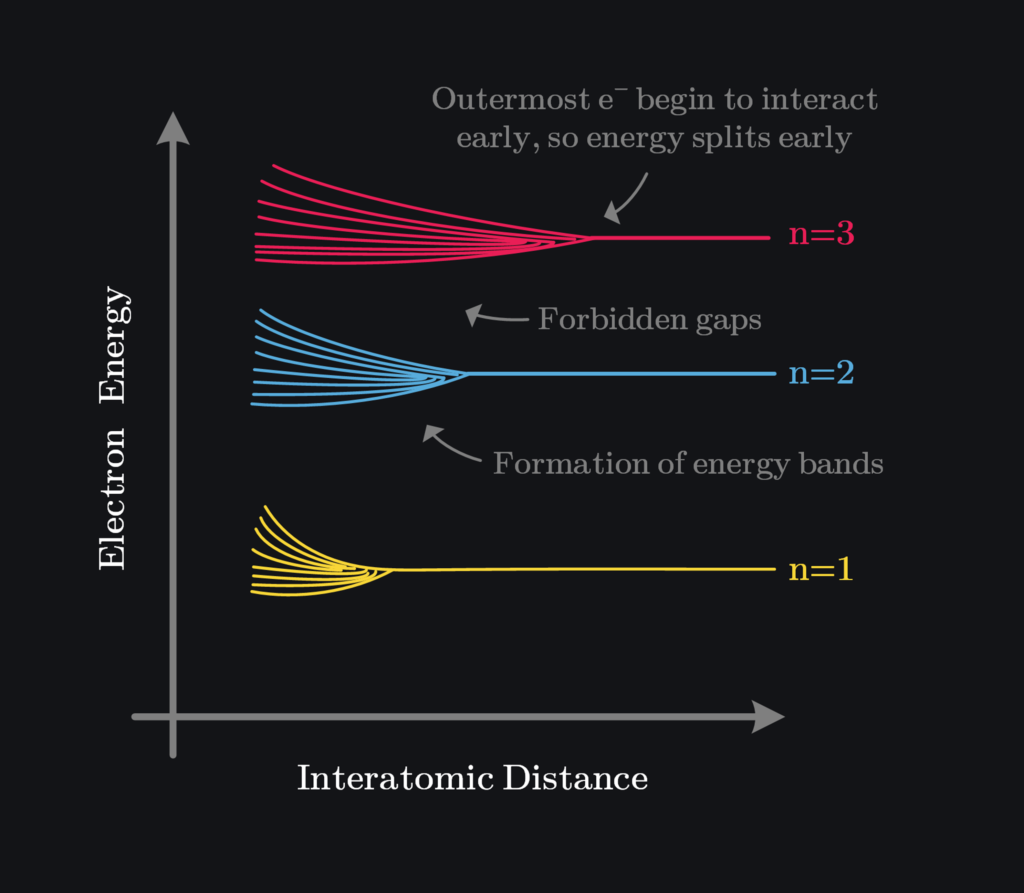
As atoms move closer during crystal formation, the outermost electron clouds of neighboring atoms begin to overlap. The valence electrons interact not only with their own nucleus but also with the nuclei of nearby atoms.
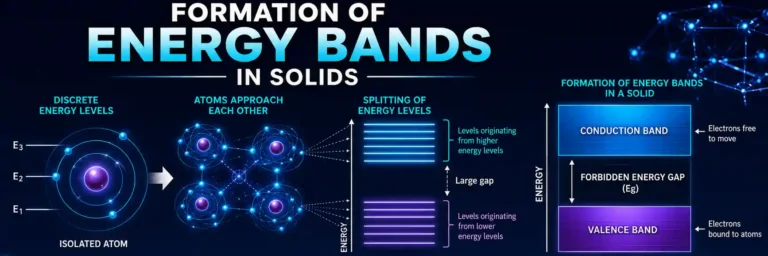
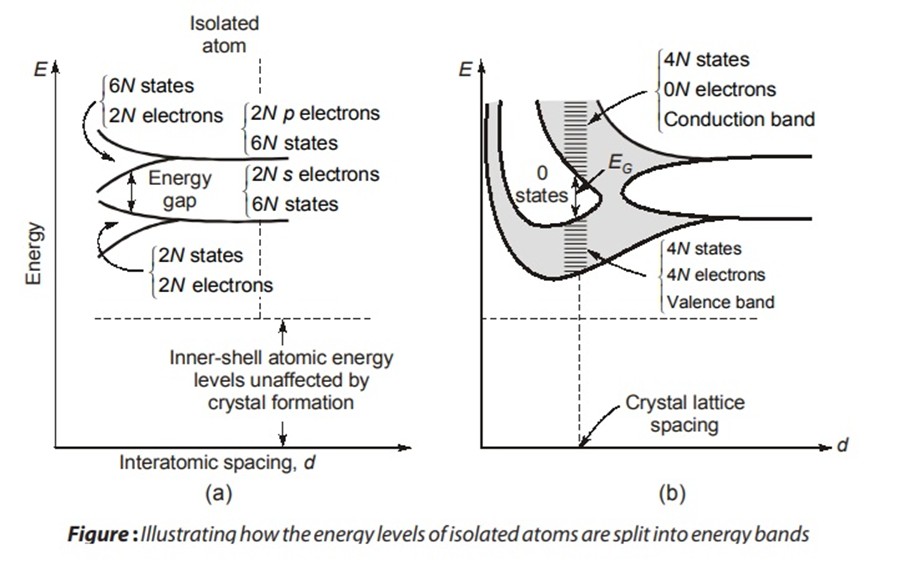
According to the Pauli Exclusion Principle, no two electrons can occupy the same quantum state. Therefore, each atomic energy level splits into many closely spaced energy levels. The closer the atoms are, the greater the splitting is.
Consider a solid containing N identical atoms, where N ≈ 1023. Each original atomic energy level splits into N closely spaced energy levels. Since N is extremely large, the spacing between adjacent levels becomes extremely small (about 10-23 eV). As a result, these levels merge and appear as a continuous energy band.
Thus:
- Allowed energy levels combine to form energy bands.
- The regions where no energy levels exist are called forbidden energy gaps (band gaps).
It is important to note that inner-shell (core) electrons, such as the 1s and 2s electrons, remain tightly bound to the nucleus, so their energy levels are almost unchanged and nearly discrete.
⚡ Interactive: Watch Energy Levels Split Into Bands
CANVAS SIMULATIONDrag the slider to bring N atoms closer together and watch their identical, sharp energy levels spread into bands. Notice how the outer (valence) level spreads far more than the inner one, and how a forbidden gap opens between the two resulting bands.
🔹 Why Only Certain Energy Levels Split Significantly?
Not all electron energy levels are affected equally when atoms come together to form a solid. The amount of splitting depends on how strongly the electrons of neighboring atoms interact with each other.
The inner-shell (core) electrons are located very close to the nucleus and are tightly bound by a strong electrostatic force. Since their wave functions have very little overlap with those of neighboring atoms, their energy levels remain almost unchanged and show only negligible splitting.
In contrast, the outermost valence electrons are farther from the nucleus and are less tightly bound. When atoms are closely packed in a crystal, the wave functions of these valence electrons overlap significantly with those of neighboring atoms. This strong interaction causes their energy levels to split into a large number of closely spaced levels, eventually forming broad energy bands.
📊Classification of Energy Bands in Solids:
In any crystalline material, three primary regions define its electrical nature:
Valence Band (VB): The highest energy band that is completely filled (or nearly filled) with electrons at absolute zero temperature (0 K) is called the Valence Band.
Conduction Band (CB): The energy band above the valence band in which electrons are free to move throughout the crystal and conduct electricity. At 0 K, it may be completely empty or partially filled.
Forbidden Energy Gap (Eg): The energy difference between the top of the valence band (EV) and the bottom of the conduction band (EC). No stable electron states exist within this gap.
🎨 Energy Band Diagrams:
⚖️ Advantages of Energy Band Theory:
The Energy Band Theory provides a comprehensive explanation of the electrical behavior of solids and forms the foundation of modern electronics.
✅ 1. Explains Electrical Conductivity
It clearly distinguishes why conductors, semiconductors, and insulators behave differently by analyzing their energy band structures.
✅ 2. Explains Semiconductor Behaviour
The theory explains how materials like silicon and germanium become conductive when they receive thermal or optical energy, which is essential for semiconductor devices.
✅ 3. Basis of Modern Electronic Devices
The operation of transistors, diodes, LEDs, laser diodes, solar cells, and integrated circuits is understood using energy band theory.
✅ 4. Predicts Material Properties
Scientists can estimate the electrical and optical behaviour of new materials by studying their band structures before manufacturing devices.
✅ 5. Supports Material Engineering
By controlling the band gap through doping or material selection, engineers can design materials with specific electrical properties for different applications.
⚠️ Limitations of Energy Band Theory
Although highly successful, the theory has certain limitations.
❌ 1. Simplified Crystal Model
The basic theory assumes a perfect crystal lattice, whereas real crystals contain defects, impurities, and dislocations.
❌ 2. Limited Treatment of Electron-Electron Interactions
The simple band model does not fully account for complex interactions between electrons, which become important in strongly correlated materials.
❌ 3. Does Not Explain All Magnetic Properties
Phenomena such as ferromagnetism and antiferromagnetism require more advanced quantum mechanical models.
❌ 4. Advanced Quantum Treatment Required
A rigorous explanation of band formation requires solving the Schrödinger equation with a periodic potential (Bloch’s theorem), which is beyond introductory Engineering Physics.
🌍 Applications of Energy Band Theory:
The concept of the formation of energy bands in solids is fundamental to numerous engineering and technological applications.
📱 1. Semiconductor Devices:
Energy band theory explains the operation of PN junction diodes, transistors, MOSFETs, and integrated circuits by describing electron movement between the valence and conduction bands.
☀️ 2. Solar Cells:
When sunlight falls on a semiconductor, photons provide energy greater than the band gap, exciting electrons into the conduction band and generating electric current.
💡 3. Light Emitting Diodes (LEDs):
In LEDs, electrons recombine with holes across the band gap, releasing energy in the form of visible light. The band gap determines the color of the emitted light.
🔴 4. Laser Diodes:
Laser diodes use controlled electron transitions between energy bands to produce coherent, monochromatic laser light for communication, medicine, and industry.
💻 5. Computer Processors and Integrated Circuits:
Modern CPUs and memory chips contain billions of semiconductor transistors whose operation depends entirely on the controlled movement of electrons between energy bands.
📡 6. Optical Communication:
Photodiodes, laser transmitters, and optical receivers in fiber-optic communication systems rely on semiconductor energy band principles for efficient signal transmission.
🔋 7. Rechargeable Batteries and Sensors:
Many advanced battery materials and electronic sensors are designed by tailoring their energy band structures to improve charge transport and sensitivity.
⚖️ Atomic Energy Levels vs Energy Bands:
| Atomic Energy Levels | Energy Bands |
|---|---|
Discrete |
Nearly continuous |
Found in isolated atoms |
Found in solids |
Large energy separation |
Very small separation |
No band gap concept |
Band gap present |
📐 Kronig-Penney Model: Full Mathematical Derivation:
To mathematically justify the existence of allowed energy bands and forbidden gaps, we use the Kronig-Penney Model, which approximates the periodic potential of a 1D crystal lattice as an array of rectangular potential wells and barriers.
1. Setting Up the Potential Energy Function:
Consider a 1D periodic potential V(x) with periodicity (a+b):
Where:
a = width of potential well (atomic spacing)
b = width of potential barrier
Vo = height of potential barrier
Since V(x) = V(x + a + b), we apply Bloch’s theorem, which states that the wave function ψ(x) for an electron in a periodic potential takes the form:
Where u(x) = u(x + a + b) is a periodic function with lattice period (a + b), and k is the wave vector.
2. Time-Independent Schrödinger Equations:
The 1D time-independent Schrödinger wave equation is:
Where ℏ = h/2π, m is the electron mass, and E is the total electron energy (E < Vo).
For Region I (0 < x < a, where V(x) = 0):
Where we define the wave parameter α as:
For Region II (-b < x < 0, where V(x) = Vo):
Where we define the decay parameter β as:
3. Applying Bloch’s Theorem:
Substituting ψ(x) = u(x) eikx into the Schrödinger equations yields two differential equations for the periodic functions u1(x) and u2(x):
For Region I (0 < x < a):
For Region II (-b < x < 0):
The general solutions to these ordinary differential equations are linear combinations of complex exponentials:
Where A, B, C, D are arbitrary constants determined by boundary conditions.
4. Boundary Conditions and the Secular Determinant:
To ensure physical continuity of the wave function and its derivative across boundaries at x = 0 and x = a:
$$u_1(0) = u_2(0)$$
$$\left.\frac{du_1}{dx}\right\vert{}_{x=0} = \left.\frac{du_2}{dx}\right\vert{}_{x=0}$$
$$u_1(a) = u_2(-b)$$
$$\left.\frac{du_1}{dx}\right\vert{}_{x=a} = \left.\frac{du_2}{dx}\right\vert{}_{x=-b}$$
Setting up these boundary conditions produces a set of 4 linear homogeneous equations in A, B, C, D. For non-trivial solutions, the determinant of the coefficient matrix must vanish, yielding the exact transcendental dispersion equation:
5. The Delta-Function Potential Approximation:
To simplify the transcendental equation, Kronig and Penney introduced an idealization: let barrier height Vo→∞ and barrier width b → 0 such that their product remains constant, representing a Dirac delta-function potential barrier strength:
Here, P is a dimensionless measure of barrier strength (potential energy height). Under this approximation:
Substituting these approximations into the dispersion equation gives the famous Kronig-Penney dispersion relation:
This simple formula is the mathematical cornerstone of band theory!
6. Physical Interpretation of the Result:
The left-hand side function $$f(\alpha a) = P \frac{\sin(\alpha a)}{\alpha a} + \cos(\alpha a)$$ is plotted against αa:
Since the right-hand side is cos(ka), its value is strictly bounded between -1 and +1:
Allowed Energy Bands: Ranges of αa (and thus energy E ∝ α2) where f(αa) falls between -1 and +1. Here, real solutions for wave vector k exist.
Forbidden Energy Bands (Gaps): Ranges of αa where $$\vert{}f(\alpha a)\vert{} > 1$$ No real values of k exist, meaning electron propagation is completely forbidden!
⚡ Quick Answer Section:
# Explain the formation of energy bands in solids.
Answer: The formation of energy bands in solids is the process in which the discrete energy levels of isolated atoms split into a very large number of closely spaced energy levels when atoms come together to form a crystal. These closely spaced levels merge to form continuous energy bands that determine the electrical properties of solids.
# Why are energy bands formed in solids?
Answer: Energy bands are formed because neighboring atoms in a crystal interact with each other. Their outer electron wave functions overlap, causing each atomic energy level to split into many closely spaced levels. These levels combine to form continuous energy bands.
# What is the origin of energy bands in solids?
Answer: Energy bands originate from the splitting of discrete atomic energy levels due to the interaction of closely packed atoms and the Pauli Exclusion Principle when a large number of atoms form a solid crystal.
# Who gave energy band theory?
Answer: The modern Energy Band Theory was developed by Alan H. Wilson (1931) based on Felix Bloch’s quantum mechanical treatment of electrons in crystals. The theory evolved from the contributions of Niels Bohr, Arnold Sommerfeld, Felix Bloch, and Alan H. Wilson.
# What is energy band?
Answer:An energy band is a continuous range of allowed electron energy levels in a solid crystal. It is formed due to the splitting and merging of discrete atomic energy levels when a large number of atoms come together.
# What is the forbidden energy gap?
Answer: The forbidden energy gap is the energy region between the valence and conduction bands where no electron energy states exist. Electrons must acquire energy equal to or greater than this gap to participate in electrical conduction.
# What is the valence band?
Answer: The valence band is the highest occupied energy band containing the outermost electrons involved in chemical bonding. Electrons in this band are generally bound to atoms and have limited mobility.
# What is the conduction band?
Answer: The conduction band is the energy band above the valence band in which electrons are free to move throughout the crystal. Electrons in this band contribute directly to electrical conduction.
# What is the difference between discrete energy levels and energy bands?
Answer: Discrete energy levels exist in isolated atoms and have fixed energies. Energy bands are continuous ranges of closely spaced energy levels formed when a large number of atoms combine to form a solid.
# Which theory explains the electrical behavior of solids?
Answer: The Energy Band Theory explains the electrical behaviour of solids by describing the arrangement of electron energy bands and the forbidden energy gap in materials.
🧮 Solved Numerical Problems:
Problem 1: Calculating Electron Wave Vector in a Crystal
Question: Calculate the wave vector k for an electron in a 1D crystal lattice with lattice spacing a = 2.5 Å, given that α a = π/2 and the Kronig-Penney parameter P = 3π/2.
Solution:
Given: a = 2.5 Å = 2.5 × 10⁻¹⁰ m, α a = π/2, P = 3π/2
To Find: Wave vector k
Calculation: Using the Kronig-Penney relation:
Substitute given values:
Since sin(π/2) = 1 and cos(π/2) = 0:
Physical Check: Since cos(ka) cannot exceed 1, no real value of k exists for these parameters! This state lies inside a forbidden energy gap.
Problem 2: Energy Band Gap Photon Wavelength
Question: A semiconductor material has a band gap energy of Eg = 1.42 eV. Find the maximum wavelength of light that can excite an electron from the valence band to the conduction band.
Solution:
Given: Eg = 1.42 eV = 1.42 ×1.6× 10-19 J = 2.272 × 10⁻¹⁹ J, Planck’s constant h = 6.626 × 10⁻³⁴ J.s, Speed of light c = 3 × 10⁸ m/s
To Find: Cutoff Wavelength λmax
Calculation: Since
Answer: The maximum photon wavelength required is 875 nm (near infrared).
Problem 3: How many energy levels will be produced from one original atomic energy level?
Question: A crystal contains approximately 5 × 10²² atoms. How many energy levels will be produced from one original atomic energy level?
Solution: According to energy band theory, each atomic energy level splits into as many energy levels as there are atoms.
Therefore, N = 5 × 10²² energy levels will be formed.
Important Examination Questions
Short Answer
- What is an energy band?
- Define forbidden energy gap.
- What is meant by valence band?
Long Answer
- Explain the formation of energy bands in solids using energy level approach with neat diagrams.
- Describe valence band, conduction band, and forbidden energy gap.
Conceptual Questions
- Why do discrete energy levels merge into bands in solids?
- What is the role of Pauli’s exclusion principle in band formation?
❓ Frequently Asked Questions (FAQs):
# Why do isolated atoms not have energy bands?
Answer:
Isolated atoms have only discrete energy levels because there is no interaction with neighboring atoms. Energy bands are formed only when a large number of atoms combine to form a solid crystal.
# Does every solid have energy bands?
Answer:
Yes. All crystalline solids possess energy bands. However, the width of the band gap and the arrangement of these bands vary from one material to another.
# What is the relationship between band gap and electrical conductivity?
Answer:
Electrical conductivity is inversely related to the band gap. A smaller band gap allows electrons to move more easily into the conduction band, resulting in higher electrical conductivity.
# Can electrons exist inside the forbidden energy gap?
Answer:
No. The forbidden energy gap contains no allowed electron energy states, so electrons cannot remain within this region.
# Why is silicon widely used in electronics?
Answer:
Silicon has a moderate band gap of approximately 1.12 eV, making it suitable for controlling electrical conductivity through temperature changes and doping.
# How does temperature affect electrical conduction in semiconductors?
Answer:
As temperature increases, more electrons gain enough energy to cross the band gap and enter the conduction band. Consequently, the electrical conductivity of semiconductors increases.
# What is the role of the Pauli Exclusion Principle in energy band formation?
Answer:
The Pauli Exclusion Principle prevents electrons from occupying identical quantum states. As atoms approach one another, this restriction causes the original atomic energy levels to split into many closely spaced levels, resulting in energy bands.
🏁 Conclusion:
The formation of energy bands in solids is one of the most fundamental concepts in Engineering Physics because it explains the electrical behaviour of all solid materials.
When isolated atoms come together to form a crystal, their discrete energy levels split into a vast number of closely spaced levels due to interatomic interactions and the Pauli Exclusion Principle. These levels merge to form continuous energy bands, namely the valence band and the conduction band, separated by the forbidden energy gap.
Understanding this concept provides the foundation for studying conductors, semiconductors, insulators, PN junctions, transistors, LEDs, laser diodes, and solar cells. Whether you are preparing for university examinations or exploring the science behind modern electronics, mastering energy band formation will make many advanced semiconductor topics much easier to understand.